





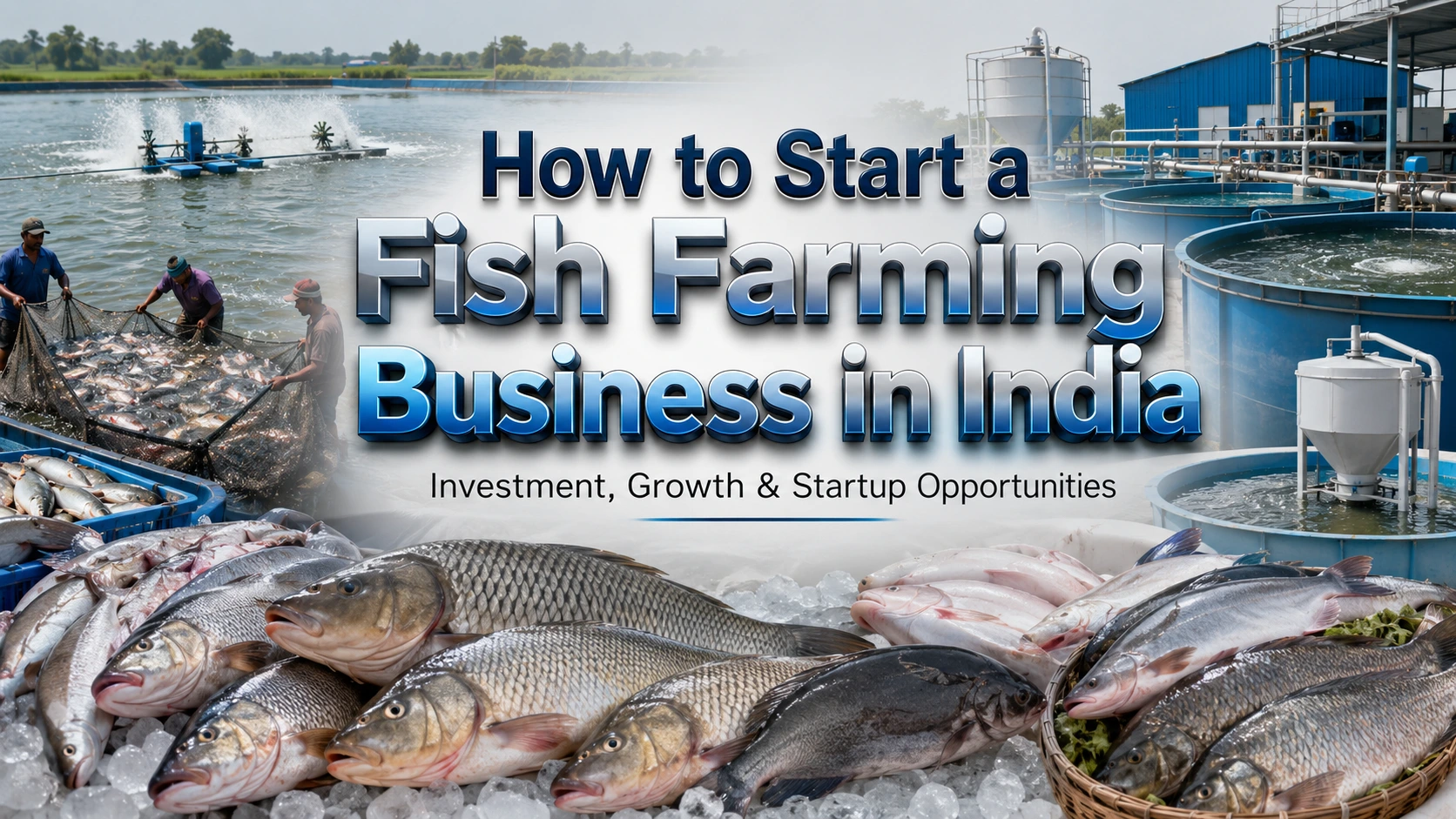
Fish Farming Business in India
Why Fish Farming Business Ideas Are Gaining Serious Traction
India’s aquaculture industry is no longer a rural sector with a few farmers. It is one of the most potential business ideas for entrepreneurs who realize the food demand, export potential and rural enterprise. India is one of the world’s biggest fish producers, accounting for almost 8% of the world’s fish production, and the consumption of fish is increasing rapidly in India. Fish farming provides an opportunity that is perfect for first-generation entrepreneurs and MSME investors, with minimal entry requirements, robust government support and rising demand in the market. This article spells out the exact steps you need to take in order to start a fish farming enterprise in India, how much it will cost you and how much you will earn from it and why it is a very good time to make the move.
Why the Aquaculture Sector Is Growing Fast
The fish consumption per person in India has increased consistently in the last ten years. All these factors are contributing to a demand for protein. Traditional sea and river fishing (capture fisheries) is experiencing a period of stagnation, however, due to over-exploitation and seasonality. Fish farming or aquaculture fills this demand-supply gap.
In recent years, over ₹57,000 crore was generated in foreign exchange earnings, with shrimp and fish exports going to the markets of USA, EU, Japan and Southeast Asian countries. The National Fisheries Development Board (NFDB) estimates that 28 million people are dependent on the fisheries sector in India. This is not a sideline industry; it’s a structural opportunity.
Moreover, aquaculture of freshwater fish, such as Rohu, Catla and Tilapia species can be commenced on a small land area of only 0.5 acre. Profitability can be achieved in the first production cycle itself within 6-12 months. This means that for investors who have access to water bodies, it means that they appreciate high water utilization and quick return on invested amount.
Read the Complete Book Here: Handbook on Fisheries and Aquaculture Technology
Government Policies and Incentives Supporting Fish Farming
Aquaculture is accorded special importance under various schemes by Government of India as a high growth sector. A policy environment like no other in recent years is welcoming entrepreneurs entering the space today.
Pradhan Mantri Matsya Sampada Yojana (PMMSY)
It is the flagship scheme of the fisheries sector. The Project cost of pond construction, fingerlings, feeds and equipment for general categories, SC/ST and women entrepreneurs up to 60% is supported by the Government under Pradhan Mantri Matsya Sampada Yojana (PMMSY). This scheme has been a lifesaver for the rural aquaculture entrepreneurs.
Fisheries and Aquaculture Infrastructure Development Fund (FIDF)
FIDF provides concessional loans for fisheries infrastructure development such as Fish Processing Units, Cold Stores, Feed Mills etc. Banks provide loans at low interest rates to the eligible entrepreneurs.
MSME Credit Guarantee Scheme
The Credit Guarantee Fund Trust for Micro and Small Enterprises (CGTMSE) offers collateral-free loans to fish farming MSMEs. This drastically decreases the dangers faced by new business people with no collateral.
In addition, state governments offer their own incentives. For instance, there are specific subsidies given for new aquaculture units in Andhra Pradesh, Odisha and West Bengal. The information on the fisheries policies can be viewed through the Department of Fisheries, Ministry of Fisheries, Animal Husbandry and Dairying.
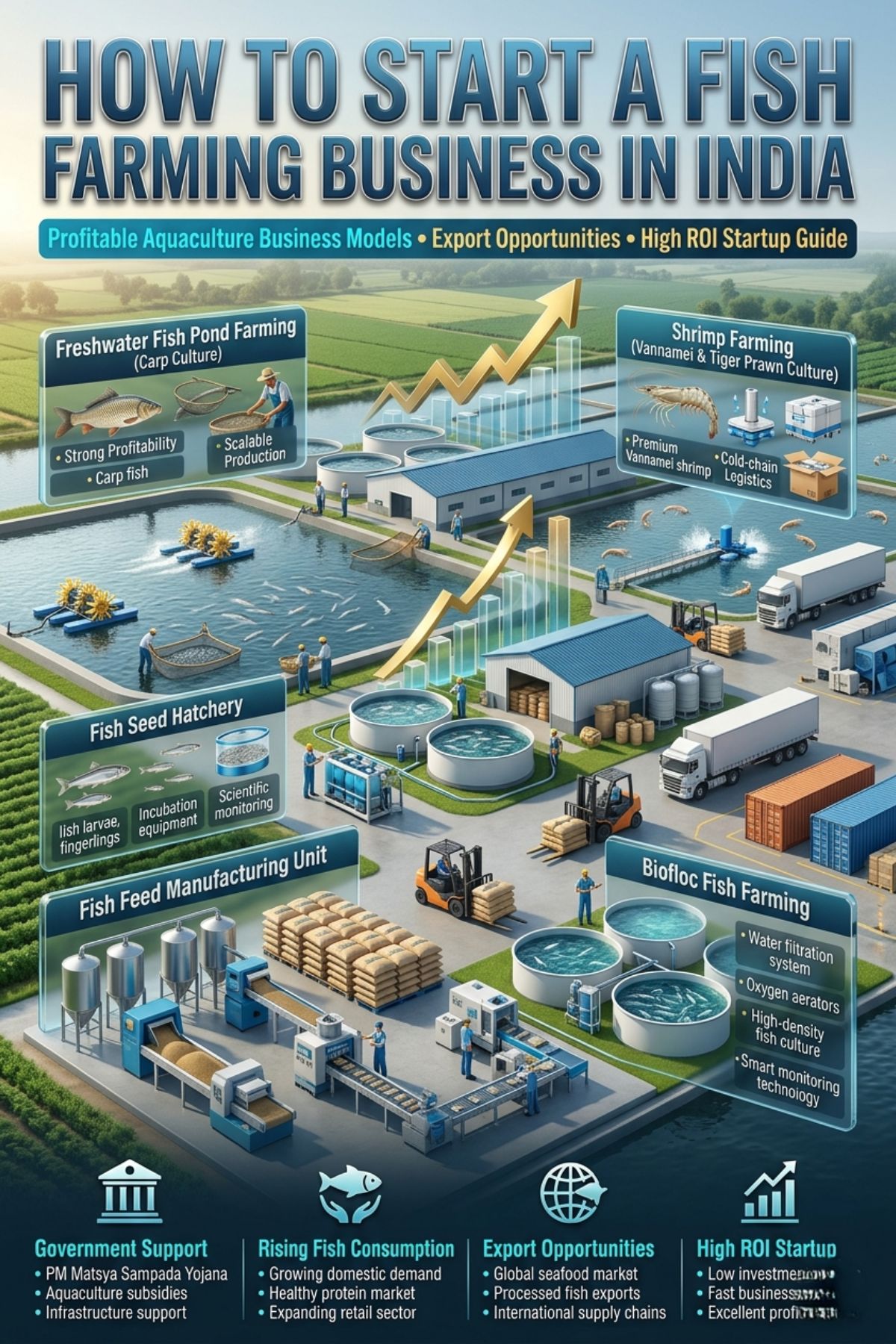
Multiple Business Ideas in Fish Farming for Startups
1. Freshwater Fish Pond Farming (Carp Culture)
In India, the most common type of freshwater aquaculture is carp farming, which is mostly done with Rohu, Catla, and Common Carp. The initial investment for a productive fish pond of an entrepreneur with a land of 1–2 acres is ₹4–6 lakh, comprising of pond preparation, fingerlings, feed and equipment etc. The average stocking density produces a harvest of 3,000–5,000 kg per acre per crop cycle. This means the gross revenue of ₹15–25 lakh per acre per year at prevailing market prices with two crops. The business model is simple, technology is available and the market is always on the move – mandis, retail buyers and wholesalers.
Get Detailed Project Report (DPR): Fisheries and Aquaculture: Fish and Marine Products, Fish Farming, Processing, Value-Added Products and Projects
2. Shrimp Farming (Vannamei or Tiger Prawn Culture)
Shrimp is the most export-oriented aquaculture activity in India. In coastal states such as Andhra Pradesh, Gujarat and Odisha, Lito Penaeus vannamei (Pacific white shrimp) has emerged as the dominant one. The investment needed for 1 ha shrimp farm is ₹12-20 lakh and the revenue is ₹40-80 lakh per crop cycle with good management. Entrepreneurs in coastal belts can turn this into a business as the value per kg is high and it is in demand in the international market. But water quality management, biosecurity and disease control are all areas of the business that require precision in which the professional guidance brings in a lot of improvement.
3. Fish Seed Hatchery
Fish seed hatchery are facilities used to produce fingerlings (baby fish) that are sold to the grow out farms. This is a B2B business idea that has a steady and increasing number of customers. Quality fish fry demand is always outstripping the supply as the number of fish farms is increasing in India. The cost that can be spent in setting up a medium scale hatchery is in between ₹8–15 lakh, which can produce annual revenue of ₹20–40 lakh based on species and volume. The biology / fisheries knowledge of entrepreneurs will be an added advantage here. Seasonality risk is also reduced in hatcheries as they can produce throughout the year.
4. Fish Feed Manufacturing Unit
The cost of aquaculture feed accounts for 60-70% of the total aquaculture operating expense in any fish farm. Even with this, in many aquaculture areas outside cities, quality commercial feed is still not available. Small-scale fish feed pellet manufacturing facility, which produce a protein enriched extruded or pelleted feed, can be directly used in the service of local farmers. It is a manufacturing-based business idea which has got strong market demand in its upstream. For a small unit of production of 1-2 MT per day, the initial investment ranges from ₹10 to 18 lakh. Raw materials are fishmeal, soybean meal, rice bran and vitamins. They have consistent margins and expand well with reach of distribution.
5. Biofloc Fish Farming
Biofloc fish farming is an advanced and water-saving fish farming system that converts fish waste to microbial protein that the fish eat. This helps to cut feed and water consumption by a significant amount. The system is ideally suited to land constrained entrepreneurs in urban and peri-urban settings. The cost of setting up a biofloc system for Tilapia or catfish can be as low as ₹5–8 lakh for a 10-tank system, and the fish can be harvested in 4-5 months with a yield of 2,000-3,000 kg. Biofloc farming has become more popular among the tech savvy entrepreneurs and urban arbitrageurs due to its space efficiency and reduced environmental impact.
Turn your budget into a successful business plan
Import–Export Opportunity Analysis
India is one of the biggest exporters of fish in the world both in terms of quantity and value. The top export categories are: frozen shrimp, fish fillets and dried seafood. The main export markets are the USA, China, EU and Japan. The Marine Products Export Development Authority (MPEDA) reports that exports of seafood have increased steadily and more than 50% of the export value is contributed by shrimp.
The first steps for new entrepreneurs are usually contract farming with existing exporters, or establishing a small processing unit that meets the HACCP and EU food safety standards. The basic processing unit costs begin at the minimum of ₹25–30 lakh, and will provide access to the premium rates of export markets, which are 40–60% higher than market rates in India.
India imports high value ornamental fish and some cold-water fish. The major thrust for the domestic entrepreneurs is in the area of import substitution (IS) which means to produce the items which are being imported by Indian consumers, even if it is specially raised fish varieties or value-added fish products.
Indian MSME Success Stories in Aquaculture
Avanti Feeds Ltd — Rachakonda Satyanarayana (Andhra Pradesh)
The Rachakona family founded the small shrimp feed business Avanti Feeds and made it one of India’s biggest aquaculture businesses. The business logic was very simple: if you have a control over the feed supply chain, you have a control over the margins throughout the entire farming value-chain. Avanti Feeds is now running a shrimp processing unit and exports to more than 30 countries, in addition to its feed business. The takeaway for any new businessperson is that vertical integration makes them resilient. The proven model of growth of MSMEs is to embark on feed or hatchery business and then move to farming and processing.
Apex Frozen Foods — P. Satyanarayana Murthy (Andhra Pradesh)
Apex Frozen Foods is a publicly listed shrimp processing and export entity which started as a small shrimp processing unit at the coast. Early investment in food safety certifications (HACCP, BRC, and EU approval) opened up premium European markets for the promoter. A lesson from this case is that if you get your compliance and quality infrastructure right from the beginning you can be able to sell to global markets.
Sneha Aqua Products — Small-scale Biofloc Success
A smaller and yet significant example is of West Bengal where a few first generation entrepreneurs have established biofloc farms with investments less than ₹10 lakh making profit out of it. These traders also sold directly to urban retailers and retailers who were on the local network that is created on WhatsApp, which reduced the need for the traditional mandi system and helped them keep margins high. The lesson is that small scale producers can benefit greatly from the returns generated with technology-driven production models and direct sales.
Related Article: Why Fish Farming Project Could Be Your Next Smart Move
How NPCS Can Help You Enter the Fish Farming Sector
Niir Project Consultancy Services (NPCS) provides detailed Market Survey cum Techno-Economic Feasibility Reports (DPRs) for aquaculture and allied businesses to the entrepreneurs and investors. Our reports include details on manufacturing processes, demand and market analysis, process flow diagrams, capacity planning, machinery specifications, raw material sourcing, and complete financial projections with profitability and break-even analysis. From a business point of view, be it for a fish pond, hatchery, feed unit or biofloc system, a professionally produced DPR can be a valuable tool to assess the business before putting in capital and it will add weight to your arguments when you approach the bank for financing under PMMSY or FIDF.
Key Data Table: Fish Farming Business Models at a Glance
| Business Model | Investment (₹ Lakh) | Revenue/Year (₹ Lakh) | Payback Period | Key Market |
| Freshwater Carp Pond | 4–6 | 15–25 | 1–2 years | Local mandis, retail |
| Shrimp Farming | 12–20 | 40–80 | 1.5–2 years | Export, processors |
| Fish Seed Hatchery | 8–15 | 20–40 | 2–3 years | Grow-out farms |
| Fish Feed Unit | 10–18 | 25–45 | 2–3 years | Fish farmers |
| Biofloc Tilapia Farm | 5–8 | 18–30 | 1–2 years | Urban retail, HoReCa |
Frequently Asked Questions (FAQs)
Q1. What is the size of fish farming land required for a business in India?
A small pond-type carp farm can be established in only as little as 0.5 acre. Less than that — 10 tanks can be installed in 1,000-2,000 sq. ft depending on your finances and production goals.
Q2. Which government subsidy is there for fish farming?
In the PMMSY, the central government will provide subsidy up to 60% of the project costs for general categories comprising pond construction, feed, fingerlings and equipment costs, where the project is eligible. The subsidy to SC/ST and women entrepreneurs is up to 40% while the remaining is funded by state governments and the beneficiary.
Q3. What is the most profitable fish in India?
Vannamei shrimp is the most profitable for coastal businesses per kg. Rohu, Catla and Tilapia are the most suitable fish for inland areas. The Biofloc Tilapia is a very appealing fish for the first time fish farmers because of its relatively short growth period and its high demand in the urban market.
Q4. Do you offer fish farming loans?
Yes. Fish farming has been categorized as an agricultural activity and therefore it falls under the category of priority sector lending. Kisan Credit Cards (KCC) can be utilised for working capital. A combination of FIDF Concessional Term Loans is available for infrastructure intensive projects. CGTMSE provides collateral free loan for MSME registered units.
Q5. What is the time for the fish to be harvested from the pond?
In 6-9 months, most of the freshwater fishes such as Rohu and Catla are ready for marketable size. Shrimp cycles are shorter, 90-120 days. Harvesting Biofloc Tilapia can be done in 4–5 months. This implies rapid recovery of capital than many other agribusiness activities.
Q6. Is there a license to establish a fish farm in India?
In rural areas, permissions for the use of land for farming farm-raised fish are usually minimal and the land must be registered with the district fisheries office. A Coastal Aquaculture Authority (CAA) registration is required for shrimp and coastal aquaculture. FSSAI certification is required for processing units and MPEDA registration is a must for exports along with HACCP/BRC certification.
Conclusion
For the country, aquaculture is in the nexus of food security, export growth and rural entrepreneurship. The demand-side story is strong, policy support is for real, and technology (basic ponds to biofloc systems) is within reach of novice farmers. All said, good planning, selection of species compatible with the environment, and having a viable financial model are the prerequisites for success in aquaculture. Entrepreneurs coming into the industry with realistic forecasts, appropriate technical input and awareness of the government incentives should be able to create a long-lasting and remunerative business in aquaculture.
For data on policy updates, explore the Ministry of Fisheries, Animal Husbandry and Dairying and the APEDA (Agricultural & Processed Food Products Export Development Authority) portal for export-related guidance.


