





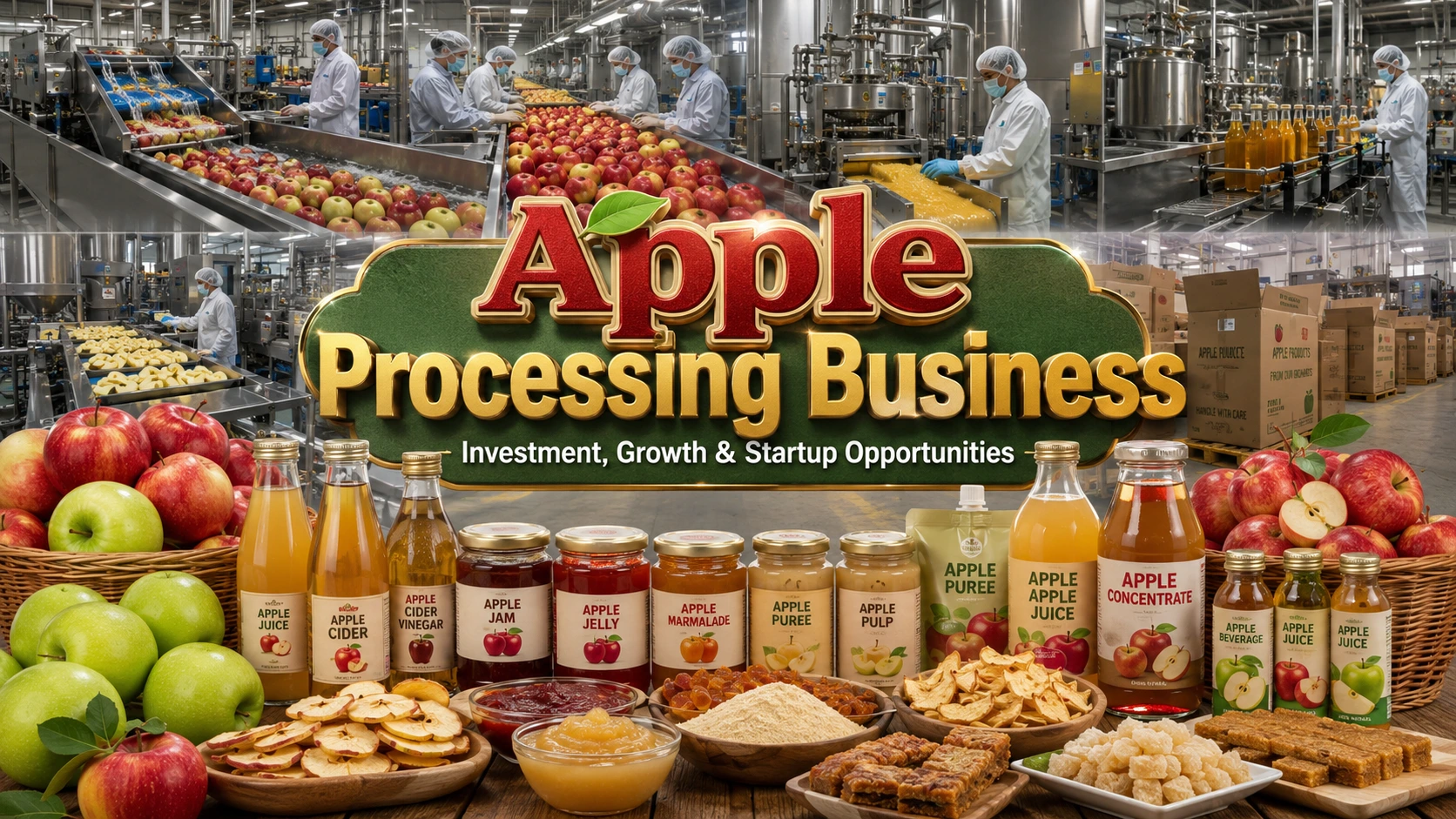
Apple Processing Business
Millions of metric tonnes of apples are harvested from the apple belt of Himachal Pradesh, Jammu & Kashmir and Uttarakhand annually. However, a large portion of this crop goes bad before it reaches consumers. This gap is not a concern for entrepreneurs and MSME investors. It’s a business opportunity. There are several different business concepts that can be scaled in the apple processing industry, including juice and cider making, extraction of pectin, and dried apple products, all of which have a high domestic demand and serious export potential. Furthermore, the combination of government support, an increasing awareness of consumer health and the increase of organised retail have made this sector very appealing for first generation manufacturers and industrial investors.
Why the Apple Processing Sector Deserves Serious Attention
India is one of the major apples producing countries in the world and the processing industry is still in a very underdeveloped state when compared with the raw material provided. Even in horticulture, processing has remained well below the international standards in India, thus giving a structural opportunity to smart entrepreneurs. Besides, increasing health awareness among Indian consumers is driving the preference for packaged juices, health drinks, juices concentrates and dried snacks. These classifications have been expanding at a healthy pace throughout the modern retail, quick-service restaurant and institutional purchasing sectors.
Demand for apple products is increasing across the Middle East, Southeast Asia, and Europe for export, specifically for apple concentrate, dried apple rings and organic apple cider vinegar. IMD has significant margin opportunity for Indian manufacturers who invest in quality investments and certification programs. Meanwhile, domestic foodservice, beverage and FMCG companies are actively looking for processed apple inputs, which in turn provides them a B2B revenue stream and results in a low market risk for new players.
Get Detailed Insights from This Book: Handbook on Fruits, Vegetables & Food Processing with Canning & Preservation
Government Support and Policy Incentives
Food Processing is identified as the priority sector by Government of India. There are several schemes that are directly suitable for entrepreneurs entering into the apple processing manufacturing segment. The Pradhan Mantri Kisan Sampada Yojana (PMKSY) under the Ministry of Food Processing Industries (MoFPI) offers capital subsidies and grants for various structures like food parks, primary processing centres and cold chain facilities, which are directly connected to the apple processing businesses.
Further, the Government of India’s Production Linked Incentive (PLI) Scheme for Food Processing provides financial benefits for incremental sales, which is beneficial for scale-up projects. The Ministry of MSME runs credit guarantee schemes (CGTMSE) and technology upgradation programmes for smaller units, while the DPIIT’s Startup India initiative offers regulatory flexibilities and tax benefits for early-stage food processing startups. Shared infrastructure will also be available to the entrepreneurs establishing units in the notified food parks, which will help them reduce initial capital investment at the project’s start.
Apple Processing Business Ideas: Manufacturing Opportunities for Entrepreneurs
1. Apple Juice and Juice Concentrate Manufacturing
The most commercial entry in this segment is apple juice and concentrate production. They are washed, sorted, crushed, pressed, filtered, pasteurised and packaged into aseptically sealed containers. An extra evaporation phase yields a concentrated juice with a higher Brix that is stable enough to be used by beverage companies, confectionery makers and institutional kitchens. The unit economics are good – there is reasonable control over the cost of raw apples available locally and there is a reasonable price premium for the finished product.
Furthermore, small and mid-size manufacturers can focus on institutional B2B customers like beverage companies, hotels and airline food service companies, generating more consistent revenue than just consumer retail. Cold press technology should also be assessed by entrepreneurs to sell at a higher price margin in health-driven retail stores.
2. Dried Apple and Dehydrated Apple Snack Manufacturing
Indian consumers have been drawn to the health benefits of dried apples and this is reflected in the recent growth in the dried apple industry. The process involves hot air or freezing technologies, which enable moisture to be extracted from apple slices, creating light weight products with a high shelf life. The economic aspects of logistics are therefore advantageous, as dried apples are much less expensive to transport and store than fresh or frozen fruits.
For sales, the sale of unprocessed dried apples is boasting strong margins in organised grocery, modern trade and ecommerce. Further, food grade dehydrated fruit has food market trade in the Gulf, Europe and North America. A small unit with accurate drying capacity can yield high returns in three years of operation.
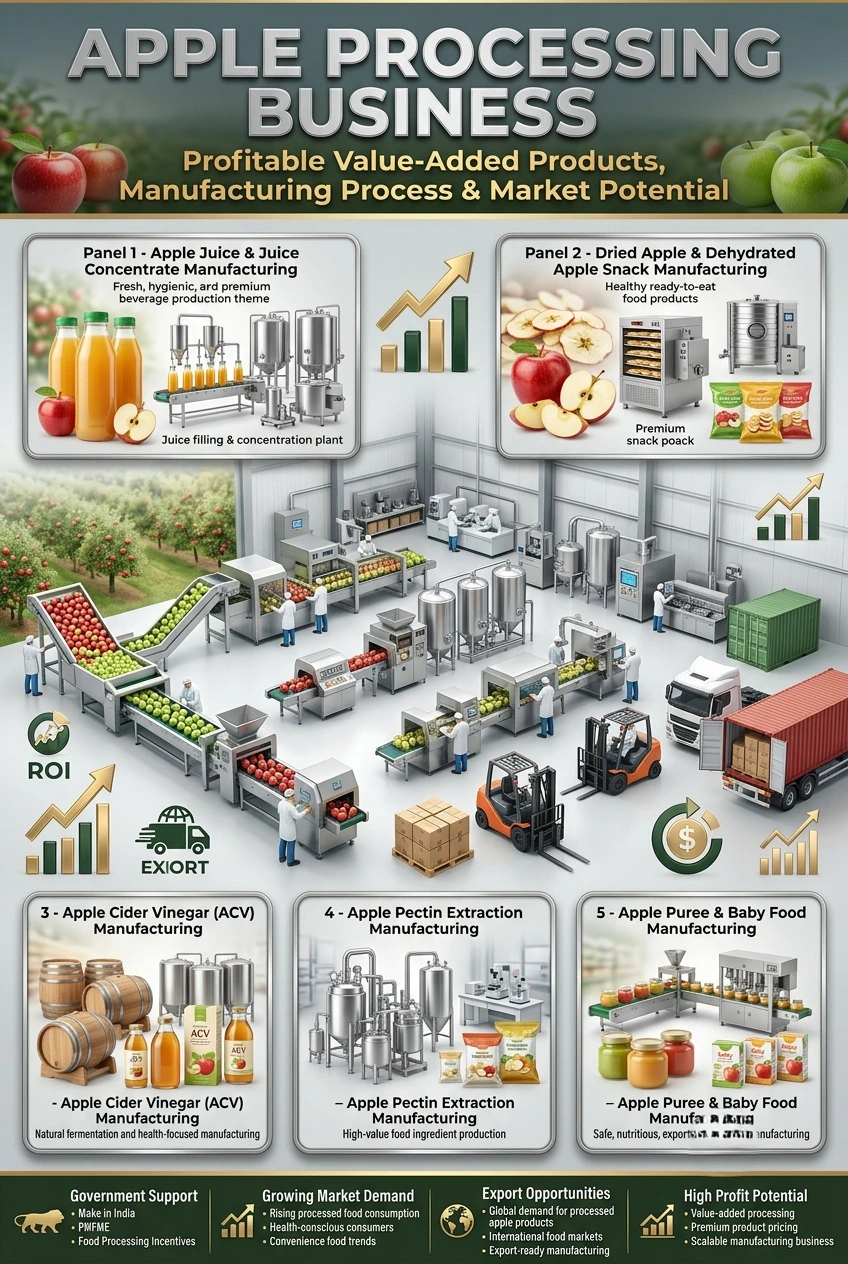
3. Apple Cider Vinegar (ACV) Manufacturing
Apple Cider Vinegar has emerged as a sought-after product in health, wellness and nutraceutical markets. Manufacturing is done by crushing apples in order to extract the juice, followed by fermenting with yeast to create alcohol, and then by a secondary acetic acid fermentation. The outcome is a product that can be used in food, health supplements and cosmetics. As such, the addressable market is varied and spread across channels. Importantly, the premiums in the organic ACV segment are high and India’s Himalayan apple belt is well placed to source for organic raw material to position products as premium.
It is an export-ready opportunity from day one as Agricultural & Processed Food Products Export Development Authority (APEDA) is actively supporting the export market of the processed food products like vinegar.
4. Apple Pectin Extraction Manufacturing
Apples contain pectin, a natural gelling agent which is extracted from apple pomace, the solid material remaining from the juicing process. This is attractive for entrepreneurs who already have juice or concentrate production, and are looking to incorporate a value addition layer as pectin. Demand for pectin in the food, pharmaceutical, and cosmetic industries is driving the large and growing global pectin market. 96% of pectin in India is being imported; thus, manufacturing pectin in the country is a real opportunity for import substitution with government support.
The method includes treating the dried apple pomace with dilute acid, extracting the pectin and spray drying it into powder form. Also, the National Horticulture Board (NHB) provides technology assistance and development grants for establishing value added horticulture processing units, which directly assist in businesses such as pectin extraction.
Get Detailed Insights from This Book: Apple Pomace Pectin Manufacturing Business Plan
5. Apple Puree and Baby Food Manufacturing
Apple puree is an essential ingredient in baby food, jams, bakery items, health drinks and more. The manufacturing process is relatively simple, which includes washing, pulping, heat processing and aseptic or retort packaging. The margin profile is good, though, especially with baby food, where quality and consistency is worth paying for. Urbanisation, dual income family and packaged nutrition are new drivers of baby food market in India which are growing at a steady rate.
Likewise, apple puree is utilized by food ingredient producers as a natural sweetener and flavorant in food products — adding to the B2B customer base of this product. Producers who are starting their food business should look into the food safety certification (FSSAI) and export wishing should consider BRC or IFS certification early in the life of the business.
Import–Export Opportunity Analysis
Currently, India imports a substantial amount of pectin and apple concentrate which can be produced domestically in the country at a reasonable cost. At the same time India has unexploited export demand for the Apple processed products in consumers’ markets where preference is for origin-specific products from the Himalayan region. Health-conscious importers in the UAE, Singapore, UK and Germany are keen on buying apple cider vinegar, dried apple snacks, and organic apple juice.
Food safety norms, such as Codex Alimentarius standards and country-specific requirements, are mandatory requirements for exporters. The price realization from export markets is however, often higher by 25–40% once certified, which significantly enhances the project profitability. Apple processing units who choose to export can benefit further from export documentation and incentives provided by the Directorate General of Foreign Trade (DGFT), which strengthen the apple industry’s financial attractiveness for export.
Besides, the Federation of Indian Export Organisations (FIEO) links up new food processors with overseas buyers thereby easing the entry of new entrepreneurs into the export market.
Build a profitable business with the right idea
Indian MSME Success Stories in Apple Processing
1. Himachal Agro Foods – Dr. Y.S. Parmar Model of Value Addition
The legacy of agricultural research in the state of Himachal has inspired several entrepreneurs of the MSME category to establish profitable apple processing units in Solan and Shimla districts by directly linking the procurement of apples with the processing unit. These enterprises have cut out the middleman, optimised the raw material price structure and established regional brands of apple juice and preserve. The strategic choice – to invest in cold store at the farm gate – was the most crucial cost lever and allowed for year-round manufacturing instead of seasonal production.
2. Himalayan Organics – Turning Apple Byproduct into Premium ACV
Himalayan Organics is a popular MSME brand that established a reputable brand in the apple cider vinegar market with genuine sourcing from the Himalayan orchards and clean label product positioning. The company understood that the price of the certified organic, unfiltered ACV would be much higher in India, and among export buyers, and invested in acquiring organic sourcing certification and premium packaging. This success story offers one of the essential tips for new entrepreneurs: the narrative of quality and perceived origin matters just as much as the formulation.
3. Catch Foods / DS Group – Scaling from Regional to National
The DS Group is a food company (Catch brand products) that offers a relevant lesson as to how to scale up a processed food business. From a base in the region, the group grew its processed fruit and flavouring product lines nationally, focusing on quality, institutional sales connections and early FSSAI and BIS compliance. The message for MSME entrepreneurs is simple: compliance investments during the early life of the project provide a defensible competitive edge that competitors from the informal sector may not be able to copy within the short time.
Related Article: Profitable Business Opportunity: Pectin from Apple Peels
How NPCS Supports Your Apple Processing Business Journey
At Niir Project Consultancy Services (NPCS), we give expert consulting services for the preparation of Detailed Techno-Economic Feasibility Reports (DPRs) for the setting up of new industries or businesses which include Market Survey. We provide comprehensive reports detailing manufacturing processes, market research and demand analysis, process flow diagrams, Product mix and capacity planning, Machinery & raw material details and full project financials and profitability analysis. Our feasibility reports enable entrepreneurs to make realistic revenue projections, break-even estimates, and capital requirements to assist bank managers and investors in committing to the sector of apple processing. We want to be able to help entrepreneurs determine feasibility, profitability and long-term scalability before they invest a single rupee.
Apple Processing Business: Key Market & Project Indicators
| Metric / Product Segment | Details / Estimates |
| India Apple Production Volume | ~25–27 Lakh Metric Tonnes (Annual) |
| Processing Penetration Level | ~2–4% (vs. global benchmark of 20–25%) |
| Apple Juice Concentrate Market (India) | High-growth; significant import dependence |
| Apple Cider Vinegar Retail Price (Premium) | ₹400–₹900 per litre (branded, organic) |
| Dried Apple Snack Export Price Realisation | ₹250–₹500/kg (FOB India) |
| Pectin Demand in India | Largely import-dependent; growing industrial use |
| Estimated PMKSY Subsidy (Cold Chain) | Up to 35% of eligible project cost |
| Minimum Viable Unit CAPEX (Juice Unit) | ₹20 Lakh – ₹60 Lakh (small scale) |
| Projected Revenue (Mid-Scale ACV Unit) | ₹60 Lakh – ₹1.5 Crore per annum |
| Export Markets with Active Apple Product Demand | UAE, UK, Germany, Singapore, USA |
Frequently Asked Questions (FAQ)
Q1. What is the minimum investment needed to start an apple processing business in India?
The investment depends on your products and their capacity A small-scale apple juice and dry fruit manufacturing set can be started between 20-60 lakh depending on the equipment cost, raw material cost, and working capital for small-scale. A plant for producing apple cider vinegar and an extraction plant of pectin need an investment between 50- 2 Crore for more elaborate processes. Government subsidies under PMKSY can offset 25–35% of eligible capital costs.
Q2. Is apple processing a seasonal business?
Raw apple availability is seasonal — primarily August to November in Himachal Pradesh and J&K. However, entrepreneurs who invest in cold storage or controlled atmosphere (CA) storage can extend the processing window across the year. Additionally, working with apple concentrate as a raw material input — sourced from other manufacturers — allows year-round operations for downstream products like ACV and puree.
Q3. What certifications does an apple processing unit require in India?
FSSAI License/Registration compulsory Food processing businesses need FSSAI registration/ license in general. Premium organic products must have the organic certification from APEDA recognized bodies. Export certified products like BRC Global standards, IFS Food or ISO 22000 certifications will be an asset from an international buyer perspective. Food units located in the food parks notified by the government are eligible for faster regulatory approvals.
Q4. What are the best export markets for Indian apple-processed products?
The UAE, the United States, the United Kingdom, Germany, and Singapore are proving to be active markets for Indian processed apple products like organic apple cider vinegar, dried apple snacks and apple concentrate, as producers in India can effectively sell the story of their produce from Himalayan roots. APEDA provides export market development assistance and organises international buyer–seller meets specifically for processed horticulture products.
Q5. Can I get a bank loan for an apple processing manufacturing unit?
Yes. Processing of apples falls under the Food Processing industry which is included under Priority Sector Lending in RBI guidelines. The Credit Guarantee Fund Trust for Micro and Small Enterprises(CGTMSE) provides collateral-free loans up to INR 5 Crore to MSME projects. Detailed Project Report (DPR) can enhance chances of approval.
Q6. How do I source raw apples reliably for my processing unit?
Direct farmer tie-ups, Farmer Producer Organisations (FPOs), and state horticulture department procurement channels are the most effective sourcing models. Himachal Pradesh and J&K governments actively encourage contract farming arrangements between processors and growers. Additionally, establishing cold storage near the orchard zone allows bulk procurement during peak season at competitive prices — improving raw material cost efficiency substantially across the year.
Conclusion: Apple Processing Is a Business Whose Time Has Come
The apple processing industry in India is a perfect mix of agriculture, industry, and a dynamic consumer base. The abundance and policy support in the supply side, the possibility of import substitution, and the export opportunity all combine to make it an attractive investment opportunity. From a juice and concentrate level or a high dollar ACV or pectin production, the basics are on the entrepreneur’s side. The first step is to have a thorough feasibility study, invest in good infrastructure up front and pick a niche product where the demand is easily visible.
Additionally, the government’s focus on horticulture-led rural industrialisation will continue to boost the ecosystem through supporting policies, grants and institutional financing. The apple processing industry is a unique blend of social good, scalability, and profitability for entrepreneurs with a willingness to invest wisely and execute with discipline.


