





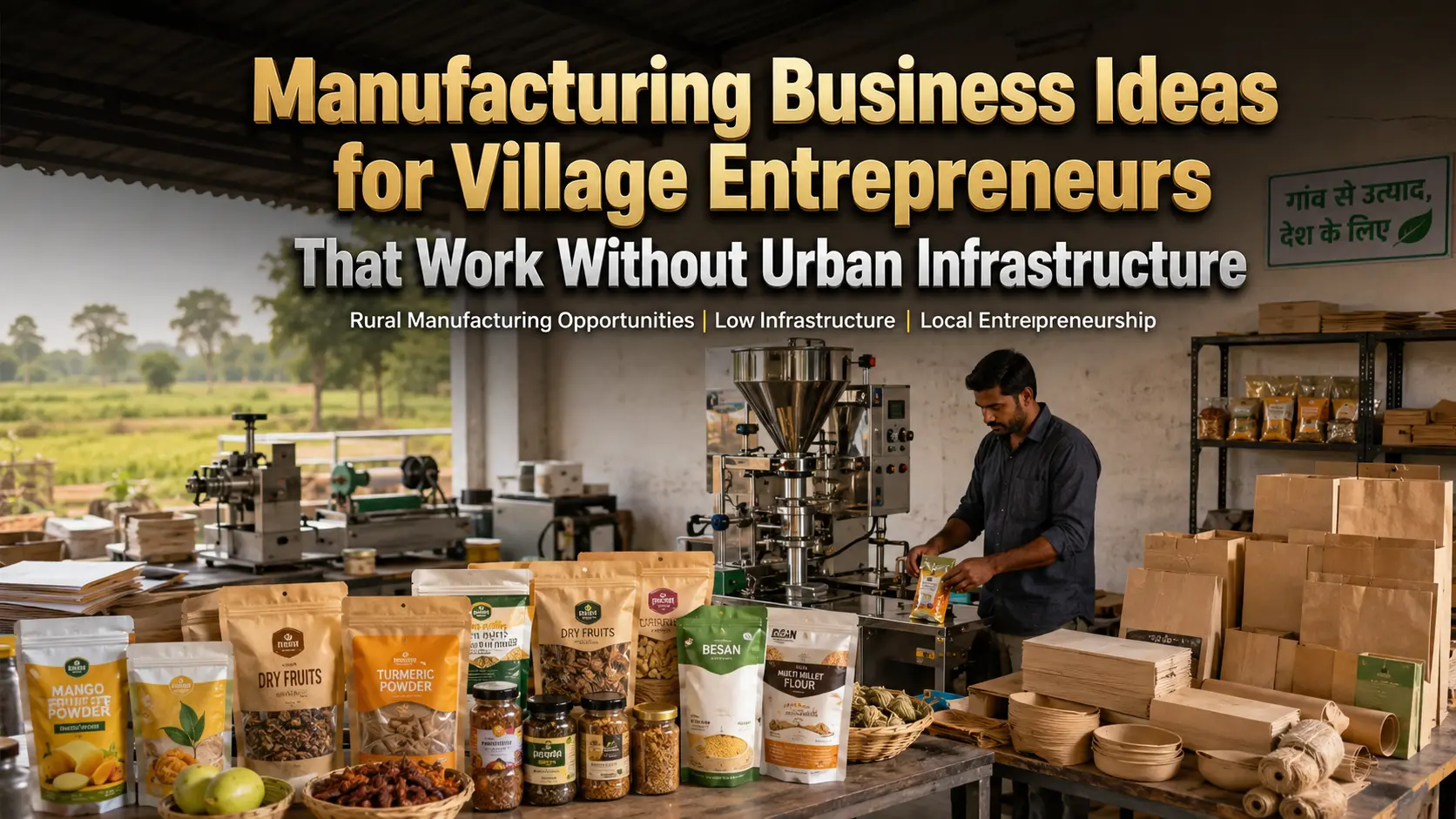
Manufacturing Business Ideas for Village Entrepreneurs
The primary objective of this book is to correct this misconception about how Indians’ villages are the producers of deserts. They are underdeveloped production centers that have a lot of agricultural raw materials, traditional craft skills, cheap labor, and plenty of land. What the village entrepreneurs often don’t have is the ability to make. What they lack are the ideas for what kinds of businesses can actually be successful without urban infrastructure, a platform to leverage government resources and the belief that a manufacturing business can be built and maintained from a rural location.
These enterprise ideas have established that making in a village isn’t a vote of no confidence — it’s a competitive strength. The lower cost of land, lower labour costs, less expensive raw material, and the availability of government incentives especially developed for rural businesses make it a serious business proposition for those who are willing to plan methodically and execute consistently – at least when it comes to village-based manufacturing.
Why Villages Are the Next Frontier for Indian Manufacturing
This is no more a rural economy in India. This Pradhan Mantri Gram Sadak Yojana has resulted in linking more than 97% of the habitations with all-weather roads. The advent of mobile internet access has enabled e-commerce, digital payments and business connectivity to the most isolated districts. The Saubhagya scheme has brought about tremendous improvement in power supply. In addition, raw material intensive manufacturing firms have an inherent cost advantage by being near their raw material, which is nearly always a rural or semi-rural area.
The Ministry of MSME has introduced a Scheme known as ASPIRE to promote rural industrial clusters and rural livelihood business incubators, giving financial and infrastructural assistance to the village-level manufacturing. Moreover, consumers—local and abroad—are clamoring for authentic, farm-to-table items from all sorts of products, from food to craft to natural personal care. Premium value of a story “Made in Village” when supported by quality and certification.
Government Policies Empowering Rural Manufacturing
There is a significant and varied number of government schemes available to village entrepreneurs especially for rural manufacturing. For the rural manufacturing unit, Pradhan Mantri Employment Generation Programme provides the subsidy in the scale of 25-35% which is 10% more than the urban area (15-25%). For the village industries like food processing industries, agarbatti industries, soap & candle industries, textiles and leather products, Government of India via KVIC (Khadi and Village Industries Commission) provides several supports like, grants, training, linkages, etc.
Deen Dayal Antyodaya Yojana – National Rural Livelihoods Mission (DAY-NRLM) is a link between rural SHGs, capital, training and market linkages for manufacturing-based livelihoods. The PM FME scheme provides a capital subsidy of 35% to the micro food processing units in the rural areas, a significant advantage for food manufacturers from the villages.
Moreover, NABARD’s rural enterprise fund offers refinancing facilities to Banks for rural manufacturing loans, which helps in enhancing credit availability in the districts where the banks mostly focus on urban manufacturing. ILO’s rural enterprise development programmes in India highlight the successful practices of rural manufacturing scale up with enterprise development at the community level which gives the village entrepreneurs a validation to create a credible enterprise.
7 Manufacturing Business Ideas for Village Entrepreneurs
1. Bamboo Products and Handicraft Manufacturing
India is the second largest resource base of bamboo in the world. Bamboo is found in large numbers in various parts of northeast India, Odisha, Chhattisgarh and in some regions of South India, mostly as an underutilised natural resource. The market demand of the bamboo products, such as furniture, baskets, mats, toothbrushes, kitchenware, decorative items and construction panels, has been strong and booming at both local and international markets. Bamboo entrepreneurs in the village can establish small bamboo processing units and develop product manufacturing business with little equipment such as splitters, strippers, polishers and simple bamboo joinery tools.
The bamboo cultivation and enterprise development is supported by the government through the National Bamboo Mission. Handicrafts, ecommerce, home decor stores, and export are channels for products to be sold. In addition to this, APEDA’s handicraft export facilitation is also assisting in export of artisan products. This is one of the best rural manufacturing avenues in India owing to its zero raw material cost (bamboo is wild and grows), strong craft tradition and global market demand.
Get Detailed Project Report (DPR): Handicraft (Cane & Bamboo) Manufacturing Guide
2. Jaggery (Gur) and Sugarcane Products Manufacturing
The production of sugarcane is concentrated in the states of Uttar Pradesh, Maharashtra, Karnataka, Tamil Nadu and Bihar where there is a tradition of enterprise among the rural population. The sugar cane belts have village entrepreneurs who have natural raw material advantage for jaggery (gur) manufacturing. In the modern processing of jaggery, a clean and hygienic process with quality grading, packaging and branding, jaggery is sold at 3–5 times the price of the traditional processing gur which is sold in bulk to the traders. The value-added products like sugarcane juice (bottled or fresh), molasses, sugarcane vinegar, jaggery powder, from the same raw material base, generate multiple revenues from a single crop.
The manufacturing process involves the use of a crusher, juicing machine, large kadhai (cooking pans or modern evaporators) and packaging machine, which are all available and useful in rural areas. Branding and online selling have opened up premium markets for village manufacturers of Jaggery, which they can directly tap into without relying upon commodity traders.
View Full Project Details: Jaggery (Gur) Manufacturing from Sugarcane – Export Quality
3. Pottery and Terracotta Products Manufacturing
India’s pottery and terracotta making tradition dates back thousands of years and the demand for handmade terracotta products is on the rise globally. Clay pots, decorative pots, terracotta jewellery, garden pots and kitchen storage vessels are high demand items in the urban Indian market, export and international homeware markets. Clay deposits, traditional skills, and space for kiln-based production are available to village potters all over Rajasthan, Gujarat, Bengal, and Orissa.
The challenges of upgrading from traditional craft to a branded, quality graded export-ready product include consistent clay sourcing, design modernisation, kiln temperature control, packaging and market access. Government skill development programmes through the Development Commissioner for Handicrafts and the Craft Council of India do just this – provide skill development, linkage and facilitate exports.
Related Article: Start Pottery Business in India: Complete Business Plan, Investment & Profit Guide
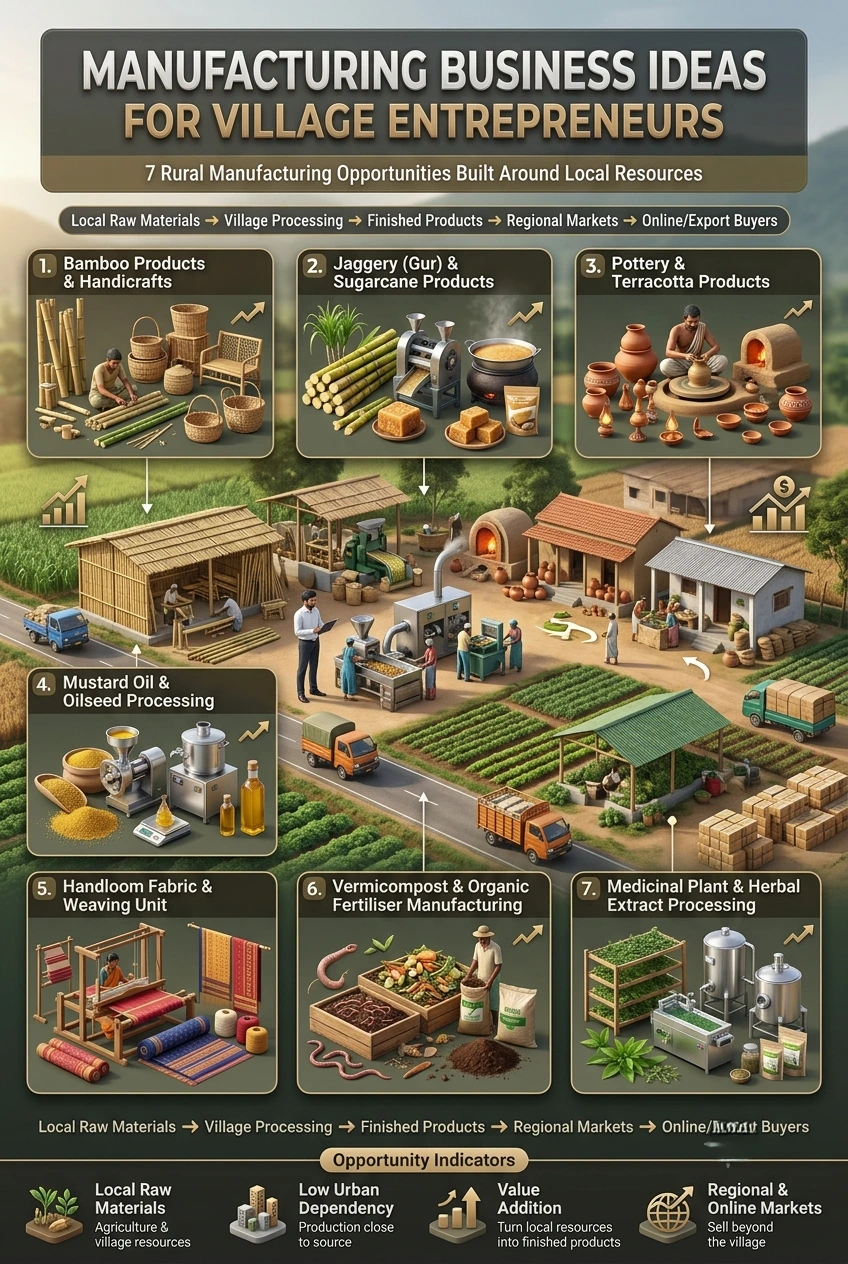
4. Mustard Oil and Oilseed Processing
Mustard oil is the primary cooking medium in large parts of North and East India. Village entrepreneurs in mustard-growing regions of Rajasthan, Haryana, UP, and MP have access to raw mustard at farm-gate prices — creating a significant input cost advantage over urban oil processors. A wood-press (ghani) or expeller-based mustard oil unit can be set up in a village with modest capital and basic infrastructure. Cold-pressed and ghani-extracted mustard oil commands premium pricing among urban consumers seeking authentic, traditionally processed oils — a trend accelerating through organic and natural food movements.
Packaging in branded containers and selling through online channels or to urban distributors converts a local oil-pressing unit into a premium food brand. The Invest India agri-business sector data confirms strong growth in premium edible oil segments — precisely where village-based traditional processors have competitive authenticity advantages.
Read the Complete Book Here: Fruits, Vegetables, Corn and Oilseeds Processing Handbook
5. Handloom Fabric and Weaving Unit
The largest sector for handlooms in the world for the sheer number of weavers it boasts, India’s handloom industry is chronically short on funds and awareness. Villages that are steeped in weave – the Varanasi in UP, the Pochampally in Telangana, the Chanderi in MP, the Kutch in Gujarat, the Sambalpuri in Odisha – produce some incredible pieces, which command extremely good prices, if they are properly branded and marketed. A village entrepreneur or group setting up a cluster of weavers or an cooperative weaving unit can go directly to urban boutiques, designers, and buyers in exports, circumventing layers of middlemen who’d hog the margin.
The Office of Development Commissioner for Handlooms provides yarn subsidy, design input, market development, and e-marketing support. Digital storytelling — sharing the weaving process and the artisan’s story through social media and brand platforms — has proven to be a powerful driver of premium pricing for handloom products.
Check Out This Recommended Book: The Complete Technology Book on Textile Spinning, Weaving, Finishing and Printing
6. Vermicompost and Organic Fertiliser Manufacturing
Every village in India has access to organic waste — agricultural residue, cattle dung, kitchen waste, and crop by-products. Converting this waste into premium organic fertiliser through vermicomposting or composting is a manufacturing business that has zero raw material cost, very low capital requirement, and growing domestic demand as Indian agriculture shifts toward natural and organic practices. The National Centre of Organic and Natural Farming provides technical guidance and certification for organic fertiliser manufacturers. State agriculture departments in most states provide training, earthworm supply, and market linkage for new vermicompost units.
The transition to natural farming mandated under PM Pranam and state natural farming missions creates institutional buyers — agriculture departments, FPOs, and organic farming cooperatives — for verified organic fertiliser. This is a village business where the raw material is free, the process is learnable, and the buyer base is growing rapidly.
Get Detailed Insights from This Book: The Complete Book on Organic Farming and Production of Organic Compost
7. Medicinal Plant and Herbal Extract Processing
India’s forests, agricultural lands, and wastelands harbor medicinal plants which have commercial uses in the pharmaceuticals, nutraceuticals and cosmetic industries. Primary processing units-cleaning, drying, grading and packaging-could be set up by village entrepreneurs in villages where cultivation takes place, namely in the districts in Uttarakhand, Himachal Pradesh, MP, Rajasthan and Kerala, so that their produce could be sold to large processors or directly to foreign buyers. Market linkage, support in cultivation of medicinal plants and development of herbal gardens can be facilitated by the National Medicinal Plants Board (NMPB).
Aloe Vera gel extraction, oil distillation of turmeric, oil extraction of Neem, oil distillation of essential oils of lemon grass, citronella, rose geranium can be done at the village level with relatively cheap equipment and can earn good export incomes.
There is a firm long-term potential in this segment of manufacturing given the increasing demand for natural plant-based materials in the beauty care, pharmaceutical, and food industries around the world.
Explore This Book: Herbal Cosmetics & Ayurvedic Medicines (EOU)
Import–Export Opportunities for Village Manufacturers
Village-made products increasingly carry a market premium that factory-made products cannot replicate. Handloom textiles, bamboo goods, terracotta, organic food, and herbal products all command “artisanal origin” premiums in export markets. The APEDA’s agri-export zones and organic product export support provides certification and market access pathways. The Craft Export Promotion Council facilitates international buyers for handcraft and artisanal manufacturers. Village entrepreneurs who invest in packaging, quality certification, and digital marketing can access export markets directly — without the urban middlemen who have historically captured the bulk of export value from village-made products.
Indian MSME Success Stories From Village-Based Manufacturing
Lijjat Papad demonstrates how a village-cooperative manufacturing model can become a national institution. Starting in a Mumbai chawl but replicating the distributed home-production model across rural India, Lijjat today employs tens of thousands of women across rural centres. Fabindia, founded by John Bissell, built an entire retail empire on the back of village weavers and artisanal manufacturers — demonstrating the value that proper branding, quality management, and market access can unlock from rural production. Amul’s cooperative dairy model — while primarily dairy-focused — shows definitively that village-scale production, when organised and marketed professionally, can compete with urban-based companies at the highest levels of the FMCG market.
Stop guessing—choose the right business with confidence
How NPCS Supports Village Entrepreneurs
We at Niir Project Consultancy Services (NPCS) provide professional consulting for the preparation of Market Survey cum Detailed Techno-Economic Feasibility Reports (DPRs) for setting up new industries or businesses. Our reports include detailed manufacturing processes, market research and demand analysis, process flow diagrams, product mix and capacity planning, machinery and raw material details, and complete project financials with profitability analysis. For village entrepreneurs who may lack access to urban consulting resources, our DPRs provide the professional-grade business planning needed to access bank loans, government subsidies, and institutional buyers.
Rural Manufacturing Business Viability Overview
| Business | Raw Material Availability | Infrastructure Needed | Key Market | Government Support |
| Bamboo Products | North-East, Odisha, MP | Basic workshop | Urban retail, Export | National Bamboo Mission |
| Jaggery Products | UP, Maharashtra, Karnataka | Moderate | Urban premium, online | PMEGP, PM FME |
| Pottery/Terracotta | Rajasthan, Bengal | Kiln, shed | Urban, Export | Handicraft schemes |
| Mustard Oil | Rajasthan, Haryana | Expeller machine | Urban, online | MSME, PMEGP |
| Handloom Fabrics | Pan-India (regional) | Loom, workspace | Urban boutique, Export | Handloom Commissioner |
| Vermicompost | Pan-India | Open land | Local farmers, FPOs | Natural Farming schemes |
| Medicinal Plants | Uttarakhand, MP, Kerala | Drying, grading | Pharma, Export | NMPB |
Conclusion — The Village Entrepreneur’s Advantage Is Real
Village manufacturing in India is not a second-best option. It is a distinct competitive advantage for entrepreneurs who choose the right products, access the right government support, and invest in packaging, branding, and digital market access. The businesses listed in this article — bamboo crafts, jaggery processing, pottery, oil pressing, handloom weaving, vermicompost, and medicinal plant processing — all leverage what villages have in abundance: raw materials, traditional skills, land, and authentic origin stories that urban factories cannot replicate.
The government’s policy ecosystem is firmly on the side of rural manufacturers. The consumer trend toward authentic, naturally made, locally sourced products is accelerating. And digital infrastructure has permanently lowered the barrier between village production and national — even global — markets. There has never been a better time to build a manufacturing business from a village. Start with a business plan, register your enterprise, and use every scheme available to you. The city is no longer a prerequisite for success.


