





Udyam vs Udyog Aadhaar vs GST
There is always someone coming each week to a consulting office for the same confusion. They are interested in establishing a small production facility and they have already been exposed to three different views on paperwork. One of the relative’s states that Udyog Aadhaar is sufficient. A chartered accountant calls for the primary time that GST is primary. When a bank manager asks for a Udyam certificate, he doesn’t even look at the project file. More good business ideas fail because of this confusion, than because of insufficient funds ever do.
The reality is no more complicated than it seems. The Udyog Aadhaar is no longer available as a real system. It was replaced by Udyam Registration several years ago and is now serving as the sole identity document for all Micro, Small and Medium Enterprises in India. GST is not a separate tax registration, it is activated based on turnover, or the type of your business, rather than by being an MSME. After an entrepreneur understands where each document fits into the registration process, this registration maze is no longer a maze.
This article details the steps new manufacturers need to take, the order, and why they need to take them. It also inspects the government help that’s offered after filing, the sectors which are about to be fruitful and a few manufacturers from India who grew their business from a small unit.
Why Manufacturing Deserves a Serious Look Right Now
India’s manufacturing landscape is undergoing a real transformation. An active search for diversifying supplier base from a single country is taking place among global buyers and Indian units are starting to receive orders which would otherwise go elsewhere, five years ago. This is no blip. Strategies for long-term electronics, auto component and specialty chemical buyers were reshaped.
Meanwhile, domestic consumption continues to rise. The growing middle class is purchasing more packaged food, more branded consumer goods, more construction material and more engineered products annually. Exporting is not the only path to a manufacturer’s success. While an export order may be on the table, a well-run unit can carry it for years due to strong regional demand.
Profitability is also different in manufacturing than it is in other businesses, such as trading and services. Beyond the break-even production volume, margins usually increase more rapidly due to the relatively fixed nature of the level of certain costs, such as rent, compliance, and core labor. This is the point which will typically be identified on a feasibility study and here is where a significant profit opportunity is likely to start.
The cost of raw materials, power tariffs, logistics etc also differ significantly across the states and the same product idea can have a different margin profile in Gujarat as compared to Bihar. That is why, not a guess, but a proper techno-economic feasibility report should be behind any manufacturing decision.
There has also been some flexibility in the interest rate charged for business loans, and banks have become more at ease lending against Udyam MSME status, compared to a few years ago. All of this, with the added backing of an easier credit window and a government guarantee, is indeed a positive window for a first-time manufacturer as long as the project math is good. Launching at the right time, such as during the festive season or year-end, around these demand cycles, especially for consumer-based products, can also help you get to your first profitable quarter sooner.
Government Policies and Incentives Supporting New Manufacturers
The government has layered multiple schemes, and a majority of the first-time entrepreneurs employ a single or two schemes. They all start with a free and paperless Udyam registration by the Ministry of Micro, Small and Medium Enterprises. It has superseded Udyog Aadhaar and now gets integrated with GST, Income Tax and Government e-Marketplace, thereby eliminating the need of multiple registrations.
Udyam Registration and MSME Classification
According to the latest definition, the maximum investment that can be made in plant and machinery for a micro enterprise is ₹2.5 crore, and the turnover is limited to ₹10 crore. A small business can invest up to ₹25 crores and earn a turnover of ₹100 crores. Marketing definition of a medium enterprise is that it has an investment of the range of ₹125 crore and turnover of the range of ₹500 crore. These calculations do not include export turnover and an export-rich unit will have a cushion of additional turnover before graduation to the next band.
These limits are important because the eligibility for scheme, interest subvention and priority sector lending all depend on the band in which they fall. The business which remains conscious about its Udyam classification will be able to keep benefits from going down the drain due to accidental classification.
Credit Guarantee and Collateral-Free Loans
Collateral-free loans up to Rs 10 crore have been now covered under the Credit Guarantee Fund Trust for Micro and Small Enterprises (CGTMSE) for eligible micro and small units. It has driven many banks to extend credit to entrepreneurs lacking in property to secure as collateral since the government guarantee takes up a significant amount of risk.
PMEGP and Margin Money Subsidy
The KVIC Prime Minister’s Employment Generation Programme provides a direct subsidy of 15-35 per cent of the project cost depending upon the category of the applicant and whether the unit is located in an urban or rural area. This subsidy can reduce the amount of loan an entrepreneur has to arrange in a manufacturing project by one-third.
Production Linked Incentive and Sector-Specific Support
The Production Linked Incentive (PLI) scheme for additional production and investment in various industries including electronics, specialty steel, textiles, among others, should be watched by larger manufacturers looking to scale up. It has not been designed to be used on a first expansion with a relatively small project budget, but only on a subsequent phase of expansion by the manufacturer. Even a small unit is indirectly benefited since large manufacturers have their various ancillary service and support requirements and registering early and being compliant with Udyam Regulations makes one a suitable candidate when the opportunities come.
State-Level Industrial Policies
Every major state runs its own industrial policy on top of central schemes, and the difference between states can be significant. Gujarat, Uttar Pradesh, Maharashtra, and Tamil Nadu all publish capital subsidy, stamp duty exemption, and power tariff concession details on their respective industry portals, such as Invest UP, Industries Commissionerate Gujarat, and Maharashtra Industry, Trade and Investment Facilitation Cell. Checking the relevant state portal before finalising a project location often changes the numbers in a feasibility report considerably.
Beyond these, the Startup India initiative under DPIIT provides tax holidays and relaxed compliance for recognised startups and the GST composition schemes ease the tax burden for very small manufacturers with turnover less than the composition tax limit. All of these benefits are voluntary. An entrepreneur has to apply, follow deadlines and, in most cases, enlist the assistance of a consultant, who is already familiar with the paperwork.
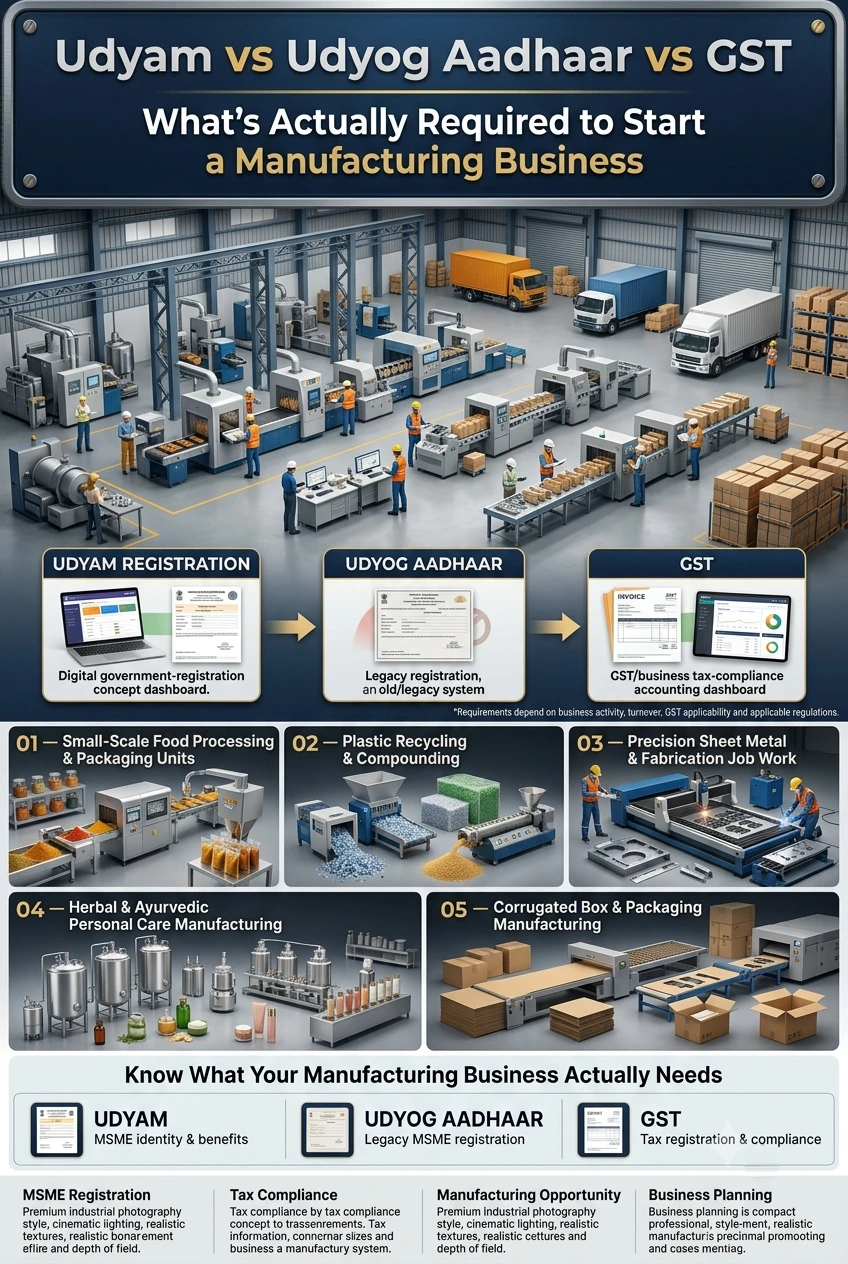
Business Ideas for New Manufacturing Entrepreneurs
The real question is what to produce once the registration road is clear. The business ideas have been selected, because they have a steady demand in India along with a project cost, which a first-time entrepreneur can financially back with PMEGP or a CGTMSE loan.
1. Small-Scale Food Processing and Packaging Units
One of the more benign industries for a new processor is food processing as it is a business that never really stops. When manufacturing and packing pulses, spices, snacks or ready to cook mixes, a small unit can be set up and gradually scaled up as local retailers place repeat orders. The working capital cycles are short due to rapid movement of packaged food in both kirana stores and modern retail.
Further, there are the subsidy schemes operated directly by the Ministry of Food Processing Industries, making it even easier to enter the market. The major problem is the consistent quality and getting the product FSSAI licensed as early as possible as no retailer would take a risk of stocking an unlicensed product even if it is a good product.
Get Detailed Insights from This Book: Food Packaging Technology Handbook
2. Plastic Recycling and Compounding
India has recently been more stringent on single use plastics and moved towards prescribing the mandatory recycled content for packaging, turning plastic recycling into one of the more lucrative manufacturing models for a new player. A compounding facility which transforms post-industrial or post-consumer plastic waste into usable granules can help packaging companies, pipe and consumer goods companies that are seeking recycled content to meet their regulatory requirements.
The cost of machinery is acceptable, and raw material – in the form of plastic scrap – can frequently be lower than anticipated when a successful collection system is operational. The quality of the sorting is a major determinant of the margins, and a founder who takes the time to invest in the proper segregation equipment will generally pay for that investment in the first year.
3. Precision Sheet Metal and Fabrication Job Work
Automotive, electronics and white goods manufacturers always outsource sheet metal fabrication instead of acquiring all required components. Without having a final product brand, A job-work unit that provides laser cutting, bending and welding services can establish a consistent customer base. This is a good model for an entrepreneur who has a technical or engineering background – as the business grows, it’s typically through referrals, so relationships tend to begin on a personal level. Investment focuses mainly on machinery, and not on raw materials stock, thus keeping working capital pressure lower than in most manufacturing enterprises. With the growth of electronics and EVs component manufacturing in India, the demand for precision fabrication job work is growing further.
Related Article: How to Start a Plastic Waste Recycling Business: A Comprehensive Guide
4. Herbal and Ayurvedic Personal Care Manufacturing
There has been a marked shift towards using herbal and ayurvedic personal care products by consumers and this is no longer a niche market for the elite consumers of urban areas. Herbal soap, hair oil, and skin care products are also more popular in rural and semi-urban areas, both for cost and for the trust they place in the product. A small unit that processes for regional brands, or processes its own brands, can be profitable using relatively simple processing equipment.
Units manufacturing certified ayurvedic formulations also get support from various schemes under AYUSH. The challenges here are formulation expertise and the right licensing within the Drugs and Cosmetics regulations, which a skilled consultant can help get right from the outset.
Get Detailed Project Report (DPR): Ayurveda & Herbal Products, Essentialv Oils, and Phytochemicals
5. Corrugated Box and Packaging Manufacturing
These days, every manufacturer, every e-commerce seller, and every FMCG distributor requires packaging, and corrugated box manufacturing is one of the busiest businesses in the ancillary segment that is constantly on the rise. This business doesn’t often suffer from demand issues as demand increases in tandem with India’s overall manufacturing and e-commerce growth.
Moderate investment is required to set up a single face or three-ply unit, and they are usually break-even sooner than more specialised manufacturing lines as the demand is local and repeat order is regular. This is a factor of proximity to industrial packs, because if the unit is not close to its customers the freight costs on the packaging materials for bulky products can be extremely damaging to margins.
View Full Project Details: Corrugated Boxes Manufacturing: Complete Business Guide
Import-Export Opportunity Analysis for New Manufacturers
While India is a net importer, it has significant opportunities for new manufacturing players who are interested in exploring overseas markets. Some of the product lines in which India is already a large importer, such as specialty chemicals, some electronic components, and precision engineering components are good candidates for import substitution. A new company entering into one of these categories doesn’t just look for profit, but also gets into a space where the government is making a concerted effort to bolster it with PLI and import duty measures.
The export market is also steady with industries such as processed food, textiles, leather goods, engineering products, etc. still facing a strong demand from abroad. Importer Exporter Code is issued by Directorate General of Foreign Trade for all foreign trade transactions and export promotion councils in different sectors provide assistance for market access, buyers etc. and in some cases, they provide freight subsidy. A manufacturer who signs up for an IEC early – even before the first export order comes through – is not in danger of losing out on a real opportunity later.
A practical approach for a first-time exporter is to build a strong domestic client base first, then use trade fairs and export promotion council introductions to test overseas demand with small trial shipments. This limits risk while still keeping the export door open.
Currency fluctuation is another factor new exporters underestimate. A favourable exchange rate can flatter margins on paper, but a sudden rupee appreciation can erase that advantage within a single shipping cycle. Building a small buffer into export pricing, rather than quoting the tightest possible margin, protects a young manufacturing business from getting squeezed on its very first overseas order.
Indian MSME Success Stories Worth Studying
Haldiram’s – Manoharlal Agarwal and family. What began as a small namkeen shop in Bikaner grew into one of India’s largest snack food companies without losing its regional flavour identity. The founding family’s decision to standardise recipes while scaling production, rather than diluting quality for volume, is the single biggest lesson for any food processing entrepreneur today. They expanded city by city instead of trying to go national overnight, which kept quality control manageable at every stage.
MDH Spices – Mahashay Dharampal Gulati. Dharampal Gulati rebuilt a spice business from almost nothing after Partition and turned it into a household name through consistent quality and aggressive, memorable branding. His insistence on personally checking product quality even after the company had grown into a large enterprise shows why manufacturing businesses cannot separate brand trust from operational discipline.
TVS Group – T.V. Sundaram Iyengar and successors. What started as a transport business evolved into one of India’s largest engineering and auto component groups through deliberate, phased diversification into manufacturing. The group’s pattern of entering adjacent manufacturing segments only after mastering the previous one is a useful playbook for any entrepreneur tempted to expand too many directions at once.
The common thread across all three stories is patience with process and impatience with quality shortcuts. None of these businesses scaled by cutting corners on the product itself.
Getting the Feasibility Numbers Right Before You Invest
Every idea in this article sounds workable on paper, but paper is exactly the problem. Machinery costs, raw material prices, manpower requirements, and realistic demand figures vary by product, by location, and by scale, and a rough estimate is not the same as a bankable project report.
We at Niir Project Consultancy Services (NPCS) provide professional consulting for the preparation of Market Survey cum Detailed Techno-Economic Feasibility Reports, commonly known as DPRs, for entrepreneurs setting up new industries or businesses. Our reports include detailed manufacturing processes, market research and demand analysis, process flow diagrams, product mix and capacity planning, machinery and raw material details, and complete project financials with profitability analysis. The objective is straightforward: help an entrepreneur evaluate feasibility, profitability, and long-term scalability before a single rupee goes into machinery.
Identify high-growth industries before others do
Registration and Compliance Snapshot
| Registration / Scheme | Purpose | Cost to Applicant | Typical Turnaround |
| Udyam Registration | MSME identity for scheme, credit, and procurement access | Free | Same day |
| GST Registration | Mandatory tax registration above threshold turnover or for interstate supply | Free (professional fees may apply) | 3–7 working days |
| Udyog Aadhaar | Discontinued; fully replaced by Udyam Registration | Not applicable | Not applicable |
| PMEGP Margin Money Subsidy | Capital subsidy of 15–35% of project cost via KVIC | Free to apply | 4–8 weeks (bank sanction dependent) |
| CGTMSE Credit Guarantee | Collateral-free loan covers up to ₹10 crore | Guarantee fee charged by lender | Assessed with loan application |
| Importer Exporter Code (IEC) | Mandatory for any import or export activity | Nominal government fee | 1–2 working days |
Conclusion
Udyam Registration, GST, and the now-defunct Udyog Aadhaar often get mixed up because entrepreneurs are told to “register the business” without anyone explaining which registration does what. Udyam is your MSME identity. GST is your tax registration. Udyog Aadhaar is history. Once that distinction is clear, the rest of the paperwork becomes a checklist rather than an obstacle.
The bigger decision is still the one that happens before any registration: choosing the right business ideas, sizing the project correctly, and building financial projections that survive contact with a bank’s credit committee. That groundwork determines whether a manufacturing unit becomes a genuine growth story or a struggling shop that never quite covers its costs.


