





Home Based Manufacturing Business
Indian home is quickly turning into a production center. Women entrepreneurs are operating small manufacturing units from their backyard and garages, spare room and kitchens, and not requiring any commercial premises and huge investments in cities, towns and villages, and earning a regular income. They are not part-time businesses. Several of those business ideas have grown to become crore turnover businesses. The transition taking place is due to three forces, which are coming together: consumers are increasingly buying artisanal and locally produced goods; there is greater access to e-commerce without the need to have a physical store; and the government has backed women-led manufacturing with subsidies, trainings and credit guarantee schemes.
Why Home-Based Manufacturing Is a Serious Business Opportunity for Women
The business opportunity of manufacturing at home is strong. There is no rent for commercial space. Labour can be provided by family members. Raw materials can be purchased on a small-scale basis. With platforms like Amazon, Meesho, JioMart or WhatsApp Business, distribution does not need a distributor anymore. Furthermore, women-led local business products are becoming popular among consumers – especially in the food, personal care and handcraft sector. The World Bank’s Women Entrepreneurs Finance Initiative (We-Fi) underscores that women entrepreneurs in developing economies suffer a $1.7 trillion financing gap, and the solution is to fill it with targeted schemes that can help increase women’s manufacturing output dramatically.
Government Policies and Incentives for Women Manufacturers
There is a good pool of schemes designed specially for women entrepreneurs in manufacturing. Women can take the Udyam Registration on the MSME Ministry’s Portal in a matter of minutes and avail priority loan. In the Shishu, Kishore and Tarun categories of Mudra Yojana, women entrepreneurs are given preferential interest rates and loans without any collateral up to ₹10 lakh. Under the Mahila Udyam Nidhi Scheme by SIDBI, women-owners of small businesses can easily avail soft loans at low interest rates. The PM FME scheme is especially relevant for the women food processors as 35% capital subsidy is provided to micro food processors and the Women SHGs are provided with seed capital directly.
Also, women-led startups can avail 80% rebate on patent filing fees under the Start-Up India Scheme of DPIIT and there are relaxed compliance and expedient exit norms, and access to Fund of Funds. The Office of Development Commissioner for Handicrafts offers design training, market development assistance and e-marketing support to women engaged in handloom and handicraft production activities. IBEF’s MSME sector overview further shows that women-led MSME now plays a significant role of providing more than ₹90,000 crore contribution to the Indian economy, which is expected to grow considerably more.
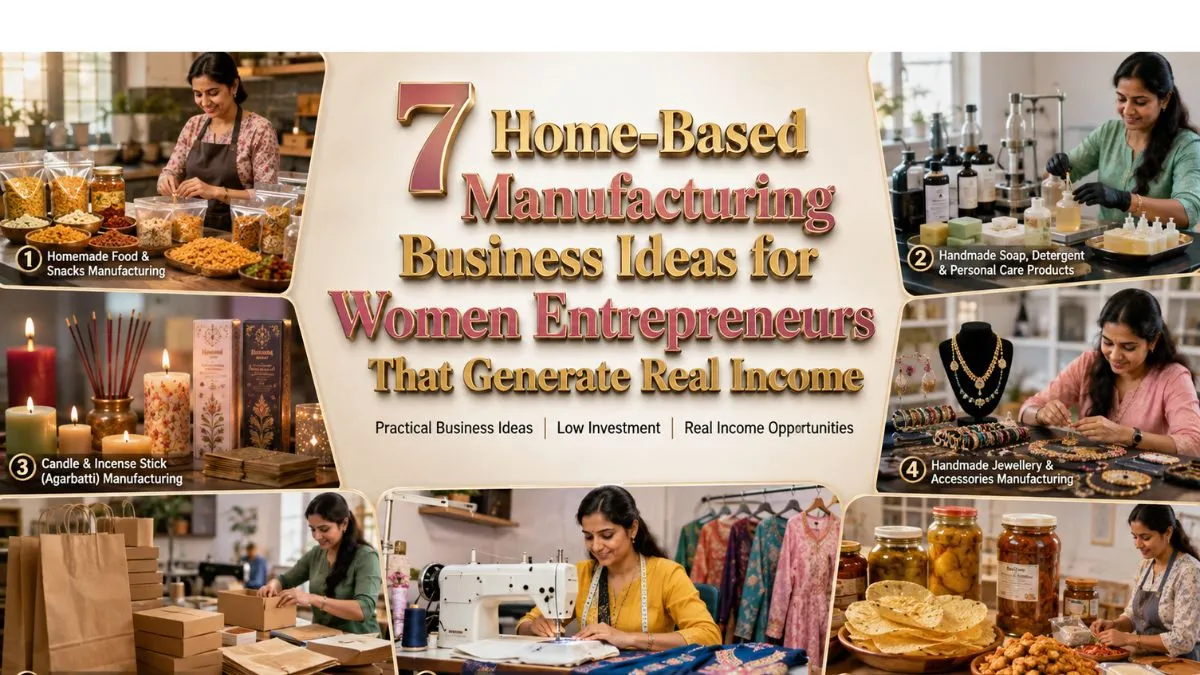
7 Manufacturing Business Ideas Women Can Run From Home
1. Homemade Food and Snacks Manufacturing
The Indian snack food market is a multi-thousand crore market where there is ample scope for the traditional products of the respective regions with a truly authentic value. The women who prepare murukku, chakli, namkeen, pickle, papad, khakhra, dry sweet or any type of regional snacks at their own homes can set up a formal manufacturing business in their homes. It’s all about being FSSAI registered, keeping the quality consistent, securing packages and distributing it through local retail, corporate gifting, and online marketplaces.
In fact, many great female-led food brands began right here – with one woman, a home kitchen, and a product that people really liked. This is one of the most easily available manufacturing businesses for women in India, as the PM FME scheme offers capital subsidy and the various food processing missions offered by the states give them training and equipment.
Read the Complete Book Here: The Complete Technology Book on Snack Foods
2. Handmade Soap, Detergent, and Personal Care Products
Large FMCG brands dominate personal care market in India. However, another significant market of shoppers is actively looking for handmade natural, chemical-free products and that market is primarily in soaps, face washes, body scrubs, hair oil and lip balms. The equipment needed for a home-based soap and personal care making unit is fairly minimal, consisting of a melting pot, moulds, packing materials, and fundamental raw material such as caustic soda, coconut oil, essential oils and natural additives.
There are minimal start-up costs. Once the brand has developed a loyal consumer base, margins will be very high. Women entrepreneurs in this category have become successful to sell products via Instagram stores, wellness stores, and online stores. Know-how is learnable online via courses and ITI programmes offered by government. It has a high perceived product value which allows for premium selling prices.
Explore This Book: Modern Technology of Soaps, Detergents & Toiletries (with Formulae & Project Profiles
3. Candle and Incense Stick (Agarbatti) Manufacturing
Making candles and agarbatti is one of the oldest cottage industries in India, and one of the most profitable home-based manufacturing business for women with low investment. India is one of the biggest producers and exporters of agarbatti. Religious practice, aromatherapy and home fragrance related trends drive domestic demand. A simple machine (rolling unit) to roll the agarbatti can be prepared at home using a hand-operated machine, bamboo sticks, binding powder, aromatic material and packaging.
More output is provided by semi-automatic machines. There has been a recent surge of interest in candle manufacturing, especially the gifting market and home decor and high-end retail sections of the market for soy wax decorative or aromatherapy candles. They both have very low raw material cost, and are sold at high margins, especially if sold online with good product photography and strong branding.
Get Detailed Project Report (DPR): Agarbatti (Incense Sticks) Manufacturing Guide
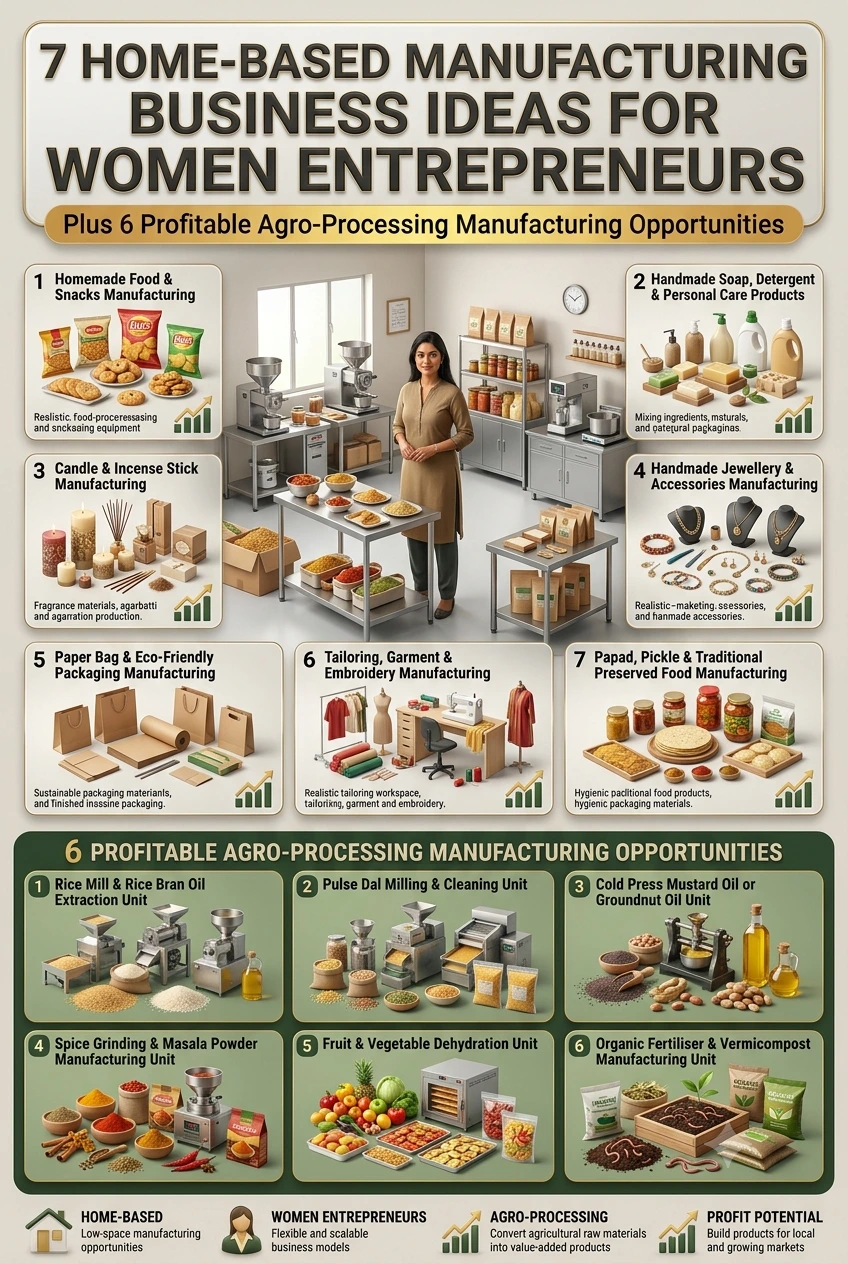
4. Handmade Jewellery and Accessories Manufacturing
India’s jewellery making industry is one of the largest and a most creative industry in the world with millions of artisans. However, there has been a rise of an alternative market for terracotta, jute, fabric, resin, beads, wire and recycled fashion jewellery beyond traditional jewellery of gold and silver. Using few pieces of equipment and building a brand, women with craft skills can start a home-based jewellery manufacturing business and reach out to people via Instagram, Pinterest, Etsy and local shops.
The Gems and Jewellery Export Promotion Council (GJEPC) offers export facilitation and market development assistance to jewellery manufacturers, including smaller ones. There are no purity standards for Fashion jewellery, giving room for creativity. Order volumes remain high throughout the season, as in the case of weddings, festivals, and gifting. Custom design services can be offered to clients who are women in a manufacturing business and can give them even better margins.
5. Paper Bag and Eco-Friendly Packaging Manufacturing
India’s single-use plastic ban has created a large and urgent demand for paper bags, cloth bags, and eco-friendly packaging across retail, food service, and e-commerce sectors. A paper bag manufacturing unit can be set up at home or in a small workspace with a paper bag making machine (available for modest investment), paper rolls, adhesive, and printing equipment. The market includes kirana stores, restaurants, apparel boutiques, and grocery chains — all of which need ongoing supply. Government supply through KVIC and state industrial development corporations also provides steady orders to women SHGs and small manufacturers. This is a business where volume is the driver — and consistent quality and timely delivery quickly translate into repeat orders and long-term contracts.
Access Complete Business Plan: Paper Bags from Waste Manufacturing Guide
6. Tailoring, Garment, and Embroidery Manufacturing Unit
India’s textile and garment sector is massive — but millions of rural and semi-urban women with sewing skills remain underemployed in this value chain. A home-based stitching and garment manufacturing unit can start with one or two sewing machines and target school uniforms, hospital scrubs, festival wear, or export garment sub-contracting. Women with embroidery skills — particularly regional embroideries like Chikankari, Phulkari, Kutch, or Mirror work — can supply to urban boutiques and export houses at premium rates. The Textile Ministry’s SAMARTH Scheme provides skill training and employment linkage for women in textiles. With e-commerce enabling direct-to-consumer sales, garment and fabric manufacturing businesses run from home have real growth potential beyond piece-rate sub-contracting.
Related Article: Top 20 Textile, Apparel & Garment Manufacturing Business Ideas
7. Papad, Pickle, and Traditional Preserved Food Manufacturing
Papad and pickle manufacturing are among the oldest and most proven home-based manufacturing businesses in India. Products like aachar, murabba, chutney, and papad have multi-generational brand equity in regional markets. Today, with clean labelling, natural preservation, and regional authenticity becoming strong selling points in both domestic and NRI markets, the timing could not be better for women to launch their own preserved food brands. The FSSAI’s basic registration process is simple, and schemes under PM FME provide packaging, branding, and marketing support. Many women in Maharashtra, Rajasthan, and Gujarat have built crore-plus enterprises from pickles and papads alone — starting from a small home kitchen and expanding methodically as orders grew.
View Full Project Details: Papad Plant Manufacturing Project Report
Import–Export Opportunities for Women-Led Manufacturing
Women-made products — particularly in food, handicrafts, personal care, and fashion accessories — carry a premium in international markets. NRI communities in the USA, UK, UAE, Canada, and Australia are consistent buyers of Indian traditional food products, jewellery, and ethnic accessories. APEDA’s export facilitation for organic and processed foods helps small manufacturers enter export markets with certification and packaging support. The India Handmade Bazaar and Craft Export Promotion Council provides similar support for handcraft manufacturers.
Indian MSME Success Stories Led by Women in Manufacturing
Lijjat Papad, founded by Jaswantiben Jamnadas Popat and six other women in 1959, is the most iconic example of home-based manufacturing scaling into a national brand. Starting with papad making in a Mumbai chawl with ₹80 as seed capital, Lijjat today employs over 45,000 women members. The business model — distributed home production, collective quality control, and cooperative ownership — remains relevant and replicable.
Sasha Exports, founded by women artisans in West Bengal, has scaled handloom and craft products into global export markets by connecting rural women weavers directly to international buyers. Just Herbs, a natural personal care brand founded by Arush Chopra and built on a network of women formulators and home-based processors, demonstrates how home-scale personal care manufacturing can become a premium direct-to-consumer brand.
How NPCS Supports Women Entrepreneurs in Manufacturing
We at Niir Project Consultancy Services (NPCS) provide professional consulting for the preparation of Market Survey cum Detailed Techno-Economic Feasibility Reports (DPRs) for setting up new industries or businesses. Our reports include detailed manufacturing processes, market research and demand analysis, process flow diagrams, product mix and capacity planning, machinery and raw material details, and complete project financials with profitability analysis. Our objective is to help entrepreneurs evaluate feasibility, profitability, and long-term scalability before investing. For women entrepreneurs starting home-based manufacturing, our compact DPRs provide the technical and financial validation needed to access bank loans and government scheme benefits.
Start with clarity—choose the best business idea
Home Manufacturing Business Comparison Table
| Business | Startup Capital Range | Key Raw Materials | Best Sales Channel |
| Homemade Snacks | Low | Flour, oil, spices | Local retail, online |
| Soap & Personal Care | Low | Oils, caustic soda, additives | Instagram, online, wellness stores |
| Candle & Agarbatti | Very Low | Wax, bamboo sticks, fragrance | Local retail, gifting |
| Fashion Jewellery | Very Low | Beads, wire, fabric | Online, boutiques |
| Paper Bags | Moderate | Paper rolls, adhesive | B2B supply |
| Garments & Tailoring | Low-Moderate | Fabric, thread | Boutiques, direct |
| Pickles & Papad | Very Low | Vegetables, spices, oil | Local, NRI export |
Conclusion — The Home as Your First Manufacturing Unit
The boundary between home and business has blurred permanently in India’s MSME economy. Women entrepreneurs who treat their home space, their time, and their skills as business assets — and back them up with proper registration, quality control, and smart marketing — are building real enterprises from scratch every day. The seven manufacturing business ideas covered here are not theoretical possibilities. They are lived realities for hundreds of thousands of Indian women who chose to manufacture instead of merely work.
The opportunity is clear. The policy support is real. The market demand is growing. The next step is yours. Choose a business that matches your skills, register it, and start manufacturing — because every major brand started exactly where you are right now


