





Paper Bag Manufacturing Business
A revolution is happening in the Indian packaging industry. The recent plastic ban has made packaging manufacturers in the retail, food and pharmaceutical industries urgently turn to paper packaging. This has resulted in a huge demand for paper bags in India.
This is a golden opportunity for business owners. The market is already good; supply is short and barrier to entry for this business is very less than in other manufacturing businesses. This can turn out to be a good and fast-moving business, if well managed.
Table of Contents
ToggleWhy Paper Bag Manufacturing Is Booming
The growth of the business cannot be attributed to chance; it is influenced by a trend that has been in the making for quite some time now.
- Plastic ban by the government has removed a competitor
- Retailers are moving to smaller towns
- Food delivery brands are looking for sustainable packaging
- Demand is growing for export because of global bans on plastics
Because of these trends, the smaller manufacturers are constantly receiving wholesale orders for products, in the Tier 2 and Tier 3 cities where there is no supply.
Download the Full Guide: Our Books
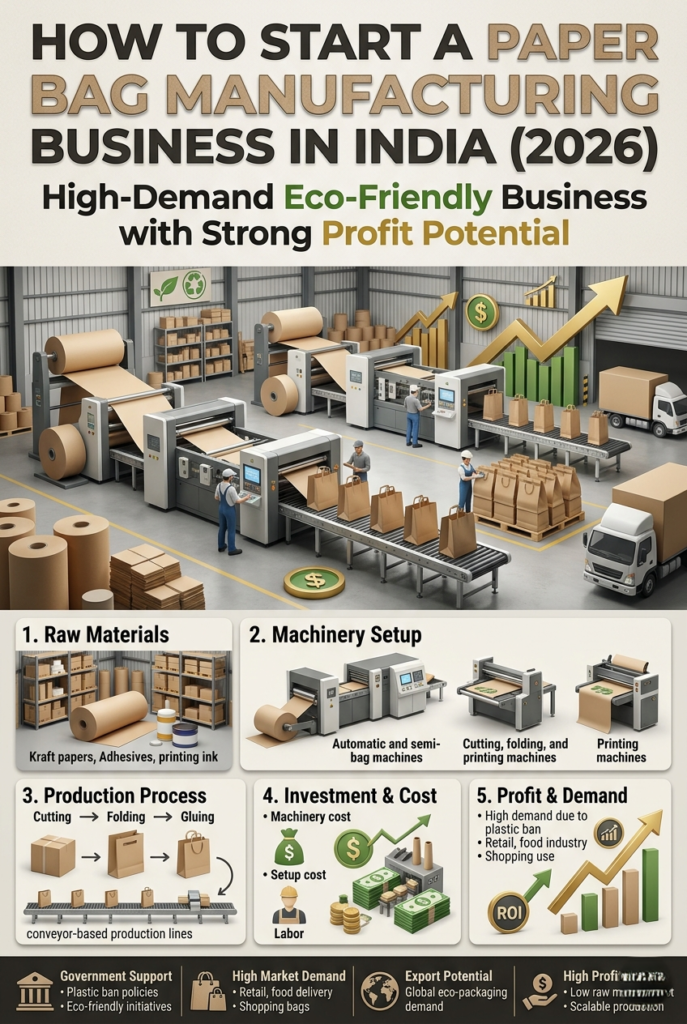
Investment and Business Setup
The amount that has to be invested in the paper bag making unit is not much, but it depends upon the scale on which you want to run the business.
You can run small business supplying locally with the investment of 8-12 lakhs. But for a stable business to survive the competition you need to make the investment in the range of 20-30 lakhs. With this you will be able to establish more machines and process large orders.
Typical setup includes:
- Industrial space of 1,500–3,000 sq. ft.
- Basic machinery setup
- Raw material stock
- 2 months operating capital
Setting up on the outskirts of a city will help keep rents and running costs lower while allowing access to markets.
Machinery and Production Process
Your machinery’s quality will determine how much you can produce and how much you make. Most start with semi-automatic machinery and later switch to fully automatic machines.
Key machines required:
- Paper bag making machine
- Flexo printing machine (for branding)
- Paper cutting machine
- Die cutting machine
The manufacturing process is simple. Paper is input into the machine and after processing it takes the shape of the bag, and either gets printed or processed according to the client’s needs. Once set up, the process is reliable and efficient after a few weeks.
Get Detailed Project Report (DPR): Paper Bags for White Cement Packaging – Detailed Project Report
Raw Materials and Sourcing
The primary raw material is Kraft paper and depends on the thickness on the type of the bag you have to make.
You can obtain it from wholesalers in the beginning, but later on, when you have a larger turnover, buy directly from the mill for price advantage. It’s important to keep raw material cost in check as this will impact your profit.
Profit Margin and Earnings
The profit margin is another key benefit of this business. With a small unit, steady income is achieved on lower capacity on monthly basis.
With 60% capacity, can generate monthly income 4-6 lacs. Once stabilizes and operating at full capacity it could generate monthly income 8-10 lacs.
Breakdown of profits:
- Raw material cost: 45–50%
- Operational expenses: 20–25%
- Net profit margin: 16–25%
It is preferable to include printed bags as they are more profitable, it can be added to your production as the business grows.
How to Get Customers Fast
Acquiring customers is crucial in this industry. Rather than just marketing, cold calling is more effective.
Begin by reaching out to local businesses that have paper bags. Supermarkets, medical stores, clothing stores, restaurants and others. Many of these businesses are unhappy with their suppliers’ service or quality.
By providing superior service and quality, you can gain long-term customers fast. It’s better to have a handful of big buyers than many small ones.
Government Schemes and Financial Support
The government is very supportive of small manufacturing, which can help minimise your investment costs.
Major schemes include:
- PMEGP for capital subsidy
- MUDRA loan for small businesses
- CGTMSE for unsecured loans
These credit services help first-time entrepreneurs to kick-start their businesses without putting financial stress. Getting your business registered under MSME will help you access these.
Related Article: Paper Bottle Manufacturing in India
Role of NIIR Project Consultancy Services (NPCS)
If you are looking to get funds from banks or apply for subsidies, you must have a business plan. Here’s where NPCS can assist.
NPCS offers project reports including technical, financial and operational planning. These are used by entrepreneurs to get loans and clearances from the government.
Their advice helps you make the right decisions and to set up your business on the right foot. This can significantly impact the success rate of first-time entrepreneurs.
Challenges You Should Be Aware Of
As profitable it is, it must be properly planned. Ensuring the quality, it is crucial or you will receive rejected dispatches.
Delivery on time. Clients often need routine supply, and if you’re unable to deliver on time, you can lose your portfolio. Cash flow is another consideration, given clients typically pay on credit.
Conclusion
Paper bag manufacturing in India is one of the most viable and profitable business ideas. The industry has high demand, government encouragement and low barriers to entry.
But speed and management are critical to success. Those who can supply quality products and services, build strong customer relationships and maintain the supply chain are those who succeed.
So, if you are looking to establish a manufacturing business, now is the right time to start and create a sustainable profitable business.
FAQs
- What is the capital requirement for this business?
To begin, you need ₹8-12 lakhs but is best if you start with ₹20-30 lakhs.
- Is the business profitable?
Yes, the net profit margin is 16% to 25% of turnover depending on size of business and customers.
- Is it suitable for beginners?
Yes, it requires no special skills, and machine vendors will provide training.
- What is the time to start production?
4-6 months (depends on setup and approvals).
- How to get bulk orders?
By contacting local shops, supermarkets, hotels.
- Will the government help?
Yes, like PMEGP that gives up to 35% subsidy on project cost.


