





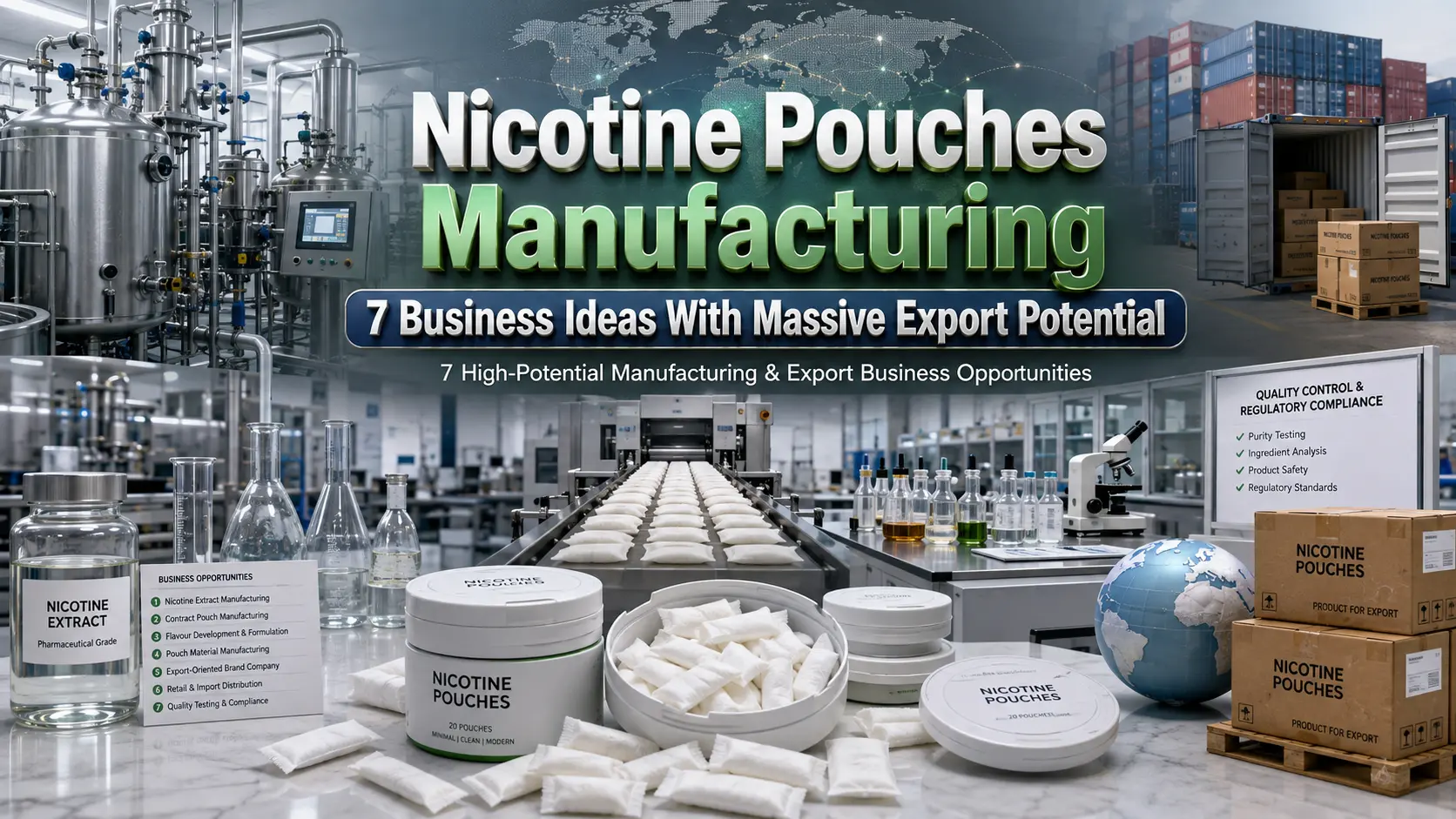
Nicotine Pouches Manufacturing
Why Nicotine Pouches Are One of the Smartest Business Ideas Right Now
Nicotine pouches are one of the most interesting business opportunities in the global tobacco-alternative category as it has experienced the highest growth, margins and is in sync with consumer trends globally. The small, tobacco-leaf-free pouches provide nicotine via oral absorption (no smoke, no vapour, no spit) and have been a game-changer for the traditional tobacco market in Europe, North America and Scandinavia at an impressive pace. This is a strong export manufacturing segment for Indian entrepreneurs that not many are taking the plunge in it seriously. That’s the opportunity that lies between them.
In a short period, the global nicotine pouch market has evolved from being near-insignificant in value to billions of dollars in value. Brands such as Zyn, Velo and On! have developed vast customer bases, and the organised production system is still mainly based in Scandinavia and the United States. India’s competitive labour market, tobacco processing facility and its ability to extract nicotine from tobacco for pharmaceutical use make it an ideal player to make an entry into the market strategically. This is a field worth in-depth investigation if you are looking into serious business ideas in FMCG, pharma or the tobacco alternative business.
Why the Nicotine Pouch Sector Is Growing at an Exceptional Rate
Global Demand Outpacing Supply
The global oral nicotine market is one of the fastest growing markets for the nicotine pouch segment. Anti-smoking laws are becoming more stringent all over the world and more and more smokers are focused on their health, while a shift in culture of people away from smoking combustible tobacco is a significant driver for consumer demand. Active smokers and tobacco users are looking for harm reduced alternatives. Nicotine pouches are a good solution to this need because they are discreet, no tobacco leaf material, and odourless.
Historically, Scandinavian countries (and especially Sweden) has been leading in the production and consumption of smokeless tobacco products such as snus. But the nicotine pouch category (no tobacco leaf) has created a global market which is not geographically limited. This presents a huge potential for new production companies from Asia, especially India.
View Full Project Details: Nicotine From Tobacco Waste Manufacturing
India’s Competitive Advantage in Nicotine Extraction
India produces one of the largest amount of nicotine for pharmaceutical use (in particular in Andhra Pradesh, Gujarat and Karnataka). Firms such as Alchem International and Aarti Industries have developed strong capabilities in the field of nicotine extraction from the raw material of tobacco. This pharmaceutical manufacturing facility offers entrepreneurs a natural advantage in terms of the supply chain, since they can create nicotine pouches or the active ingredients for them.
Moreover, India’s competitive manufacturing cost base, presence of existing FMCG packaging infrastructure and favorable regulatory landscape for less risky products makes it an attractive production base. India’s Make in India campaign actively encourages export-oriented manufacturing enterprises. The time to start can’t be better; competition is low and there’s a huge demand in the world for your products.
Government Policies and Incentives Supporting This Business
MSME Benefits for Nicotine Pouch Startups
The Ministry of MSME, Government of India, offers a range of both financial and operational support to the entrepreneurs involved in the business of making nicotine pouches. With the Credit Guarantee Fund Trust for Micro and Small Enterprises (CGTMSE), eligible businesses can avail of a loan of up to ₹2 crore without needing to pay any collateral. The complete information about eligibility and application is available in the MSME CGTMSE Scheme. Once registered on the Udyam portal, various subsidies, opportunities in the priority sectors, and government procurement benefits are unlocked.
The Ministry of MSME’s Cluster Development Programme also supports groups of manufacturers in establishing shared infrastructure, quality testing facilities, and common packaging lines — particularly valuable for new entrants in the oral nicotine space who can benefit from pooled resources. Entrepreneurs can explore available MSME schemes and support programmes directly on the ministry portal.
Production Linked Incentive (PLI) and Make in India Support
Although there is no specific PLI scheme for nicotine pouches, there are indirect routes to qualify, such as manufacturers of the Food Processing and Pharmaceutical PLI schemes, which produce pharmaceutical-grade nicotine extracts that are used for the production of nicotine pouches. The DPIIT Make in India sector investment framework describes the framework of policy environment for new manufacturers of products that use alternatives in the Indian market.
The Startup India initiative by the Department for Promotion of Industry and Internal Trade (DPIIT) also offers the following benefits to eligible startups: Tax exemption for three years for startups, Speedy patent process, and access to the Fund of Funds mechanism. This is especially true for entrepreneurs creating unique tobacco products or flavors for the nicotine pouch market.
Export Promotion and Trade Incentives
APEDA offers infrastructure and market development assistance to processed natural products such as natural extracts from plants. APEDA trade statistics and export data pages provide real time export performance data for entrepreneurs to use for benchmarking business plans. Besides, there are a number of categories under the RoDTEP scheme, which are beneficial to the nicotine extract and pouch manufacturers to boost their export margins.
7 Profitable Business Ideas in the Nicotine Pouch Sector
1. Pharmaceutical-Grade Nicotine Extract Manufacturing
This is the upstream play and also the most structurally strong position in the entire supply chain. Nicotine extraction refers to the process of obtaining nicotine from the raw material of the tobacco plant, which is then refined to pharmaceutical-grade nicotine. The active ingredient in nicotine pouches, nicotine patches, nicotine gums, and inhalers. Nicotine demand, and consequently the global demand for pharmaceutical nicotine, is increasing in line with the growth of NRT and the smokeless nicotine product categories.
The advantage of Indian manufacturers is that they have a plentiful supply of raw material—tobacco—which has established processing know-how in pharmaceuticals and also have existing infrastructure for solvent extraction. The opportunity for an entrepreneur to enter this space is not only for domestic pouch manufacturers but also for global pouch brands looking for diversification in the source of their supply besides Western Europe and China. The regulatory process includes a Drugs and Cosmetics Act drug manufacturing licence and the business model is based on long-term contract manufacturing deals with the FMCG and pharma buyers.
Get Detailed Insights from This Book: Drugs & Pharmaceutical Technology Handbook
2. White-Label Nicotine Pouch Contract Manufacturing
The global market for nicotine pouches is dominated by a few large brands, though the actual manufacturing is increasingly outsourced to contract manufacturers that can manufacture at high quality and on a large-scale. International brands that want to expand their supplier base and cut down on per-unit manufacturing costs can use the services of a white label or contract manufacturing unit in India.
The model will demand investments in a controlled production environment, hygienic environment and in equipment which can be used for filling pouches, as well as quality assurance systems, and will follow the pharmaceutical manufacturing standards. The good thing is that it is a recurring revenue model, based on volume and you don’t need to invest in marketing the way a consumer brand does, to build one from scratch.
FMCG manufacturers or pharma background Indian entrepreneurs are well suited to this model. For producers, export production can provide very predictable revenue, particularly for those who sell to the European Union and United Kingdom where there are now established regulatory environments for nicotine pouches. It is a perfect business model for those business founders who want to avoid the exposure in the consumer market and would like to focus on the B2B business model.
3. Flavour Development and Formulation Lab for Nicotine Pouches
One of the most unique qualities of the nic pouch market is how much flavour is used to differentiate brands. The selection of pouches is influenced by consumers, beyond the level of nicotine, based on flavour profile, strength, and sensory experience. For a contract manufacturer or a brand who requires product differentiation a flavour development and formulation laboratory specializing in nicotine pouch formulations can be of service. This is a food science, pharmaceutical chemistry and a sensory science business. Ingredients used for flavouring pouches should be deemed to be fit for their intended use and should be approved within the appropriate regulatory systems of the export markets.
An Indian formulation lab can serve as a B2B services provider, developing and testing new flavour combinations like citrus, menthol, spearmint, cinnamon and berry Flavors to international pouch brands. It is a business concept that is low in infrastructure requirements compared to manufacturing or production, high in the margin and rich in IP, and the intellectual capital generated is a long-lasting competitive advantage.
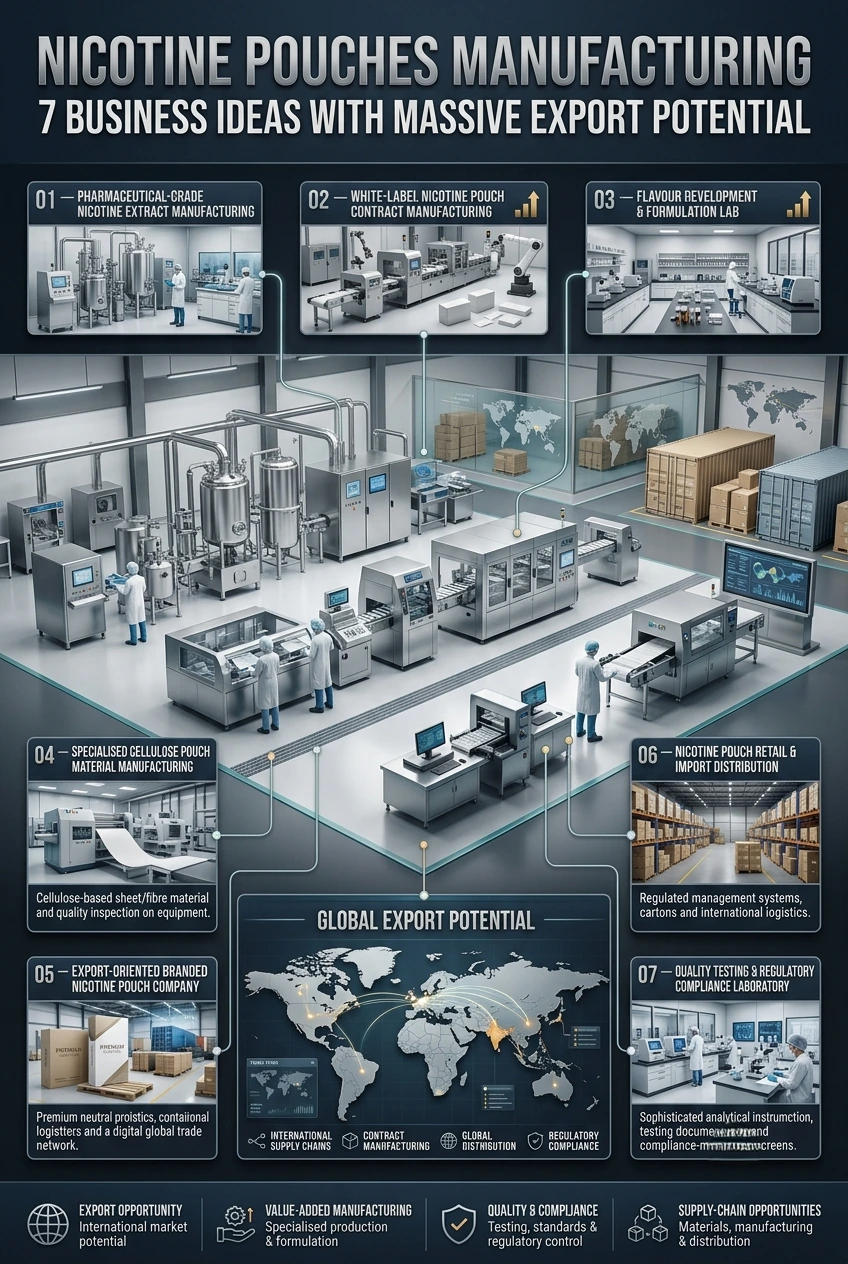
4. Specialised Cellulose Pouch Material Manufacturing
Each nicotine pouch is contained within a small, permeable pouch that is composed of a plant-derived cellulose material—a non-woven fabric that lets the nicotine and flavour into the user’s gum, but keeps the filling material in the pouch. This type of pouch material is an important raw material and the world supply is limited to a handful of Scandinavian and European specialty paper producers. An Indian producer of speciality nonwoven cellulose pouching product for the oral nicotine alternative market would help to fill a major void in the Asian market.
The business needs a knowledge of non-woven fabric manufacturing, food-contact materials compliance and precision cutting and forming machinery. The long-term value lies in its production, however, as nicotine pouch production in Asia increases, sourcing of the pouch material in the local area will be vital for the cost competitive production of these pouches. It is a deep tech play with huge first-mover advantage to an entrepreneur willing to invest in specific pieces of equipment in the Indian context.
5. Export-Oriented Branded Nicotine Pouch Company
The riskiest yet most rewarding business model in this category is to create an Indian branded nicotine pouch business specifically for the export market. Nicotine pouch adoption in Southeast Asia, Middle East and Africa is in its early stages. If an Indian brand can establish a strong identity, develop a good formulation of the flavour and price it would be able to carve a niche before the big guns from the west enter the market.
The brand-building approach needs funding for product design, regulatory clearance for intended markets, and the development of trade relationships — but the profit on branded consumer products is much greater than the profit on contract manufacturing. It’s an ideal model for founders who have experience developing FMCG brands, especially in export markets.
6. Nicotine Pouch Retail and Import Distribution (India)
The most obvious market opportunity mentioned in this article is production, but another good and little-known business concept is the importation and distribution of known foreign nicotine pouch brands in the domestic market. The urban adult consumer market, especially for the working population, travelers and expatriates, is an expanding market for modern nicotine alternatives in India.
To establish a regulated import and distribution company for globally established brands, one should be compliant with customs regulations, registered with the consumer product and should have a modern trade/e-commerce distribution system. Import distribution margins are not as high as manufacturing, while capital investment is significantly less. This model is best suited for a “bridge” business, where categories are created and retail relationships built at the same time as manufacturing capacity is built.
7. Quality Testing and Regulatory Compliance Laboratory
With the increase in the production of nicotine pouches in India, separate testing and regulatory compliance services will also be required. Nicotine content verification, heavy metal screening, microbiological testing, food-contact material compliance certification and formulation stability studies are all possible testing options available to testing laboratories. These services are necessary for manufacturers who aim to sell their products in the export markets, which have detailed requirements for product safety, notably the European Union, United Kingdom, United States and Canada.
A world-class independent testing laboratory that is ISO 17025 certified and has international regulatory consultant collaborations can create a defensible, recurring revenue business across the entire nicotine pouch producer ecosystem. The long-term moat is robust, because it costs a lot for manufacturers who have developed compliance relationships to switch.
Import–Export Opportunity Analysis for Nicotine Pouch Entrepreneurs
Export Destinations With High Growth Potential
Indian tobacco companies making tobacco pouches have the best export prospects in the Middle East and North Africa (Mena) region, specifically in the Gulf Cooperation Council (GCC) states and Sub-Saharan Africa. The Southeast Asia adult nicotine user market is substantial, and is currently catered to by combustible cigarettes and traditional chewing tobacco. The regulatory landscape in these markets is developing and a new cohort of consumers is emerging for today’s nicotine alternatives. The Invest India Pharmaceuticals and Healthcare Sector page offers valuable information on export-ready manufacturing standards and government programs to support investments by nicotine product manufacturers.
Pharmaceutical Nicotine Export: A Parallel Revenue Stream
Beyond finished nicotine pouches, India’s pharmaceutical nicotine extract industry already exports to global NRT manufacturers in Europe and North America. Entrepreneurs investing in nicotine extraction facilities can develop dual revenue streams — supplying pharmaceutical nicotine to international buyers while using a portion for domestic pouch manufacturing. This vertical integration model significantly improves unit economics and provides revenue stability through diversification. The IBEF Pharmaceuticals Sector Report highlights India’s growing position as a global pharmaceutical ingredient supplier — a positioning that extends naturally to nicotine extract trade.
Regulatory Compliance as the Gateway to Premium Markets
The single most important investment an Indian exporter can make is in regulatory compliance for target markets. The EU’s Tobacco Products Directive (TPD) and the US FDA’s Modified Risk Tobacco Product (MRTP) framework set demanding standards for nicotine pouch products. Manufacturers who invest early in achieving these certifications gain access to the world’s highest-value consumer markets and command premium pricing. The World Bank Trade and Competitiveness resources offer useful context on the importance of compliance infrastructure for emerging market manufacturers targeting developed economies
Related Article: From Waste Tobacco to Global Markets: Profitable Nicotine Extraction and Refining Business Ideas
Indian MSME Success Stories in Nicotine and Tobacco Alternatives
Alchem International: From Nicotine Extraction to Global Supply
Alchem International, a Delhi-based pharmaceutical company led by founder Ravi Chadha, built one of India’s most respected pharmaceutical nicotine businesses by focusing relentlessly on quality and regulatory compliance for export markets. The company invested early in GMP-certified manufacturing infrastructure and built direct relationships with European and North American NRT brands. Their lesson for new entrepreneurs is clear: in a regulated product category, quality infrastructure is a revenue enabler. By achieving compliance with European pharmacopoeia standards, they commanded premium pricing and built multi-year supply agreements that competitors without equivalent certification could not access.
Aarti Industries: Scaling Speciality Chemical and Active Ingredients Export
Aarti Industries, headquartered in Mumbai and led by the Gogri family, built a global speciality chemicals and active pharmaceutical ingredients business from an MSME base. While not exclusively focused on nicotine, their trajectory illustrates the scalability of active ingredient manufacturing from India into global markets. Their model — deep backward integration, investment in R&D, and disciplined compliance with global regulatory requirements — offers a powerful blueprint for entrepreneurs entering the nicotine extract and pouch material manufacturing space.
Godrej Consumer Products: FMCG Manufacturing Excellence
Godrej Consumer Products, with its strong FMCG manufacturing DNA and recent moves into health and wellness adjacencies, demonstrates how established Indian manufacturers are increasingly entering the personal care and wellness alternatives market. Led by Sudhir Sitapati as Managing Director, Godrej has consistently leveraged manufacturing scale and distribution reach to build export-competitive consumer products. For an MSME entrepreneur in nicotine pouches, the key lesson is that distribution infrastructure development must parallel manufacturing capability — having a great product in a factory is meaningless without the channel to reach the consumer. This lesson applies directly to nicotine pouch business ideas where product access in export markets is as important as product quality.
Turn your budget into a successful business plan
How NPCS Can Support Your Nicotine Pouch Business
We at Niir Project Consultancy Services (NPCS) provide professional consulting for the preparation of Market Survey cum Detailed Techno-Economic Feasibility Reports (DPRs) for setting up new industries or businesses in the nicotine pouch and tobacco-alternative sector. Our reports include detailed manufacturing processes, comprehensive market research and demand analysis, process flow diagrams, product mix and capacity planning, machinery and raw material details, and complete project financials with profitability analysis.
For entrepreneurs evaluating entry into nicotine pouch manufacturing, our feasibility studies help you assess the capital requirements, regulatory compliance investments, machinery sourcing, raw material supply chains, and realistic revenue projections — from white-label contract manufacturing to pharmaceutical nicotine extraction. Our objective is to help entrepreneurs evaluate feasibility, profitability, and long-term scalability before investing. The PIB press release on MSME support for export-oriented manufacturing outlines the government support ecosystem that complements our advisory services.
Nicotine Pouch Market: Key Data Overview
| Segment | Key Detail | Relevance for India |
| Global Market Size | Multi-billion dollar, high-growth | Export manufacturing opportunity |
| Growth Rate (CAGR) | 25–30% annually (sector estimates) | Rapid expansion window |
| Top Consumer Markets | USA, Sweden, UK, Germany, GCC | Primary export targets |
| India’s Role Currently | Pharmaceutical nicotine supplier | Ready supply chain base |
| Key Input: Pharma Nicotine | India is a top global producer | Upstream cost advantage |
| Leading Global Brands | Zyn, Velo, On!, Nordic Spirit | Contract supply targets |
| Regulatory Framework (EU) | Tobacco Products Directive (TPD) | Compliance requirement |
| Domestic Regulatory Status | Evolving — no specific pouch law yet | Early-mover advantage |
| Employment Potential | High per unit of capital invested | MSME job creation |
| Export Opportunity Rating | Very High (underserved by India) | Strategic priority sector |
Conclusion: The Time to Enter the Nicotine Pouch Business Is Now
The nicotine pouch sector represents one of the most compelling export-oriented manufacturing business ideas available to Indian entrepreneurs today. The global market is growing rapidly. India has the raw material advantage, pharmaceutical manufacturing expertise, and cost-competitive production capability to become a significant player in this supply chain. Yet the number of Indian manufacturers seriously pursuing this opportunity remains remarkably small.
The window for first-mover advantage is open — but it will not remain open indefinitely. Global brands are actively seeking supply chain diversification. Export markets in Southeast Asia, the GCC, and Africa are growing their nicotine pouch adoption. And the Indian regulatory environment, while still developing, is moving toward greater clarity for alternative nicotine products.
Whether your entry point is upstream pharmaceutical nicotine extraction, white-label contract manufacturing, flavour formulation, pouch material production, or branded export — each model offers a credible path to a profitable, scalable business. The key to success is detailed feasibility planning, regulatory compliance investment from day one, and a clear target market strategy.
Entrepreneurs who invest in rigorous project preparation — through detailed techno-economic feasibility reports, market demand analysis, and professional regulatory guidance — consistently outperform those who move on instinct alone. This is a sector where preparation is a competitive advantage. Engage a professional consultancy, conduct your due diligence, and move decisively. The nicotine pouch opportunity is real, it is large, and it is available right now for those willing to pursue it seriously.
Reference Citations
- Ministry of MSME — CGTMSE Scheme Page
- IBEF — Pharmaceutical India Sector Report
- PIB — MSME Export Manufacturing Support Press Release
- MSME — Credit Guarantee Scheme (CGTMSE)
- Invest India — Pharmaceuticals Sector Page
- Make in India — Food Processing Sector Brief
- World Bank — Trade Topic Page


