





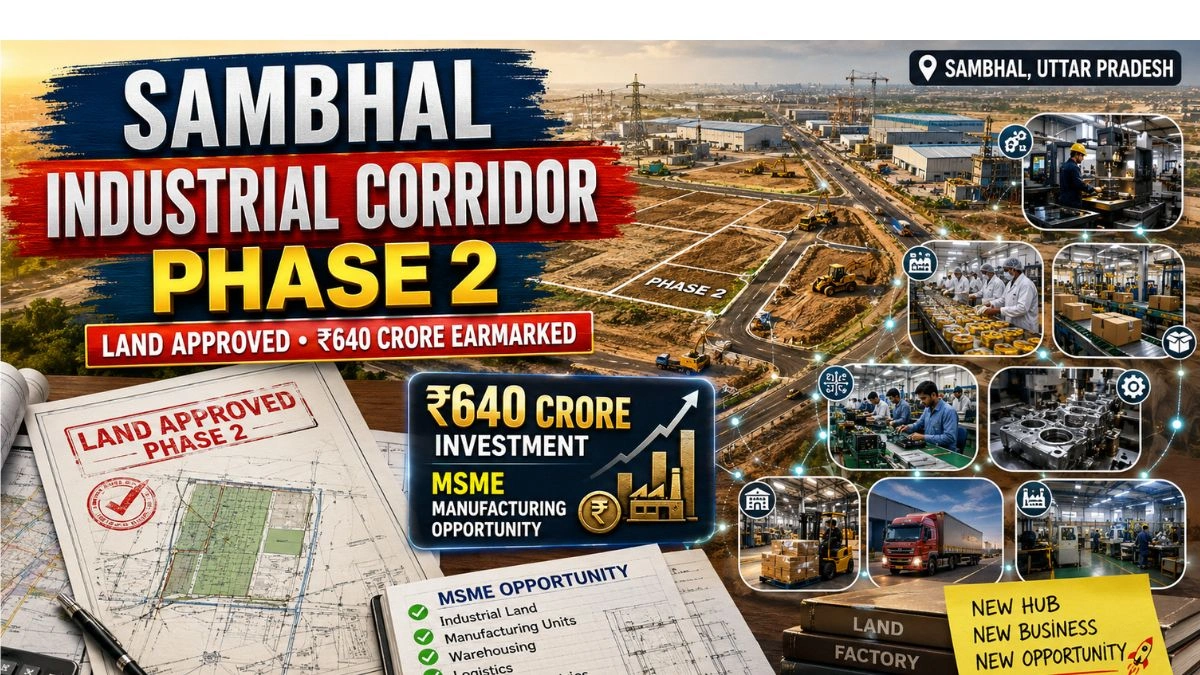
The significant policy move in UP is fast creating a strong industrial gateway which the entrepreneurs, MSME manufacturers, investors and logistics players will not want to miss! The government has officially given approval for gross land acquisition of around 329 hectares under the Phase 2 of the Sambhal Industrial Corridor, a land acquisition project under the umbrella of the highly ambitious industrial belt of the Ganga Expressway with a budgetary outlay of ₹640 crore. This comes after the completion of Phase 1, in which approximately 240 hectares were developed in various villages, and the industrial infrastructure development has progressed in an advanced state.
The industrial footprint has now grown significantly in phase 2, bringing the Sambhal Integrated Manufacturing and Logistics Cluster (IMLC) to its targeted area of around 591 acres along the Ganga Expressway corridor. The Ganga Expressway, which was once a dream to come true and is expected to join Meerut and Prayagraj via 594 kilometres, has become a reality and is now a viable industrial zone with the potential of attracting investments worth more than ₹47,000 crore in 12 districts. The current time is perhaps more commercially relevant than any other for manufacturers, startups and MSME entrepreneurs to view the availability of plots, position in the supply chain and accessibility to manufacturing.
What This Development Means for Indian Businesses
The Phase 2 clearance of land acquisition is not just a routine clearance though. It’s a direct indication that Uttar Pradesh Expressways Industrial Development Authority (UPEIDA) is dedicated to quickly making Sambhal a developed industrial hub. Once a project reaches this level of construction, and acquisition is formally approved in Phase 2 with funding, it indicates that industrial plots, trunk infrastructure and logistics connectivity are either available, or actively being developed — all of which reduces the risk associated with a greenfield industrial investment.
The historical significance of Sambhal is the presence of the MSME base where handicrafts such as bone, horn, wooden, resin etc. are produced and are exported to European markets. Planned industrial infrastructure brings a fundamental change, because artisanal and small manufacturing can now upgrade to organised and scale-ready manufacturing units in an industrial area that has been properly serviced.
The Sambhal IMLC is especially aimed to induct industries in the field of textiles, agro-processing, and MSMEs. The construction of an industrial node on an expressway with the government providing infrastructure and land at set rates, with a focus in western Uttar Pradesh and on the outskirts of the National Capital Region, is a significant competitive edge for entrepreneurs who currently operate from various places in the area. The UPEIDA has also announced that the plots of the Sambhal node will be allocated to the small manufacturers on the basis of an interview.The UPEIDA has also confirmed that the smaller manufacturers will have a real chance to get formally tenanted industrial land through an interview-based allotment process.
Why This Region Could See Stronger Industrial Growth
The structural push and pull mechanisms for the Sambhal industrial corridor are very powerful. The Ganga Expressway is a 206 km long, 20 lane, 4+2 carriageway dedicated to India’s Ganga River linking 12 districts of Meerut, Hapur, Bulandshahr, Amroha, Sambhal, Badaun, Shahjahanpur, Hardoi, Unnao, Raebareli, Pratapgarh and Prayagraj. This will form a ‘spine’ of industry that just didn’t exist 10 years ago. Industrial growth is usually preceded by infrastructure and expressway connected industrial nodes have already been a proven model as seen in the successful development of the Agra-Lucknow and the Purvanchal expressway corridors.
Investment momentum is getting strong. In the Ganga Expressway corridor, more than a thousand investment proposals worth about ₹47,000 crore have been received, out of which 6,500-plus acres of land have been identified. The Cabinet of Uttar Pradesh Government has separately approved budget of ₹245.42 crore for the development of trunk infrastructure specifically at the Sambhal IMLC separate from the budget allocated for land acquisition under Phase 2. Together these represent institutional investments, rather than plans for the future, that are structured and backed by the state from more than one budget line, which is a telling sign of institutional support for Sambhal’s growth.
Additionally, western Uttar Pradesh has a huge unserved industrial labor pool, reduced land prices compared to NCR and nearness to the markets where consumption takes place in Delhi NCR – all of which makes manufacturing economics attractive in several sectors. The westernmost nodes, such as Sambhal, along the Ganga Expressway are expected to gain from the actual industrial migration as land adjacent to NCR gains value and is becoming scarce.
Government Policies and Incentives Supporting the Opportunity
Entrepreneurs evaluating a manufacturing entry in the Sambhal corridor have access to a layered framework of central and state government support.
At the central level, the Make in India initiative provides policy backing for domestic manufacturing across virtually all sectors, while the MSME Ministry’s credit support schemes — including the Credit Guarantee Fund Trust for Micro and Small Enterprises — enable collateral-free credit access for businesses investing in new manufacturing setups.
The PM Vishwakarma Scheme offers enterprise development loans of up to ₹3 lakh at a concessional 5% interest rate for artisans and craftspeople, directly relevant to Sambhal’s existing handicraft MSME base that can use this scheme as a stepping stone into organized manufacturing. In Uttar Pradesh, ₹129 crore has already been disbursed under this initiative to over 15,000 beneficiaries in the handicrafts sector.
The Uttar Pradesh Expressways Industrial Development Authority (UPEIDA) is the nodal authority for industrial plot allotment, infrastructure, and industrial cluster development along the Ganga Expressway corridor. Entrepreneurs can directly approach UPEIDA for information on plot sizes, allotment conditions, and industrial cluster categories.
The state’s Invest UP portal facilitates single-window clearances for manufacturing investments in Uttar Pradesh, while the UP MSME Policy offers capital subsidies, interest subsidies, and stamp duty exemptions for eligible manufacturing units, particularly in priority sectors including textiles, food processing, and handicrafts.
For export-oriented manufacturers, the Directorate General of Foreign Trade (DGFT) and the Export Promotion Council for Handicrafts (EPCH) provide export licences, buyer matching, and market development support — particularly relevant to Sambhal’s longstanding export heritage in handicraft goods.
Manufacturing Business Opportunities Emerging From This Development
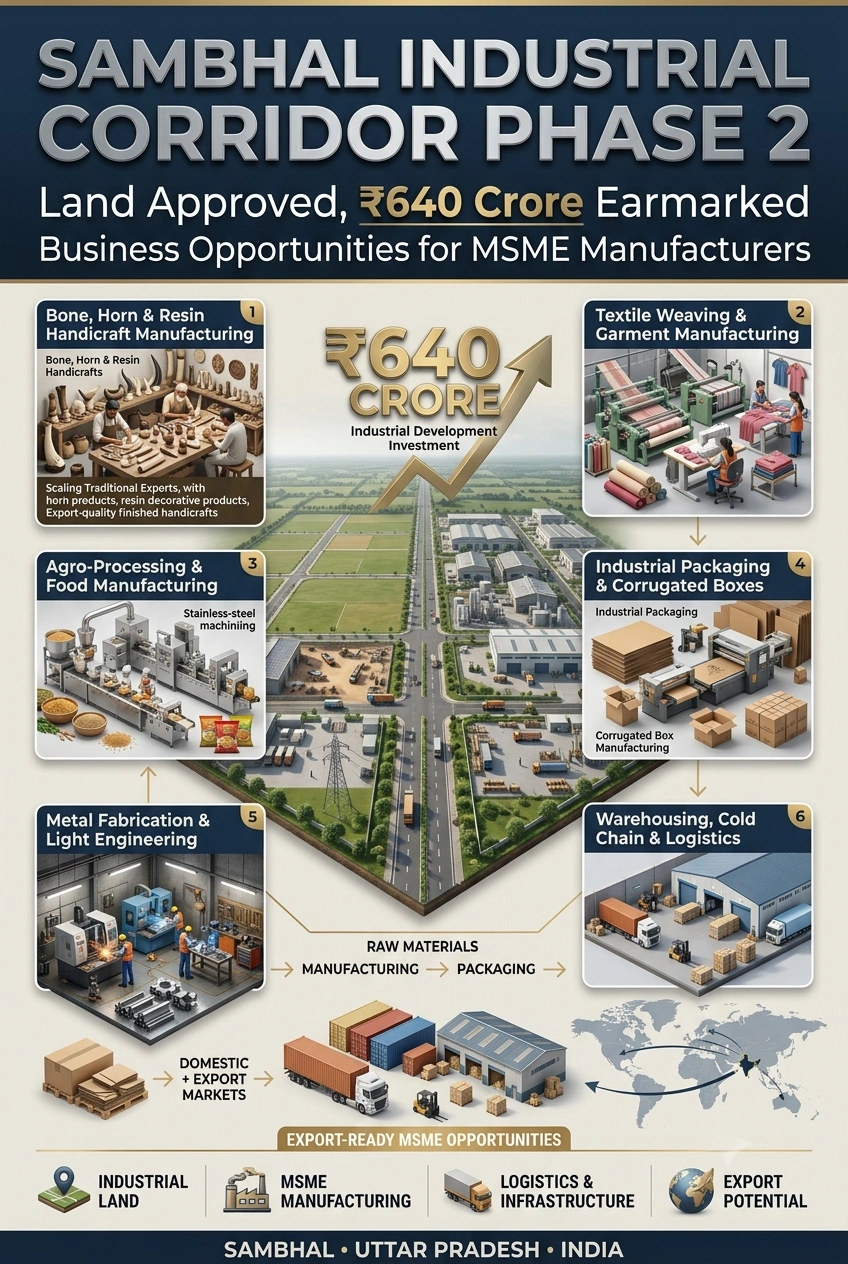
1. Bone, Horn, and Resin Handicraft Manufacturing — Scaling Traditional Exports
Sambhal is known for its centuries-old reputation in the bone, horn, resin and wood crafts business especially for marketing to the European market. Organized industrial plots are available during Phase 2, thus giving entrepreneurs a chance to arrange the production which was traditionally done at cottage levels in the form of organized manufacturing units with quality certification, standard production, and export-oriented packaging. Its customers are international export houses, home décor brands and ethnic lifestyle retailers. The suitability of MSME is good and the market potential in the EU and US is good, subject to production standardisation. Needs for investment are still low compared to other manufacturing industries.
Related Article: Forest-Based Products Manufacturing: A Complete Business Ideas Guide
2. Textile Weaving and Garment Manufacturing
Western Uttar Pradesh has a centre of organic textile production and UPEIDA specifically identifies Sambhal IMLC as appropriate for businesses in the textile sector. Expressway connectivity to the garment and logistics hub of Meerut will enable entrepreneurs to establish fabric weaving, yarn processing or fabric-ready units as well as a vast pool of skilled labour. The domestic market demand for value-priced readymade garments is still rising and the export market potential is commercially viable for the UP-based manufacturers to Middle Eastern and African countries. The cost of land in lower is reasonable as compared to NCR, which gives a fair margin advantage.
Read the Complete Book Here: The Complete Technology Book on Textile Spinning, Weaving, Finishing and Printing
3. Agro-Processing and Food Manufacturing
Sambhal district is located in the fertile agricultural belt. Once the industrial infrastructure is set up, agro-processing activities such as rice milling, pulse processing, oil extraction and packaged foods manufacturing are attractive businesses. It is a natural advantage to be close to farmgate supply and expressway connected distribution system. MSME scale agro-processing unit can be started with comparatively low capital and there is growing demand for private label processed foods in the domestic FMCG supply chain. In the cluster, there are also opportunities for supporting infrastructure, like cold chain infrastructure, and food-grade warehouse units.
Get Detailed Project Report (DPR): LIST OF PROFITABLE FOOD PROCESSING BUSINESS IDEAS
4. Industrial Packaging and Corrugated Box Manufacturing
Each and every manufacturing cluster creates captive demand for packaging. With the increase in the number of light manufacturing, textile, handicraft and agro-processing units in Sambhal IMLC, demand for corrugated packaging, industrial cartons, polypropylene bags, and protective packaging will also increase along with tenancy. Packaging manufacturing is one of the anchor MSMEs in any industrial cluster that has proven to have local demand and is relatively easy to implement the technology required. Investment is scalable and the cluster is at an early stage and so first mover suppliers will have price and proximity advantages.
Explore This Book: Handbook on Modern Packaging Industries
5. Metal Fabrication and Light Engineering Components
This linkage of supply chain with light metal fabrication naturally exists in Sambhal region because of its proximity with Moradabad which is one of the largest brass and metal export centres of India. Presence in Sambhal IMLC can give advantage to the entrepreneurs to establish the units of manufacturing of precision metal components, machine parts and fabricated metal structures along with the raw material hub of Moradabad and expressway for logistics. In addition, with the Defence Manufacturing Supply Chain localization under the UP Defence Industrial corridor, there is a structured demand for precision engineered components from certified MSME vendors.
View Full Project Details: Metal Fabrication Plant Project Report
6. Warehousing, Cold Chain, and Logistics Infrastructure
Logistics and warehousing facilities are not traditional manufacturing, but they can still be a good business opportunity in developing industrial clusters. Professionally run warehouses, cold chains and logistics parks will be increasingly needed as Phase 2 will bring in more additional land and the cluster will be filled with manufacturing tenants. The Sambhal IMLC zone offers a true first mover advantage to third party logistics operators and warehouse developers aiming at UP’s growing agro-commodity supply chains as well as consumer goods supply chains.
Import-Export and International Market Opportunity
Export Opportunity:
Sambhal already has a longstanding tradition of exports of bone, horn, and resin-based handicrafts, which has been supported by European buyers, thus ensuring a ready commercial route for organising the manufacturing entry. The market for home décor and ethnic lifestyle products has been steadily expanding and is in direct reach of the entrepreneurs who formalized the production, acquired quality certifications, and improved packaging of their products, with buyers in Germany, France, the UK, and the United States. The textile industry also provides export possibilities to the Middle Eastern, African and ASEAN markets where price competitive Indian woven fabrics and readymade garments continue to enjoy good demand.
Import Substitution Opportunity:
Many precision-made metal components, specialty packaging materials and some machine for processing food-grade are being imported by India, which have alternatives of their domestic production and can be developed in organized industrial clusters like Sambhal. For those who want to establish light engineering and agro-processing units that fit into the India Atmanirbhar Bharat movement, they can seek out import substitution business from known domestic players looking for cost and security of supply chain benefits over imports.
Indian MSMEs and Startups in Related Industries
- Moradabad Brass Cluster Enterprises (Western UP): The Moradabad brass and metal export cluster, approximately 80 kilometres from Sambhal, represents the regional benchmark for what organized MSME manufacturing in western UP can achieve. Moradabad-based units — many of which are small and medium manufacturers — export metal goods worth thousands of crores annually to global markets. The Sambhal corridor provides an opportunity for both new entrants and Moradabad-area units seeking to diversify or expand capacity to access formally tenured industrial land with better infrastructure and lower congestion.
- Agro-Processing MSMEs in Hardoi (UP Ganga Expressway Node): The Hardoi IMLC node along the same Ganga Expressway corridor has attracted agro-processing MSMEs seeking proximity to agricultural supply and expressway distribution access. Entrepreneurs in the food and agro-processing sector can study the Hardoi cluster model to understand practical plot allotment timelines, utility connection requirements, and UPEIDA working processes before making investment decisions about the Sambhal node.
- Bone and Horn Handicraft Exporters of Sarai Tarin (Sambhal): Sarai Tarin, a locality within Sambhal, has long functioned as an informal manufacturing base for bone, horn, wooden, and resin handicrafts, with products exported to European markets. These existing artisan clusters represent a natural upgrading pathway — moving from home-based or workshop production into organized IMLC-based units with quality infrastructure, allowing entrepreneurs to scale volumes, achieve quality certifications, and access institutional buyers.
What Entrepreneurs Should Evaluate Before Investing
Before committing capital to a manufacturing project within the Sambhal industrial corridor, entrepreneurs should undertake a structured pre-investment evaluation covering the following key dimensions:
Market Demand: Validate actual buyer demand for the intended product — both domestic and export — before making infrastructure commitments. Sectoral demand in textiles, handicrafts, and agro-processing is established, but niche product categories require independent market verification.
Plot Allotment Status and Timeline: Engage directly with UPEIDA to understand current Phase 1 and Phase 2 plot availability, plot sizes (typically starting from 12,500 sq m), allotment pricing (starting at approximately ₹5,000 per sq m based on current UPEIDA listings), and the interview-based allotment process. Phase 2 land acquisition is recently approved — actual plot allotment timelines will depend on acquisition completion and infrastructure development.
Infrastructure Readiness: Phase 1 infrastructure is near-complete, making Phase 1 plots closer to ready-for-occupancy. Phase 2 plots will require a longer gestation before infrastructure utilities — power, water, road, drainage — are fully commissioned. Plan project timelines accordingly.
Raw Material Access: Evaluate proximity to key raw material sources. For handicrafts, Sambhal has embedded supply networks. For agro-processing, the surrounding agricultural districts provide farmgate supply. For textiles, yarn sourcing logistics from Ludhiana, Surat, or NCR should be factored into working capital plans.
Technology, Machinery, and Working Capital: Identify machinery requirements specific to your manufacturing process, evaluate total project cost including land, civil construction, machinery, utilities, and initial working capital — typically 6-12 months of operating expenses should be planned before reaching breakeven.
Regulatory and Quality Compliance: Manufacturing units must comply with relevant BIS standards, environmental clearances, fire safety norms, and export-related certifications (ISO, GI marks, buyer-specific standards) depending on the sector. Assess compliance costs during project planning.
Competition and Pricing: Analyse existing competitors operating in the target product segment from nearby established clusters such as Moradabad, Ghaziabad, and Noida. Price benchmarking against established producers should inform your cost-of-production targets before investing.
Build a profitable business with the right idea
How NPCS Can Help Entrepreneurs Evaluate the Opportunity
NPCS – Niir Project Consultancy Services has extensive experience supporting entrepreneurs, MSMEs, manufacturers, and investors in evaluating emerging industrial opportunities like the Sambhal corridor. NPCS provides end-to-end project development support including:
Detailed Project Report (DPR) Preparation covering technical specifications, cost estimates, machinery requirements, manpower planning, and financial projections.
Market Research and Demand Analysis for target products — both domestic and export markets — to validate commercial assumptions before capital is committed.
Feasibility Studies that assess the financial viability of proposed manufacturing projects, covering payback periods, break-even analysis, and return on investment projections.
Technology Consultancy to identify appropriate manufacturing processes, equipment suppliers, and production benchmarks for specific product categories.
Plant and Machinery Assessment covering equipment sourcing options, layout planning, and utility requirements specific to the proposed production scale.
For entrepreneurs targeting the Sambhal industrial cluster or any other emerging UP manufacturing zone, NPCS provides the analytical rigour needed to move from initial interest to bankable investment decisions.
Business Opportunity Snapshot
| Parameter | Details |
| Industry | Manufacturing, MSME, Logistics, Handicrafts, Agro-Processing |
| Market Driver | Ganga Expressway IMLC development; Phase 2 ₹640 Cr land acquisition approved |
| Key Development | 329 hectares approved for acquisition; Sambhal IMLC 591-acre corridor in development |
| MSME Opportunity | High — Textiles, Handicrafts, Agro-Processing, Packaging, Light Engineering |
| Manufacturing Potential | Bone/Horn Exports, Textiles, Food Processing, Metal Fabrication, Logistics |
| Export Potential | Moderate to High — European markets for handicrafts; MEA for textiles |
| Import Substitution | Light engineering components, specialty packaging, food processing machinery |
| Government Support | UPEIDA, UP MSME Policy, PM Vishwakarma, Make in India, DGFT, EPCH |
| Investment Consideration | Plot from ~₹5,000/sq m; Phase 1 infrastructure near-ready; Phase 2 mid-term |
| Risk Level | Moderate — Phase 2 gestation time; land acquisition completion timeline risk |
| Growth Outlook | Strong — anchored by ₹47,000 Cr pipeline and state-backed expressway infrastructure |
Conclusion
The formal approval of Phase 2 land acquisition for the Sambhal Industrial Corridor — backed by a ₹640 crore outlay for 329 hectares — marks a decisive step in transforming western Uttar Pradesh into a structured industrial hub linked to India’s largest expressway network. With Phase 1 infrastructure near-complete, a major state-backed investment pipeline confirmed across the Ganga Expressway corridor, and the Sambhal IMLC designed specifically to attract MSME-scale manufacturers in textiles, handicrafts, and agro-processing, the commercial case for early evaluation is compelling.
Sambhal’s natural advantages — an established handicraft export heritage, proximity to NCR markets, lower land costs than traditional industrial hubs, and a large workforce — combine with the newly formalized infrastructure investment to create conditions where patient, well-prepared entrepreneurs can build sustainable manufacturing businesses with genuine domestic and export upside.
Entrepreneurs should not wait for the cluster to fill before evaluating their entry. Early movers in developing industrial clusters consistently secure better plot positions, more competitive pricing, and stronger supply-chain relationships with fellow tenants. The right time to investigate the opportunity is now — before Phase 2 plots are allotted and before the cluster reaches maturity.


