





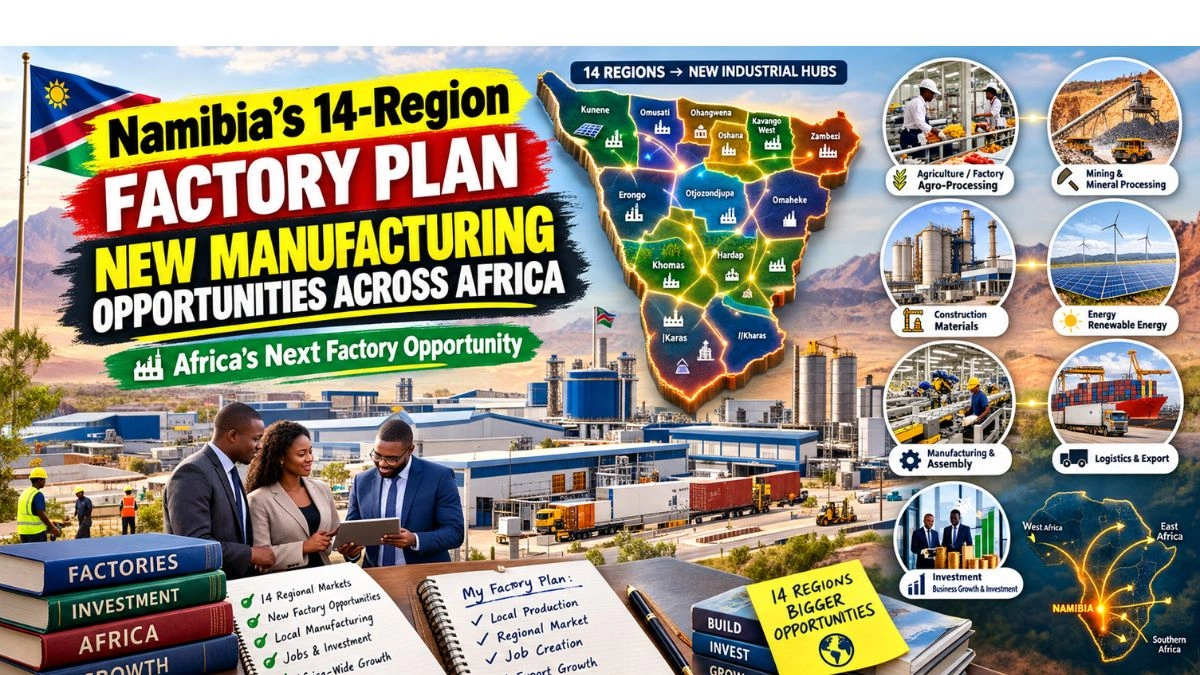
Namibia 14 Region Factory Plan
The region is experiencing a major industrial policy development movement in southern Africa and investors, manufacturers and entrepreneurs who keep their eyes on emerging market opportunities in Africa should watch. Namibia’s government has set itself the target of industrialising the country on a national scale, with a particular industry development project in each of the country’s 14 administrative regions. The policy is coming from the very top of government, and progress is already evident — with regional stakeholders already actively involved with the plan.
The strategic vision is unambiguous – to move away from Namibia’s past as a supplier of raw and unprocessed materials, and to develop local value-addition potential in all regions. Every proposed regional factory will be based on the agriculture, mineral and natural resources of the region — from livestock-heavy southern regions to fisheries and agricultural production in the northern and eastern parts of the region.
For Indian entrepreneurs, MSMEs, food manufacturing, mineral beneficiation, packaging and light manufacturing professionals, this presents a real opportunity – from watching to participating, from supplying to partnering to establishing operations in one of Africa’s most stable and business friendly economies.
What This Development Means for Indian Businesses
One of the most important structural changes that any economy can be making is the transition from primary commodity exports to value added manufacturing. Namibia is moving towards this exact same change — and the impact is spreading far and wide.
The impact for Indian businesses is complex. There is direct demand for technology, machinery and processing skills. Equipment suppliers, process engineers and manufacturing consultants are among the skills and competencies required for the proposed regional factories. Indian companies that have competitive strengths in food-processing machinery, grain-milling equipment, cold-chain infrastructure and mineral-processing technology are primed to step in.
Second, the policy provides a strong rationale for Indian manufacturers to consider entering into joint ventures or long-term supply contracts with Namibian companies. With the government’s push for domestically processed products, import-substitution becomes a reality in the market — and Indian companies that provide intermediate products or packaging materials for local factories or provide expertise for specialised processes could see a readily available market.
Third, it has a dimension of services and consultancy. As Namibia progresses from policy intent to plant construction, Indian companies specializing in feasibility studies, plant commissioning, project management and environmental compliance can play a role of implementation partners. The Namibia Ministry of Industrialisation, Trade and SME Development is the first point of contact of the Government of the Republic of Namibia regarding industrial development collaboration opportunities.
The India–Africa Forum Summit initiatives under the Ministry of External Affairs should also be taken into account by entrepreneurs planning new market entry in the sub-Saharan Africa because they offer diplomatic and institutional platforms, which facilitate Indian business engagement with African governments.
Why This Industry Could See Stronger Growth
The one-factory-per-region move is not a one-off policy move. It is set into the Namibia Sixth National Development Plan that has industrialisation, value addition and employment creation as national priorities. Those institutional anchoring counts – it increases the chances of budget allocation, government coordination and policy continuity, which are all critical for implementation, in a standalone programme.
Namibia’s 14 regions are a vast area of productive capacity. Inland fisheries and timber in Zambezi. Mining and coastal fisheries processing is found in Erongo. The livestock and viticulture are practiced by Hardap and Karas. The forestry and agricultural potential exist in the Kavango East and Kavango West. The leather and meat processing industries could be a part of Kunene’s pastoral economy. But this geographic spread opens the door to a programme that can’t be offered in a single, uniform solution — and the complexity affords opportunities to specialised suppliers and consultants.
In Africa, the overall trend of industrialisation is another structural factor. Regional trade areas such as the African Continental Free Trade Area (AfCFTA) are opening up market opportunities for manufactured goods made in Africa. Under AfCFTA’s rules, a Namibian export processing zone (EPEZ) with a local processing unit that processes local beef, fish or horticulture into finished products would be eligible for preferential tariff treatment in the 54 member countries in Africa. That market-access aspect adds a much greater commercial dimension to each proposed regional factory than would the domestic dimension alone.
Indian businesses can directly compare with the approach of cluster-based industrial development undertaken by Ministry of MSME’s Cluster Development Programme in India. The experiences that India has gained with clusters of resources-based manufacturers, such as problems encountered with infrastructure, lack of skills, development of supply chains, are also transferable to the Namibian context.
Government Policies and Incentives
The Indian entrepreneur who is considering an opportunity that is tied to the process of regional industrialisation in Namibia should consider charting out the incentive landscape in Namibia and in India’s export and outbound investment support.
The Production Linked Incentive (PLI) scheme in India, under Invest India, encourages domestic manufacturing in specific sectors such as Food Processing and Speciality Chemicals — industries pertinent to the kind of factories Namibia wants to construct. Complementary commercial logic may be possible for companies that are going for export connections to Namibia while also claiming PLI benefits.
The Ministry of Food Processing Industries (MoFPI) has several schemes which provide support to the food-processing industries of India for the creation of processing capacity and supply chains such as Pradhan Mantri Kisan SAMPADA Yojana. For firms already involved in agro-processing under MoFPI- support it is logical to expand their skills into markets such as Namibia.
The Udyam Registration Portal is useful for MSMEs as it grants the formal MSME identity to access various Government support schemes, such as credit-guarantee and export-promotion schemes which are applicable to businesses targeting international markets.
Innovative start-up entrepreneurs with solutions in the manufacturing or agri-tech sector should checkout Startup India Portal for recognition by DPIIT, tax breaks and other facilitation by the government sector, which are potential avenues for technology exports to Namibia’s nascent factories.
Export oriented business should reach out to the Agricultural and Processed Food Products Export Development Authority (APEDA) that assists Indian agri-industry exporters in providing them with market intelligence, quality certification and linkages with the buyers – which are directly relevant on the visit to the Namibian and broader African market.
It is also important for engineers and project developers bidding for plant commissioning or infrastructure contracts to know National Small Industries Corporation (NSIC), which are supporting the MSMEs in India in technology transfer, export promotion and international collaborations, which are a natural resource for the businesses targeting the industrial markets of Africa.
Manufacturing Business Opportunities Emerging From This Development
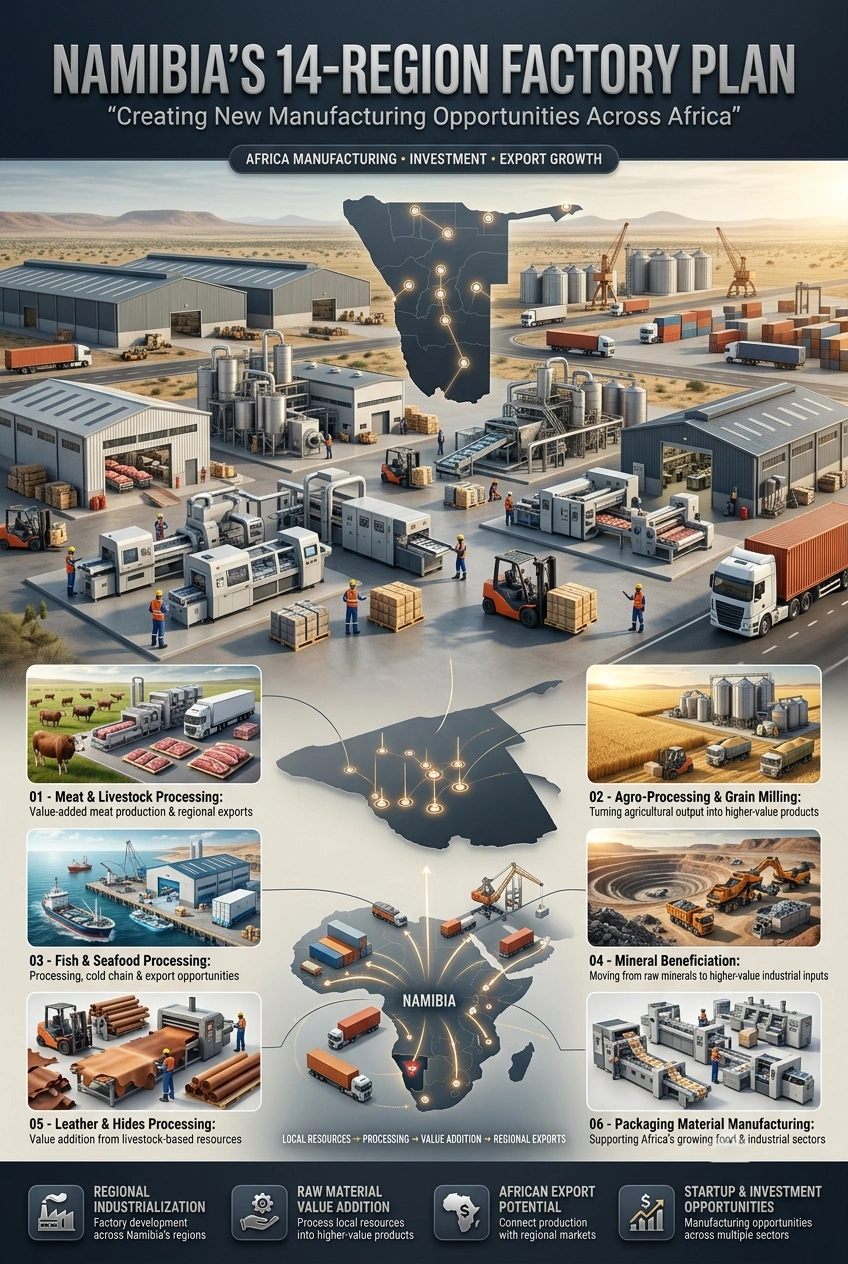
1. Meat and Livestock Processing Plants
There are some developed livestock industries in Namibia, especially in the southern and western parts of the country, notably livestock production based on cattle and small stock. Regional factories will be set up in these areas, providing significant value-added meat processing prospects. Chilled/frozen carcasses, dried meat, sausages and packaged meats are viable manufacturing streams. The experience of Indian machinery suppliers in abattoir hardware, cold-chain systems and meat-processing lines could be leveraged to supply directly or through involvement in the local partnerships. This is a commercially viable option, as it has export potential, particularly to Europe and the Middle East, where Namibian beef already enjoys quality recognition.
Get Detailed Project Report (DPR): Goat Farming for Meat and Breeding
4. Agro-Processing and Grain Milling Units
Significant smallholder and commercial agriculture is found in areas like Omusati, Ohangwena and Kavango East where pearl millet and maize, as well as horticultural crops, are produced. It is logical that a programme of the regional factory should include grain-milling, flour-processing and units making packaged foods in these areas. Proficiency in the design of flour-milling plant, pulse-processing machinery, or packaged-staple manufacturing could be helpful for Indian entrepreneurs in providing technology and implementation support. The scale is appropriate for MSME involvement and the economic multiplier is very strong – reducing the dependence on processed food in regions.
Read the Complete Book Here: Modern Technology of Agro Processing & Agricultural Waste Products
3. Fish and Seafood Processing Facilities
The fishing industry in the Namibian Exclusive Economic Zone (EEZ) and along the Namibian coast is one of the most productive in Africa. It is worth to note that, Walvis Bay is located in Erongo Region where the fishing industry is concentrated, although value addition in Namibia is limited when taken as a ratio of the number of raw fish exported. There is significant potential for processing based in the region generating canned fish, fish meal, fish oil, frozen fish products and fishmeal-based aquaculture inputs, which are driven by the government’s policy on regional manufacturing capacity. Those who have experience in the seafood sector naturally make good processing-plant builders and packaging-technology companies in India.
4. Mineral Beneficiation and Industrial Input Manufacturing
Namibia is one of the most important minerals producing nations in Africa, holding world-class deposits of diamonds, uranium, zinc, copper and rare earth elements. Erongo, Karas, and Khomas regions are at the centre of mining activity. The implementation of regional factory policy in the zones adjacent to the mines may speed up the downstream mineral beneficiation, that is, to transform the mined concentrates into valuable industrial products instead of transporting the raw ore. Specialised reagents, processing chemicals and beneficiation plant components may be provided by Indian chemical-engineering companies or manufacturers of inputs. Technical requirements are more complex, as are margins.
Explore This Book: The Complete Technology Book on Minerals & Mineral Processing
5. Leather and Hides Processing
Namibia has a major livestock herd which provides a regular supply of raw hides and skins which are now exported, or utilised only in a partial form in the country. There may be a regional factory in a livestock-belt region to support a tannery or leather-finishing facility, which provides raw materials for footwear, leather goods, and other industrial uses. The entrepreneurs from the leather sector in India are knowledgeable as well as have market connections to start such a business with Namibian raw material suppliers, in one of the world’s oldest leather manufacturing industries.
6. Packaging Material Manufacturing
All of the regional factories to be set up as part of Namibia’s plan will be requiring packaging – whether it’s packaging for food products like meat or fish or packaging for industrial products like grain, fertiliser and mineral concentrates. Currently, substantial amount of packaging waste is imported to Namibia. One MSME scale unit producing BOPP bags, PP woven sacks, corrugated cartons or food-grade flexible packaging together can be utilized in multiple factories in a region. The investment cost of an entry level packaging sector is affordable, the demand is known, and the economics of import substitution are good.
Related Article: How to Start a Packaging Business in India: 4 Profitable Manufacturing Ideas
Import-Export and International Market Opportunity
Export Opportunity
The EU-SADC Economic Partnership Agreement, the AGOA (AfCFTA) with the United States, and AfCFTA are the preferential market access agreements Namibia has. Preferential market access agreements that Namibia has include EU-SADC Economic Partnership Agreement, AGOA (AfCFTA) with the United States, and progressively AfCFTA. In contrast to the goods produced by countries without such agreements, processed and value-added goods produced in Namibia can be sold at reduced or zero tariff rates in these markets.
Indian-Namibian joint ventures for processed beef, seafood products, specialty foods or leather goods could utilise Namibia as an export hub for the European and African markets. India EXIM Bank actively supports Indian businesses to grow their business in African countries and makes them bankable and commercially viable from the beginning.
Import Substitution
Processed food, packaged consumer goods, industrial packaging and food processing intermediates are currently imported in large quantities into Namibia. The recent construction of regional factories will make domestic sourcing of these inputs more important. Policy preference and supply chain proximity will benefit the entrepreneur who sets up import substituting manufacturing facilities within Namibia (or who provides inputs for such Namibian factories).
An Indian manufacturing point of view, early involvement in the development of the supply chain in Namibia means the exporters may be enabled to enter the local manufacturing market in phases that makes sense, as volumes grow, thereby minimizing initial capital risk.
Indian MSMEs and Startups in Related Industries
Aditya Birla Group / Hindalco – Metals and Minerals Processing
One of the excellent examples in India is the Hindalco Industries, a part of Aditya Birla Group, which is a resource linked value-added manufacturing company. Hindalco is an example of how proximity to raw materials, technical investment and vertically integrated processing capacity can revolutionize commodity industries into high-margin manufactures businesses. Namibia’s mineral beneficiation opportunity would be useful to entrepreneurs to know about the integration model that Hindalco has adopted.
Godrej Agrovet – Agri-Processing and Rural Manufacturing
Godrej Agrovet’s approach of combining agricultural input supply, animal husbandry, and food processing in rural geographies is very similar to the concept of the regional factory programme as put in place by Namibia. By doing so, the company shows that it is possible to make a profit, scale up, and make an impact in agricultural areas where raw materials and labor are more readily available. This is a model of distributed production that could be adapted for the Namibian context for MSMEs interested in agro-processing.
Cremica Food Industries – Food Processing MSME
Cremica Food Industries of Punjab is a family-owned enterprise that went through the MSME food manufacturing scale, expanding from condiments and sauces to diversifying its food manufacturing business. The practices of product diversification, quality and market-driven product development used by Cremica can be replicated by smaller Indian food processors, who share the same vision of diversifying their product lines, and are relevant to the identification of viable product lines for a Namibian regional food processor.
What Entrepreneurs Should Evaluate Before Investing
Any entrepreneur evaluating a manufacturing opportunity in or connected to Namibia’s regional factory programme should conduct structured due diligence across the following parameters:
- Market Demand: Assess which product categories have documented import dependence in Namibia and which are likely to be prioritised in specific regions based on available raw materials.
- Raw Material Availability: Confirm proximity to, and consistency of, raw material supply — especially for agri-processing and fisheries-based operations where seasonal variation is a factor.
- Technology and Machinery: Identify appropriate processing technology, evaluate local and international equipment sources, and assess the cost of commissioning and maintenance support in the Namibian context.
- Infrastructure and Utilities: Evaluate power supply reliability, water availability, road connectivity, and cold-chain infrastructure in target regions — these vary significantly across Namibia’s 14 regions.
- Regulatory Environment: Understand Namibia’s business registration requirements, investment promotion frameworks under the Namibia Investment Promotion and Development Board (NIPDB), food safety regulations, and environmental compliance requirements.
- Labour and Skills: Assess local skilled-labour availability and evaluate whether technical training programmes or expatriate expertise will be needed during plant commissioning.
- Working Capital: Manufacturing operations in export-oriented sectors often carry significant working capital requirements due to payment cycles, logistics delays, and inventory management — plan accordingly.
- Competition: Identify existing processing capacity in the region and assess whether the market can sustain new entrants or whether product differentiation is necessary.
- Break-Even Analysis: Model realistic break-even timelines based on actual Namibian raw material costs, processing costs, and achievable selling prices — factoring in export-market price benchmarks.
- Risk Management: Identify currency risk (NAD/USD/INR exposure), political risk (low in Namibia historically), supply-chain disruption risk, and regulatory change risk.
Entrepreneurs who take time to conduct genuine feasibility analysis — rather than acting on surface-level observation — are far more likely to identify the specific niche where their capital, technology, and expertise can generate sustainable returns.
Choose the right startup backed by real market demand
How NPCS Can Help Entrepreneurs Evaluate the Opportunity
NPCS – Niir Project Consultancy Services has been assisting entrepreneurs, MSMEs, industrial investors, and development institutions in evaluating manufacturing and processing opportunities for decades. For businesses assessing the types of opportunities discussed in this article — food processing, agro-industries, fisheries value-addition, mineral beneficiation, leather processing, or packaging manufacturing — NPCS provides several critical services.
Detailed Project Reports (DPRs) prepared by NPCS provide the structured financial, technical, and market analysis needed to validate a manufacturing opportunity before committing capital. These reports cover plant layout, machinery requirements, raw-material sourcing, cost-of-production modelling, break-even analysis, and projected returns — the analytical backbone that any serious investor requires.
Market research and feasibility studies from NPCS help entrepreneurs understand actual demand dynamics, competitive landscapes, and supply-chain realities — particularly valuable when evaluating opportunities in geographies or sectors where market data is thin. Technology consultancy and plant-and-machinery assessment services ensure that entrepreneurs select appropriate production technologies and make informed capital investment decisions.
For Indian entrepreneurs considering engagement with Africa’s emerging manufacturing markets, NPCS’s industrial project planning capabilities offer a practical starting point — converting broad opportunity awareness into actionable investment intelligence.
Business Opportunity Snapshot
| Parameter | Details |
| Industry | Agro-processing, food manufacturing, fisheries, mineral beneficiation, leather, packaging |
| Market Driver | Government-mandated regional industrialisation — one factory per region across 14 regions |
| Key Development | National policy shift from raw-material export to domestic value-addition manufacturing |
| MSME Opportunity | Packaging, agro-processing, grain milling, food-grade supplies, technical services |
| Manufacturing Potential | Meat processing, fish processing, flour milling, leather tanneries, mineral processing, packaging |
| Export Potential | High — EU, USA (AGOA), and 54 African markets (AfCFTA) with preferential tariff access |
| Import Substitution | Processed foods, packaging materials, industrial chemicals, food-processing intermediates |
| Government Support | Namibia NIPDB; India PLI, MoFPI, APEDA, MSME, Startup India, NSIC schemes |
| Investment Consideration | Moderate to significant; varies by sector and region — conduct project-level feasibility first |
| Risk Level | Moderate — Namibia is politically stable with strong rule of law |
| Growth Outlook | Positive — supported by national development plan, AfCFTA access, and rising African demand |
Conclusion
Namibia’s commitment to establishing a dedicated manufacturing facility in each of its 14 regions is more than an infrastructure announcement — it is a structural economic reorientation that will generate demand for processing technology, supply-chain services, packaging, and industrial inputs across the entire country. The policy is backed by presidential directive, linked to Namibia’s national development plan, and already moving forward.
For Indian entrepreneurs and MSMEs, this is the kind of early-stage opportunity that rewards those who engage before markets become crowded. The sectors most likely to benefit — meat processing, fish value-addition, grain milling, leather manufacturing, mineral beneficiation support, and packaging — are precisely the areas where Indian manufacturing has proven competitiveness, technological depth, and scalability.
Africa’s economic trajectory is unmistakable: growing populations, rising middle-class demand, expanding regional trade frameworks, and governments increasingly determined to capture more of the value generated from their own natural resources. Namibia represents one of the continent’s most stable, transparent, and investor-friendly environments within which to establish or service this manufacturing wave.
The right response for serious entrepreneurs is not to wait and watch. It is to begin with rigorous market research, commission a credible feasibility study, prepare a bankable Detailed Project Report, and develop a phased investment plan that matches capital availability with market opportunity. Those steps — undertaken methodically — convert a promising global development into a fundable, executable business.


