





Shea Butter Business in India
An Overlooked Goldmine in India’s Natural Beauty Economy
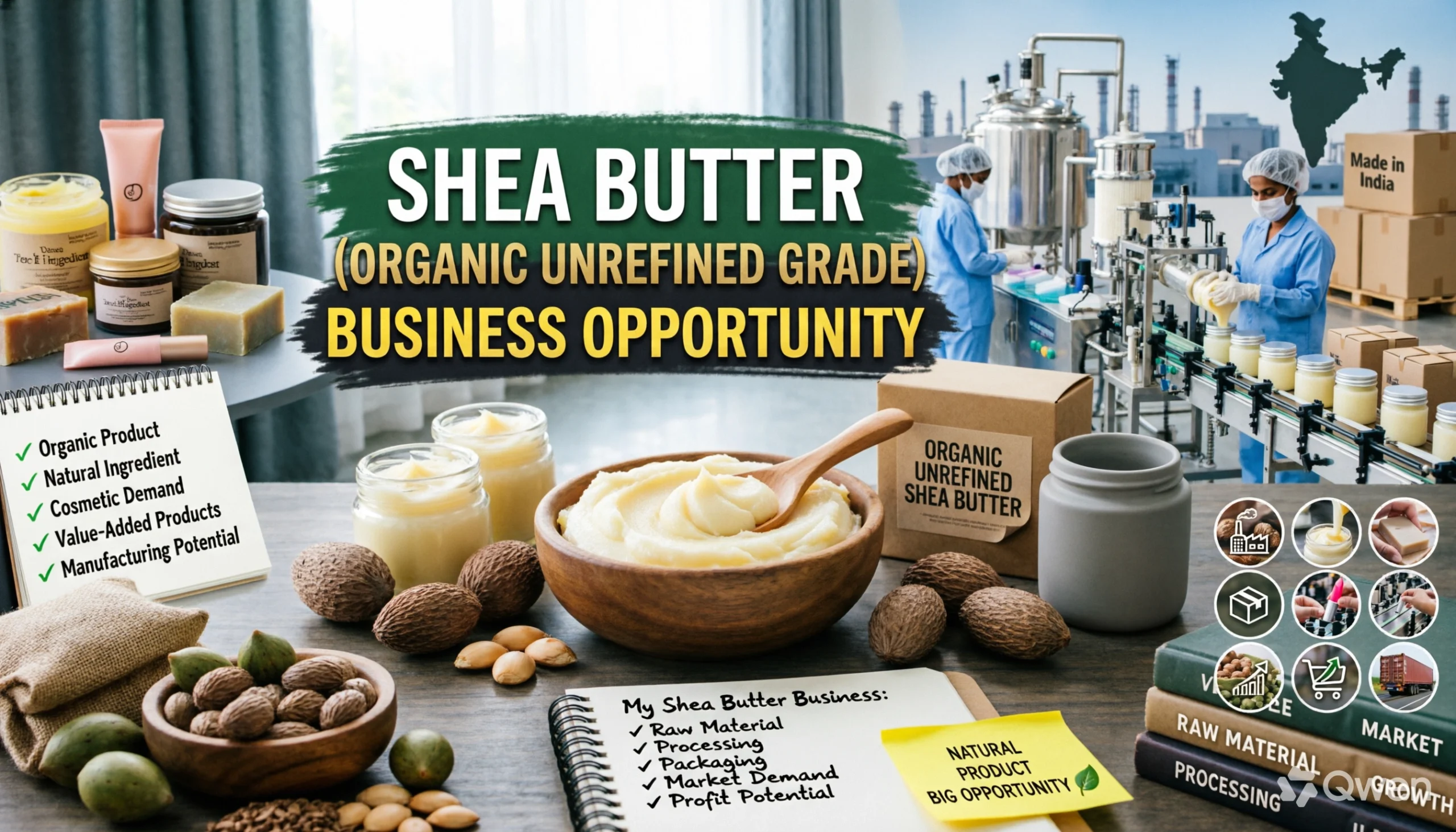
Business ideas abound in the agro-processing and natural cosmetics industry in India and there is not much other that can match the potential of organic unrefined shea butter in terms of global opportunities. Shea butter is a premium ingredient in cosmetics, hair products, nutraceuticals and food worldwide, and is harvested from the Vitellaria paradoxa tree of West Africa. Even growing India is importing most of its shea butter’s needs, and there is a huge opportunity for the entrepreneurs looking to establish shea butter processing, blending or specialty product business in this ingredient, one which has high margin of profit.
The global shea butter market is worth more than USD 2.5 billion and is expected to grow at a steady CAGR. The European Union, United States, South Korea and Japan are already exceeding the demand for certified organic unrefined shea butter. At the same time, Indian MSMEs have just begun to tap into this value chain. From opportunity to government assistance, project models to groundbreaking success stories from the field, this article shares the complete business case for both startup founders looking at premium cosmetic manufacturing and investors interested in agro-processing for export.
Related Article: Top 25 Mens Product Business Ideas
Why Organic Shea Butter Is a High-Opportunity Business Right Now
Global Demand Is Outpacing Supply
There are organic, unrefined grades of shea butter that fetch much more premium prices than other grades that are refined. Organic unrefined grades are preferred by international buyers, especially cosmetic manufacturers in Europe, due to their ability to contain higher levels of triterpenes, tocopherols and cinnamic acid esters, which provide better skin-healing and anti-aging properties. This has pushed the price of certified organic shea butter up to USD 2,500-3,800/metric tonne in the wholesale global markets. This is an interesting import arbitrage and value addition opportunity for Indian entrepreneurs.
India’s Import Dependence Creates a Processing Window
India sources shea butter mostly from West African countries, specifically from Ghana, Nigeria and Burkina Faso. Industrial use in the country is high, with thousands of tonnes being used by the cosmetic, pharmaceutical and food industries each year. Domestic processing, on the other hand, is limited, as well as organic certification infrastructure and specialty blending capabilities. This is a problem and an opportunity. If entrepreneurs start reprocessing or certification aligned storage units or special formulation units in India, they can provide the cosmetic products to domestic cosmetic companies at higher prices, and in parallel they can also tap into the regulated market for re-export.
Rising Domestic Premiumisation
The natural and organic personal care market’s share in India is expanding at more than 12% per year. More and more, consumers are turning down emulsifiers made in the lab and are looking for alternatives to butter from plants in body lotions, lip balms, baby skin care and hair conditioners. At its heart of this change is shea butter. Shea has already become mainstream in the form of essential ingredients in brands such as Mamaearth, Plum and WOW Skin Science. But the value chain behind them is thin and reliant on imports — which is the right time for Indian businessmen to develop their capabilities upstream.
Government Policies and Incentives Supporting This Business
The Ministry of MSME‘s Credit Guarantee Fund Trust for Micro and Small Enterprises (CGTMSE) offers collateral-free credit up to ₹5 crore for first-generation entrepreneurs — a significant enabler for processing units. The PMFME Scheme (Pradhan Mantri Formalisation of Micro Food Processing Enterprises) under the Ministry of Food Processing Industries provides 35% capital subsidy for food-grade and cosmetics-grade agro-processing units.
Additionally, the Production Linked Incentive (PLI) Scheme for Food Processing encourages investments in value-added processing including plant-based extracts and specialty fats. Shea butter processing — particularly when integrated with organic certification and export orientation — qualifies under multiple sub-categories of this scheme.
The Agricultural and Processed Food Products Export Development Authority (APEDA) under the Ministry of Commerce supports exporters with market development assistance, quality upgradation grants, and access to international buyer databases. For entrepreneurs targeting EU or US organic markets, APEDA’s organic certification support is directly relevant.
State-level support also plays a key role. Entrepreneurs in Uttar Pradesh (ODOP Scheme), Gujarat (MSME Policy), and Rajasthan (RIPS 2019) can access additional capital subsidies, land allotment concessions, and power tariff rebates. Maharashtra’s MSMEDI clusters also support cosmetics-grade manufacturing units.
Get Detailed Insights from This Book: Book
Manufacturing Business Ideas for Startups: Shea Butter Sector
1. Organic Shea Butter Import Processing and Certification Unit
This is perhaps the most profitable option available for all of the Indian entrepreneurs. Shea butter is imported in bulk (50 kg drums or 200 kg barrels) from West Africa at comparatively lower prices as raw shea butter. The entrepreneur can set up a processing unit where this bulk material is sent for processing and filtration, deodorisation (partial, so as not to destroy the organic properties), colour-standardisation and repackaging in containers certified organic-compliant.
There are three revenue streams to this business model; 1) importing cosmetic products for local brands, 2) servicing the Ayurvedic formulation manufacturers, 3) re-exporting as certified grade finished product to EU or ASEAN buyers. The investment in a mid-scale unit begins around ₹45–60 lakh and the gross margin can reach 35–45% based on the certification premiums that can be obtained. Investing in USDA Organic or COSMOS certification early will be seen to provide a return in 2-3 production cycles for the price of certification.
2. Shea Butter-Based Natural Cosmetics Manufacturing
This model goes one step further: from the production of shea butter to the production of finished cosmetic products, which can be branded and sold or even provided for cosmetic companies in the form of white label. Body butters, moisturising creams, intensive hair masks, baby skin balms, anti-stretch mark formulas are just a few of the ideas for business in this niche. The home value chain of such products is expanding at a rapid rate, with clean-beauty consciousness in urban India.
There are two routes for entrepreneurs to pursue for launching a business: either create their own D2C (direct-to-consumer) brand and sell the products online, or manufacture white-label goods for major cosmetic companies that do not have their own manufacturing facilities. The second route is a quicker path to revenue, with less marketing investment. Capital investment required for a small to medium cosmetics manufacturing unit certified to the Drugs and Cosmetics Act is in the order of Rs.25-50 lakh for basic minimum investment in equipment and compliance, with reasonable utilisation of the equipment, the unit can earn revenue of Rs.1.5-3 crore in a year.
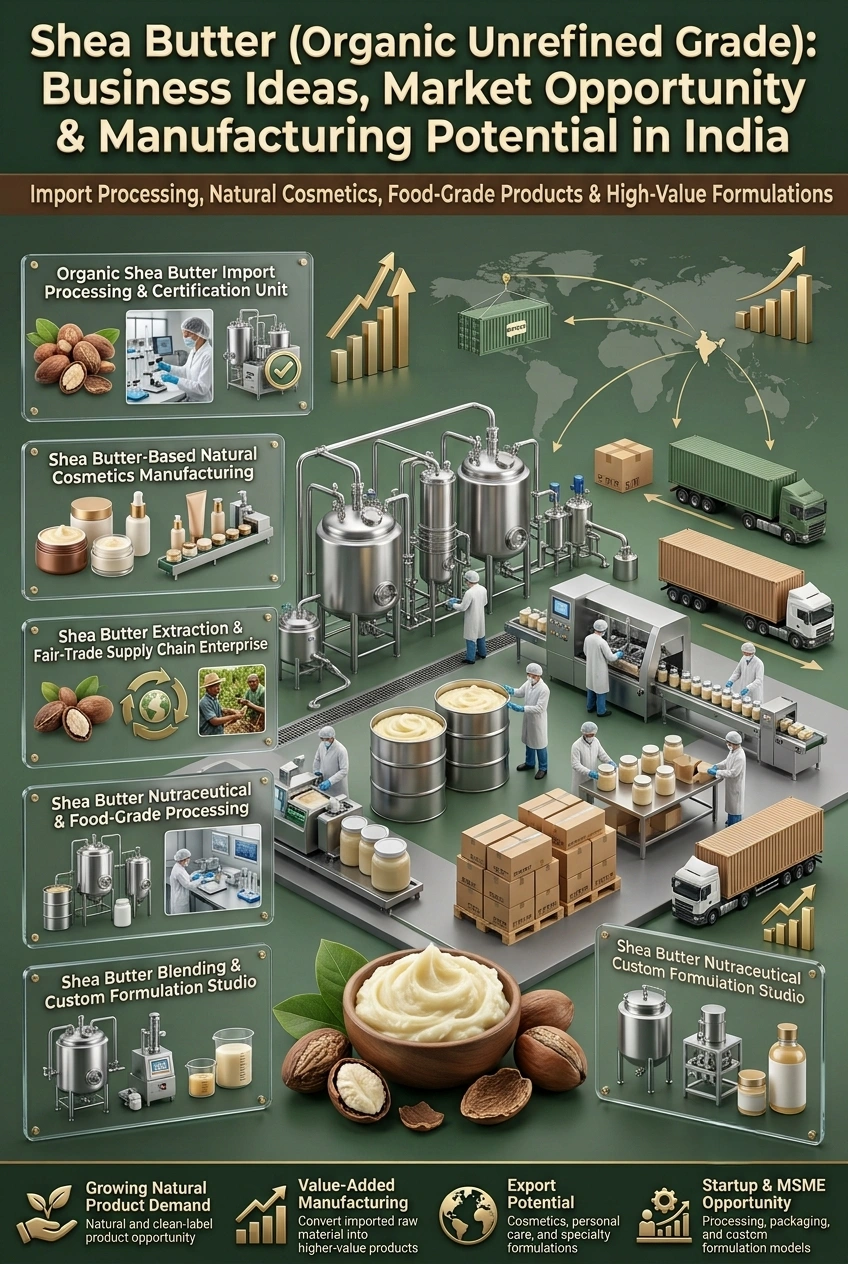
3. Shea Butter Extraction and Fair-Trade Supply Chain Enterprise
The second and more complex, but high-margin, business idea is the development of a sourcing and supply chain business that can directly work with shea cooperatives in West Africa, import shea kernels or crude butter from Africa and set up a unit for extraction and processing of shea butter that is certified by a fair-trade organization in India. This model is attractive to high-end international buyers who now require transparency along the supply chain and documentation of ethical sourcing.
The business generates value with certification – fair-trade plus – organic, quality standardisation and tailored supply agreements with cosmetic manufacturers in Europe. The working capital requirement is somewhat higher, with an initial inventory of import goods being in the order of ₹1–1.5 crore but the price realisation is much superior. The model is most suited to a businessperson with export experience or previous exposure to agri-commodity trading. The assistance of APEDA and India’s bilateral trade agreements with various African countries also remove transaction hurdles.
4. Shea Butter Nutraceutical and Food-Grade Processing
In India, the edible qualities of unrefined shea butter are underestimated. It is employed in traditional cooking and is becoming a popular ingredient in confectionery and chocolate production (cocoa butter equivalent) and in formulations for skin nutrition and anti-inflammatory applications around the world. The establishment of a Food-Grade Shea Butter Processing Unit in India with FSSAI certification and procurements for pharmaceutical or confectionery companies is a unique and less competitive business opportunity. The business needs to invest in food processing equipments, hygienic design of the facility and the FSSAI license.
Food Safety and Standards Authority of India (FSSAI) has laid down special regulations for specialty fats and plant-derived food ingredients. Shea butter producers have to follow these regulations. The revenue model is B2B (supplying manufacturers, not end consumers), and generally, these revenue streams are stable and contract-based.
5. Shea Butter Blending and Custom Formulation Studio
Increasingly, the cosmetics industry requires a combination of ingredients, rather than a single raw material. There is a niche market in India for combining organic unrefined shea butter with complementary butters such as kokum, mango seed butter or moringa butter, and selling them as proprietary cosmetic base, which is being catered by a shea butter blending studio. These are the perfect customers for a small skincare brand, a salon brand or an Ayurvedic manufacturer. The investment needed is comparatively low (₹15–30 lakh), and knowledge of formulation is necessary as well as a certified laboratory environment. Custom batch orders, contract blending fees and sometimes proprietary product lines via B2B sales channels are the revenue sources.
Import–Export Opportunity Analysis
India’s Trade Position in Shea Butter
India is a net importer of shea butter. Ghana, Nigeria, Burkina Faso and Ivory Coast are the main countries of origin for imports. Importation has been on a steady rise since recent years, with the cosmetics, confectionery and pharmaceutical industries contributing to this trend. Within the Directorate General of Foreign Trade (DGFT) classification, shea butter is classified as HS Code 1515.90 and the current import duty regime (plus consideration of GST) makes it costlier for domestic manufacturers to use processed and certified shea butter than to use crude and semi processed grades.
Get Detailed Project Report (DPR): DPR Consultant in India – Detailed Project Report Consultants & Consultancy Services
Export Potential: Where the Real Money Is
Re-export potential for certified processed shea butter in India is significant. COSMOS-certified and USDA Organic-certified shea butter is valued highly by the European Union cosmetic ingredient market because of its superior quality. This premium segment can be tapped by Indian entrepreneurs who invest in appropriate processing and certification infrastructure. India’s organic products export market is expanding at a fast pace, and processed natural extracts and specialty ingredients are making significant strides, says India Brand Equity Foundation (IBEF). The main target markets are Germany, France, United Kingdom, Netherlands and South Korea.
In addition, Indian entrepreneurs can now leverage on preferential sourcing arrangements with West African cooperatives via the India Africa Forum Summit process and bilateral trade agreements; this will enable them to have access to competitive raw materials whilst providing the necessary infrastructure for export grade quality in their country.
Indian MSME Success Stories in Natural Ingredient Processing
1. Kama Ayurveda – Premiumising Natural Ingredients
Kama Ayurveda was founded by Vivek Sahni and Vikram Goyal, and it is one of the most popular premium natural beauty brands in India. The company was founded around the goal of sourcing and formulating with high-quality natural butters and botanical extracts, such as shea, to serve an urban audience with the highest quality, most luxurious and pleasant formulas. They are a success case, thus proving the business model effective, source ethically, make with integrity and retail at premium prices. The lesson for new entrepreneurs is obvious – it’s not enough to simply process shea butter, it’s all about the brand story, transparency of sourcing, formulation know-how, and margin expansion.
2. Forest Essentials – Export-Ready Premium Positioning
Mira Kulkarni’s Forest Essentials has established a luxury Ayurvedic personal care brand which now sells internationally to markets such as UK and Singapore. Its strategic natural butters and oils, along with positioning through its Ayurvedic heritage, enabled the company to compete with the European luxury brands for pricing. As shea butter entrepreneurs can attest to, Forest Essentials demonstrates that by positioning premium, backed by real quality and certification, commodity processing can become a high-value brand export business.
3. Pahadi Local – MSME-Scale Natural Cosmetics Success
Pahadi Local was started by Abhinav Khandelwal and was launched as a small batch natural ingredient brand and has since become a popular name in the clean beauty movement in India. The brand’s commitment to single-sourced, natural ingredients, such as butters and cold-pressed oils, is in step with today’s consumers. Their journey proves that entrepreneurs can create a successful business at even MSME scale with minimal investment if they can focus on ensuring quality ingredients, uphold honesty in sourcing, and prioritize digital-first marketing.
Find the most profitable startup for your investment range
About NPCS: Feasibility Support for Your Shea Butter Business
At Niir Project Consultancy Services (NPCS), we offer professional consulting services to entrepreneurs and investors who would like to venture into the shea butter processing, cosmetic production, or agro-processing business, and require to prepare a Market Survey cum Detailed Techno-Economic Feasibility Report (DPR). The reports include the detailed manufacturing processes, market research and demand analysis, process flow diagrams, product mix, capacity planning, machinery and raw material sourcing details, and complete project financials with a profitability analysis. We aim to assist entrepreneurs determine feasibility, profitability, and long-term scalability prior to investing. Furthermore, we make you an APEDA online link for export-oriented registration & market development assistance.
Shea Butter Business: Quick Market & Project Reference Table
| Parameter | Details / Estimates |
| Global Market Size | USD 2.5+ Billion |
| Market Growth Rate (CAGR) | ~6–8% annually |
| Key Import Origins (for India) | Ghana, Nigeria, Burkina Faso, Ivory Coast |
| HS Code (India) | 1515.90 |
| Key Export Markets (Re-export Potential) | EU, USA, UK, South Korea, Japan |
| Processing Unit Investment (Mid-Scale) | ₹45–60 Lakh |
| Cosmetics Manufacturing Unit Investment | ₹25–50 Lakh |
| Blending Studio Entry Investment | ₹15–30 Lakh |
| Typical Gross Margin (Certified Organic Grade) | 35–45% |
| Key Certifications for Premium Pricing | USDA Organic, COSMOS, Fair Trade, FSSAI |
| Relevant Government Schemes | CGTMSE, PMFME, PLI (Food Processing), APEDA |
| Domestic Market Growth Rate (Organic Beauty) | ~12% annually |
Conclusion: The Time to Enter Is Now
Organic unrefined shea butter is at the cusp of three strong global trends: clean-beauty, organic ingredients and the premiumisation of personal care. It is one of those industries that has all the right ingredients for Indian entrepreneurs: it is a clear import substitution play, has high value regulated export markets, and is covered by the Government with active schemes, and more importantly a consumer base ready to pay a premium price for genuinely natural products.
The business ideas are not only diverse, but come in a range of investment amounts as well. The Shea Butter value chain opens up opportunities for new players in India who have a high regard for quality and are certified organic reprocessors, cosmetic manufacturers, or specialty ingredient blenders. Those that move early, and with the appropriate feasibility analysis, certifications and market positioning strategy, will have a great head start.
For entrepreneurs planning to enter this space, conducting a rigorous feasibility study is the first and most critical step. Consult resources like MSME’s official portal, Make in India, and DPIIT’s Startup India initiative to understand regulatory pathways. And work with experienced consultants who can translate market opportunity into a bankable project plan.


