

• Latest
  • Trending
  • All
Maize Starch Manufacturing: Business, Plant Cost

Why Maize Starch Is Becoming a High-Potential Manufacturing Business

September 20, 2026
Paper Water Bottle Manufacturing: Cost, Machinery & Business

Paper Water Bottle Manufacturing: A Sustainable Business Opportunity Explore Manufacturing Technology, Machinery, Investment and Market Potential

September 20, 2026
GRC Manufacturing Business in India: Investment, Market.

GRC Manufacturing Business in India: Facade Panels, Decorative Products, Investment and Market Opportunities

September 20, 2026
Project & Profile
गांव में Business Ideas और ग्रामीण उद्यमिता के अवसर

गांव में शुरू करें ये 7 Business Ideas और हर महीने कमाएं ₹50,000 — कम निवेश, ज़्यादा मुनाफा

September 19, 2026
Solar Business Ideas in India: 5 Profitable Manufacturing

5 Solar Business Ideas: Profitable Manufacturing and Service Units in India

September 19, 2026
Food Processing Business Ideas: 5 Profitable Units

Food Processing Business Ideas: 5 Profitable Manufacturing Units to Start in India

September 19, 2026
Chemical Business Ideas in India: 5 High Manufacturing Units

5 Chemical Business Ideas: High-Margin Manufacturing Units to Start in India

September 19, 2026
Ferro Alloy Manufacturing Business in India: Opportunities

India’s Steel Surge Is Creating a New Wave of Opportunities for the Ferro Alloy Sector

September 18, 2026
बिना किसी गारंटी के सरकार दे रही ₹50 लाख

बिना किसी गारंटी के सरकार दे रही ₹50 लाख तक का बिज़नेस लोन, जानिए कैसे करें क्लेम?

September 18, 2026
2027 में कभी न बंद होने वाले 5 बिज़नेस आइडियाज

2027 में कभी न बंद होने वाले 5 बिज़नेस आइडियाज: कम लागत में शुरू करके बनाएं बड़ी कंपनी

September 18, 2026
Compressed Biogas CBG Plant in India: Government Schemes

India’s Compressed Biogas Revolution: Why Animal and Agricultural Waste Could Fuel the Next Wave of Rural Manufacturing Opportunities

September 17, 2026
Goat Farming Business Loan Detail

बकरी पालन बिज़नेस लोन कैसे ले | Goat Farming Business Loan Detail

September 15, 2026
Biomass Gasification Business in India: Syngas, Methanol

Business Ideas in Biomass-Derived Syngas, Methanol, Hydrogen & DME: From Farm Waste to Clean Fuel

September 13, 2026
  • About
  • Advertise
  • Privacy & Policy
  • Contact
Sunday, September 20, 2026
  • Login
Entrepreneur India Blog
  • Home
  • About
  • Books
  • Business Ideas
  • Contact
No Result
View All Result
Entrepreneur India Blog
No Result
View All Result
Home Agri Business Opportunities

Why Maize Starch Is Becoming a High-Potential Manufacturing Business

by P.K. Chattopadhyay
September 20, 2026
in Agri Business Opportunities, Food Processing Business Industry
0
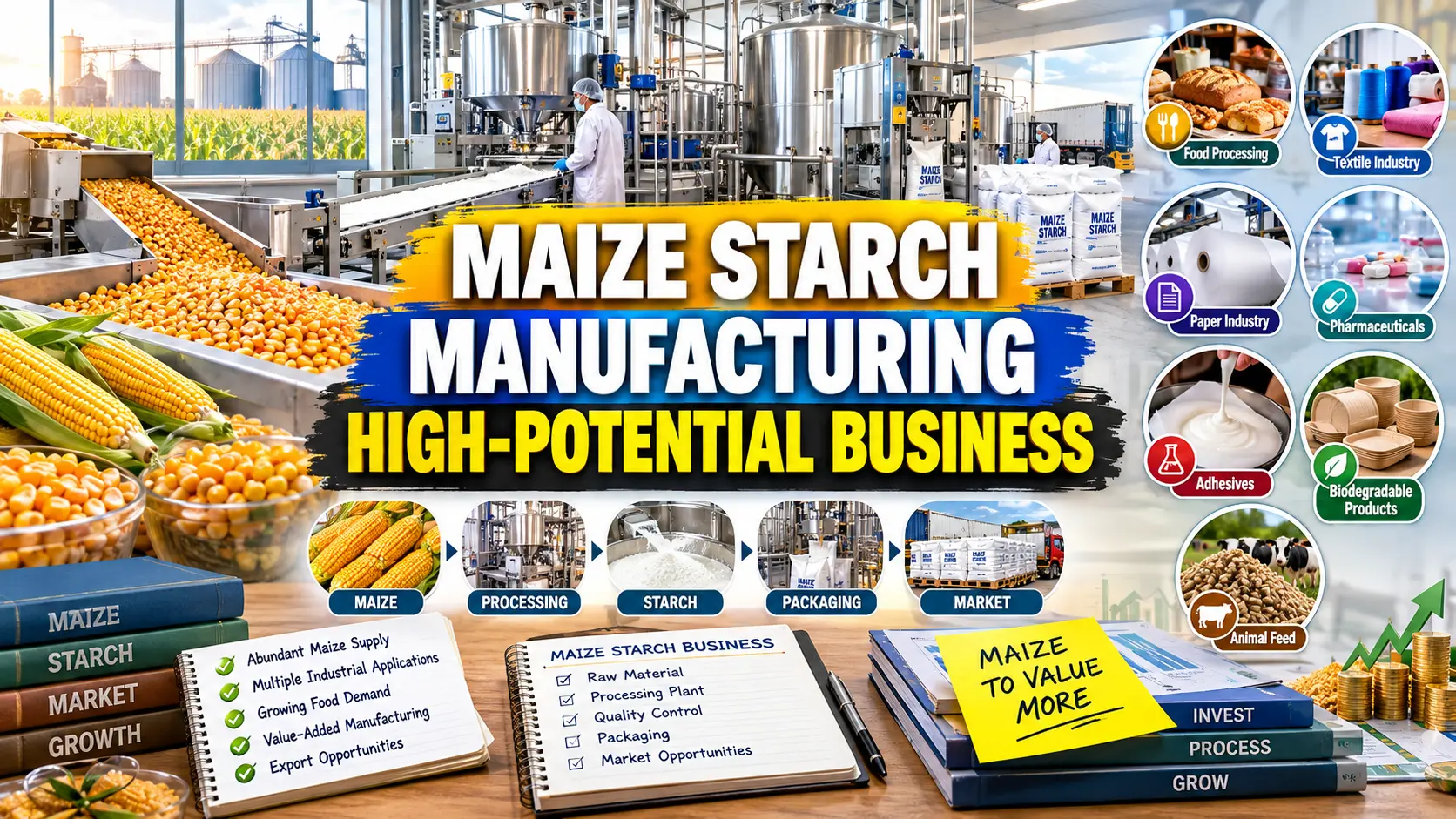
Maize Starch Manufacturing: Business, Plant Cost

Maize starch manufacturing and wet milling processing plant

492
SHARES
1.4k
VIEWS
Share on FacebookShare on Twitter

Maize starch quietly underlies dozens of industries, from packaged food to pharma, paper, textiles, and adhesives, making it one of the most reliable business ideas in the Indian agro-processing sector. It is both ubiquitous – as farmers across the country can produce it – and increasingly indispensable, as food processing is rising across the country. At the same time, a well-run wet-milling operation can balance its books by selling to multiple industrial clients as opposed to only one major consumer. For an entrepreneur based near maize-producing farms, such a venture can also have backward integration in the form of purchasing farmers’ produce.

Table of Contents

Toggle
  • Why Maize Starch Manufacturing Is a Smart Business Idea Right Now
  • Government Policies & Incentives
  • Multiple Manufacturing Business Ideas for Startups
  • Import–Export Opportunity Analysis
  • Market Outlook & Scaling Roadmap
  • Skills, Manpower & Quality Control
  • Indian MSME Success Stories
  • How NPCS Can Help Entrepreneurs Evaluate the Opportunity
  • Common Pitfalls to Avoid
  • Conclusion
  • Your Investment Deserves the Right Opportunity
    • Frequently Asked Questions

Why Maize Starch Manufacturing Is a Smart Business Idea Right Now

Food processing, pharma, textile sizing, and paper coatings are all major consumers of maize starch in various end forms, giving starch-makers an unusual edge of having diversified buyers for their products. Meanwhile, the government has been buying up surplus maize, and promoting crop diversification, ensuring the supply of raw material for processors is steady. In turn, this allows maize starch manufacturers to enjoy the higher margins derived from downstream processing of their product, as opposed to selling raw starch.

Government Policies & Incentives

Maize processing plants are eligible for capital subsidy and credit support, as per agro-processing schemes operated by the Ministry of Food Processing Industries; meanwhile, starch and derivative manufacturers can count on export promotion by the Agricultural and Processed Food Products Export Development Authority. As a small-scale business owner, you can also apply for collateral-free loans through the Ministry of MSME’s credit-linked scheme, and several maize-producing states offer additional benefits for processors willing to integrate backward and purchase farm produce directly, rather than relying on intermediaries. In addition, several food processing park programs in maize-producing states offer shared cold storage and testing infrastructure, letting you bypass the need for large-scale infrastructure investments.

Multiple Manufacturing Business Ideas for Startups

Basic Wet-Milling Starch Extraction Unit

The most obvious business plan for maize starch centers on extracting it from maize kernels using wet milling technology, and selling it to various manufacturers. This is the safest way to get started because it only requires standard equipment, and a small-scale processor can immediately target multiple buyers, from food, textile, and paper manufacturers.

Modified & Specialty Starch Production

Meanwhile, modifying native starch and turning it into specialty binders or modified starch products commands substantially higher prices, and is preferred by pharma and instant food manufacturers. Note that this requires much closer quality control to meet the specifications of your buyers, but can be a rewarding avenue for serial processors.

Maize Germ Oil & Co-Product Recovery

If setting up a maize starch extraction unit seems too simple, consider adding value to the production chain by recovering and refining germ oil, or selling fibre and gluten meal as animal feed. In fact, most maize processors that are able to recover and sell their co-products regularly report substantially better revenues than those that do not.
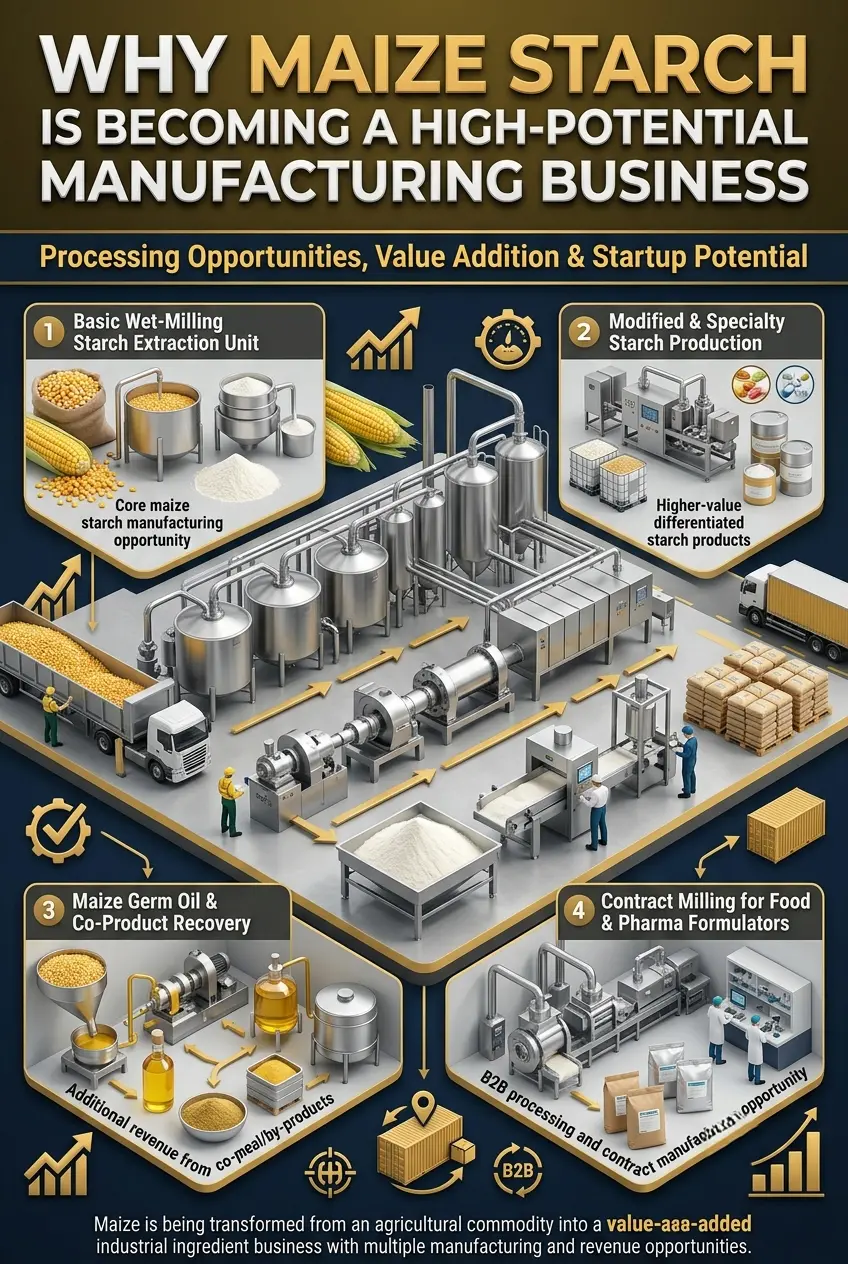
Maize Starch Manufacturing Plant and Processing
Maize starch manufacturing and wet milling processing plant

Contract Milling for Food & Pharma Formulators

As a newcomer, you may want to bypass the challenges of securing a long-term supply contract and branding your own starch products by acting as a contract miller for manufacturers in need of food-grade starch, dextrose, or gluten meal.

Starch-Based Biodegradable Packaging Feedstock Supply

With biodegradable packaging companies looking to expand their footprint, a maize processor can position itself as a reliable supplier of starch feedstock for blown film extrusion.

Import–Export Opportunity Analysis

India is already a major maize starch and derivative exporter, and demand from regional neighbours is set to rise, given the competitiveness of Indian prices versus alternatives in Southeast Asia. Meanwhile, the domestic market for processed food and pharma is set to balloon, and outpace local starch production capacity in several key markets, where trade facilitation initiatives from the Confederation of Indian Industry and other private sector groups promote agro-processing exports.

Market Outlook & Scaling Roadmap

The outlook for maize starch remains strong, with rising demand from multiple industries, across the country. Nevertheless, commodity starch prices tend to be volatile, due to the proximity of processors to local maize prices, and a wet-milling operation may find itself locked in difficult cost-profit calculations when maize prices rise faster than the rates it can charge to downstream manufacturers. In such a scenario, downstream integration and co-product recovery can make the difference between profitable and unprofitable operations, and a processor that has not made such preparations may find itself unable to finance further expansion. This highlights the importance of diversification into higher-margin starch products, and selling co-products, as a way to hedge against volatile commodity prices.

Skills, Manpower & Quality Control

A maize wet milling plant falls under the category of continuous manufacturing, and as such has to have staff on 24-hour shifts. For a small-scale processing unit, this typically means a workforce of 25-30 people. However, a process engineer who can manage steeping, separation, and product quality is the most valuable asset a young processor can employ. As a maize starch processor moves into downstream processing of modified starch, additional manpower may be required to test and control the viscosity and purity of modified starch, to the satisfaction of pharma and food buyers.

Indian MSME Success Stories

Gulshan Polyols — Prem Kumar Gupta

Prem Kumar Gupta built the Gulshan Polyols Group by vertically integrating his starch processing business, and diversifying into higher value-added products. In particular, his company’s pioneering work in sorbitol production has given it an edge over competitors, and showed the market that derivative production can be a rewarding extension for native starch manufacturers.

Sukhjit Starch & Chemicals — The Ahuja family

Sukhjit Starch & Chemicals has been able to establish itself as one of Punjab’s most dependable maize processors, in part due to its relationships with local maize growers, who regularly sell their crops to the processor. This has allowed Sukhjit to benefit from more predictable supply costs during times of farm price volatility.

How NPCS Can Help Entrepreneurs Evaluate the Opportunity

We at Niir Project Consultancy Services (NPCS) can help you prepare a Market Survey cum Detailed Techno-Economic Feasibility Report for setting up new industries or businesses. Our reports contain exhaustive information on complete process, market analysis and requirement, process flow diagram, product specifications, machinery, raw materials and utilities, and complete project financials with profitability analysis. This helps entrepreneurs to evaluate the project at hand, its viability, financial requirements, and profit potential before making any commitments, and helps to save money and time spent on wrong projects during the initial stages.

For entrepreneurs evaluating the opportunity of Maize Starch Manufacturing, such a report becomes especially critical, as it examines the entire value chain, from machinery selection and raw material procurement to manpower planning and project financials. In fact, you may only approach banks, NBFCs, and state MSME departments for loans and other funding after submitting a detailed project report, as funding agencies will have to assess the viability of your project on an individual basis.

Working with a professional consultancy can also shorten your learning curve substantially, as you can rely on NPCS’s experience with similar manufacturing projects to help you navigate the intricacies of setting up a business in this field. In particular, the groundwork done by NPCS analysts can become crucial in assessing the financial viability of the project – its machinery, manpower, and raw material costs, and potential profit therefrom – which is essential in determining whether a proposed business venture is worthy of your capital.

NPCS has published a comprehensive printed reference book on Maize Starch Manufacturing, covering technology, market, investment details, and processes in depth – the printed book: Handbook on Maize (Corn) Processing and Manufacture of Maize Products

For a detailed techno-economic Project Report on setting up a manufacturing business in this sector – including plant economics, machinery, financials, and government incentives – the NPCS Project Report: Maize Starch & Liquid Glucose – Manufacturing Plant, Detailed Project Report.

Common Pitfalls to Avoid

New processors should always be aware of the working capital requirements before establishing their processing facilities, as they may need substantial funding to buy maize ahead of processing. Similarly, new processors may fail to grasp the potential of their co-products, and sell them for lower prices than the market dictates – thus leaving money on the table.

Conclusion

Maize starch manufacturing is one of the few business ideas that can offer both reliable raw material supply and diverse markets for your output, but it still requires careful planning and execution to be a success. As a newcomer, you may want to contact maize-producing states’ investment promotion agencies, such as Invest UP portal, ahead of time to discuss your options.

Your Investment Deserves the Right Opportunity

Every serious investment begins with choosing the right sector and the right business model. With hundreds of industrial opportunities available across India’s manufacturing and clean-energy landscape, making the most informed choice is critical. NPCS Startup Selector tool helps entrepreneurs, MSMEs, and investors identify the most suitable business opportunities based on their investment capacity, location, and interests — so your capital is directed toward a venture with the strongest fit and potential.

Frequently Asked Questions

What is the minimum investment for a maize starch plant? +
A small wet-milling unit processing around 25–30 tonnes of maize daily typically requires ₹2–3 crore in project cost.
What are the main industries buying maize starch? +
Food processing, pharmaceuticals, textiles, paper, and adhesive manufacturing are the largest buyer categories.
Is farmer tie-up necessary for raw material supply? +
It is not mandatory, but direct farmer procurement arrangements significantly improve raw-material cost stability and quality control.
What by-products come from maize wet milling? +
Germ, fibre, and gluten meal are the main by-products, often sold into edible oil and animal feed markets.
Are modified starches more profitable than native starch? +
Yes, modified and specialty starches used in food and pharmaceutical applications typically command higher margins.
What licences are needed for a starch manufacturing unit? +
FSSAI licensing, pollution control consent, and standard factory licensing are the core regulatory requirements.
Is export demand strong for Indian maize starch? +
Yes, particularly in neighbouring and Southeast Asian markets where Indian starch is priced competitively against alternatives.
How long does plant commissioning typically take? +
A small to mid-size unit can generally be commissioned within eight to twelve months, including machinery installation and trial runs.
What government schemes support this business? +
Food processing capital subsidy schemes and export promotion support are the most relevant government programmes for this sector.
Can this business be started as an MSME? +
Yes, most small and mid-size maize starch units qualify comfortably under MSME classification and financing norms.
How is maize wet milling different from dry milling? +
Wet milling steeps maize in water before separating starch, germ, fibre, and protein, producing purer starch than dry milling, which is used mainly for flour and grits.
What quality parameters do food-grade buyers check? +
Moisture content, viscosity, whiteness, and microbial load are the key parameters food and pharmaceutical buyers typically test before approving a starch supplier.
Is maize price volatility a major risk for this business? +
Yes, and many processors manage it through forward contracts with farmers or aggregators rather than relying solely on open-market seasonal purchase.
Can gluten meal be sold directly to poultry feed companies? +
Yes, gluten meal is a well-established protein input for poultry and aquaculture feed, giving processors a ready secondary market.
Can maize starch units export directly or only through traders? +
Both models are common; larger processors often export directly to regional buyers, while smaller units frequently work through established trading houses.
Is contract farming a realistic way to secure maize supply? +
Yes, several processors have successfully used contract farming arrangements to lock in maize quality and quantity ahead of the crushing season.
Does maize processing require round-the-clock operation? +
Yes, steeping and separation stages typically run continuously in shifts rather than stopping at the end of a standard working day.
How many workers does a small maize starch unit need? +
A small unit typically employs 25 to 30 workers across steeping, milling, separation, and drying operations.
What quality tests matter most for starch buyers? +
Viscosity, moisture content, and whiteness are the most commonly tested parameters that food and industrial buyers check before approving a supplier.
Can smaller processors access shared testing infrastructure? +
Yes, several state food processing cluster schemes provide shared common facility centres with testing equipment for smaller processors.
Why is working capital planning especially important in this business? +
Seasonal maize procurement often requires large upfront purchases ahead of the crushing season, creating working capital pressure many new entrants underestimate.
Is it a mistake to ignore co-product marketing? +
Yes, treating germ, fibre, and gluten meal as waste rather than active revenue streams leaves meaningful money unclaimed.
How much working capital is typically needed relative to project cost? +
Working capital requirements can rival fixed capital investment in seasonal procurement businesses, making financing planning critical from the outset.
Tags: Maize Starch Business in IndiaMaize Starch ManufacturingMaize Starch Manufacturing BusinessMaize Starch Manufacturing PlantMaize Starch Plant
Share197Tweet123
Previous Post

GRC Manufacturing Business in India: Facade Panels, Decorative Products, Investment and Market Opportunities

Next Post

Paper Water Bottle Manufacturing: A Sustainable Business Opportunity Explore Manufacturing Technology, Machinery, Investment and Market Potential

P.K. Chattopadhyay

P.K. Chattopadhyay

P. K. Chattopadhyay is a seasoned Project Consultant with over 45 years of hands-on experience in project consultancy across diverse industries. He has guided hundreds of companies and entrepreneurs through project planning, feasibility studies, and industrial setup — turning business ideas into practical, scalable ventures. A prolific author of business and startup-focused books, P. K. Chattopadhyay brings together real-world industry data, actionable insights, and proven execution strategies tailored for entrepreneurs and investors at every stage of their journey. His core expertise spans manufacturing projects, market analysis, and business viability assessment — making his work an indispensable resource for anyone building a sustainable and profitable business from the ground up.

Next Post
Paper Water Bottle Manufacturing: Cost, Machinery & Business

Paper Water Bottle Manufacturing: A Sustainable Business Opportunity Explore Manufacturing Technology, Machinery, Investment and Market Potential

Leave a Reply Cancel reply

Your email address will not be published. Required fields are marked *

Contact Us

    Categories

    • Agri Business Opportunities
    • Business Ideas
    • Chemical Industry Business Opportunities
    • Cosmetics and Personal Care Business
    • Eco Friendly Sustainable Business
    • Entrepreneurship Leadership and Startup Growth
    • FMCG Consumer Products Business
    • Food Processing Business Industry
    • Future & Emerging Industries
    • Government Schemes Policies for Business
    • Import Export Business Opportunities
    • Industrial Project Reports Business Guide
    • Investment Funding for Startups
    • Manufacturing Business Ideas for Startups
    • Market Research Trends for Business
    • MSME & Small-Scale Industries
    • Paper Pulp Industry Business
    • Pharmaceutical Industry Business
    • Plastic & Packaging Business
    • Renewable Energy Startups
    • Startup Business Opportunities
    • Startup Business Planning and Strategy
    • Technology & Automation Business
    • Textile Industry Business
    • Uncategorized
    • Waste Management & Recycling Business
    • Water & Environmental Business
    Entrepreneur India Blog

    Copyright © 2026 Entrepreneur India

    Navigate Site

    • About
    • Advertise
    • Privacy & Policy
    • Contact

    Follow Us

    Welcome Back!

    Login to your account below

    Forgotten Password?

    Retrieve your password

    Please enter your username or email address to reset your password.

    Log In
    No Result
    View All Result
    • Home

    Copyright © 2026 Entrepreneur India

    Not enough quota to unlock this post
    Unlock left : 0
    Are you sure want to cancel subscription?