

• Latest
  • Trending
  • All
Compressed Bio Gas Plant in India: Cost, Business Guide

Compressed Bio Gas Plant in India: A High-Potential Clean Energy Business

September 22, 2026
5 Cosmetics and Personal Care Business Ideas in India

Cosmetics and Personal Care Business Ideas: 5 Profitable Units in India

September 22, 2026
Gypsum Board and Plaster of Paris Manufacturing in India

Gypsum Board and Plaster of Paris Manufacturing in India:

September 21, 2026
Project & Profile
Biodegradable bag manufacturing using corn and cassava starch

How to Start Biodegradable Bag Manufacturing Business Using Corn & Cassava Starch

September 21, 2026
Jatropha Biodiesel and Medicinal Herbs Business in India

Jatropha Biodiesel, Ashwagandha, Stevia and Medicinal Herbs: India’s Most Untapped Agri-Business Opportunity

September 21, 2026
Paper Water Bottle Manufacturing: Cost, Machinery & Business

Paper Water Bottle Manufacturing: A Sustainable Business Opportunity Explore Manufacturing Technology, Machinery, Investment and Market Potential

September 20, 2026
Maize Starch Manufacturing: Business, Plant Cost

Why Maize Starch Is Becoming a High-Potential Manufacturing Business

September 20, 2026
GRC Manufacturing Business in India: Investment, Market.

GRC Manufacturing Business in India: Facade Panels, Decorative Products, Investment and Market Opportunities

September 20, 2026
गांव में Business Ideas और ग्रामीण उद्यमिता के अवसर

गांव में शुरू करें ये 7 Business Ideas और हर महीने कमाएं ₹50,000 — कम निवेश, ज़्यादा मुनाफा

September 19, 2026
Solar Business Ideas in India: 5 Profitable Manufacturing

5 Solar Business Ideas: Profitable Manufacturing and Service Units in India

September 19, 2026
Food Processing Business Ideas: 5 Profitable Units

Food Processing Business Ideas: 5 Profitable Manufacturing Units to Start in India

September 19, 2026
Chemical Business Ideas in India: 5 High Manufacturing Units

5 Chemical Business Ideas: High-Margin Manufacturing Units to Start in India

September 19, 2026
Ferro Alloy Manufacturing Business in India: Opportunities

India’s Steel Surge Is Creating a New Wave of Opportunities for the Ferro Alloy Sector

September 18, 2026
  • About
  • Advertise
  • Privacy & Policy
  • Contact
Tuesday, September 22, 2026
  • Login
Entrepreneur India Blog
  • Home
  • About
  • Books
  • Business Ideas
  • Contact
No Result
View All Result
Entrepreneur India Blog
No Result
View All Result
Home Renewable Energy Startups

Compressed Bio Gas Plant in India: A High-Potential Clean Energy Business

by P.K. Chattopadhyay
September 22, 2026
in Renewable Energy Startups, Eco Friendly Sustainable Business
0
Compressed Bio Gas Plant in India: Cost, Business Guide

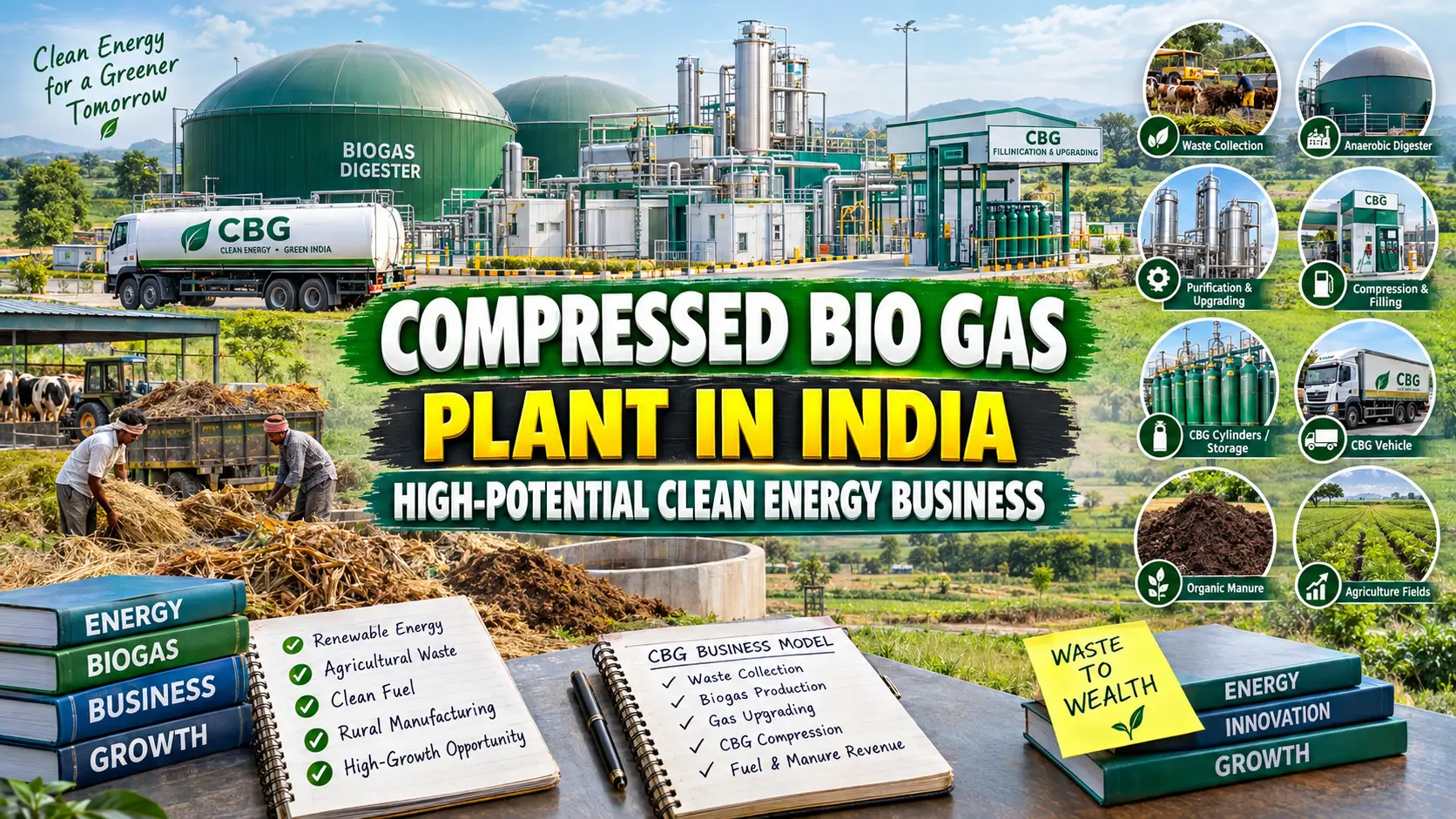
Compressed Bio Gas production from agricultural waste, cattle dung and organic waste in India.

491
SHARES
1.4k
VIEWS
Share on FacebookShare on Twitter

Compressed Bio Gas Plant in India

India’s efforts to reduce fuel import and manage agricultural and municipal waste has evolved into one clear business idea: Compressed Bio Gas production. CBG plants can utilise agricultural residue, cattle dung and municipal organic waste into a clean fuel that can directly substitute compressed natural gas with oil marketing contractually committed buyers.

Table of Contents

Toggle
  • Why Compressed Bio Gas Is a Smart Business Idea Right Now
  • Government Policies & Incentives
  • Multiple Manufacturing Business Ideas for Startups
  • Import–Export Opportunity Analysis
  • Market Outlook & Scaling Roadmap
  • Skills, Manpower & Quality Control
  • Indian MSME Success Stories
  • How NPCS Can Help Entrepreneurs Evaluate the Opportunity
  • Common Pitfalls to Avoid
  • Conclusion
  • Your Investment Deserves the Right Opportunity
    • Frequently Asked Questions

Why Compressed Bio Gas Is a Smart Business Idea Right Now

India’s SATAT initiative has created assured offtake links between CBG producers and oil marketing companies. This eliminates the biggest risk for new manufacturers: finding buyers. Feedstock availability is unusually strong: agricultural residue, press mud and municipal solid waste is abundant and often actively needing disposal solutions, acting as a byproduct rather than scarce commodity. As India seeks to cut back on natural gas imports and manage crop-burning pollution, CBG occupies a rare intersection of energy security, waste management, and farmer income policy priorities.

Government Policies & Incentives

The SATAT (Sustainable Alternative towards Affordable Transportation) scheme, administered via the Ministry of Petroleum and Natural Gas, provides CBG offtake assurances from oil marketing companies which de-risks investment in new plant. Renewable energy capital subsidies are available from the Ministry of New and Renewable Energy, and feedstock aggregation from agricultural residue often qualifies for additional state incentives regarding crop residue management and pollution control. Several state renewable energy departments provide viability gap funding on top of central capital subsidy for CBG projects, particularly those addressing crop-residue burning, which could significantly improve project bankability for new entrants.

Multiple Manufacturing Business Ideas for Startups

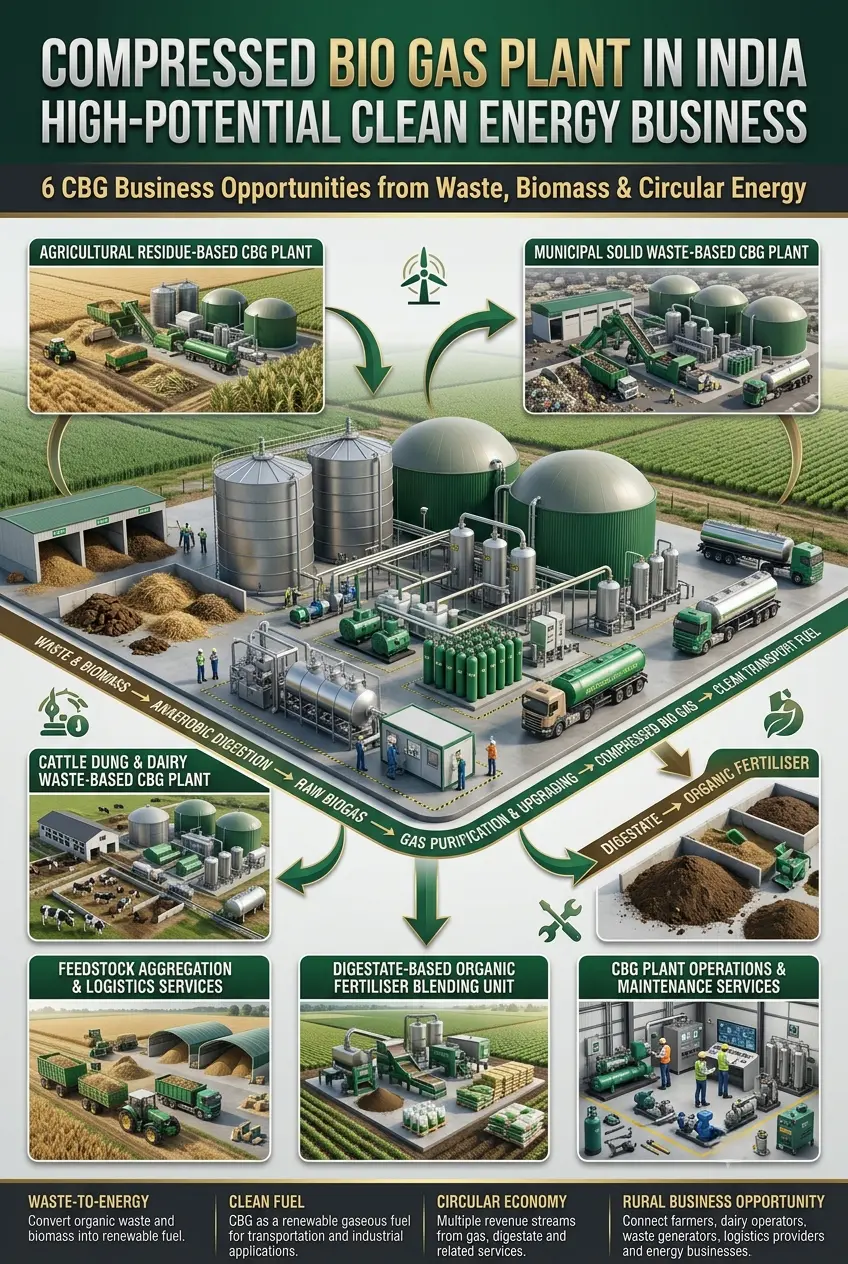
Agricultural Residue-Based CBG Plant

A plant based on paddy straw, crop residue and press mud can address both the CBG offtake as well as crop-burning pollution that many states wish to reduce. This model is well-suited to areas near paddy or sugarcane belts: abundant feedstock, seasonal aggregation logistics and farmer support for an alternative to burning residue.

Municipal Solid Waste-Based CBG Plant

Urban local bodies are interested in diverting organic waste from landfills and a CBG plant processing segregated municipal wet waste can secure long-term feedstock supply agreements with municipal corporations. This model is well-suited to entrepreneurs comfortable with municipal tendering process and contract structure.

Cattle Dung & Dairy Waste-Based CBG Plant

Areas with strong dairy and livestock concentration offer a steady, non-seasonal feedstock stream via cattle dung and dairy processing waste. Besides CBG sales, the fermented residue can be sold as organic bio-manure offering a second revenue channel, supporting the government’s push to reduce chemical fertiliser reliance.

Feedstock Aggregation & Logistics Services

Since reliable feedstock supply is the biggest challenge for CBG plants, a business focused solely on aggregating agricultural residue or organic waste and supplying multiple plants can operate profitably without plant infrastructure ownership, serving as a valuable service layer in the growing CBG ecosystem.
Compressed Bio Gas Plant in India for Clean Energy Production
Compressed Bio Gas production from agricultural waste, cattle dung and organic waste in India.

Digestate-Based Organic Fertiliser Blending Unit

The fermented digestate can be dried, blended and packaged into branded organic fertiliser products for agricultural retail, providing a second consumer-facing business line for a CBG plant. As government policy pushes towards reduced chemical fertiliser reliance, a well-branded organic fertiliser product line can develop direct relationships with farming communities near the plant.

CBG Plant Operations & Maintenance Services

With more CBG plants coming into operation under SATAT, a specialised operations and maintenance service provider can handle digester monitoring, gas purification troubleshooting and feedstock quality management to serve multiple plant owners with no in-house technical teams, generating steady service revenue without infrastructure ownership.

Import–Export Opportunity Analysis

CBG directly substitutes imported compressed natural gas and LNG, and is actively promoted as a strategic import-substitution fuel by the Ministry of Petroleum and Natural Gas. Since CBG is consumed domestically as transport and industrial fuel, export opportunity is limited but the associated organic bio-manure by-product does find growing demand from agricultural exporters to reduce chemical fertiliser residues in produce meant for premium export markets.

Market Outlook & Scaling Roadmap

With crop-residue pollution, municipal waste management pressure, and fuel import reduction goals all pointing to the same solution, CBG capacity addition is expected to remain a national priority for years to come, backed by an expanding network of SATAT offtake agreements. Plants that diversify their feedstock sources, agricultural residue, municipal waste and dairy waste rather than relying on a single seasonal source, tend to have more consistent output and stronger bankability.

Skills, Manpower & Quality Control

CBG plants require process operators trained in anaerobic digestion monitoring alongside mechanical staff for gas purification and compression equipment. A small plant typically employs 25 to 30 workers and the most critical early hire is a process engineer with biogas or wastewater treatment experience as digester health directly determines gas yield and plant profitability. Feedstock logistics coordinators are equally important given the central reliance of reliable supply.

Indian MSME Success Stories

Indian Oil-Adani Gas CBG initiatives — Joint industry-government partnerships

Early CBG projects have been developed under public-private partnerships between oil marketing companies and private developers, showcasing how assured offtake agreements under SATAT have improved bankers’ lending to bio-energy projects significantly compared a decade ago.

Punjab-based paddy straw CBG entrepreneurs — Various regional agri-entrepreneurs

Several Punjab-based entrepreneurs have built early paddy straw CBG capacity to address stubble-burning pollution, showcasing how aligning a business model with an urgent local environmental problem can accelerate regulatory support and community cooperation for feedstock sourcing.

How NPCS Can Help Entrepreneurs Evaluate the Opportunity

We at Niir Project Consultancy Services (NPCS) provide professional consulting for the preparation of Market Survey cum Detailed Techno-Economic Feasibility Reports (DPRs) for setting up new industries or businesses. Our reports include detailed manufacturing processes, market research and demand analysis, process flow diagrams, product mix and capacity planning, machinery and raw material details, complete project financials with profitability analysis. Entrepreneurs use these reports to evaluate feasibility, profitability and long-term scalability prior to investment, thus reducing guesswork at the most capital-intensive stage of a new venture.

For anyone evaluating Compressed Bio Gas, that groundwork is most important before any capital is committed: NPCS studies explore machinery selection, raw material sourcing, plant layout, manpower planning and a complete financial model: capital cost, working capital, revenue projections, return on investment. Entrepreneurs approaching banks, NBFCs or state MSME schemes for financing typically need exactly this kind of documented feasibility study, since lenders rarely fund a project on the idea alone. Working with an established consultancy shortens the learning curve considerably, allowing a first-time promoter to benefit from patterns NPCS has already observed across hundreds of similar manufacturing projects.

NPCS has published a comprehensive printed reference book on Compressed Bio Gas, covering technology, market analysis, investment parameters, manufacturing processes in-depth — the printed book: Biogas and Compressed Biogas (CBG) Production Handbook (from Waste & Renewable Resources).

For a detailed techno-economic Project Report for setting up a manufacturing business in this sector — including plant economics, machinery lists, financial projections and applicable government incentives — the NPCS Project Report: Compressed Bio Gas (CBG) Production from Cow Dung, Napier Grass, Municipal Waste, and Agricultural Residues.

Common Pitfalls to Avoid

The most common and costly mistake is underestimating feedstock logistics complexity, assuming agricultural residue will be consistently available without dedicated collection arrangements. A second frequent pitfall is skimping on digester monitoring instrumentation, which makes it difficult to diagnose declining gas yield prior to a serious operational problem.

Conclusion

Compressed Bio Gas manufacturing offers a genuinely rare combination among business ideas: offtake assured, feedstock abundant, and policy supportive. Entrepreneurs could coordinate with agriculture-heavy states such as Invest Punjab portal to align feedstock sourcing and incentive support prior to committing capital to plant construction.

Your Investment Deserves the Right Opportunity

Every serious investment begins with choosing the right sector and business model. With hundreds of industrial opportunities in India’s manufacturing and clean-energy landscape, making the most informed choice is critical. NPCS Startup Selector tool helps entrepreneurs, MSMEs and investors identify the most suitable business opportunities based on their investment capacity, location and interests — so your capital is directed to a venture with the strongest fit and potential.

Frequently Asked Questions

What is the SATAT scheme? +
A: SATAT is a government initiative under which oil marketing companies commit to purchasing CBG from registered producers at pre-agreed pricing.
How much investment is needed for a small CBG plant? +
A: A small plant processing around 80–100 tonnes of feedstock daily typically requires ₹8–12 crore in project cost.
What feedstock can be used for CBG production? +
A: Agricultural residue, municipal organic waste, press mud, and cattle dung are all viable feedstocks for CBG production.
Is feedstock supply a major risk in this business? +
A: Yes, securing consistent, contracted feedstock supply is typically the single most important factor in project success.
What by-product comes from CBG production and is it valuable? +
A: Fermented organic residue can be processed into bio-manure, providing a valuable secondary revenue stream.
How long does it take to set up a CBG plant? +
A: Depending on scale and approvals, commissioning typically takes twelve to eighteen months from land acquisition to operation.
Who buys the CBG produced by these plants? +
A: Oil marketing companies under SATAT agreements are the primary buyers, alongside select industrial gas consumers.
What approvals are required to start a CBG plant? +
A: Environmental clearance, pollution control consent, and a formal SATAT registration or offtake agreement are the key requirements.
Can a CBG plant help address crop-burning pollution? +
A: Yes, paddy straw and crop-residue based CBG plants directly reduce the need for farmers to burn residue after harvest.
Is this business suitable for first-time entrepreneurs? +
A: It is capital-intensive and technically demanding, so partnering with experienced process consultants or technology providers is strongly advisable for first-time entrants.
What is the shelf life of compressed biogas after production? +
A: CBG is generally supplied and consumed on a continuous cycle rather than stored long-term, similar to how CNG is handled in the distribution network.
Can a CBG plant sell gas outside the SATAT framework? +
A: Yes, industrial and commercial buyers seeking a piped or cylinder-based gas alternative can be served directly, alongside SATAT-linked OMC offtake.
How is feedstock quality monitored for consistent gas yield? +
A: Regular testing of moisture content, organic load, and contamination levels in incoming feedstock helps maintain digester efficiency and predictable output.
What is the typical digester retention time? +
A: Retention time varies by feedstock and technology but generally ranges from twenty to forty days for stable anaerobic digestion.
Can a single company operate multiple CBG plants? +
A: Yes, several developers operate multiple plants across different feedstock regions once the initial project proves technically and financially viable.
Is CBG plant operation technically demanding for a first-time promoter? +
A: It requires solid process engineering understanding, which is why many first-time promoters partner with experienced technology providers or O&M specialists.
How many workers does a small CBG plant typically need? +
A: A small plant processing 80 to 100 tonnes of feedstock daily typically employs 25 to 30 workers across feedstock handling, digestion, and gas processing.
What experience should a CBG process engineer ideally have? +
A: Prior experience in anaerobic digestion, biogas, or wastewater treatment process monitoring is highly valuable for this critical technical role.
Is feedstock logistics coordination a specialised role? +
A: Yes, given how central reliable, consistent feedstock supply is to plant performance, dedicated logistics coordination is a valuable early investment.
Do states offer additional funding beyond central subsidy? +
A: Some state renewable energy departments offer viability gap funding on top of central capital subsidy, particularly for crop-residue-based projects.
Why is feedstock logistics often underestimated by new CBG promoters? +
A: Agricultural residue availability is seasonal and scattered, requiring dedicated collection arrangements that many first-time promoters do not plan for adequately.
Is digester monitoring instrumentation worth the extra investment? +
A: Yes, since it allows early diagnosis of declining performance before gas yield drops become a serious, harder-to-reverse operational problem.
Should a new CBG promoter partner with an experienced technology provider? +
A: Yes, particularly for first-time promoters, since digester design and feedstock-specific process tuning benefit significantly from prior experience.
Tags: CBG BusinessCBG InvestmentCBG Plant CostCBG Plant in IndiaCBG ProductionCBG Project ReportCompressed Bio Gas PlantCompressed Biogas
Share196Tweet123
Previous Post

Cosmetics and Personal Care Business Ideas: 5 Profitable Units in India

P.K. Chattopadhyay

P.K. Chattopadhyay

P. K. Chattopadhyay is a seasoned Project Consultant with over 45 years of hands-on experience in project consultancy across diverse industries. He has guided hundreds of companies and entrepreneurs through project planning, feasibility studies, and industrial setup — turning business ideas into practical, scalable ventures. A prolific author of business and startup-focused books, P. K. Chattopadhyay brings together real-world industry data, actionable insights, and proven execution strategies tailored for entrepreneurs and investors at every stage of their journey. His core expertise spans manufacturing projects, market analysis, and business viability assessment — making his work an indispensable resource for anyone building a sustainable and profitable business from the ground up.

Leave a Reply Cancel reply

Your email address will not be published. Required fields are marked *

Contact Us

    Categories

    • Agri Business Opportunities
    • Business Ideas
    • Chemical Industry Business Opportunities
    • Cosmetics and Personal Care Business
    • Eco Friendly Sustainable Business
    • Entrepreneurship Leadership and Startup Growth
    • FMCG Consumer Products Business
    • Food Processing Business Industry
    • Future & Emerging Industries
    • Government Schemes Policies for Business
    • Import Export Business Opportunities
    • Industrial Project Reports Business Guide
    • Investment Funding for Startups
    • Manufacturing Business Ideas for Startups
    • Market Research Trends for Business
    • MSME & Small-Scale Industries
    • Paper Pulp Industry Business
    • Pharmaceutical Industry Business
    • Plastic & Packaging Business
    • Renewable Energy Startups
    • Startup Business Opportunities
    • Startup Business Planning and Strategy
    • Technology & Automation Business
    • Textile Industry Business
    • Uncategorized
    • Waste Management & Recycling Business
    • Water & Environmental Business
    Entrepreneur India Blog

    Copyright © 2026 Entrepreneur India

    Navigate Site

    • About
    • Advertise
    • Privacy & Policy
    • Contact

    Follow Us

    Welcome Back!

    Login to your account below

    Forgotten Password?

    Retrieve your password

    Please enter your username or email address to reset your password.

    Log In
    No Result
    View All Result
    • Home

    Copyright © 2026 Entrepreneur India

    Not enough quota to unlock this post
    Unlock left : 0
    Are you sure want to cancel subscription?