





Aloe Vera Business in India
The Plant That Has Always Been There — And Finally Has the Market to Match
Most Indians have a pot of aloe vera growing at the edge of the kitchen door. It is one of those plants that belong to the background of everyday life — there, but never noticed. What is changing rapidly is how that utility is being monetised, and how the global markets are paying products derived from it.
The global aloe vera market reached USD 941.3 million in 2025 and is projected to grow to USD 1,620.6 million by 2034 at a CAGR of 6.2%. When aloe vera extracts are considered — the processed concentrates used in pharma, cosmetics, and food applications — the combined market was valued at USD 2.86 billion in 2024 and is forecast to reach USD 5.34 billion by 2032 at a CAGR of 8.15%. These figures are not niche but mainstream, and reflect a global trend toward plant-based, functional ingredients in some of the world’s fastest-growing categories.
India’s place at the opportunity window is one that few other countries have, and the country has the potential to be the leading producer of aloe vera raw material and value-added derivatives. The gap and opportunity come from being able to commercially scale what farmers and processors already know how to do.
Why the Aloe Vera Market Is Growing So Consistently
The demand for aloe vera is not driven by a single trend. It cuts across multiple industries, and that is what gives this market its breadth and resilience.
In cosmetics and personal care, aloe vera gel is now a standard ingredient in moisturisers, sunscreens, after-sun care, shampoos, conditioners, face masks, and anti-ageing serums. The documented properties — humectant action, anti-inflammatory activity, wound healing acceleration, and UV damage mitigation — make it one of the few natural ingredients that matches its marketing claims, and global cosmetics brands are actively reformulating to replace synthetic humectants and preservatives with aloe vera-based compounds, and this reformulation is creating new high-volume ingredient demand.
In food and nutraceuticals, aloe vera gel has been approved as a food ingredient in several major markets. Aloe vera drinks, health juices, functional beverages, and dietary supplements represent a growing revenue segment, particularly in Japan, the United States, and South Korea — markets that have historically paid premium prices for high-quality Indian botanical exports.
In pharma and clinical medicine, the documented research base for aloe vera has grown substantially. Clinical studies have demonstrated significant results in wound healing, burn treatment, diabetic ulcer management, gastrointestinal disorders, psoriasis, dental applications, and immune modulation. Cancer research and AIDS-related studies have explored the immunostimulatory properties of acemannan — the large molecular-weight mucopolysaccharide found in aloe gel — and this clinical credibility is opening procurement doors with institutional healthcare buyers that was previously inaccessible to herbal product manufacturers.
The Ministry of AYUSH has consistently identified aloe vera as one of the priority medicinal plants under India’s National AYUSH Mission, with active support for expansion of cultivation area and value-added processing units at the farm cluster level.
India’s Position in the Global Aloe Vera Supply Chain
India is among the select few countries that combine the right agro-climatic conditions with existing commercial cultivation capacity for Aloe barbadensis Miller — the species responsible for the vast majority of the global aloe vera commercial production. States such as Rajasthan, Gujarat, Andhra Pradesh, Maharashtra, and parts of Tamil Nadu have established aloe vera cultivation zones, and the remarkable drought tolerance makes it suitable for semi-arid farming regions where cash crops are limited.
The commercial opportunity cuts across multiple value chain levels, with the primary level of fresh leaf supply to processing units representing an entry point, and the tertiary level of formulated products — gels, juices, capsules, topical preparations, cosmetic bases — commanding the highest returns and direct brand building.
The Agricultural and Processed Food Products Export Development Authority (APEDA) has identified medicinal and aromatic plant exports — of which aloe vera derivatives form a key component — as a priority export category. Aloe vera gel and powder exports from India are finding buyers in the EU, the United States, and Japan, where documents of organic certification and residue-free cultivation are increasingly required and achievable through organised supply chains.
For MSMEs and agri-entrepreneurs, the MSME Ministry’s Credit-Linked Capital Subsidy Scheme and various state-level agro-processing incentive programmes have made capital access for small-scale aloe vera processing units significantly easier than a decade ago.
The Commercial Product Landscape: What Can Be Made From Aloe Vera
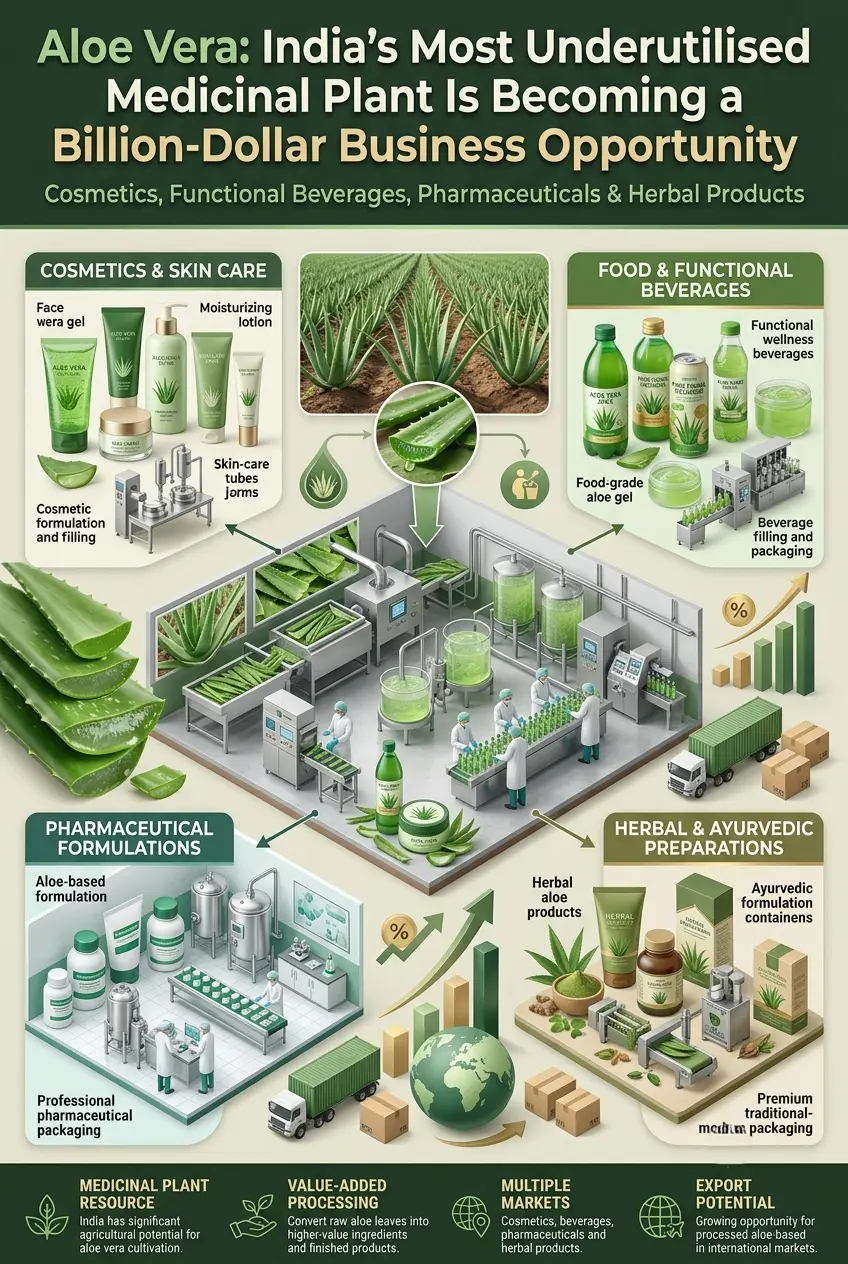
The range of products that can be derived from aloe vera is much broader than most people realise. That is what makes it such an attractive agricultural and manufacturing proposition.
Cosmetics and Skin Care
Aloe vera gel, stabilised and concentrated, is a base ingredient for sunscreen lotions, moisturisers, after-sun products, anti-acne treatments, anti-ageing serums, and hair care products. The Indian cosmetics market — valued at over USD 15 billion and growing at roughly 10% annually — represents a significant domestic procurement opportunity alongside export potential.
Food and Functional Beverages
Aloe vera juice and gel-based health drinks are among the fastest-growing segments in India’s functional food market. The low-laxative aloe vera gel formulations approved for food use have opened the category to mass-market FMCG distribution.
Pharmaceutical Formulations
Aloe vera-based ointments, wound dressings, dental gels, toothpastes, and topical anti-inflammatory preparations are already commercially produced. As the clinical evidence base expands, the range of approved pharmaceutical applications is expected to follow.
Herbal and Ayurvedic Preparations
Aloe vera is a component in a wide range of traditional formulations — from Kushta and Majun preparations in the Unani system to gel-based preparations recommended under AYUSH guidelines. The Ministry of AYUSH’s support for Ayurvedic manufacturing provides a strong institutional market.
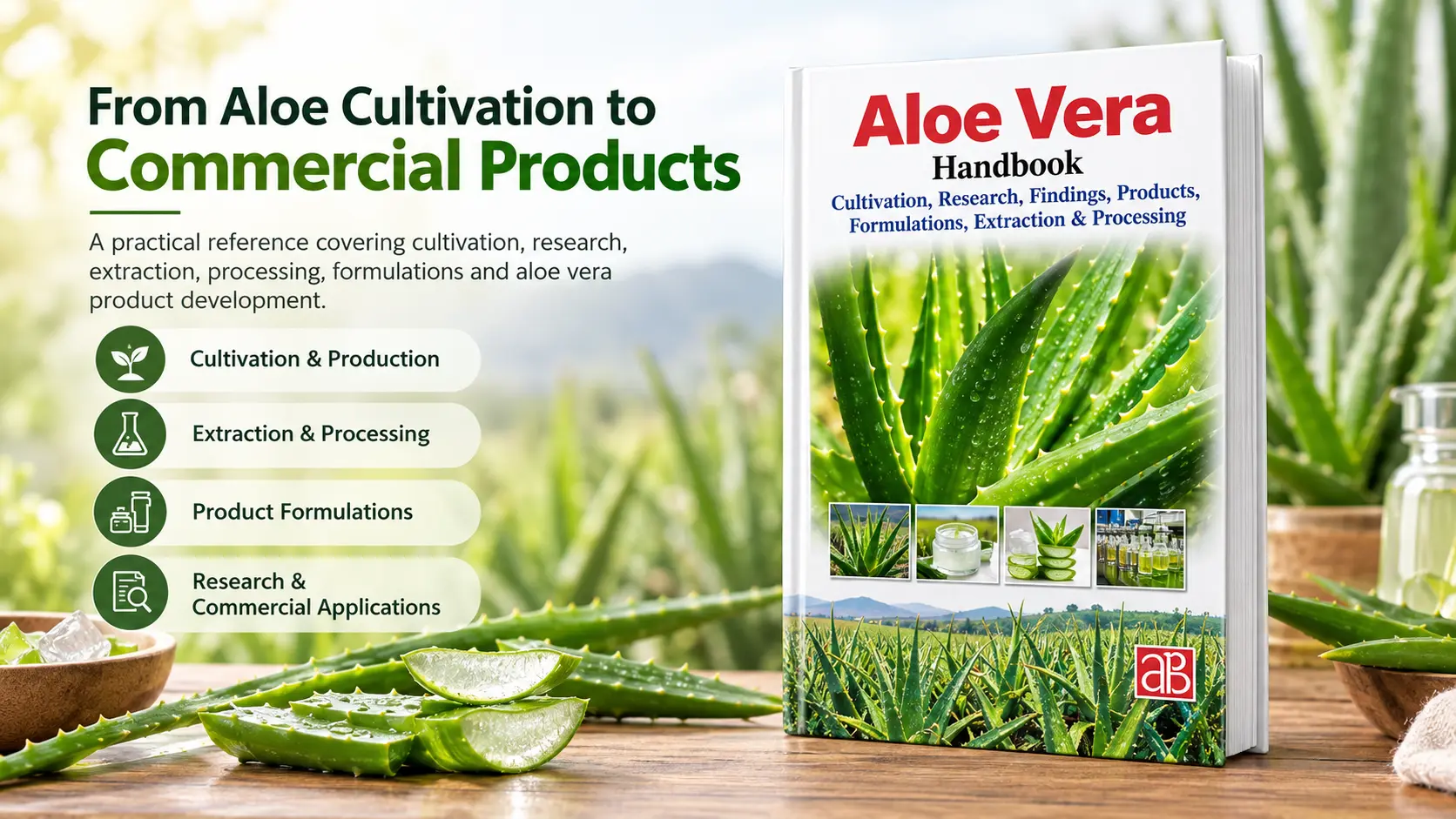
About the Book: Aloe Vera Handbook — Cultivation, Research Finding, Products, Formulations, Extraction & Processing
The Aloe Vera Handbook authored by H. Panda and published by Asia Pacific Business Press Inc. under the NIIR imprint is one of the most comprehensive single-volume references on the science, cultivation, and commercial application of this remarkable plant.
At 496 pages, it combines four distinct bodies of knowledge that are rarely found together in a single accessible reference — the agricultural science of cultivation, the chemical and biological science of the active constituents, an extensive compilation of global clinical and pharmacological research findings, and the practical processing and formulation guidance needed to turn raw aloe vera into commercial products.
What the Book Covers
- Historical developments and validated research findings — antibacterial, anti-inflammatory, anaesthetic, analgesic, antifungal, and immunostimulatory properties
- Geographical distribution, botanical anatomy, and chemical investigation of different leaf components
- Complete agro-technique for cultivation: land preparation, disease management, harvesting, storage, yield data, and economics of cultivation per hectare
- Investment opportunity analysis — global market scenario, Japanese market data, key international players, Indian market overview, and strategy for capacity creation
- Extensive research findings compilation — 40+ peer-reviewed clinical study summaries covering wound healing, diabetes, heart disease, cancer, AIDS, gastrointestinal disorders, burns, skin inflammation, and dental applications
- Detailed extraction process guidance — aloe vera gel process, whole leaf cold process advantages, solvent extraction, spray drying, soft extract production, and effluent treatment
- Herbal formulations — traditional Unani and Ayurvedic preparations incorporating aloe vera, with formula details
- US patents section — 12+ detailed patent summaries covering aloe vera ophthalmic solutions, toothpastes, ointments, decongestant compositions, immune-boosting extracts, and anticancer applications
The clinical research chapters are particularly exceptional in scope. The book compiles and summarises an extraordinary body of evidence — from wound healing studies and AIDS research to gastrointestinal disorder trials and radiation burn management — giving readers access to decades of pharmacological knowledge in a single reference. This is the kind of material that would otherwise require access to multiple academic journals and research databases.
For entrepreneurs and manufacturers, the investment opportunity chapter is immediately actionable. It covers global market sizing, the specialty raw material market for cosmetics and toiletries, driving factors for demand, key international and Indian players, and detailed strategy for capacity creation and marketing — structured as a practical business intelligence brief rather than a theoretical market overview.
The book is the rare reference that documents the process economics of cultivation — including economics per hectare — and provides the baseline data needed for techno-economic feasibility analysis of aloe vera farming and processing ventures for project planners and bank loan officers.
Who Should Read This Book
The readership is genuinely diverse. Farmers evaluating aloe vera as a cash crop will find the agro-technique and cultivation economics chapters directly useful. Cosmetics and personal care manufacturers looking to reformulate with aloe vera-based inputs will find the ingredient science and formulation chapters essential. Pharmaceutical manufacturers and R&D teams will find the clinical research compilation invaluable as a literature review foundation. Entrepreneurs planning a gel extraction or aloe vera processing unit will find the process guidance and investment analysis directly applicable to project planning.
Students of pharmacy, agricultural science, and food technology will find it a reliable academic reference. Consultants and project report writers evaluating aloe vera ventures will find the economics, process, and market data all in one place. And healthcare professionals interested in evidence-based botanical medicine will find the clinical research sections rigorous and substantive.
What makes the book stand out in a field crowded with general wellness content is its commitment to technical accuracy and commercial specificity. It does not over-simplify the plant’s properties or make unsubstantiated claims. It documents what the research actually shows, describes what the processing actually involves, and outlines what the commercial opportunity actually looks like — with numbers.
5 AUTHENTIC GOVERNMENT REFERENCE LINKS
- Ministry of AYUSH — National AYUSH Mission and Medicinal Plant Cultivation Support: https://ayush.gov.in/
- APEDA — Agricultural & Processed Food Products Export Development Authority, India: https://apeda.gov.in/
- Ministry of MSME — Schemes for Agro-Processing and Small Manufacturers: https://msme.gov.in/
- Invest India — Opportunities in the Pharmaceuticals and Herbals Sector: https://www.investindia.gov.in/sector/pharmaceuticals
- National Medicinal Plants Board (NMPB) — Ministry of AYUSH, Government of India: https://nmpb.nic.in/
PURCHASE THE BOOK
The Aloe Vera Handbook — Cultivation, Research Finding, Products, Formulations, Extraction & Processing is available now from Asia Pacific Business Press Inc. / NIIR Project Consultancy Services. Whether you are planning an aloe vera cultivation venture, setting up a gel processing unit, formulating cosmetic or herbal products, or simply need the most complete technical and clinical reference on this plant available in one place — this is the book.
Buy from the publisher, Amazon India, or Flipkart:
Niir.org — Official Book Page: https://www.niir.org/books/book/aloe-vera-handbook-cultivation-research-finding-products-formulations-extraction-processing/isbn-8178330245/zb,,7a,a,0,0,a/index.html
Amazon India: https://www.amazon.in/dp/B0072GKM1C
Niir Project Consultancy Services (NPCS) | Asia Pacific Business Press Inc. (APBP)
106-E Kamla Nagar, New Delhi — 110007 | ISO 9001:2015 Certified
30+ Years | 150,000+ Project Reports | 85 Countries | niir.org
For bulk orders, institutional purchases, or consultancy enquiries: www.niir.org
Your Investment Deserves the Right Opportunity
Every serious investment begins with choosing the right sector and the right business model. With hundreds of industrial opportunities available across India’s manufacturing and clean-energy landscape, making the most informed choice is critical. NPCS Startup Selector tool helps entrepreneurs, MSMEs, and investors identify the most suitable business opportunities based on their investment capacity, location, and interests — so your capital is directed toward a venture with the strongest fit and potential.


