





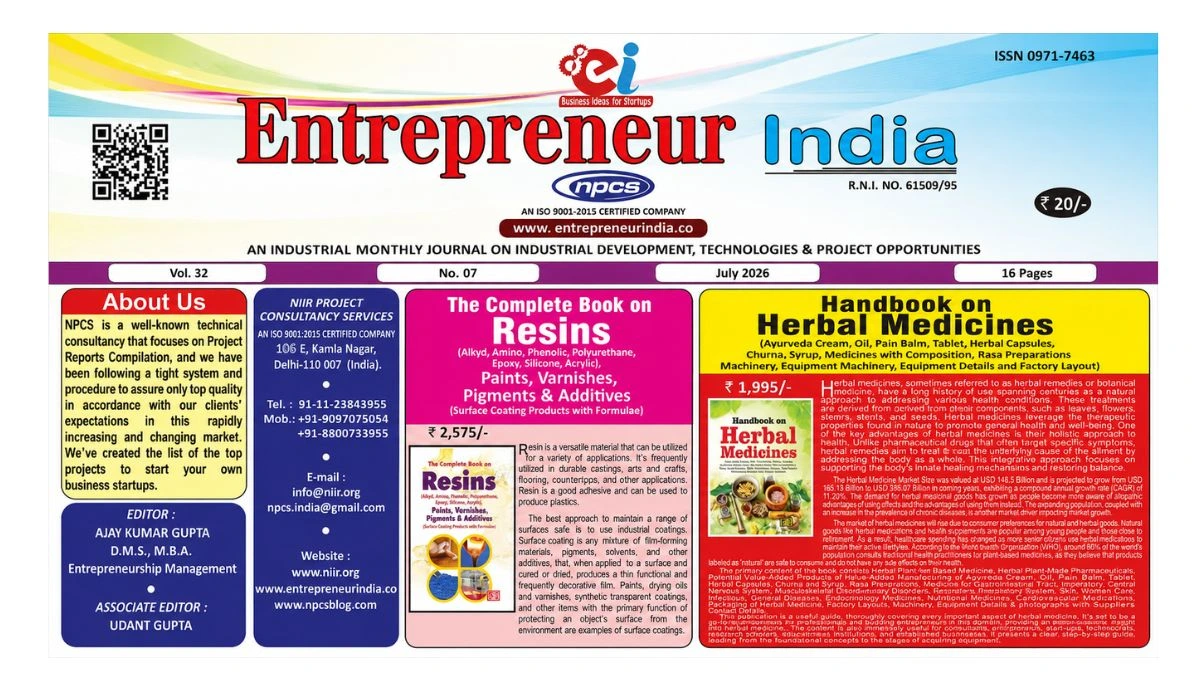
Entrepreneur India Magazine July 2026
The Entrepreneur India July 2026 issue is out now and features a curated list of manufacturing opportunities, industrial project ideas, market-centric views and actionable information for entrepreneurs who want to start or grow their businesses.
The July 2026 edition is aimed at entrepreneurs, MSMEs, start-ups, investors, consultants, financial institutions and industrial planners published by Niir Project Consultancy Services (NPCS). Instead of providing an idea of a business venture, the question is about the actual questions that will determine if a manufacturing opportunity can actually be turned into a viable industrial project.
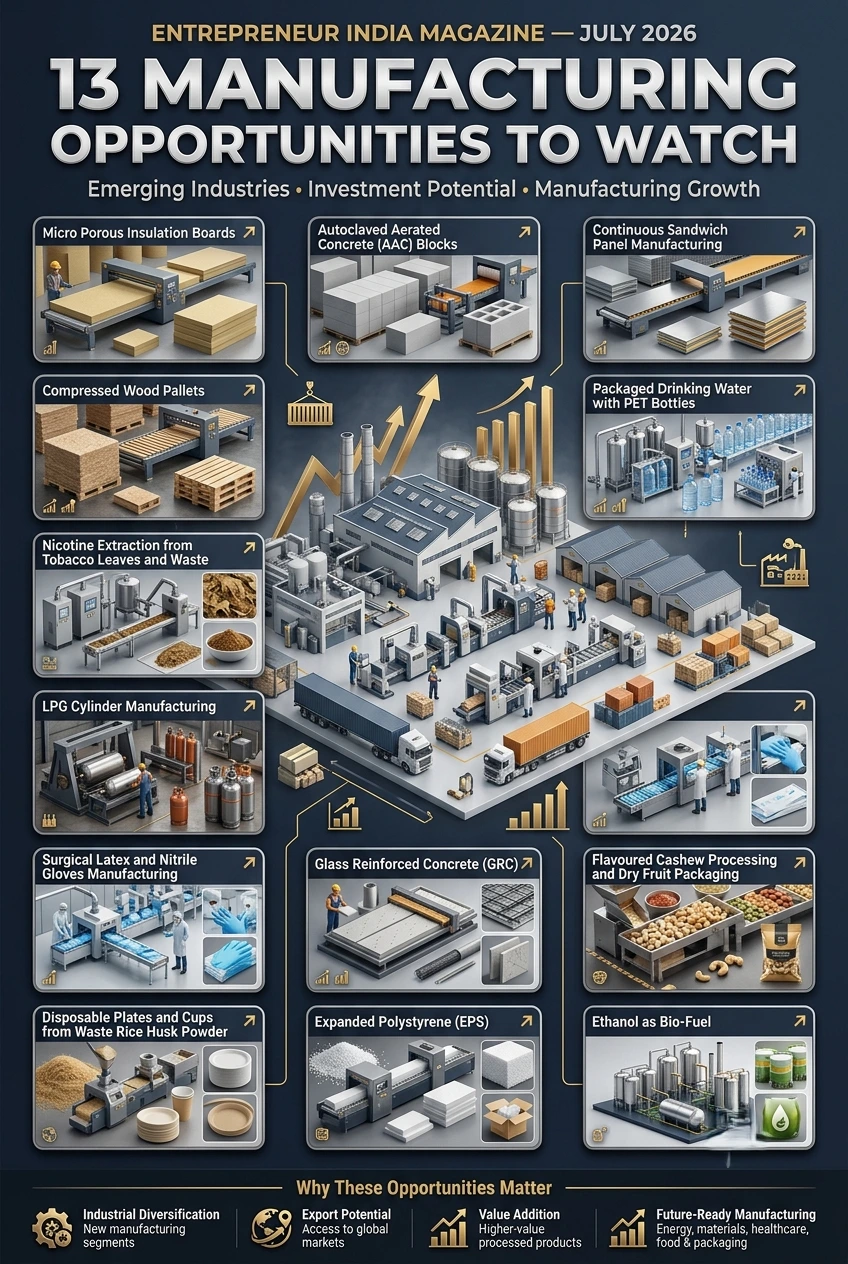
The 13 manufacturing opportunities in this latest issue include industrial insulation, construction materials, logistics, healthcare products, food processing, packaging, renewable energy, specialty products and waste-to-wealth applications.
If manufacturing business opportunities in India are being researched by anyone with an eye on 2026, then the problem can serve as a starting point to help them find the areas of industrial demand with value addition, sustainability, infrastructure development, and domestic consumption.
About Entrepreneur India July 2026
It takes a lot more than simply finding a product that will sell in order to start a manufacturing enterprise.
Before giving any capital to a technology, plant capacity, machine, raw materials, investment, operating cost, regulatory requirement, market position and customers, an entrepreneur should analyse the technology, plant, machine, raw materials, investment, operating cost, regulatory requirement, market position and customers.
Entrepreneur India – July 2026 takes a pragmatic approach to manufacturing. The magazine is a mixture of market intelligence, project economics, manufacturing information and investment indicators that assist readers to evaluate industrial opportunities prior to making any major investment decisions.
The issue is especially germane to the entrepreneurs who have come out of the idea phase and started examining the actual project implementation of their ideas.
The magazine’s overall goal is to educate the readers about the methodology of assessing the potential of industrial concepts and their development into viable, viable startups and investment projects.
13 Manufacturing Opportunities Featured in the July 2026 Issue
The Entrepreneur India July 2026 magazine boasts 13 manufacturing projects as one of its top highlights.
The projects span across various industries in India, such as construction, infrastructure, healthcare, food processing and packaging, logistics, energy and sustainable manufacturing.
1. Micro Porous Insulation Boards
Micro Porous Insulation Boards is a niche application in the industrial insulation market.
The project focuses on industrial applications that require thermal insulation and energy efficiency like steel plants, furnaces, cement plants, aluminium, glass and electric vehicles and other energy-intensive industrial applications.
Advanced insulation material can be a great component in energy efficient industrial operations, as industrial businesses seek to improve their energy efficiency and manage operating costs.
This project shows how technically driven products can have multiple industrial end-use areas of interest for entrepreneurs.
Get Detailed Project Report (DPR): Micro Porous Insulation Boards Manufacturing
2. Autoclaved Aerated Concrete (AAC) Blocks
One of the major modern construction materials discussed in the issue includes AAC Blocks.
The project targets on light, energy efficient, environmentally friendly building products.
The demand for construction materials is going high due to the ever-dynamic urbanization and infrastructural development, thus AAC Blocks are an important manufacturing segment for the entrepreneurs who are interested in construction related industrial opportunities.
View Full Project Details: AAC Blocks Manufacturing Project Report
3. Continuous Sandwich Panel Manufacturing
In the industrial construction of modern times, Continuous Sandwich Panels are widely used.
Their uses in industrial buildings, warehouses, cold stores, logistics facilities, pharmaceutical plants, and pre-engineered buildings are explored in the July issue.
This opportunity is closely tied in with the growing industrial infrastructure in India and the need for quicker, more efficient, and insulated building systems.
Access Complete Business Plan: Continuous Sandwich Panel Manufacturing
4. Compressed Wood Pallets
The issue also delves into a combination of logistics demand and sustainable manufacturing practices that is Compressed Wood Pallets.
This idea will take wood waste and transform it into pallets for logistics, warehouses, exports and modern supply chains.
This is especially true with the rise in the popularity of circular-economy models, under which industrial waste can be utilized in a commercial product instead of being discarded.
Read the Complete Book Here: The Complete Technology Book on Wood and Its Derivatives
5. Nicotine Extraction from Tobacco Leaves and Waste
A particular niche area that was addressed is the extraction of nicotine from tobacco leaves and waste.
The project showcases the potential of transformation of agricultural by-products to higher value pharmaceutical and specialty chemical products.
It’s a more general waste-to-wealth manufacturing approach, where value can be added by recovering commercially useful materials from existing agricultural material.
Get Detailed Project Report (DPR): Nicotine Extraction from Tobacco Waste
6. Packaged Drinking Water with PET Bottles
Packaged drinking water continues to be a key consumer-oriented manufacturing industry.
The July issue delves into packaged drinking water in PET bottles, in light of the various factors such as urbanization, travel, hospitality, retail consumption, and the growing demand for safe packaged drinking water.
The project is designed to serve as a template for an industry that has access to the market, quality of production, product packaging, distribution, and regulatory compliance.
Access Complete Business Plan: PET Bottled Water Manufacturing Plant Report
7. LPG Cylinder Manufacturing
This is another industrial project highlighted in the issue, LPG Cylinder Manufacturing.
LPG cylinders are a capital-intensive manufacturing opportunity associated with the domestic and commercial energy supply infrastructure, and unlike many new consumer businesses, they don’t have an endless supply of available product.
Sustainable demand in the domestic market is cited as an important factor in promoting this industrial sector in the issue.
Related Article: How to Start a Transparent LPG Cylinder Business Using Fiberglass Composite Technology
8. Surgical Latex and Nitrile Gloves Manufacturing
Another strong theme in this July’s issue is healthcare manufacturing.
Surgical latex and nitrile gloves are used to solve the needs to prevent infection or healthcare facility needs.
The project also promotes export potential, as the quality healthcare consumables have their share of importance both in domestic and international markets.
Get Detailed Insights from This Book: Medical & Surgical Disposable Products Handbook
9. Glass Reinforced Concrete (GRC)
Glass Reinforced Concrete is offered as a chance for modern construction materials.
Durability, fire resistance, and design flexibility are some of its applications that can benefit from these properties.
Specialized construction products, in addition to conventional building materials, can provide opportunities as construction demands more materials that can be used to fulfill functional, aesthetic, and performance needs.
View Full Project Details: Glass Reinforced Concrete Manufacturing
10. Flavoured Cashew Processing and Dry Fruit Packaging
The food processing activities are represented by Flavoured Cashew Processing with Packaging of Dry Fruits.
It is a project that has a specialization on value addition, branding, packaging and altering consumer preferences.
Organised food manufacturers can achieve product differentiation by developing new products, packaging them in interesting ways, and positioning them as premium products.
Explore This Book: The Complete Book on Cashew (Cultivation, Processing & By-Products)
11. Disposable Plates and Cups from Waste Rice Husk Powder
The creation of waste rice husk powder disposable plates and cups, being one of the more sustainable solutions in the issue, should be mentioned.
The idea creates a biodegradable tableware by using agricultural wastes and promotes the concept of circular economy.
It’s also a sign of increasing eco-consciousness and the shift to non-plastic items.
Get Detailed Insights from This Book: Manufacture of Value Added Products from Rice Husk (Hull) and Rice Husk Ash (RHA)
12. Expanded Polystyrene (EPS)
Another opportunity for manufacturing is Expanded Polystyrene, which was covered in the July edition.
EPS finds applications across packaging, cold-chain logistics, electronics, fisheries, construction, and insulation.
Its diverse applications demonstrate how a single material can serve several industrial value chains and end-use sectors.
Get Detailed Project Report (DPR): EPS Manufacturing Business Guide
13. Ethanol as Bio-Fuel
Ethanol as Bio-Fuel is another of the strategically significant renewable-energy sectors, featured in the magazine, that are highlighted here as a final opportunity.
The project is linked with government blending initiatives, availability of agricultural feedstock and the long-term interest of India in cleaner energy solutions.
Ethanol represents the convergence of agriculture, energy, industrial processing, and sustainability – a topic of interest for entrepreneurs exploring renewable-energy manufacturing opportunities.
Check Out This Recommended Book: Handbook on Biofuel, Ethanol and Bioenergy Based Products
What Makes This Issue Different?
Having a list of business ideas isn’t sufficient to make an investment choice.
Once the opportunity has been identified, the real challenge starts.
When starting an entrepreneurial venture, there are questions that need to be answered, such as:
- What tech will be needed?
- What aspect(s) of a plant’s capacity should be taken into account?
- What equipment and machinery do you require?
- What are the raw materials needed?
- What is the potential market?
- What do the major operating costs consist of?
- Which are the applicable regulations?
- Which report should be submitted for the project?
- What are the ways of financing?
- What are some of the things that might make a project viable or not?
The July 2026 issue will try to give a more practical industrial eye going beyond project concepts.
Market surveys, highlights of techno-economic feasibility reports, project cost indicators, manufacturing-process references, guidance on machinery and equipment, industry trends, regulatory and compliance considerations, financing assumptions, and information on specialized technical publications are all included in the magazine.
It can be a very helpful resource as an entrepreneur progresses from researching a project to developing a detailed project report, investment proposal, project expansion or meeting with lenders.
Manufacturing Trends Reflected in Entrepreneur India July 2026
Bigger themes begin to emerge in the projects featured in this report across India’s manufacturing sector.
Sustainable Manufacturing
Sustainability is not just about reporting on the environment. It is becoming more and more a factor in product development and manufacturing.
Compressed wood pallets and disposable tableware made from rice-husk are examples of how waste products can be turned into commercial products.
Infrastructure and Construction
AAC Blocks, Sandwich Panels and GRC are the areas, which continue to offer opportunities, associated with the construction and infrastructure.
In today’s building industry, efficiency, performance, durability, insulation and flexibility are increasingly required properties of materials.
Healthcare Manufacturing
The fact that surgical latex and nitrile gloves are still relevant today shows that healthcare consumables remain relevant.
For manufacturers, these are opportunities for them to be involved in healthcare products where quality, consistency, compliance, and production are important.
Energy Efficiency and Renewable Energy
There are two opposing sides of the energy opportunity: Micro Porous Insulation Boards and ethanol.
One of them is for energy loss reduction in industrial applications and the other is for production of renewable fuels.
Value Addition
Value addition is seen as important in the commercial value of flavoured cashews, dry-fruit packaging, nicotine extraction, and waste-based products.
Its principle is simple: manufacturing opportunities do not necessarily revolve around more raw material. They may also be generated by processing, converting, packaging or obtaining more value from available resources.
Who Should Read the Entrepreneur India July 2026 Issue?
The magazine is targeted towards a wide industrial readership.
It can be beneficial for:
Entrepreneurs: Individuals who are conducting their initial research on a manufacturing opportunity can utilize the opportunities listed to help them get started with their manufacturing sector research.
Existing manufacturers can find diversification and expansion possibilities in MSMEs.
Startups: To learn about various manufacturing segments, founders can study physical products or industrial businesses.
Investors: Investors assessing the potential of industrial opportunities can use the issue to take a deeper look at industrial sectors in which they are interested.
Opportunities: Industrial consultants can make use of the project information as a reference point for their assessment of opportunities.
Financial Institutions: Project economics and investment indicators can be helpful to provide context for discussions on industrial projects.
Industrial Planners: The issue can be used for early research into plant setup, manufacturing processes, equipment and market opportunities.
The magazine’s description explicitly targets groups of entrepreneurs, MSMEs, startups, investors, consultants, financial institutions and industrial planners.
Find the most profitable startup for your investment range
Why Entrepreneurs Should Not Choose a Manufacturing Business on Demand Alone
A high demand doesn’t necessarily equal a profitable manufacturing business.
One of the key thing’s entrepreneurs need to grasp before investing is this.
The strong demand for a product can also come with high capital investment, high raw material costs, high competition, inefficient technology, regulatory hurdles, or weak distribution, which can result in poor returns.
In a similar way, a relatively niche product can be interesting if it has a good industrial use, few competitors, has some added value and the production economics are not too high.
It’s because of this that feasibility analysis is important.
The July 2026 issue focuses on structured planning based on technology, capacity, machinery, raw material, compliance, operating costs and market positioning.
Instead, the magazine should be used as an initial guide to investment research, not an investment replacement.
From Business Idea to Investment-Ready Project
Commercialization of a manufacturing idea depends on its ability to be converted to a practical project.
In this process generally understanding about the product, technology, production capacity, machinery, raw materials, manpower, utilities, market, investment requirement, operating cost, revenue, profitability, financing and risks is required.
The focus on techno-economic information for the July issue is useful as it deals with a lot of investment in manufacturing.
Entrepreneurs must have a systematic knowledge of economics of a project before investing in land, machinery, utilities, manpower and inventory.
This is especially relevant to capital intensive projects like LPG cylinder production and industrial products, where start-up capital or the business structure is not always comparable to smaller manufacturing ventures geared towards consumer products.
Free Download: Entrepreneur India July 2026
Readers interested in the manufacturing opportunities and industrial resources featured in the Entrepreneur India July 2026 issue, can delve deeper into the topic.
The issue brings together all the facts on manufacturing projects, market-oriented information, project economics, machinery guidance, industry trends and more all related to industrial planning.
Download the Latest Issue for Free
Whether you’re investigating a new manufacturing venture, considering an expansion opportunity, or just searching around for new manufacturing sectors, download the July 2016 issue and check out the projects in detail.
Conclusion: Explore the Next Manufacturing Opportunity
It is important to note that opportunities are cropping up in both traditional and emerging sectors like advanced materials, construction, healthcare, food processing, logistics, renewable energy and packaging, and sustainable manufacturing in the manufacturing economy of India, as reflected in the Entrepreneur India July 2026 issue.
The 13 projects are diverse but have a common theme – value creation through practical production in industry.
As an entrepreneur, the difficulty is not just in locating a fascinating business concept. The true question is whether that concept can be realized in a business model that’s viable.
That requires market research, technology evaluation, project economics, investment planning, regulatory assessment, and a realistic understanding of competition and execution.
The July 2026 edition provides a useful starting point for that process.
Download the Entrepreneur India July 2026 issue for FREE and explore the manufacturing opportunities, industrial insights, and project resources featured in the latest edition.
https://www.entrepreneurindia.co/magazine-details/180


