





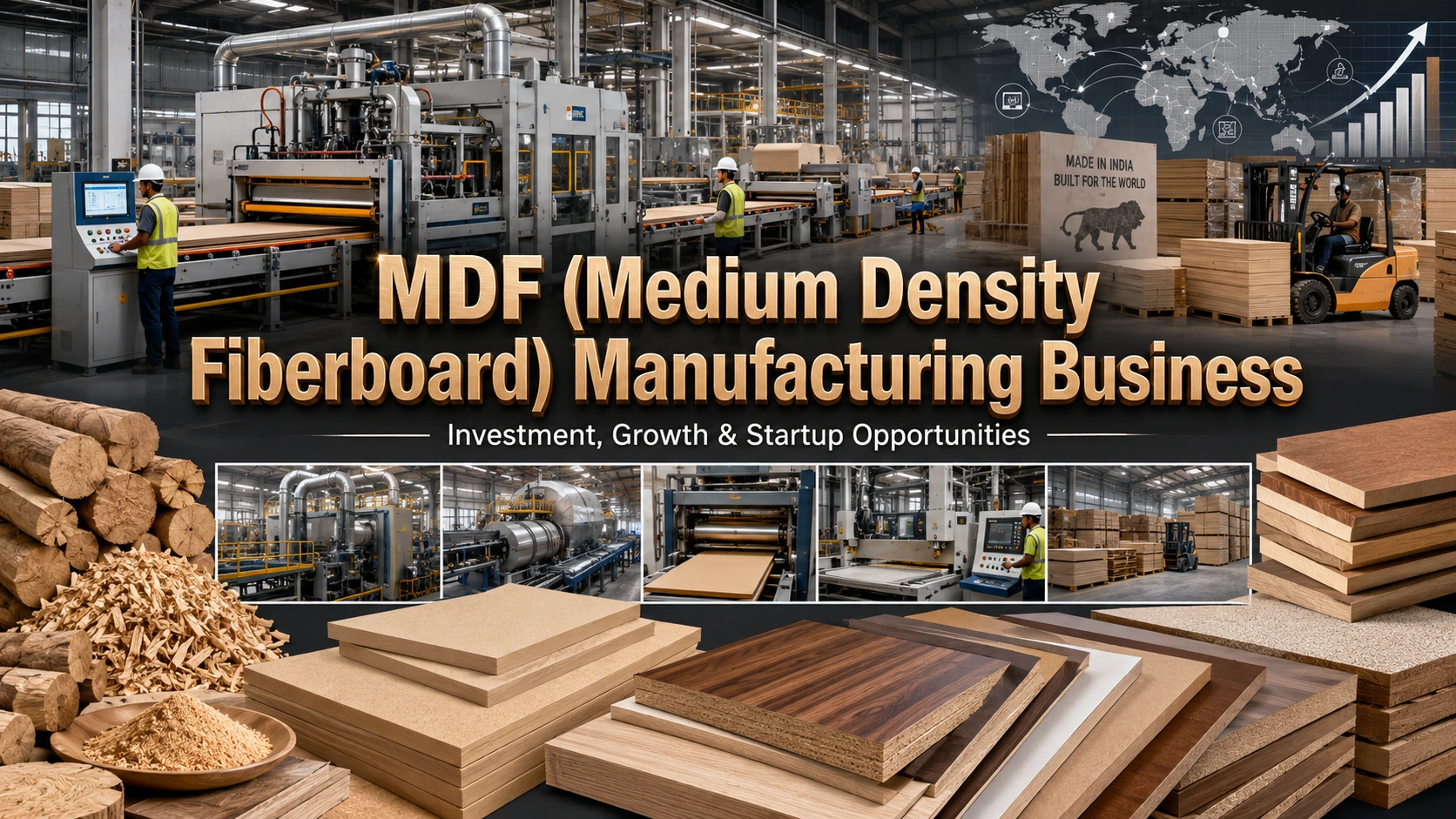
MDF Manufacturing Business
As every entrepreneur looks for solid manufacturing business ideas that they can look forward to, they will inevitably come across one uncomfortable truth: Most of the traditional businesses are already saturated, have low margins, or don’t grow quickly enough. However, there is one exception: Medium Density Fibreboard (MDF). It is at the crossroads of the growth of housing, the demand for furniture and a government initiative towards organised manufacturing. Hence, it should be taken seriously by first generation entrepreneurs as well as industrialists.
I have been involved in feasibility studies for wood-panel projects for more than 10 years and MDF always seems to be one of the areas with a high demand for panel materials that is difficult to satisfy domestically. MDF doesn’t require scarce hardwood logs like plywood. It is based on wood waste, agro-residue and fast-growing plantation species. That is one fact which alters the entire economic equations of the business.
In this article, the author begins by elucidating the commercial viability of MDF production in contemporary times, moves on to detailing which policies are being adopted by the Government which will benefit new plants, and finally concludes with the specifics of some business concepts that can be followed within this industry.
Get Detailed Insights from This Book: The Complete Technology Book on Wood and Its Derivatives
Why the MDF Industry Deserves Your Attention
The furniture and interior décor industry in India has experienced a tremendous growth in the past few years. Builder, modular kitchen manufacturers and RTA (ready to assemble) furniture manufacturers are increasingly using MDF as the standard material over plywood as it lends itself to clean cutting, to the same degree as laminate and paint and is less costly per cubic metre. Consequently, demand for engineered wood panels has been trending upward.
But India has not yet caught up with the rest of the world. The ratio of MDF to Plywood consumption is far in favour of MDF globally and in India it is highly skewed in favour of Plywood. That’s the reason there is an opportunity. Indian consumer behaviour is catching up with the world, so is the panel makers who are entering the market now.
Urbanisation and Housing Are Structural Tailwinds
The government’s affordable housing initiatives have resulted in a regular and substantial demand for interior building materials. Doors, kitchen cabinets, wardrobes and false ceiling panels are required for every new housing unit. All these applications are covered by MDF. Hence, offtake of MDF is also increasing with the continuous expansion of urban housing supply.
Moreover, the activity of real estate renovation has increased in metros and tier-2 cities. Modular, factory finished interiors are becoming a more popular option than carpeting it all on site. This trend is a boon to manufactured panel products, such as MDF, as consistency and speed are more important than ever to time-conscious customers.
Raw Material Logic Makes the Business Viable
The wood chips, sawmill residue, agro-fibre and resin are consumed by the MDF plants. These inputs are readily available throughout the plantation belts of India and a new entrepreneur does not have to compete for limited imports of timber. This is one of the best reasons for MDF to become a manufacturing business opportunity — as opposed to plywood which is dependent of logs and is more susceptible to global price fluctuations.
Get Detailed Project Report (DPR): Medium Density Fiberboard (MDF Board) Manufacturing
Government Policies and Incentives Supporting New MDF Units
Poor product ideas are hardly the reason for the failure of new manufacturers. They fail because they don’t account for capital needs, and they don’t consider the government’s help. Fortunately, the policy framework in India for MSME manufacturing has come a long way, and MDF projects are eligible to several schemes.
Credit-Linked Subsidy Through PMEGP
The Khadi and Village Industries Commission under Ministry of MSME has devised the Prime Minister’s Employment Generation Programme (PMEGP) that provides subsidy for setting up new manufacturing units. Manufacturing units can get subsidy support on project costs and it reduces the promoter’s equity contribution which is significant. This scheme can help to defray a substantial portion of the initial investment requirements for a small MDF processing or laminated-board unit.
Mutual Credit Guarantee Scheme for MSMEs
Under the Mutual Credit Guarantee Scheme (MCGS-MSME), a considerable portion of loans availed specifically for the acquisition of Plant and Machinery shall be covered by the guarantee. This collateral-easing scheme directly tackles the biggest obstacle that any new founder has to overcome: obtaining financing from a bank for expensive equipment without asking for too much collateral, and the manufacturing of MDF involves expensive presses, dryers and forming lines that cost real money.
Credit Guarantee and Collateral-Free Loans
CGTMSE or the Credit Guarantee Fund Trust for Micro and Small Enterprises provides credit facility for new units without offering any security. While this, women entrepreneurs and SC/ST entrepreneurs planning to establish a greenfield manufacturing plant, including a wood panel business, are supported by schemes specifically for them.
Quality Control and Standardisation Push
Recently, in order to ensure adherence to certain standards, the government issued Quality Control Orders for plywood and MDF boards prior to sale. At first glance, this could appear to be an imposition on compliance. In fact, it is a benefit to the organised and well capitalised new manufacturers as it drives the unregistered substandard manufacturers out of the market and increases the buyer’s confidence in registered manufacturers. BIS notifications should be closely monitored by entrepreneurs while creating specifications for their plant.
Make in India and State Investment Incentives
To promote the wood-panel and furniture industry, several state governments provide capital subsidies, exemption from stamp duty, and power tariff concessions to the units in the industrial corridors close to plantation belts under the umbrella of Make in India. There is no uniformity in state industrial policies, so potential plant founders must review the incentive package available in the state in which they choose to locate their plant; some states currently offer significantly more aggressive investment policy incentives for this sector.
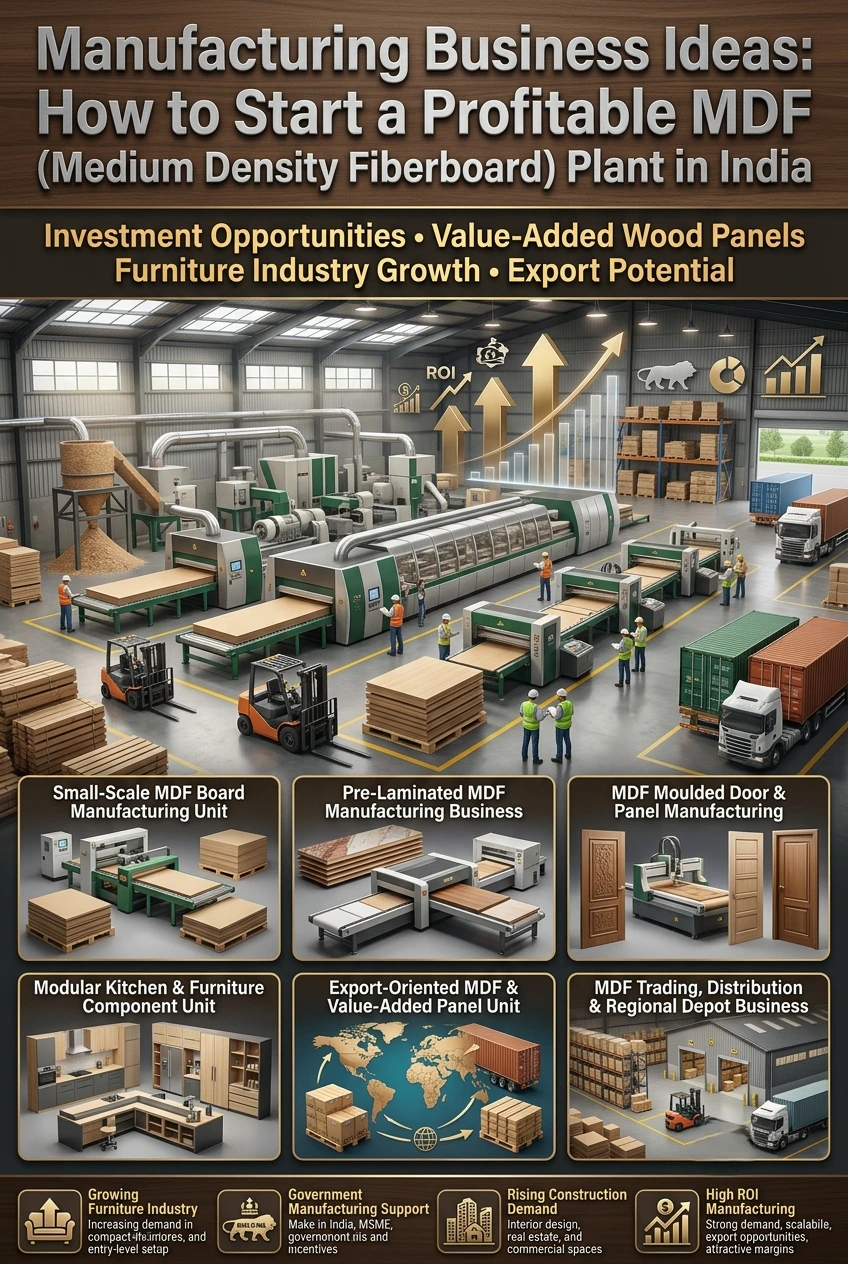
Multiple Business Ideas for Startups in the MDF Value Chain
MDF is not a cohesive industry. It’s a whole chain and every link is different based on the financial backing and willingness of the founder to take risk.
Small-Scale MDF Board Manufacturing Unit
A small MDF machine, comprising of a single day light or continuous press line with a moderate daily capacity is appropriate for a founder with limited resources of both capital and wood fibre. It is especially appropriate in the vicinity of plywood units or agro-processing belts, where the logistics of raw materials are already in place. The basic process (fibre preparation, mat forming, hot pressing and sanding) is fairly well documented and, if the right machinery vendors are selected, a new promoter can put a plant into operation within a reasonable time.
The issue here is press technology; continuous presses have a higher initial cost, but ensure board consistency is improved, a factor which is crucial when customers begin to compare panels to the branded equivalent.
Choose the right startup backed by real market demand
Pre-Laminated MDF Manufacturing Business
An entrepreneur can instead incorporate a lamination line and sell pre-laminated MDF directly to furniture manufacturers and modular kitchen brands. This is the case as it generates much more margin than sales of raw board, where the customer pays for finish, design selection and convenience of ready-to-use board. A founder who wants to come into this field should put money into a design library and a dependable chain of adhesive and melamine-foil suppliers; the quality and uniformity of the surface is key to the success or failure of the finished-panel business.
MDF Moulded Door and Panel Manufacturing
Doors, being one of the fastest growing applications for MDF, offers a resistance to warping better than solid wood and is less expensive than engineered timber doors. Production of doors with dedicated door-manufacturing unit that imports raw MDF boards from larger board mills, with the addition of moulding, painting and edge-finishing is a lighter capital investment compared to building a full board plant. This will make it an appealing starting point for founders looking to get exposure to the MDF ecosystem but don’t want to make the biggest initial investment.
Modular Kitchen and Furniture Component Unit
The founder may not be in the furniture industry but can establish a furniture component company, purchasing MDF board to make cabinet shutters, wardrobe panels, and kitchen carcasses. The second-tier cities are emerging as a market for the modular furniture retail chains and the suppliers of components are required to ensure consistent precision in CNC cutting and fast turnaround times. This is an idea that works for entrepreneurs with a better grasp of the furniture design and retailing aspects than process manufacturing.
Export-Oriented MDF and Value-Added Panel Unit
A founder that has access to coastal logistics can set up a plant specifically for the export to the Middle East, Africa and Southeast Asia where there is a growing demand for cost competitive engineered panels. Export units generally require certification, quality documentation and discipline in packaging, from the initial day of operation and they also enjoy better realisations than the domestic trade market particularly when currency fluctuations work in favour of the Indian exporters.
MDF Trading, Distribution, and Regional Depot Business
If you are a startup without any capital to manufacture, starting a regional stocking and distribution point for branded MDF boards is still a solid business plan. Constantly there is a need for reliable, close supply of wood as opposed to waiting for it to arrive by long distance freight from major mills by carriers without certainty. Reliable, nearby supply of wood is always required by carriers, small furniture factories, and local dealers, who cannot wait for long distance freight from the major mills. Once cash flow is available, a good location with good dealer relationships can become a feeder business for value added lamination or door manufacturing in the future.
Related Article: Medium Density Fiberboard (MDF) Business
Import–Export Opportunity Analysis
While the capacity has continued to grow in India, some of the MDF requirements are still being met from imports, especially the higher thickness and speciality boards. This gap will be an immediate opportunity for import substitution manufacturing because a quality-certified product that’s competitively priced can take the market for imported material.
In the export front, Indian MDF manufacturers are beginning to sell MDF panels to countries in the Middle East, Africa and neighbouring South Asian nations. Indian manufacturers now have greater leverage against international tenders with a new policy of Quality Certification in place and a new Quality Control Order regime, which will improve domestic capacity usage and boost their competitiveness. Besides, availability of raw material in plantations in India provides India with a true cost advantage over a few countries which are import dependent.
Export incentive structure and duty drawback rates are fluctuating and therefore attention must be paid to shipment and tariff data available from Directorate General of Foreign Trade and industry trade bulletins of various agencies like FICCI etc., by the founders who plan to start a unit for export.
Indian MSME Success Stories in the MDF Sector
Greenpanel Industries — Betting Early on a Category That Did Not Exist Yet
Under the leadership of Managing Director and CEO Shobhan Mittal, Greenpanel Industries created India’s largest MDF manufacturing footprint by taking an early and contrarian bet on a product category which consumers in India were only just beginning to understand in the early 1990s. Pantnagar was the first modern MDF plant of the company, which was established at a time when plywood was the sole medium of Indian interiors. The most difficult of the decision was probably getting others from within the organization to support an unknown product, Mittal said in the interview.
The timing was perfect, however: when furniture manufacturers started to move their focus onto being more factory finished, Greenpanel grabbed a larger market share than its competitors. The obvious lesson for new founders is that the business idea that is more likely to win by having a production discipline is more likely to succeed than the more popular idea.
Rushil Decor — Diversifying Into MDF From an Adjacent Panel Business
From decorative laminates to full-fledged manufacturing of MDF, Rushil Décor established plants across Andhra Pradesh and Odisha, including agroforestry associated and sustainability driven MDF manufacturing plants. Since the promoters already knew how to distribute their panels and how to get them to dealers, it was a logical extension and not a whole new market. In this case, a pattern is repeated, whereby an MSME entrepreneur with existing business experience in allied industries such as plywood dealers, laminate distributors or any furniture hardware suppliers can easily enter into the MDF business without worrying about the risks on the investment.
Century Plyboards — Building Trust Through Brand Discipline in a Fragmented Market
Starting as a regional plywood trading business, Century Plyboards became one of the most renowned organised plywood brands in India and eventually expanded its range to include MDF and laminate surfaces. The growth trajectory reflects the ability to consistently deliver quality products and earn the trust of the dealer over a number of years, which ultimately becomes a branded product with pricing power. The lesson for new players is that it’s not necessary to scale up in the first few boards, but creating a comparable level of discipline from the initial round of boards.
About NPCS — Turning This Opportunity Into a Bankable Project
Being a great idea is not enough to win your bank a loan or attract investors. All promoters will eventually require a detailed feasibility plan with numbers to support it. Niir Project Consultancy Services (NPCS), as it is popularly known, prepares Market Survey cum Detailed Techno-Economic Feasibility Reports for entrepreneurs intending to venture into manufacturing industries such as MDF. Usually, these reports include manufacturing process, market and demand analysis, process flow diagram, product mix and capacity planning, machinery specifications, raw material specifications, and detailed project financials including profitability analysis.
This is the type of structured, techno-economic work that often changes the lives of a founder deciding whether an MDF unit, lamination line, or component-manufacturing business is financially viable or a rough business idea.
MDF Business Snapshot: Market and Investment Data
| Parameter | Detail |
| India MDF market size | Approximately USD 1.28 billion, projected to reach USD 2.55 billion, at a CAGR near 7.3% |
| Global MDF market | Valued in the range of USD 33–41 billion, growing at roughly 8–9% CAGR |
| India vs global MDF-to-plywood ratio | India skewed toward plywood; global mix favours MDF by a wide margin |
| Largest application segment | Furniture, followed by cabinetry, flooring, and wall panelling |
| PMEGP manufacturing project cap | Project cost eligible up to Rs 50 lakh, with margin money subsidy of 15–35% depending on category |
| MCGS-MSME loan guarantee | Up to 60% guarantee cover on loans up to Rs 100 crore for machinery purchase |
| Leading Indian MDF producer | Greenpanel Industries, expanding capacity through its Andhra Pradesh facility |
| Key growth driver | Affordable housing schemes and rising modular furniture adoption |
Conclusion
MDF manufacturing sits in a rare sweet spot: a growing domestic market, a widening gap with global consumption patterns, supportive government financing schemes, and multiple entry points that suit different capital levels. Whether a founder chooses a full manufacturing plant, a lamination business, a door-making unit, or simply a regional distribution depot, the underlying demand trend supports serious long-term commitment. As with any capital-intensive manufacturing decision, the founders who succeed will be the ones who pair genuine market conviction with a properly documented, bankable feasibility plan before breaking ground.
Sources and References
- Ministry of Micro, Small and Medium Enterprises, Government of India
- Make in India, Department for Promotion of Industry and Internal Trade
- Invest India, National Investment Promotion and Facilitation Agency
- Bureau of Indian Standards
- Directorate General of Foreign Trade
- Federation of Indian Chambers of Commerce and Industry (FICCI)


