




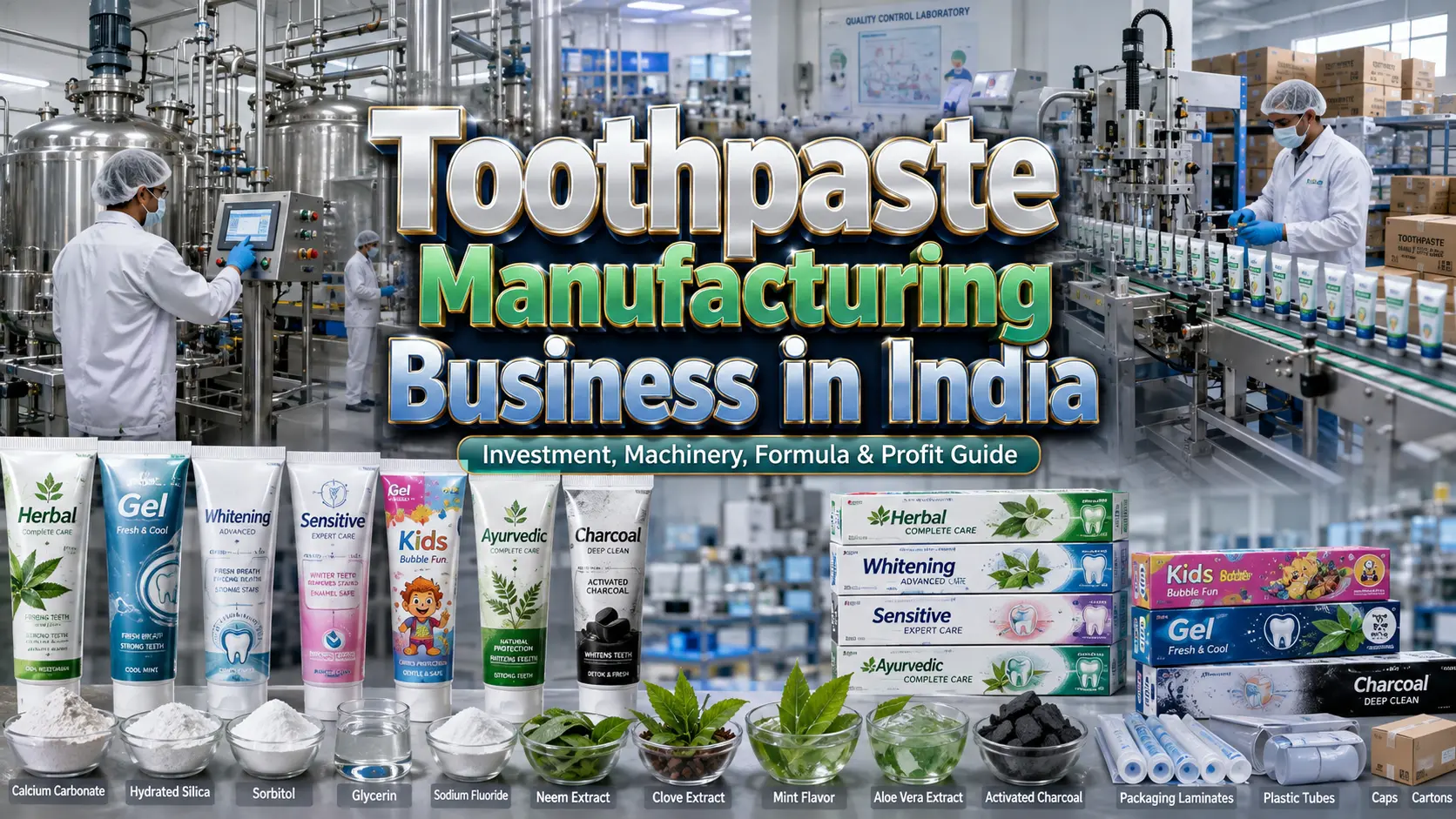
More than a billion Indians brush their teeth every day, before anything else. This one habit a day forms the backbones of one of the most resilient and scalable manufacturing sectors in India. The toothpaste manufacturing business ideas have unique features: a product that is consumed by almost everyone, multiple sub categories to enter, a domestic market worth more than USD 1.4 billion and is steadily growing. Moreover, India is the largest producer of toothpaste by volume in the world, allowing it to be in a position where it can supply as well as export toothpaste production. The toothpaste manufacturing units in India can provide real business opportunities to the aware businessman whether he is aiming to cater to mass market consumers or to the rapidly expanding herbal market, or even to the private label export market in the Middle East and Africa.
Why the Toothpaste Manufacturing Sector Rewards New Entrants
The market for oral care products in India is not only huge, it’s growing. The toothpaste market will see a compounded annual growth rate of more than 4% from nearly USD 1.44 billion to over USD 2.18 billion during the ten-year forecast period. There are three strong drivers behind this growth – increasing awareness about oral health, urbanization and the swift introduction of the branded dental products in the villages in India where tooth powder or crude alternatives still dominated.
Further, the category has experienced structural changes due to the herbs and Ayurvedic medicines. Prior to Patanjali’s launch, there was very little market share for herbal toothpaste in the market. Today, it represents almost 20-30% of the total value of the category. The oral care market is projected to grow to USD 2.13 billion by mid-decade by Invest India. Herbal and functional formulations offer better margins, less competitive price pressure from the multinationals and are a more direct fit for the requirements of export buyers from Southeast Asia, the Middle East and Africa.
Besides this, India’s production cost is also high. Domestic availability of calcium carbonate, sorbitol, sodium lauryl sulphate, glycerin and flavouring agent are available at competitive price. This enables Indian manufacturers to sell the finished products at export price points which few other countries can offer.
Get Detailed Project Report (DPR): Toothpaste Manufacturing Business
Government Policies and Incentives Supporting Toothpaste Manufacturing
The Indian government has created a well-drafted policy framework which is directly advantageous to FMCG and personal care manufacturers. As part of Make in India, the manufacturing companies in the personal care segment are getting infrastructure support, export facilitation and branding support. The Ministry of MSME provides collateral-free loans under the Credit Guarantee Fund Trust for Micro and Small Enterprises (CGTMSE) scheme, which enables the new manufacturers to get loans without any collateral, which is a great advantage to the first-generation manufacturers.
Moreover, MSME Udyam Registration also facilitates the small manufacturing sector to avail the subsidies from the government at the state level for land, power and capital equipment. The Technology Upgradation Fund Scheme (TUFS) provides for the provision of credit that would be available at subsidised rates to eligible units where they purchase modern processing and filling machines. The PLI (Production Linked Incentive) scheme for food processing also includes personal care components and incremental incentives to the manufacturers having production benchmark. Micro and Small toothpaste units can be financed up to 35% capital subsidy under the Prime Minister’s Employment Generation Programme (PMEGP) in the rural areas. Please check the Ministry of MSME for all the details of the policy.
Toothpaste Manufacturing Business Ideas for Startups
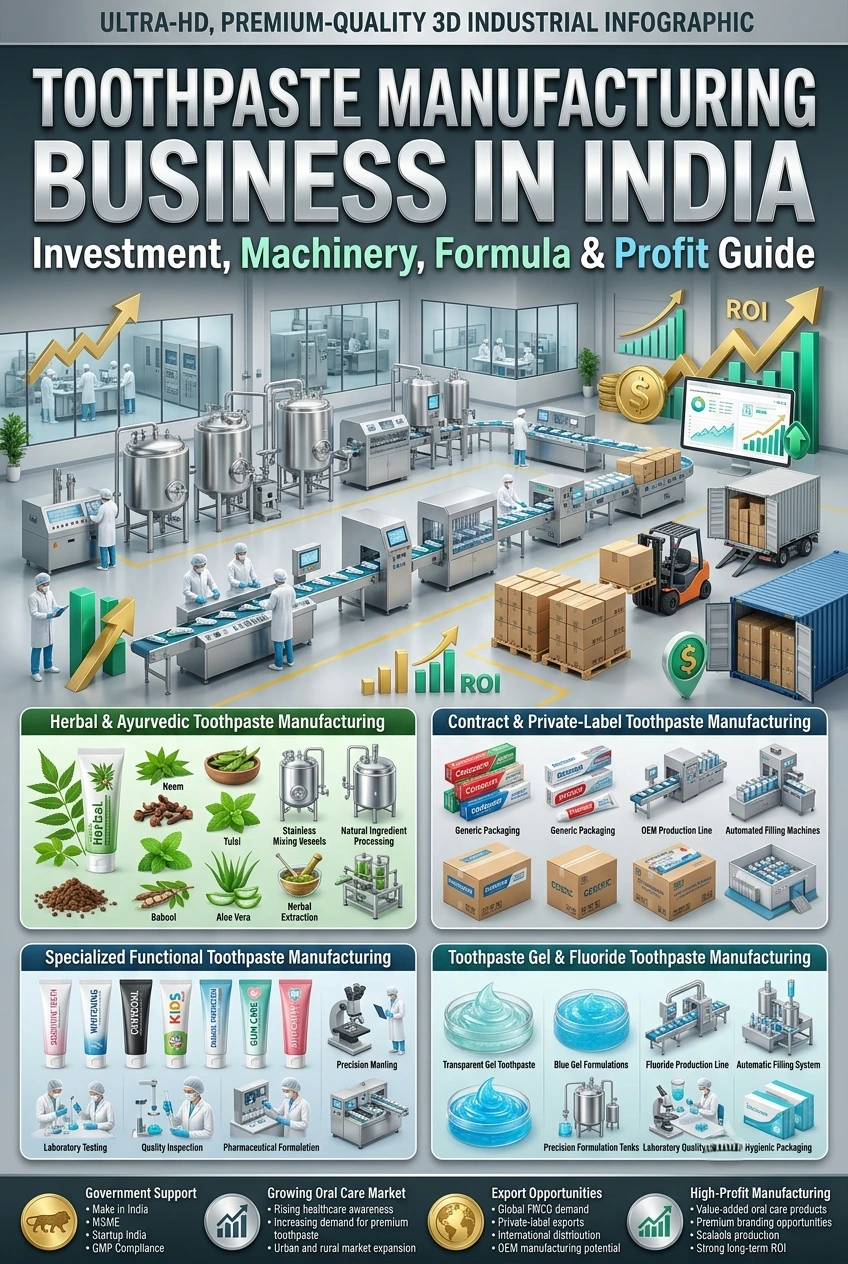
1. Herbal and Ayurvedic Toothpaste Manufacturing
The herbal toothpaste segment is one of the most lucrative avenues of commercialization for a new manufacturing company in India. The preference of the consumers for neem, clove, turmeric, charcoal, miswak and meswak formulations has changed from niche to mainstream. Likewise, herbal toothpaste typically fetches a retail price premium of 20–40% over regular variants; enabling producers to make superior margins even at moderate production levels. The investment required for a small to medium scale herbal toothpaste manufacturing unit is around ₹30 to 75 lakhs, which includes the cost of machinery, raw materials, GMP accredited premises and initial working capital. The Central Drugs Standard Control Organisation, (CDSCO) is the regulatory authority that looks after the quality standards under the Drugs and Cosmetics Act for manufacturers in this segment, who have to follow Cosmetic Manufacturing regulations. Sourcing raw ingredients from the trusted suppliers of herbal ingredients in Gujarat, Rajasthan and Uttar Pradesh is fairly easy. Further, the private label market is lucrative in the gulf, Sri Lanka, Bangladesh and African countries and this has provided immediate export potential for herbal formulations along with domestic market.
Related Article: Top 25 Herbal Ayurvedic Products Business Ideas
2. Contract and Private-Label Toothpaste Manufacturing
Contract manufacturing – the production of toothpaste for another company – is one of the most capital efficient manufacturing business models for new manufacturing entrepreneurs. Most of the time large FMCG companies and emerging D2C oral care brands opt out for outsourcing to third-party manufacturers certified as GMP. Once a new business is successful enough to get one or two contract customers, there is no more uncertainty with their revenue. Investment in a GMP certified contract manufacturing unit ranges between ₹ 50 lakh to ₹ 1.5 crore depending on the capacity and the level of automation. The Entrepreneurs are able to register their unit and avail the industrial policy support for the sectors through the Department for Promotion of Industry and Internal Trade (DPIIT). This is an excellent pathway for targeted MSME entrepreneurs to enter the market as there is a market appeal for Indian manufacturers in this segment who can offer fluoride products and herbal products, along with competitive prices, to international private label buyers.
3. Specialised Functional Toothpaste Manufacturing
The fastest growing sub-categories in India’s oral care market include sensitivity toothpastes, whitening toothpaste, gum care and children’s toothpaste. Consumers aren’t just looking for the basics in terms of hygiene; they’re looking for specific dental solutions. This transition presents a lucrative manufacturing opportunity for entrepreneurs willing to invest somewhat more in formulation development and raw material quality. Sensitivity toothpaste is sold across three different channels – FMCG, pharmaceutical and modern trade – and can include potassium nitrate or strontium chloride as main actives. A medium-size functional toothpaste unit can be established with an investment of ₹40-80 lakh. The business case is very strong: standard toothpaste can have 30-40% gross margins, but premium functional toothpaste can have 30-40% gross margins as long as the formulation quality remains consistent.
4. Toothpaste Gel and Fluoride Toothpaste Manufacturing
Gel-based toothpaste is good in metros and tier-2 cities, and has also gained popularity among younger urban consumers. The corporate demand for toothpaste and retail demand for toothpaste remains high across India with the widespread usage of fluoride toothpaste. Category diversification within a single manufacturing line provides better asset utilisation by providing a manufacturing unit to produce two types of gel and fluoride variants. Toothpaste packaging needs to comply with the standards set by the Bureau of Indian Standards (BIS) and be of good quality. The capital cost for a small to medium scale combined gel & fluoride toothpaste making unit is around ₹25-60 lakh. It’s ideal for business owners who wish to sell to regional chain pharmacies, supermarkets and dental offices, hospitals, and other institutional purchasers.
Import–Export Opportunity Analysis for Toothpaste Manufacturers
The story of India’s exports of toothpaste is really interesting. The country is the second largest toothpaste producer in Asia-Pacific region by volume and exports to various countries such as the USA, UAE, Bangladesh, UK, South Africa, Nigeria and Iraq. More than 40% of the total exports of toothpaste from India go to the top three export markets, the US, UAE, and Nepal. The average export price of USD 3,000 per tonne for India is indicative of the volume-based pricing strategy which makes it a price competitive player, offering potential for premiumisation. APEDA helps FMCG and consumer product exporters to have access to export information and market intelligence.
The opportunity is especially good in the Middle East and Africa where Indian herbal and Ayurvedic brands have a significant perception advantage. Indian origin population in the gulf countries has established a robust retail demand for familiar Indian brands in the oral care category. The indigenous population of Indian origin in the gulf countries has built a sound retail demand for well-known Indian brands in the oral care category. However, the uptake of consumer goods among consumers in Africa is increasing at a faster pace, with price-sensitive customers looking to European brands for alternatives that are affordable. Private label options or partnerships with distributors are viable and attainable options for Indian MSME manufacturers to access these markets. The Ministry of Ayush actively promotes the export of Ayurvedic toothpaste and oral care products, including participation in trade fairs and getting them certified overseas.
Get Detailed Insights from This Book: Books
Indian MSME and Industry Success Stories in Oral Care Manufacturing
Patanjali Ayurved – Baba Ramdev and Acharya Balkrishna
Patanjali’s Dant Kanti is perhaps the best example of the power of the herbal toothpaste manufacturing in India. With almost no share of the oral care market in India, whose turnover is estimated to be in the ₹10,000 crore range, Patanjali entered the market with the tag of Ayurvedic and the price tag of ₹40 for a 100g tube against ₹55–100 for its competitors. The outcome of this was a category shift, whereby near zero sales became around 20-30% in the overall market, as the herbal and ayurvedic toothpaste grew in popularity. The important thing for new businesses to learn is simply that effective formulation, clear consumer information, and value pricing can challenge even the most established players in the FMCG sector. The success of Patanjali prompted Colgate, HUL and GSK to enter the fray with their own herbal versions, which demonstrates that Indian brands can drive innovation in a category, rather than just catch up with the leaders.
Dabur India Limited – The Burman Family
The journey of Dabur’s oral care product is a real lesson in brand patience and positioning products in Ayurveda. Backed by 13 herbal ingredients, Dabur Red Toothpaste was launched in 2001 and was initially doubted by the modern consumers. But the clinical support and Ayurvedic roots of the product were what the Burman family trusted in. In time, Dabur Red evolved into a ₹1000 crore brand, India’s leading Ayurvedic toothpaste, especially in certain states such as Odisha and Andhra Pradesh. Dabur is active in exports in more than 120 countries. For new manufacturers, the Dabur story is that better formulation backed by clinical validation, coupled with patient brand building, can give long-term competitive edge and advantage, which can withstand competition like Patanjali.
Himalaya Wellness Company – Muhammad Manal’s Legacy
Himalaya was a late entrant in the oral care market as they were founded in 1930, but benefited from the scientific credibility they had already built in the field of herbal preparation for a speedy acceptance to the market. The Himalaya Herbals Complete Care Toothpaste, which contains neem, pomegranate and meswak, set a standard for GMP compliant Ayurvedic teeth care products in India. Currently, Himalaya sells its products in 106 countries and has manufacturing units in Bangalore with state-of-the-art quality controls in place. Himalaya’s model is a good example for MSME entrepreneurs that quality-based manufacturing with international standard compliance, provides good export market access. From the outset, investing in BIS certification, GMP practices and dermatology-tested formulations reap rewards on entering the regulated markets of the EU, the US and the Gulf.
Find high-return business ideas based on your budget & ROI
Expert Feasibility Support: Niir Project Consultancy Services (NPCS)
Entrepreneurs who are thinking of establishing Toothpaste and Oral Care Manufacturing Plant can avail Market Survey cum Detailed Techno-Economic Feasibility Report (DPR) from Niir Project Consultancy Services (NPCS). Our reports include the entire manufacturing process and workflow, market research and demand analysis, process flow diagrams, product mix and capacity planning, details on machinery and raw material sourcing, and overall project financials – detailing profitability analysis, payback period and ROI projections. We want to help entrepreneurs think through the viability, profitability and sustainability of their investment prior to investing. Our reports serve as analytical groundwork to support informed and confident decision-making for exploring a herbal toothpaste startup, a contract manufacturing facility, or an export-oriented unit.
Toothpaste Manufacturing Business: Key Project Data at a Glance
| Parameter | Small-Scale Unit | Medium-Scale Unit |
| Estimated Capital Investment | ₹20–50 Lakh | ₹75 Lakh – ₹1.5 Crore |
| Production Capacity (Daily) | 500 kg – 1 tonne | 2–5 tonnes |
| Raw Material Cost (% of OpEx) | 50–60% | 50–60% |
| Gross Profit Margin (Standard) | 20–25% | 25–35% |
| Gross Profit Margin (Herbal/Premium) | 30–35% | 35–40% |
| Key Machinery Required | Mixer, Tube Filler, Sealer, Packaging | Vacuum Homogeniser, Tube Filler, QC Lab, Packaging Line |
| India Market Size (Current) | USD 1.44 Billion | Growing at ~4.2% CAGR to USD 2.18 Billion |
| Key Licences Required | Drugs & Cosmetics Act, BIS, GST, Udyam | Plus GMP, ISO 9001, IEC (Export-Import Code) |
Key References and Data Sources
The following authoritative resources provide guidance and verified data for entrepreneurs entering this sector:
- Ministry of MSME, Government of India – MSME schemes, subsidies, credit guarantees, and Udyam registration support.
- Make in India – DPIIT – Manufacturing sector initiatives, FDI policy, and investment facilitation.
- Invest India – Oral care and FMCG sector overview, market sizing, and investor data.
- Ministry of Ayush, Government of India – Ayurvedic oral care export policy, certification, and market access support.
- Small Industries Development Bank of India (SIDBI) – Financing, credit lines, and capacity-building support for MSME manufacturing units.
- APEDA – Agricultural & Processed Food Products Export Development Authority – Export data, market intelligence, and FMCG trade facilitation.
- Central Drugs Standard Control Organisation (CDSCO) – Cosmetic and toothpaste manufacturing licence regulations under the Drugs & Cosmetics Act.
- Bureau of Indian Standards (BIS) – Quality standards and BIS certification requirements for toothpaste and oral care products.
- Department for Promotion of Industry and Internal Trade (DPIIT) – Industrial policy, PLI scheme guidelines, and startup registration under Startup India.
Frequently Asked Questions (FAQs) for Toothpaste Manufacturing Entrepreneurs
Q1. What is the minimum investment to start a toothpaste manufacturing business in India?
The Investment you should make Setting up a small unit of toothpaste can cost in the range of around Rs. 20-50 lakh for a simple mix and fill plant, including the cost of a GMP certified premises, basic raw materials, licenses, and some initial working capital. A medium to large sized unit targeting contract production or exports would involve investment of Rs. 75 lakhs to Rs. 1.5 crore, depending on the level of automation and capacity. You may be able to utilize the subsidy from government under the PMEGP and other MSME scheme too.
Q2. Which licences and certifications are required to start toothpaste manufacturing in India?
Under the Drugs and Cosmetics Act, 1940, toothpaste is classified as a cosmetic. Requirements to legally manufacture include: Cosmetic Manufacturing License (from State Drug Authority through CDSCO), BIS Certification (depending on the product categories), GST Registration, Udyam Registration (MSME) & IEC code (for exports). GMP certifications are preferred by institutional clients & those interested in exporting, and ISO 9001 is of great significance for retailers and distributors.
Q3. What machinery is needed to start a toothpaste manufacturing unit?
At the heart of a toothpaste making unit lies equipment like vacuum homogeniser/planetary mixer, where ingredients are mixed together to a uniform paste consistency, tube filling and sealing machine, capping & labelling machine, quality testing lab and packaging machine. For manufacturing of herbal toothpaste, wet grinder/extractor may also be in need. Entry level machines of such manufacturing unit can be easily procured from Indian manufacturers based at Ahmedabad, Mumbai, and Chennai and are of affordable price.
Q4. What are the key raw materials required for toothpaste manufacturing?
An ideal toothpaste contains the following: The standard ingredient of a standard toothpaste includes calcium carbonate or silica (for abrasion), sodium lauryl sulphate (for foamy texture), humectants like glycerin and sorbitol, a binding agent such as CMC, sodium monofluorophosphate (to provide fluoride), and flavourants like peppermint oil. Traditional herbal toothpastes consist of ingredients like neem extracts, clove oil, turmeric powder, miswak/meswak or charcoal powder. Established chemical and herbal raw material manufacturers in Gujarat, Maharashtra and Uttar Pradesh provide some of these.
Q5. Is toothpaste export from India commercially viable for a new MSME unit?
Certainly. India is already the number 2 in production volume in Asia-Pacific region for toothpaste (ahead of Southeast Asia) and it exports to over 20 countries around the world including the USA, UAE, UK, Bangladesh, South Africa, Nigeria, and other African countries. Our export realization for toothpaste in Asia-Pacific region stands at nearly USD 3,000 per tonne which is much better than the global realization prices. The herbal and ayurvedic products have very good prices, particularly in the gulf and Southeast Asian markets. An MSME manufacturer can get access to the exports either through a private label arrangement, trading houses, or direct link with distributors. Given the Indian price advantages as also, in case of herbal and ayurvedic products, their ayurvedic credentials can fetch premium prices in the destination countries.
Q6. How profitable is a toothpaste manufacturing business in India?
Gross margin on a standard formulation at a toothpaste manufacturing plant could range from 20 to 35 percent whereas an premium herbal range plant could enjoy a gross margin of 30-40%. The net margin per product of 10-20% is achieved usually during the 3rd year of operation when manufacturing is optimized. Contract manufacturing units which had an assured offtake agreement in place will also perform better during initial years, in terms of faster realization of profits than ones brand building from scratch. With government initiatives for such ventures in form of CGTMSE supported loans, PMEGP subsidies, export incentives the pay-back period for a small medium sized unit for toothpaste production shall typically be within 3-5 years.
Conclusion: A Business Built on Daily Habit
The India toothpaste industry is also at the crossroads of the needs of consumers, policy support from the government and the real market where smaller and agile manufacturers can triumph. In particular, the margins/differentiation available in the herbal and functional sub-segments are not offered in the mass market. In the interim, India’s export standing as the second biggest producer in the Asia Pacific region ensures that even a small MSME unit can have a reach into the international market. Toothpaste manufacturing in India is an idea that should be considered with keen interest by any MSME investor or a first-generation entrepreneur who wants to invest in a business that has a high demand, has a scalable economics and can be started in multiple ways. It is a big market, and it is a very real opportunity; and the time is now, in view of the current trend of consumer habits.


