





GST 2.0 Rate Changes
The Reform That Reshaped Manufacturing Costs Overnight
If you are a manufacturer in India, you would always know two things about the word GST — it has always been an opportunity and at the same time a headache. The initial design of the GST was far from simple with four slabs, compensation cess, classification issues and working capital locks in credit chains. Then came GST 2.0.
This wasn’t just a minor adjustment, but rather an entire overhaul announced by Prime Minister Narendra Modi on Independence Day, which was formally approved at the 56th GST Council Meeting in September 3, 2025. The most comprehensive changes in India’s indirect tax structure since the introduction of the GST in 2017. These four-slab system (5%, 12%, 18%, 28%) was replaced by a cleaner two-slab system — 5% for essentials, 18% for standard goods, and an additional 40% for luxury and sin goods from September 22, 2025.
This change is not just financially significant to manufacturing entrepreneurs; it’s a change in money. Input costs have changed. The output pricing is changed. New business concepts are more achievable, and some of the high dollar games will be burdened with a higher tax rate. The article covers the full impact, sector by sector and product by product, to help you rework your costs and identify where the new opportunities are.
Choose the right startup backed by real market demand
Why GST 2.0 Is a Structural Shift, Not Just a Rate Tweak
The previous system of GST resulted in the formation of what tax professionals termed as “inverted duty structures”, where raw materials were taxed at a higher rate than products, leading to a high cost of doing business and reducing margins. A textile company that was paying 12% on yarn and selling the fabric at 5% was virtually losing money on each invoice. GST 2.0 has proposed solutions to many of these issues.
A study by NIPFP (National Institute of Public Finance and Policy) (https://www.nipfp.org.in) suggests that the fiscal multiplier of the reduction in the tax rate of GST is -1.08, higher than that of personal income tax rate (-1.01) and corporate tax rate (-1.02). In simple terms, the most effective way of stimulating demand and economic activity is to reduce the GST rate on goods.
That understanding is crucial for the manufacturing industry. Consumption is promoted by cheaper end-products. The greater the consumption, the greater the capacity utilisation. The better the utilisation, the better the economics per unit will be. The cycle continues to repeat itself — and GST 2.0 has been a catalyst for the cycle in various high-volume sectors at once.
The reform also eliminates an additional compensation cess placed on a majority of products, which was in addition to the 28% base rate. This effective tax rate in the old tax system for luxury cars was as high as 45-50%. Many categories will have net outgo even lower under GST 2.0 at the new 40% slab.
What Got Cheaper: Sector-by-Sector Manufacturing Impact
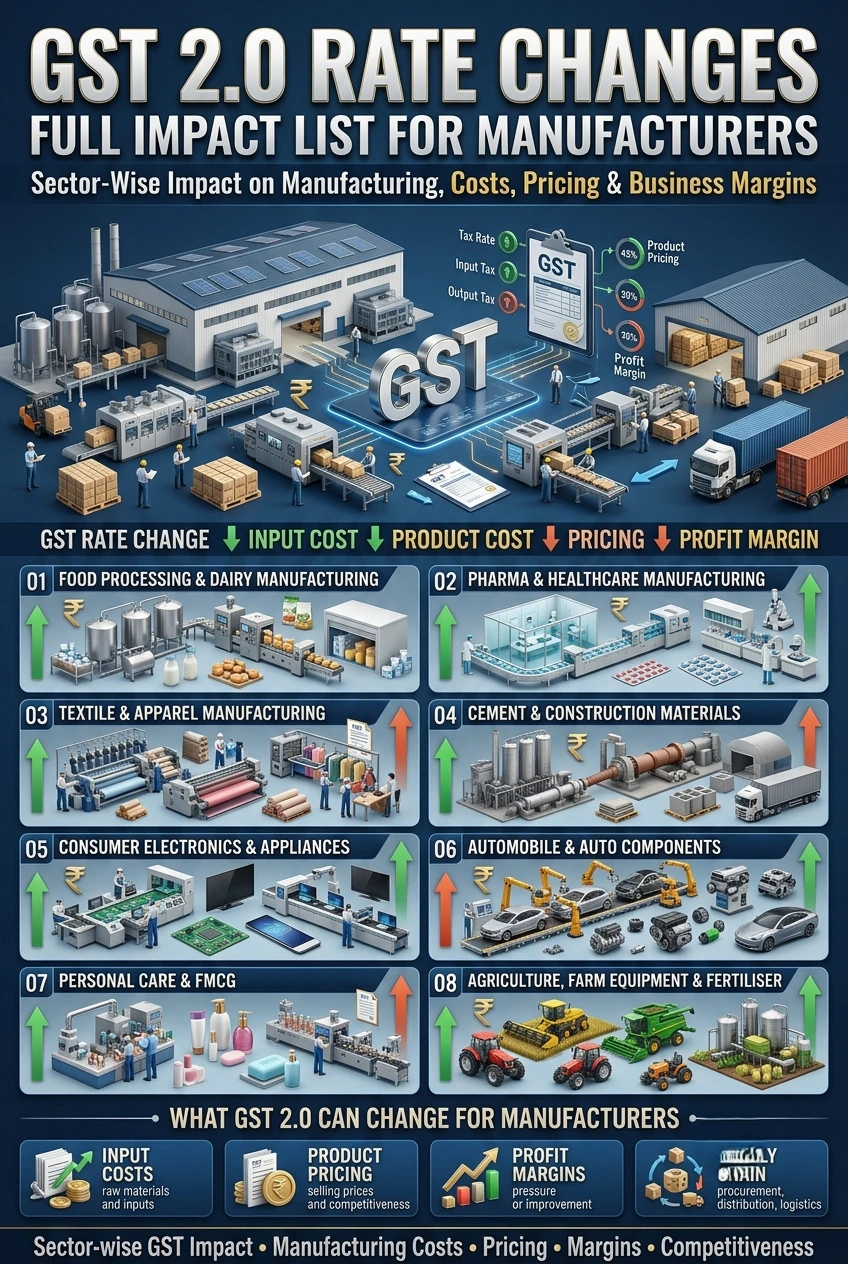
1. Food Processing and Dairy Manufacturing
This was the sector that experienced the greatest change. UHT milk is now 100% exempt from GST. The tax rates for paneer, condensed milk, butter, ghee, and cheese are reduced to nil or 5% from the earlier 12%. Common food items like pasta, cornflakes, biscuits, chocolates, cocoa based products and namkeens are reduced from 12-18% to 5%.
The saving in input cost is real for MSMEs in food processing sector, especially in states such as Punjab, Maharashtra and Gujarat. Cost of raw materials decreases. The same is true of the finished goods tax. The food processing industry is a high-value industry and has been included as a priority sector by the Ministry of Food Processing Industries (https://mofpi.gov.in) and will have a tailwind with the rationalisation of the GST regime.
In real terms, packaged food manufacturing firm fetching ingredients at 12% GST and selling products at 12% gets better sourcing rates and ease of compliance. Those small entities which used to run on the margins may now see formal GST registration as a worthwhile option.
2. Pharma and Healthcare Manufacturing
The industry that manufactures medical equipment and supplies may have been the most symbolically important. Life-saving drugs such as Onasemnogene, Daratumumab, Agalsidase Beta and Alectinib are now completely exempt from GST. The range of essential medicines and medical devices, diagnostic kits, oxygen concentrators, bandages, and thermometers, decreases to 5% from as high as 12-18%.
The domestic generic pharmaceutical manufacturing industry – which already exports over $25 billion worth of medications every year, and is a global leader – has a competitive advantage at home. The Department of Pharmaceuticals has identified the healthcare industry as a key sector for Atmanirbhar Bharat, and lower the cost of medical devices directly lowers the cost of domestic supply chain. The new input credit of 5% is now much closer to output rates for an MSME engaged in the manufacturing of diagnostic equipment and surgical goods.
The full exemption of GST from payments of health insurance premiums also lowers the delivery cost of healthcare services, and thus indirectly boosts demand for medical equipment and consumables, thereby boosting manufacturing.
3. Textile and Apparel Manufacturing
Inverted duty regimes have historically been a problem for textiles. The relief comes with the introduction of GST 2.0. The sewing thread and different yarns, important raw materials for the spinning and weaving units, decrease by 12 per cent to 5 per cent. Items like carpets, rugs, bath linen and clothes costing less than ₹2,500 per unit fall under the 5% bracket.
ICICI Securities sectoral analysis (https://www.icicidirect.com/mailcontent/idirect_gst_2_sept25.pdf) said that the rate cut on yarn would help the textile companies grab market share from the unorganised players as it will reduce their procurement cost and enable them to provide competitive prices. Cotton-belt clusters will be directly benefitted in Surat, Tiruppur and Ludhiana.
However, there’s a catch. The Goods and Services Tax (GST) rate on goods worth more than ₹2,500 has been increased from 12% to 18% now. This will rise for mid-market or premium fashion brands, which will have to keep this in mind when looking at their pricing conversations with manufacturing units that supply to organised retail.
View Full Project Details: Technical Textiles Project Report & Business Opportunities
4. Cement and Construction Materials Manufacturing
The 28% to 18% change in cement is the most significant and economically impactful change in GST 2.0. This rate reduction is equivalent to a retail discount of around ₹25-30 per 50kg bag, at the average MRP of ₹360 across all of India, as per ICICI Securities. About 60% of cement use is in housing, another 25% in infrastructure and 15% in industrial construction.
For building materials manufacturers more broadly, this creates a positive demand loop. Lower cement prices stimulate construction activity. More construction means higher offtake of steel, clay bricks, tiles, glass, wiring, plumbing fixtures, and dozens of other manufactured inputs. If you produce any construction-adjacent material, the GST 2.0 effect on cement is indirect good news for your order book.
Explore This Book: The Complete Book on Cement & Concrete Products Manufacturing
5. Consumer Electronics and Appliances Manufacturing
Air conditioners, dishwashers, refrigerators, washing machines, and televisions up to 32 inches move from 28% to 18%. This is a material change for the domestic white goods manufacturing sector, which has seen strong capacity expansion in recent years under the PLI scheme for electronics.
Component manufacturers — those producing compressors, motors, capacitors, PCBs, and plastic moulded parts for white goods OEMs — directly benefit from the improved demand outlook. The Make in India portal (https://www.makeinindia.com) identifies electronics and capital goods as two of its flagship manufacturing sectors, and this GST reduction feeds both. Lower sticker prices drive volume. Higher volume drives PLI-linked incentives and supply chain development.
6. Automobile and Auto Component Manufacturing
Small cars (petrol/LPG/CNG up to 1,200 cc, diesel up to 1,500 cc, both under 4,000 mm in length), two-wheelers up to 350 cc, and hybrid vehicles all shift to 18% from 28%. Electric vehicles remain at 5%. Auto components — tyres, gears, axles, and related parts — also rationalise to 18%.
For auto component manufacturers, this signals a volume uptick in the entry and mid segments. The Automotive Component Manufacturers Association of India (ACMA) (https://www.acma.in) has long advocated for GST reduction to stimulate OEM offtake, and that position now has a policy tailwind. Small component fabricators and precision parts manufacturers serving two-wheeler and small car OEMs are likely to see better order visibility as dealership volumes improve.
7. Personal Care and FMCG Manufacturing
Hair oil, shampoo, toothpaste, soap, shaving products, toothbrushes, candles, and matches — all down to 5% from rates of 12-18%. For small-scale FMCG manufacturers supplying these categories, the change lowers the end-consumer price without compressing producer margins, since input GST credits adjust accordingly.
This is particularly significant for cottage-level and micro-manufacturing units in rural India. Many produce herbal soaps, hair oils, and personal care items under KVIC or state government support schemes. Lower output tax rates make formalisation under GST more attractive, since the compliance cost-to-benefit ratio now tilts clearly in favour of registration.
8. Agriculture, Farm Equipment, and Fertiliser Manufacturing
Tractors, farm machinery, fertilisers, and pesticides benefit from rationalised rates under GST 2.0. For agricultural input manufacturers — fertiliser blending units, pesticide formulation plants, irrigation equipment makers — this signals both cost reduction and demand expansion. India’s Ministry of Agriculture & Farmers Welfare continues to push for mechanisation and input cost reduction in farming, and the GST alignment helps manufacturing units serving this segment operate with better margin structures.
Handicraft manufacturers — already supported by nil or lower-rate provisions under earlier regimes — also see continued protection. Marble and granite block producers and processed stone units benefit from rationalised rates, supporting demand from both domestic construction and export markets.
Related Article: Personal Care and Cosmetics: Eco-Friendly Ingredients for Local Production
What Got Costlier: The 40% Slab and Its Manufacturing Implications
The 40% bracket is deliberately narrow. It targets luxury and sin goods: tobacco products (cigarettes, pan masala, gutkha, chewing tobacco), aerated and caffeinated beverages, large passenger vehicles above 1,500 cc (over 4 metres), motorcycles above 350 cc, yachts, personal aircraft, revolvers and pistols, and online gaming and betting.
For manufacturers in the tobacco and aerated beverages space, this is a significant cost escalation. Previously at 28% plus compensation cess, the effective rate was already high. Now, at a flat 40%, the compliance calculation becomes simpler but the tax load remains punishing — which is deliberate policy. The GST Council Secretariat (https://gstcouncil.gov.in) has framed this explicitly as a health and social policy tool: make sin goods expensive enough to reduce consumption while generating revenue to fund public welfare.
Premium two-wheelers above 350 cc — a growing segment serving enthusiast riders — move to 40%. This will affect manufacturers like Royal Enfield and their component suppliers differently than the rest of the auto sector. Consumers in this bracket tend to be less price-sensitive, but the 40% rate will still dampen entry at the margin.
Mid-to-high-end textile apparel (above ₹2,500 per unit) also faces an 18% rate versus the earlier 12%, which creates a price pressure point for brands positioned in the premium-affordable segment.
GST 2.0 Rate Change Summary: Key Manufacturing Categories
| Product / Category | Old GST Rate | New GST Rate | Net Impact on Manufacturer |
| UHT Milk, Paneer, Parathas | 5–12% | 0% (Nil) | Input cost reduction; zero output tax |
| Dairy (Butter, Ghee, Cheese) | 12% | 5% | Lower input & output tax; margin improvement |
| Food Staples (Pasta, Biscuits, Namkeens) | 12–18% | 5% | Reduced output liability; competitive pricing |
| Life-saving Drugs (select) | Up to 12% | 0% (Nil) | Exempt; input credit to be reviewed |
| Essential Medicines, Medical Devices | 12–18% | 5% | Significant cost reduction for healthcare mfg. |
| Sewing Thread, Yarn (Textiles) | 12% | 5% | Direct input cost saving for weavers/spinners |
| Cement (all grades) | 28% | 18% | 10 pp saving; ₹25–30/bag cheaper at retail |
| Air Conditioners, Washing Machines, TVs | 28% | 18% | Demand uptick; better OEM order flow |
| Small Cars, Two-wheelers (≤350 cc) | 28% | 18% | Higher volumes; better auto ancillary demand |
| Footwear (≤₹2,500) | 12% | 5% | Competitive pricing; formalization incentive |
| Personal Care (Shampoo, Soap, Hair Oil) | 12–18% | 5% | Lower output tax; FMCG mfg. margin gain |
| Farm Equipment, Fertilisers | 12–18% | 5% | Agri-input mfg. cost optimisation |
| Apparel above ₹2,500 | 12% | 18% | Cost increase; pricing pressure for mfg. |
| Tobacco, Pan Masala, Aerated Drinks | 28% + cess | 40% | Punitive increase; demand expected to fall |
| Luxury Vehicles / Large SUVs / Bikes >350cc | 28% + cess | 40% | Premium segment affected; volume moderation |
Government Policies and Incentives Amplifying the GST 2.0 Effect
GST 2.0 does not stand alone. It fits into a wider policy ecosystem designed to accelerate domestic manufacturing. Understanding these complementary schemes helps manufacturing entrepreneurs extract maximum value from the current fiscal environment.
Production Linked Incentive (PLI) Scheme
The PLI scheme — running across 14 sectors — has generated over ₹1.76 lakh crore in realised investments and driven incremental production exceeding ₹18.7 lakh crore, per Press Information Bureau data (https://www.pib.gov.in/PressReleasePage.aspx?PRID=2202979). Food processing, textiles, pharmaceuticals, auto components, and solar energy are among the key sectors. PLI incentives are performance-linked, paid as a percentage of incremental sales over a base year. Combined with GST 2.0 rate reductions in many of these same sectors, the effective cost-competitiveness of Indian manufacturers improves on two fronts simultaneously.
MSME Credit Guarantee and CGTMSE
The Credit Guarantee Trust for Micro and Small Enterprises (CGTMSE) (https://www.cgtmse.in) had revised the eligibility criteria, brought down the guarantee fee rates which in a few categories are as low as 0.37% p.a. So, access to collateral-free credit is much easier and economical. For a small manufacturing unit reconfiguring its operations post-GST 2.0, working capital access at lower cost is a significant operational lever.
Maharashtra MIISP 2025 — A State-Level Example
Maharashtra state: MIISP 2025 policy introduced in end 2025 Maharashtra government had introduced the Industries, Investment & Services Policy (MIISP 2025) in end of 2025, which addresses inputs to GST 2.0. It has enhanced the SGST reimbursements, supplemented MSMEs with capital subsidies, output-linked subsidies and launched digital channels to assist processing of approvals in an easy and fast manner. It also extends incentives to industrially developed Zone A areas — a significant change from earlier policies.
Other states have similar frameworks. Entrepreneurs are well advised to browse state industrial development corporation websites (e.g., MIDC for Maharashtra, KIADB for Karnataka, GIDC for Gujarat and RIICO for Rajasthan) for schemes that may be available for state-level GST reimbursement and capital subsidies over the central government ones.
Udyam Registration and MSME Benefits
Manufacturing units registered under Udyam (Ministry of MSME) (https://udyamregistration.gov.in) gain preferential access to government procurement, priority sector lending, subsidy schemes, and delayed payment protection. With GST 2.0 pushing more units toward formal registration (since the cost-benefit equation is now more favourable), Udyam registration is a logical concurrent step for any small manufacturer reconsidering their compliance posture.
Manufacturing Business Ideas Made Viable by GST 2.0
Business Idea 1: Food Processing and Dairy Value-Addition
If you have been evaluating a food processing business — dairy-based products, packaged condiments, processed snacks, or bakery goods — the timing could not be better. With key dairy inputs (ghee, butter, paneer) now at 5% or nil, and processed food staples (pasta, biscuits, namkeens) similarly rationalised, the input cost structure for a food processing MSME has improved materially. Consider a 2-5 TPD capacity unit producing packaged ready-to-eat snacks or dairy-value-added products targeting Tier 2 and Tier 3 markets. The PLI scheme for food processing supports units with investments as low as ₹10 crore in select sub-sectors, offering cash incentives on incremental sales over four to six years.
Business Idea 2: Pharmaceutical and Nutraceutical Manufacturing
Generic pharma manufacturing — tablet presses, capsule filling, oral liquid production — has always been viable in India. But GST 2.0 has specifically improved the economics of manufacturing essential medicines and diagnostic consumables. If you can secure bulk drug procurement agreements with institutional buyers (hospitals, government health programmes), the 5% GST on output eliminates one layer of cost that previously made smaller units uncompetitive against larger factories. Nutraceutical manufacturing — protein supplements, health drinks, vitamin formulations — benefits from similar rate structures and is seeing strong demand growth as India’s health-conscious consumer base expands.
Business Idea 3: Auto Component and Precision Parts Manufacturing
With small car and two-wheeler segments moving to 18% and expected demand pick-up, the knock-on effect for auto component manufacturers is positive. Think precision-machined parts, plastic injection-moulded components, rubber seals, electronic sensors, wiring harnesses, and brake pads. Even at a micro scale — a 5-10 person precision machining shop serving a Tier 1 auto supplier — the improved OEM order environment creates more predictable revenue. ACMA membership, Udyam registration, and MSME financing through CGTMSE make this a fundable, policy-supported business segment.
Business Idea 4: Cement Accessories and Building Materials
Cement itself is produced by large corporates, but the broader building materials ecosystem is wide open for MSMEs. Fly ash bricks, AAC blocks, pre-cast concrete components, PVC pipes, tiles, ceramic sanitaryware, and waterproofing compounds are all categories where small manufacturers compete successfully. The 18% GST on cement drives construction activity — and every construction project downstream buys your product. Consider setting up a 10-30 TPD fly ash brick manufacturing unit near a coal-based power plant (for ash supply) and a growing urban cluster (for demand). The raw material is essentially free and the input tax structure is clean.
Business Idea 5: Herbal Personal Care and FMCG Manufacturing
Hair oil, shampoos, soaps, and toothpaste at 5% GST opens a genuinely attractive window for small FMCG manufacturers. With private label and D2C channels lowering the barrier to market entry, a small contract manufacturing unit — producing herbal or Ayurvedic personal care products for third-party brands — can be profitable at very modest scale. An investment of ₹50-75 lakh in basic blending, filling, and packaging equipment, combined with KVIC or state government support for khadi and herbal products, can produce a viable commercial enterprise supplying 3-5 regional brands.
Import–Export Opportunity Analysis for Manufacturing Entrepreneurs
GST 2.0 does not directly affect customs duties or IGST on imports, but it reshapes the competitive dynamics between domestic manufacturers and importers in important ways.
When domestic manufacturing inputs get cheaper through lower GST rates, the landed cost advantage of imported goods narrows. A Chinese competitor previously undercutting an Indian FMCG manufacturer partly on account of India’s inverted duty structure now faces a more level playing field. This is not theoretical — it is the explicit “Swadeshi” effect the government has designed into the reform.
On the export side, lower input GST means a lower cost base for exporters. This matters because Indian exporters — particularly in textiles, pharma, and food processing — compete on price in global markets. The Export Promotion Mission (EPM) (https://commerce.gov.in), approved by the Union Cabinet with a ₹25,060 crore outlay over six years, is now running alongside GST 2.0 rationalisation. Together, they represent the most comprehensive export-support architecture India has assembled in a generation.
For manufacturing entrepreneurs exploring export markets: pharma (API and formulations to Africa and Southeast Asia), processed food (diaspora markets in North America and Gulf), and technical textiles (industrial and medical applications in Europe) are categories where India’s cost competitiveness has visibly improved post-GST 2.0.
Indian MSME Success Stories: Lessons from the Ground
Kaveri Seeds — Making Agri-Input Manufacturing Work
Founded by G.V. Bhaskar Rao and his family in Secunderabad, Kaveri Seeds grew from a regional seed company into a listed agri-business with revenues crossing ₹1,000 crore. The company’s early decision to focus on high-yielding hybrid seeds — a genuinely manufactured product requiring significant R&D and quality control — paid off as India’s farm productivity imperative grew. The lesson for new entrepreneurs: in agriculture-adjacent manufacturing, regulatory alignment with government priorities and investment in product quality, rather than price alone, creates durable competitive advantage.
Amrutanjan Health Care — FMCG Manufacturing Built Slowly
Amrutanjan Health Care, a deeply storied Indian personal care FMCG, developed its manufacturing presence over decades primarily around an exceptionally basic, yet incredibly effective, product-medicated balms and pain relief treatments. They persevered through time by taking full control of their supply chain (manufacturing in-house, not by subcontracting), carefully vetting and maintaining standards around their base chemicals, and building enduring FMCG distribution channels over time. To young MSME entrepreneurs considering personal care or pharmaceutical manufacturing for the very first time, the Amrutanjan story simply is: own your manufacturing and formulations, give your distribution a lot of time to come by.
Action Construction Equipment (ACE) — Machinery Manufacturing for Infrastructure
Vijay Agarwal’s Action Construction Equipment, headquartered in Faridabad, transformed from a small fabrication unit into India’s largest mobile crane manufacturer. ACE’s victory could be credited in some part to fortuitous timing-a boom in India’s infrastructure spending has coincided with ACE’s increased manufacturing capacities-and in part due to intentional geographic segmentation of its product portfolio in order to meet both the demands of public sector and private construction. That means the strategic lesson for entrepreneurs looking to enter the capital equipment, road building, and infrastructure equipment manufacturing space should focus on targeting the public sector to gain greater leverage on pricing and reduce cycles of growth and contraction.
How NPCS Helps Entrepreneurs Navigate GST 2.0 Impact on Project Planning
At Niir Project Consultancy Services (NPCS), we work with manufacturing entrepreneurs at exactly the point where regulatory changes like GST 2.0 intersect with investment decisions. Whether you are evaluating a new plant, expanding an existing unit, or reassessing the financial model of a business in a sector that has seen a GST rate change, the numbers in your project report need to reflect the new cost structure — not the old one.
Our Market Survey cum Detailed Techno-Economic Feasibility Reports (DPRs) cover the full spectrum: manufacturing process selection, raw material sourcing and costing (now recalculated at GST 2.0 rates), machinery specifications, manpower planning, and complete project financials — capital investment, profitability projections, break-even analysis, IRR, and payback period. All financial modelling reflects current input costs, including revised GST on key raw materials and finished goods.
We have delivered over 150,000 project reports across 85 countries, with 30+ years of consulting experience serving MSMEs, investors, and development finance institutions. For inquiries, visit NPCS at niir.org (https://www.niir.org) or reach our New Delhi consulting team at 106-E Kamla Nagar, New Delhi.
Frequently Asked Questions (FAQs) — GST 2.0 for Manufacturers
Q1. Does GST 2.0 change anything for units under the Composition Scheme?
Yes. Composition scheme dealers — who pay a flat turnover-based rate instead of invoice-wise GST — are also impacted to the extent that their input procurement costs have changed. Units buying cement, yarn, or medicines as inputs at lower GST rates benefit from reduced procurement costs even if they themselves file under the composition scheme. That said, composition dealers cannot claim input tax credit, so the rate reduction on inputs is a cost saving rather than a credit adjustment.
Q2. If I am in the textile sector and now face an inverted duty structure, what are my options?
The GST 2.0 reform has reduced many inverted duty situations in textiles (yarn from 12% to 5%, apparel at or below ₹2,500 at 5%). However, if your specific product configuration still results in an inverted duty structure — meaning your input GST exceeds your output GST — you can claim a refund on the accumulated input tax credit. The mechanism exists under GST law; your chartered accountant or GST practitioner can file this via the GSTN portal (https://www.gst.gov.in).
Q3. How do the new rates affect working capital for manufacturers?
Lower GST rates on inputs directly reduce the amount of cash you block in input tax credit that is awaiting utilisation or refund. For a cement-heavy construction material manufacturer who was paying 28% on cement, the shift to 18% reduces the credit receivable by 10 percentage points per purchase — which means less working capital locked in the GST cycle at any given time. For cash-constrained MSMEs, this is a meaningful improvement in liquidity.
Q4. Which manufacturing sectors are most negatively impacted by GST 2.0?
Manufacturers supplying tobacco products, aerated beverages, premium motorcycles, and large luxury vehicles face a significantly higher tax burden at 40%. Their own input costs may not have changed proportionally, but the end-consumer price impact — and the expected demand moderation — will affect order volumes. Manufacturers of mid-market fashion apparel (above ₹2,500 per piece) also face an increase from 12% to 18% on their output.
Q5. Is my MSME eligible for any compensation if my sector faces higher rates?
The GST Council has not announced direct compensation for businesses affected by rate increases — rate changes are a policy instrument, not an individually targeted action. However, if your business qualifies under any PLI, state government incentive, or MSME scheme, the benefits from those programmes can offset some of the impact. A feasibility reassessment — checking whether the business model remains viable under new rates — is the first practical step.
Q6. How soon should I update my DPR or financial model post-GST 2.0?
Immediately, if the DPR is being used for bank financing, government scheme applications, or investor presentations. Financial projections built on pre-September 2025 GST rates are now materially inaccurate for affected sectors. Lenders and government agencies reviewing project reports will increasingly expect models that reflect the current rate structure. An NPCS consultant can update your existing DPR financials to reflect current input and output GST rates within your specific project configuration.
Conclusion: What GST 2.0 Means for Your Next Manufacturing Decision
India’s GST 2.0 is more than a tax reform. It is an economic positioning exercise — using the tax code to make manufacturing more competitive, consumption more robust, and compliance less burdensome. For a first-generation entrepreneur evaluating which business ideas to pursue, the rate changes are a directional signal: food processing, pharma, textiles, construction materials, consumer electronics, and auto components have all become structurally more attractive investments.
The 40% sin goods bracket tells the opposite story — it deliberately discourages production and consumption in tobacco, luxury vehicles, and aerated beverages. If you operate in those segments, your business model needs reassessment, not optimism.
Most importantly, do not make investment decisions based on pre-reform financial models. Input costs, output tax liability, and working capital requirements have all shifted. The GST Council’s official circulars and notifications remain the authoritative source for product-specific rate classification, and your chartered accountant is your first stop for entity-level impact assessment. For project feasibility and DPR preparation reflecting current rates, NPCS remains India’s most experienced industrial project consultancy — ready to help you evaluate your next manufacturing venture with clear eyes and accurate numbers.


