





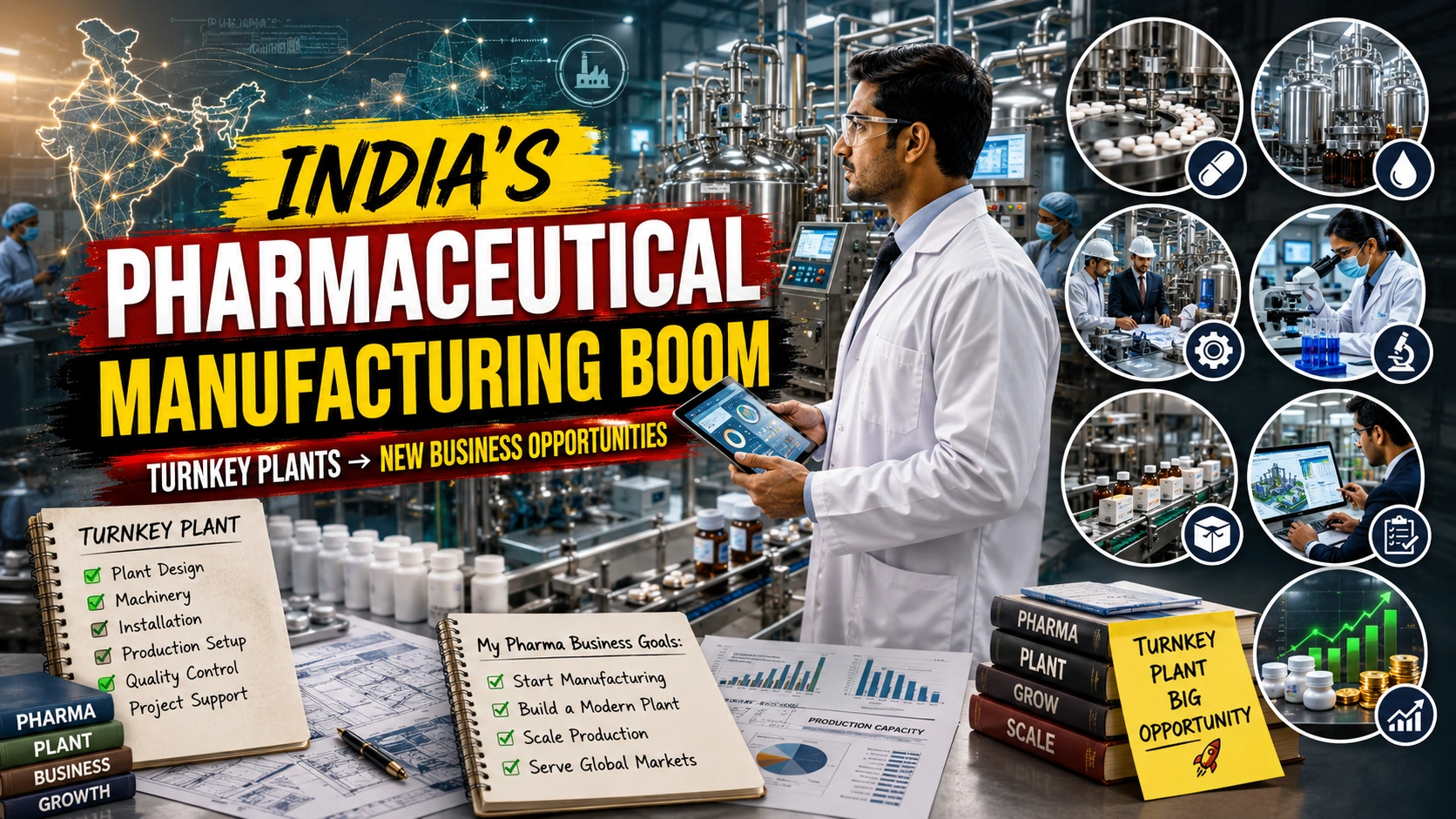
The overall scenario is a structural change in India’s pharmaceutical manufacturing industry. The country’s pharma industry is attracting investments at scale, mainly due to the high domestic demand for healthcare products, the government push to develop the domestic pharmaceutical value chain and the renewed interest of global players in the supply chain. With demand for compliant, audit-ready, pharmaceutical manufacturing plants ramped up across all segments, from MSME tablet coating to large API synthesis units.
It is this demand that is so unique that it is changing. No longer will companies be content with hodgepodge facility construction. From new generic drug start-ups to those looking to move into contract manufacturing or establish herbal and nutraceutical operations, the growing demand is for integrated, turnkey pharmaceutical plant solutions, including facility layout, process design, compliance documentation, engineering and regulatory readiness all in one place.
This investment drive and the need for professionally designed manufacturing facilities is providing a strong business opportunity, not only to the pharmaceutical companies, but to equipment suppliers, engineering consultants, cleanroom contractors, validation service providers, and an expanding network of supporting businesses. A forward-thinking entrepreneur can reap substantial rewards if they take part in this growing industrial value chain, at the right time.
What This Development Means for Indian Businesses
India is the third largest drug manufacturing country in the world, and a major exporter of generic drugs to more than 200 countries. However, the nation’s domestic pharmaceutical manufacturing infrastructure still has large gaps, with respect to GMP compliance, cleanroom design, process documentation and validation protocols—especially for the MSMEs.
The new GMP guidelines by the Government of India are putting a renewed focus on Schedule M compliance upgrades, India’s export goals to regulated markets like the US, EU, UK, and Australia, and the proliferation of new pharma facilities under the Government’s industrialization initiatives are driving all operators – at every level – to invest in professionally designed facilities.
This transition is presenting business opportunities for facility engineering consultants, cleanroom and HVAC contractors, pharmaceutical machinery manufacturers and suppliers, quality management documentation providers, boiler and utility design specialists, lab setup service providers and designers focused on NABL. The government has been clear about its aim to build a strong pharmaceutical manufacturing industry at home, and this is creating new business opportunities for enterprisers who have the necessary technical and regulatory acumen.
In addition to green field facilities, the upcoming revision of GMP norms and pressure from the global regulators is compelling thousands of existing pharma units to invest in facility upgrades, which is creating another trend of demand for plant audit services, facility audit compliance consulting and facility retrofit engineering.
Related Article: Read the Indian Pharmaceuticals Market Report
Why This Industry Could See Stronger Growth
A number of robust structural drivers are meeting to continue and grow the demand for infrastructure for pharmaceutical manufacturing in India:
First, India’s domestic pharmaceutical market is expected to continue to grow at a strong pace with an increase in healthcare penetration, increasing prevalence of chronic diseases, and increasing health insurance coverage under various government initiatives like Ayushman Bharat. An increase in domestic consumption equals an increase in manufacturing capacity demand.
Secondly, India is the pharmacy of the world – with the capacity to provide almost 20% of the world’s generic drugs by volume – and this international demand still generates capacity expansion pressure. Those market compliant facilities with regulatory approval from US FDA and EU GMP, WHO, MHRA, PIC/S and TGA are especially sought after.
Third, the Government of India’s recently launched Production Linked Incentive (PLI) Scheme for pharmaceuticals is actively promoting domestic manufacturers to expand capacity, in particular MSMEs, to invest in technology upgradations and diversify into new product segments such as APIs, complex generics and biopharmaceuticals. The financial grants provided under PLI are directly driving up capital expenditure related to setting up manufacturing facilities.
Fourth, the Indian herbal, Ayurvedic, nutraceutical and cosmetic industry is expanding at double digits on the back of the health awareness created by the pandemic and international demand of wellness products. All these segments have demand for GMP-based manufacturing units regulated by FSSAI or AYUSH, thus creating a demand for specialised plant design and turnkey plant setup.
Last but not the least, new pharmaceutical clusters, special economic zones and state-adopted bulk drug parks are being created in various pharma-manufacturing states of Gujarat, Andhra Pradesh, Himachal, Telangana and more; all of which demand 100% compliant plant infrastructure.
Government Policies and Incentives
India has put together one of the most effective policy support structures for the pharmaceutical manufacturing industry of any emerging economy. Several schemes and platforms should be noted by entrepreneurs and investors when considering this space.
The financial incentives offered by PLI Scheme for Pharmaceuticals under the Department of Pharmaceuticals are 3-10% on incremental sales over 6 years to eligible pharmaceutical manufacturers for products in categories such as a biopharmaceutical, an active pharmaceutical ingredient, a complex generic, and patented pharmaceuticals produced in India.
The Pradhan Mantri Bhartiya Janaushadhi Pariyojana (PMBJP) is driving the growth of domestic market demand for generic medicines at affordable cost and thus encouraging the capacity expansion by domestic manufacturers.
MSME Ministry’s Technology Upgradation Schemes and the Credit Guarantee Fund Trust for Micro and Small Enterprises (CGTMSE) offer MSMEs collateral-free loan guarantees and technology upgrade which can be leveraged for investments in pharmaceutical manufacturing plants.
Newer companies joining the pharmaceutical manufacturing sector can avail of recognition and support from Startup India wherein the government will offer regulatory fast tracking, tax exemptions for eligible startups and avenues for government procurement.
Pharmaceutical exporters can avail dedicated support from Pharmaceuticals Export Promotion Council of India (Pharmexcil) which will help manufacturers in accessing markets, regulatory approval for export markets, buyer-seller meets and export facilitation.
It is also necessary to have investment promotion at the state level. Investors looking to venture into industrial investments in Gujarat can access support from Invest Gujarat (iNDEXTb) for land allocation, capital subsidies, interest subsidies and single window clearances in its pharmaceutical zones.
In India, the national pharmaceutical manufacturing compliance regulatory body is the Central Drugs Standard Control Organisation (CDSCO). Compliance and adherence to the requirement laid down by the CDSCO is crucial for any manufacturing plant setup.
In cases of quality infrastructure in line with laboratory and testing requirements, entrepreneurs should seek guidance from the National Accreditation Board for Testing and Calibration Laboratories (NABL) that lays down standards for pharmaceutical testing laboratories for domestic compliance and approval to export market.
Manufacturing Business Opportunities Emerging From This Development
1. Pharmaceutical Turnkey Project Consultancy and Engineering Services
Brick-and-mortar manufacturing plant projects are on the upswing as pharma companies, ranging from big corporations to first generation MSME promoters, want to set up a compliant manufacturing plant that gives them a turnkey solution. These companies provide service from facility design, architectural drawings, HVAC design, cleanroom design, MEP (mechanical, electrical and plumbing) engineering, documentation, validation and regulatory audit readiness. Pharmaceutical engineering consultancy is a high-value, knowledge-based enterprise suitable for anyone with a knowledge of both regulatory and engineering aspects.
- It is targeted at new pharma manufacturers, existing companies in the midst of GMP upgrades, API manufacturers, herbal and nutraceutical plant developers.
- Investment consideration: Mainly human capital (technical team), with medium investment in design software and office facilities.
- High: One consultancy can undertake several projects at the same time in different states and countries.
- Opportunity to export: Indian consultants are required for setting up Pharma plants in Southeast Asian countries like Africa, Middle East etc.
Get Detailed Project Report (DPR): Pharmaceutical & Fine Chemicals Industry Handbook
2. Pharmaceutical Cleanroom Construction and HVAC Systems Manufacturing
All pharmaceutical manufacturing plants must have cleanrooms, which are areas with specifically controlled particulate levels, humidity, temperature and air-change rates. Demand for cleanroom installation, modular cleanroom panel manufacturing and pharmaceutical-grade HVAC systems has increased significantly. Civil, mechanical and electrical skills in one business opportunity – manufacturing and construction.
- Target Customers: Pharma Plant developers, biotech plant, medical device manufacturers, operation theatres in hospital.
- MSME suitability: High—cleanroom panel manufacturing and HVAC contracting can be set up at MSME scale.
- Commodities: Aluminium Profiles, Sandwich Panels, HEPA Filters, AHU, Ducting.
- Export potential: Cleanroom panel exports to the pharmaceutical markets in developing countries.
3. Pharmaceutical Machinery Manufacturing and Supply
India has a good domestic pharmaceutical machinery manufacturing segment but the demand is much exceeding the supply of the machinery for producing solid dosage form, liquid dosage form and API manufacturing like tablet press, coating machine, capsule filling, bottle filling, vial filling, ampoule lines, reactors, centrifuges and dryers. Mechanical engineering skillful entrepreneurs can make special machines for pharmaceutical industry which are not available in the market and sell them in the country and abroad.
- The main product categories are: Tablet compression machines, granulation machinery, blending systems, sterile filling lines, API reaction systems.
- Market potential: Good prospects for exports to the domestic and Southeast Asian markets.
- Medium to high capital investment, precision engineering capability required.
- Specialised machinery components, spare parts manufacturing, refurbishment services (MSME opportunity).
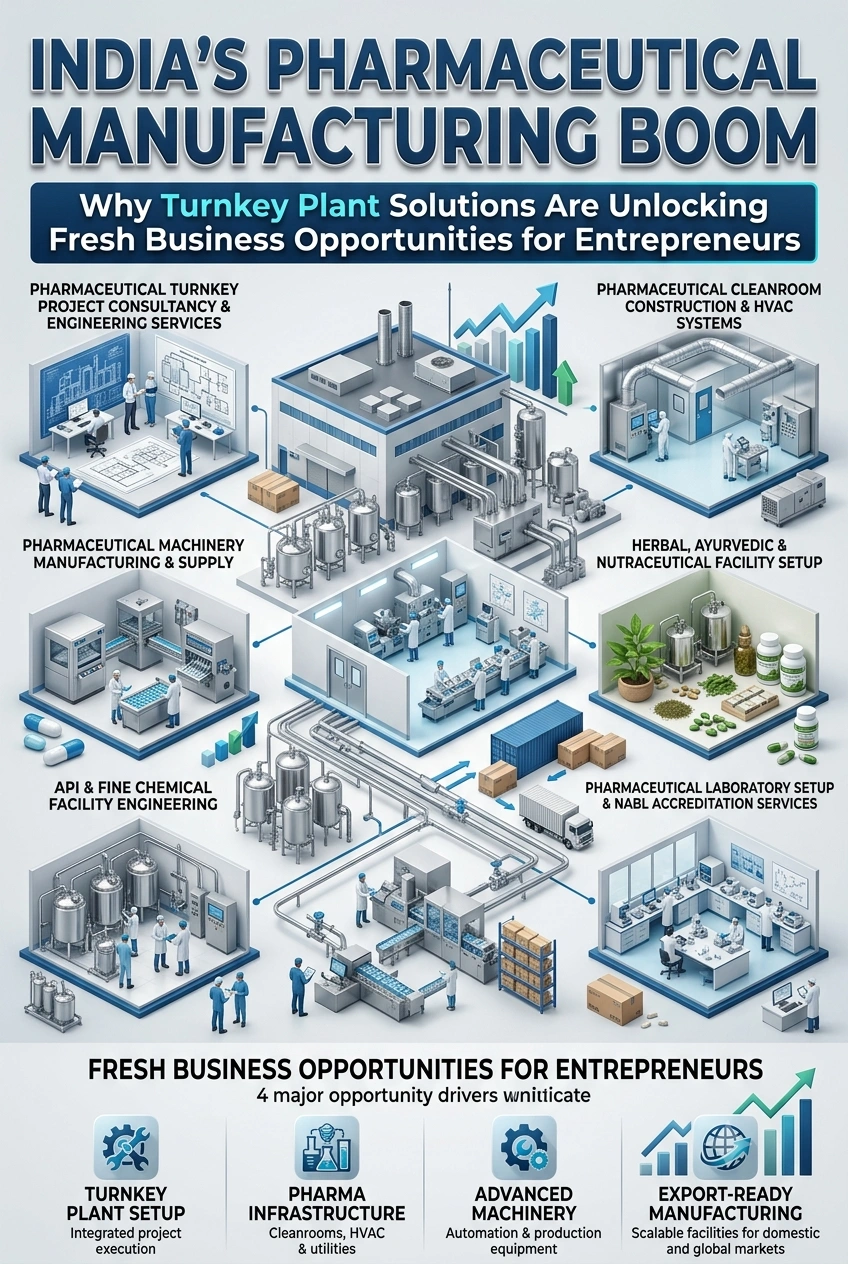
4. Herbal, Ayurvedic and Nutraceutical Manufacturing Facility Setup
The herbal medicine, nutraceutical and functional food industries in India are witnessing incredible growth. There are specific requirements for GMP in AYUSH-compliant manufacturing establishments and the need for specialized plant design, extraction and concentration systems and clean processing systems is rapidly on the rise.
- Products: The herbal extracts, ayurvedic formulations, dietary supplements, protein powders, functional beverages are all part of the products.
- Target customers: Ayurvedic companies and wellness brands, contract manufacturers.
- Large export market for certified herbal and nutraceutical products to USA, UK, Europe and Southeast Asia.
- MSME viability: Very high – Moderate investment can be made for establishing a herbal or nutraceutical facility at MSME scale.
Explore This Book: Herbal Cosmetics & Ayurvedic Medicines (EOU)
5. API and Fine Chemical Facility Engineering
Making of Active Pharmaceutical Ingredients (API) is a capital-intensive process, but can be a very strategic one. India is a top producer of API, but still it relies on China for some of its crucial starting materials and intermediates. The demand from the government to promote domestic API manufacturing, especially under PLI Scheme for critical starting materials is opening new avenues of investment in API plant engineering, containment design, automated reaction systems and waste treatment.
- Opportunity: Engineering, procurement and construction (EPC) of API and intermediates facilities.
- Specialist sub-segments include: High pressure and high temperature reactor design, containment engineering, and process automation.
- Export potential: API export to regulated and semi-regulated markets is a multi-billion-dollar opportunity.
Read the Complete Book Here: Handbook on Active Pharmaceutical Ingredients (API), Drugs & Pharmaceutical Products
6. Pharmaceutical Laboratory Setup and NABL Accreditation Services
All licensed pharmaceutical manufacturers need an in-house quality control lab. Besides, there are standalone contract testing laboratories catering to several pharma companies. Laboratory setup services are a viable business opportunity because it is an opportunity for consulting in the field of laboratory setup, which involves arranging the laboratory setup, choosing the right equipment, designing the layout, installing the instruments, developing the SOP, and supporting NABL accreditation.
- Services: Lab layout design, procurement of equipment, instrument qualification for analytical instruments, documentation support for NABL.
- Target customers: New pharmaceutical manufacturing units, contract research organisations.
- The financial value is low to medium – mainly skill and knowledge based.
Import-Export and International Market Opportunity
Pharmaceutical exports are a major source of foreign exchange for India, as finished drugs, APIs and bulk drugs are exported to more than 200 countries. But there is a gap in this export success: it is an export segment where import substitution has become both necessary and profitable.
Export Opportunity: Pharmaceutical companies that aim to supply plants that are compliant with the US FDA, EU GMP, WHO, MHRA and MHRA could become Contract Manufacturers to global generic drug companies. Exports of pharma plants, especially solid oral dosage, sterile injectable and APIs are in good demand. Indian manufacturers with facilities with global compliances can win the export contracts from regulated markets where procurement of generic drugs is a big business.
Also, as the global demand for natural health products increases, India’s herbal, Ayurvedic and nutraceutical products are being sought for in the United States, the European Union, Southeast Asia and Middle East. Having an FSSAI, GMP and AYUSH certified manufacturing unit increases the company’s capability to gain access to these international markets.
Import Substitution: India is still importing pharmaceutical equipments, precision instruments, special reagents and some raw materials. The ability to produce pharmaceutical grade HVAC system, high precision tablet compression tooling, sterile packaging material and laboratory analytical instruments at home offers Indian entrepreneurs import substitution manufacturing opportunities. The government’s thrust of ‘Atmanirbhar Bharat’ directly encourages local manufacturing of these.
Indian MSMEs and Startups in Related Industries
There are already some impressive examples of India’s pharmaceutical MSMEs and startups that have found a niche in this industrial opportunity.
ACG Worldwide
ACG Worldwide, headquartered in Mumbai, India, is one of the leading integrated pharmaceutical manufacturing technology companies in India. From making initial investments in a small capsule manufacturing plant, to eventually scaling up to tablet compression, film coating, packaging and inspection systems, the journey of an Indian company to establish itself as a global market leader is evident in the ACG story. MSMEs can learn the ACG approach of being deeply technical while being part of a high growth industrial ecosystem.
ACCEL Pharmatech
ACCEL Pharmatech is an Indian pharmaceutical engineering consultancy offering plant layout, cleanroom design, HVAC, and utility design services to pharmaceutical manufacturers across India. Operating in the same space as major multinational consultancies, ACCEL demonstrates that technical expertise, regulatory knowledge, and project management capability—rather than large financial capital—are the key entry requirements for a pharmaceutical engineering services business.
Suven Pharmaceuticals
Suven Pharmaceuticals is an MSME-origin API and CRAMS (Contract Research and Manufacturing Services) company that has built a significant domestic and export business in niche APIs and pharmaceutical intermediates. Suven’s growth path illustrates how a focused API manufacturer with strong regulatory compliance and international quality standards can build a durable export-oriented business from a modest starting point.
What Entrepreneurs Should Evaluate Before Investing
Before committing capital to any pharmaceutical manufacturing or related business opportunity, entrepreneurs should conduct a rigorous feasibility evaluation covering the following dimensions:
- Market Demand: Assess domestic and export demand for your target product category—formulations, APIs, herbal products, medical devices, or pharmaceutical engineering services.
- Regulatory Framework: Understand applicable regulatory requirements—Schedule M, WHO GMP, CDSCO licensing, AYUSH certification, FSSAI registration, NABL accreditation—and map out the compliance pathway.
- Location: Proximity to pharmaceutical clusters (Baddi, Ankleshwar, Hyderabad, Vapi, Haridwar), availability of industrial water, power reliability, logistics connectivity, and state-level incentives should all factor into location selection.
- Technology and Machinery: Identify appropriate manufacturing technology and validated equipment suppliers. Regulatory compliance of machinery is as important as production capacity.
- Raw Materials: Evaluate domestic vs import sourcing for key inputs. API manufacturers must particularly assess supply-chain security for starting materials.
- Manpower: Skilled pharmacists, chemical engineers, quality assurance professionals, and validation specialists are critical and sometimes difficult to recruit outside major pharma clusters.
- Utilities: Pharmaceutical manufacturing requires reliable, high-quality utilities—purified water systems, compressed air, nitrogen, steam, and controlled environments.
- Capital and Working Capital: Factor in not only the plant construction cost but also the working capital cycle—pharmaceutical businesses typically carry significant inventory and receivables.
- Regulatory Approvals Timeline: Drug manufacturing licence approval timelines can be 6–18 months; plan project timelines accordingly.
- Quality Standards: Non-negotiable investment in quality management systems—SOPs, validation protocols, stability studies, and batch manufacturing records.
- Competition and Pricing: Analyse the competitive landscape for your target product category and build a realistic pricing and margin model.
- Break-Even Analysis: For capital-intensive pharma plants, understanding the break-even output level and the timeline to profitability is essential for financial planning.
Find the most profitable startup for your investment range
How NPCS Can Help Entrepreneurs Evaluate the Opportunity
NPCS – Niir Project Consultancy Services is one of India’s most established industrial and project consultancy organisations, with decades of experience supporting entrepreneurs, investors, MSMEs, and corporations in evaluating and launching manufacturing and business ventures across diverse sectors.
For entrepreneurs considering opportunities in pharmaceutical manufacturing, NPCS provides a comprehensive suite of consultancy services:
- Detailed Project Reports (DPR): Covering technical specifications, plant layout, machinery requirements, raw material sourcing, manpower planning, utility requirements, financial projections, and regulatory compliance pathways.
- Market Research Studies: Independent demand-supply analysis, competitive landscape assessment, pricing studies, and export market evaluation.
- Feasibility Studies: Business feasibility analysis covering investment requirements, break-even analysis, return on investment projections, and risk assessment.
- Technology Consultancy: Process technology selection, equipment and vendor evaluation, and manufacturing technology benchmarking.
- Plant & Machinery Assessment: Identification of appropriate plant and machinery specifications, supplier evaluation, and capital cost estimation.
For entrepreneurs at the idea stage, NPCS project reports provide a cost-effective first step toward understanding whether a particular pharmaceutical manufacturing or related business opportunity justifies deeper investigation and investment.
Business Opportunity Snapshot
| Parameter | Details |
| Industry | Pharmaceutical Manufacturing, Herbal & Nutraceutical, API, Medical Devices |
| Market Driver | GMP compliance upgrades, export market growth, PLI scheme, domestic pharma expansion |
| Key Development | Rising demand for turnkey, audit-ready pharmaceutical manufacturing facilities across all segments |
| MSME Opportunity | Cleanroom construction, pharma machinery, herbal plant setup, lab services, consultancy |
| Manufacturing Potential | High—spanning equipment, cleanroom panels, HVAC, lab infrastructure, packaging |
| Export Potential | Strong—pharma formulations, APIs, herbal products, and engineering services for developing markets |
| Import Substitution | Pharma-grade HVAC, precision machinery, laboratory instruments, sterile packaging |
| Government Support | PLI Scheme, MSME support, Startup India, Pharmexcil, state pharma cluster incentives |
| Investment Consideration | Moderate to high depending on segment; engineering services require lower capital than manufacturing |
| Risk Level | Medium—regulatory complexity, skilled manpower availability, long approval timelines |
| Growth Outlook | Positive over 5–10 years, driven by domestic expansion and regulated market export ambitions |
Conclusion
India’s pharmaceutical manufacturing sector is at an important inflection point. The convergence of domestic healthcare demand expansion, export market ambitions, revised GMP regulatory requirements, government incentive programmes, and the growth of herbal, nutraceutical, and medical device manufacturing is creating sustained and multi-layered demand for compliant, professionally designed pharmaceutical manufacturing infrastructure.
For entrepreneurs, this represents a business opportunity of significant depth and duration. Whether the entry point is pharmaceutical engineering consultancy, cleanroom construction, machinery manufacturing, herbal product manufacturing, API production, or laboratory setup services, the market is demonstrating clear and growing demand.
The key to successful entry is informed decision-making—grounded in rigorous market research, accurate cost estimation, regulatory understanding, and realistic financial planning. Entrepreneurs who take the time to conduct a proper feasibility study and develop a detailed project report before committing capital will be better positioned to build durable, scalable, and compliant businesses within this expanding industrial ecosystem.


