






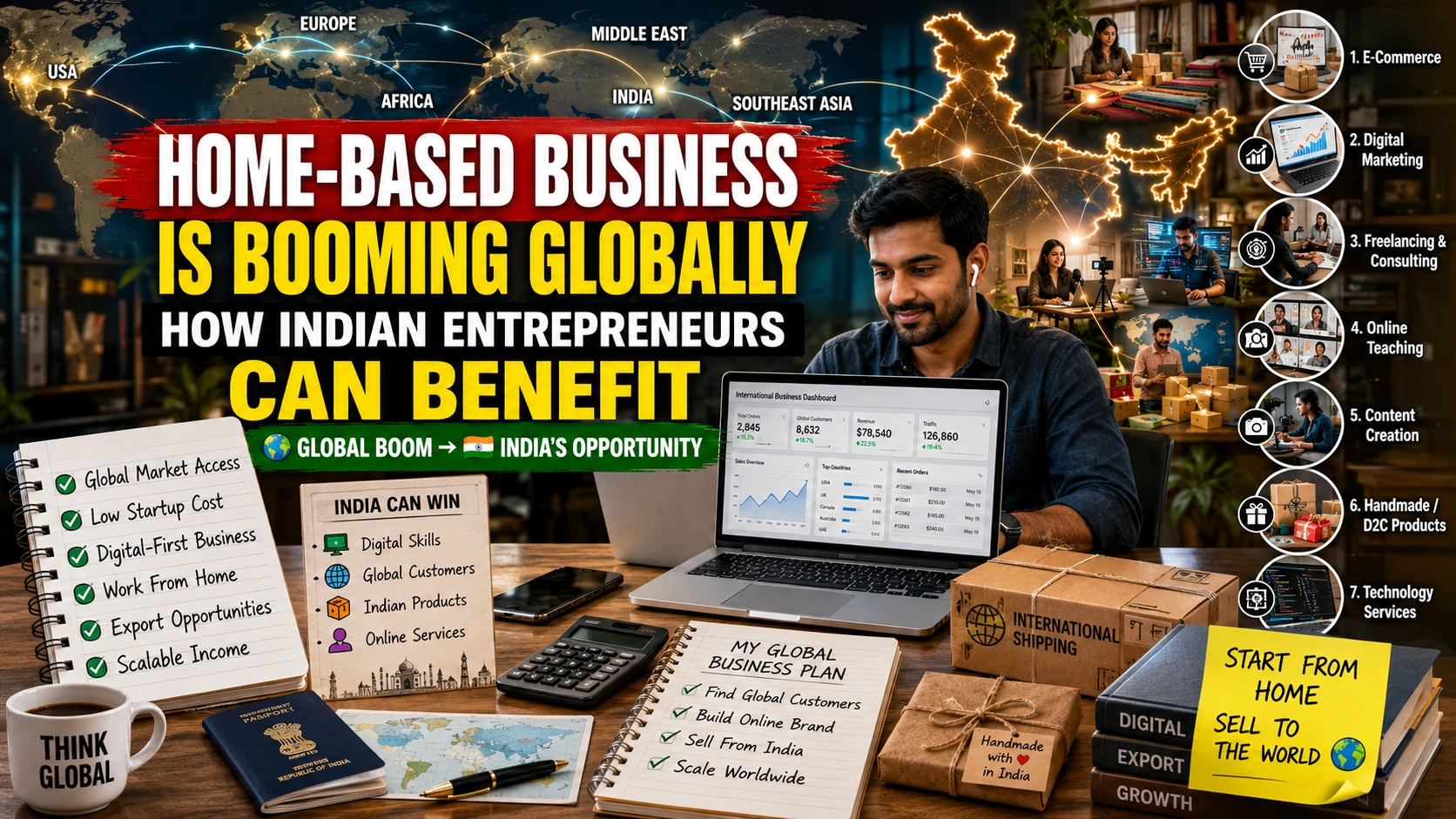
Home Based Business Opportunities
The world is undergoing a fundamental transformation and India is not a silent spectator. As the world shifts towards working from home and remote work, a massive opportunity has quietly emerged for entrepreneurs to transform traditional businesses, reimagine work, and new categories of demands for products, services and technology. In the developed world, workplace flexibility has been a longstanding preference, and across most of the world, a majority of employees say they would like to have the option to work remotely.
In fact, recent surveys indicate that a significant major of workers in the developed world now prefer to work from home. Additionally, a larger number of founders is starting businesses from home rather than in a rented office. It is estimated that 19 million businesses operate from the owner’s home, and that over 50 percent of new businesses launched in the United States are home based.
This is the commercial signal that a startup founder or MSME will sense. Services and products fueling home-based businesses worldwide are driving significant growth in digital, productivity, specialised knowledge and infrastructure. The country of India with its pool of skilled manpower, cost advantage, and growing digital infrastructure is in a unique position to develop, manufacture and export and service this emerging ecosystem. The opportunity exists, the timing is right and the policy landscape is conducive. Those entrepreneurs who consider this space now can reap benefits of early entry, scale and secure sustainable market positions.
What This Development Means for Indian Businesses
The trend of home-based entrepreneurship is more than a way of life; it is a new and measurable paradigm shift occurring in the global economy across many industries. With millions of business owners working from home, they require broadband connections, comfortable chairs and accessories, digital productivity tools, specialized software, cloud accounting and compliance software, and professional services that typically have been found in an office.
The impact for India’s enterprises can be broken down into a few categories. The first one is a services export opportunity: Indian digital agencies, consultants, coders, and content professionals can now directly cater to the growing global numbers of home-based entrepreneurs seeking access to cost-effective, quality remote partners. Secondly, there is a manufacturing opportunity in supporting hardware and equipment, including ergonomic seating, adjustable desks, noise-canceling peripherals, LED desk lighting, desktop accessories and more, which India currently relies on imports for.
Third, there is a domestic opportunity for startups in platform building, SaaS tools and managed service offerings that address India’s own burgeoning home-based entrepreneur class that is being nurtured through digitisation efforts of the government and initiatives like the ‘Startup India’.
Startup India initiative and the PM SVANidhi Programme for micro-entrepreneurs.
This is a development that should be considered by the entrepreneurs, MSMEs, manufacturers, investors and exporters across India as the underlying drivers of the demand – adoption of remote working, digital entrepreneurship, growth of the gig economy and small business formation – are structural and not cyclical.
Related Article: The ₹70,000 Business Anyone Can Start From Home
Why This Industry Could See Stronger Growth
Some structural developments are driving home based and micro entrepreneur sector to become one of the fastest-growing economic segments in the world and India as well.
India’s digital infrastructure has grown exponentially in the country. Tools of entrepreneurship are now readily available to a far greater number of people than ever before, thanks to smartphone availability, a growing presence of 4G and 5G networks, and government-led financial inclusion initiatives. The number of people connected to the internet in India now passes the 900 million mark and even bigger growth is expected in the semi-urban and rural areas — the exact region where home business formation is likely to ramp up.
Government is contributing to the momentum through its investments in skilling and entrepreneurship and digitisation. Under the Ministry of Micro, Small and Medium Enterprises, home based and micro enterprise is encouraged through the provision of credit guarantees, technology assistance, market linkage support etc. One such scheme that is actively running to support innovation in MSMEs is MSME Innovative Scheme (Incubation, Design, IPR).
On the demand side, the gig economy is growing the market for specialized home-based services like digital marketing, content creation, accounting, coding and consulting. The global economy of creators (individuals earning revenue by their skills and content without leaving home) is projected to be worth more than USD 200 billion each year and is expanding in double-digit figures yearly. This generates demand for Indian-made SaaS products, digital tools and professional services of specialisation that can be provided remotely.
Yet another is importing substitution. India is currently importing considerable amount of ergonomic office furniture, webcams, ring lights, USB peripherals and home-office accessories which can be produced in the country with relatively small capital investment and be sold in the domestic market as well as exported.
Government Policies and Incentives
Indian entrepreneurs will find a mature policy framework to enter this area. Together, the Ministry of Commerce and Industry and the Department for Promotion of Industry and Internal Trade (DPIIT) has launched various schemes that offer fiscal support, regulatory relief and market access support to startups and MSMEs.
The Credit Guarantee Fund Trust for Micro and Small Enterprises (CGTMSE) offers collateral-free credit guarantees up to ₹2 crore, making financing options more accessible for small factory establishments. The industrial estates are provided by state government with subsidized land, sheds and connections for utility with industrial development corporations like SIDCO (Tamil Nadu Small Industries Development Corporation) that are suitable for compact manufacturing units.
The Served From India Scheme (SFIS) and other market access support by India’s Export Promotion – DGFT (Directorate General of Foreign Trade) is available for service-based entrepreneurs to support service exports. The NASSCOM 10,000 Startups Programme offers technology start-ups not only mentoring but also cloud credits and access to investors. The National Portal for Udyam Registration is available for MSMEs to register in just a few minutes and get priority benefits for the MSMEs from the government of India.
State governments such as Karnataka, Maharashtra, Telangana and Gujarat have introduced specific schemes to promote digital-first businesses and home-based enterprises, like tax holidays for micro enterprises, broadband subsidy and grants for co-working spaces that can help the micro entrepreneurs who grow larger than home based setups.
Manufacturing Business Opportunities Emerging From This Development
1. Ergonomic Home-Office Furniture Manufacturing
With the global home-worker population growing, the need for ergonomic chairs for the office, sit-stand desks, laptop stands and accessories for the support of the back have increased significantly. Currently, India has a huge import substitution opportunity in the area of ergonomic furniture, with a very high level of imports from China.
Along with metal tubing, fabric, foam and MDF board available in the region, a small to medium scale manufacturer can create ergonomic chairs and desks. Customers include direct-to-consumer e-commerce channels, corporate HR departments that buy for work-from-home employees, office supply retailers, and B2B distributors. The investment in the machinery for a basic unit (cutting machine, welding machine, foam cutting machine, upholstery machine) is relatively small. There are also export markets in the Southeast Asian and Middle East markets. Suitability of MSME is high and the product category is scalable.
View Full Project Details: Wooden Furniture Manufacturing Project Report
2. USB Peripherals and Desktop Accessories Assembly
The home-based entrepreneur and remote worker market is proving to be a constant buyer of webcams, ring lights, USB hubs, mechanical keyboards and ergonomic mouse products. The Production Linked Incentive (PLI) model for IT hardware enables commercialization of MSME manufacturing of peripheral devices with imported components and locally manufactured housings, as opposed to manufacturing the chip itself.
Raw materials are plastic mouldings (which may be outsourced), printed circuit boards, LED arrays, cables and packages. Customers range from e-commerce sites to electronics retail stores to corporate gifting. Margins are satisfactory for value-added or branded products and demand will grow with India’s growing remote workforce. Significant export potential to Africa, Middle East and South Asian markets.
3. Acoustics Panels and Soundproofing Products
Background noise is a constant struggle for consultants, coaches, content creators, online tutors, and other home-based professionals. Portable desk mounted sound shields, fabric-wrapped sound absorption boards and acoustic foam panels are some of the increasingly commercially demanded solutions that have appeared.
Polyurethane foam (domestic supply), fabric, wooden frames and adhesive are used in manufacturing acoustic panels, which can be obtained from credible suppliers in India. Simple manufacturing, appropriate for small workshops. The target markets are online education platforms (for online education teacher kits), podcast studios, corporate HR departments (stipend programs for employees in the home office), and direct retail. There are markets where people like to record and stream from home, which allows for export opportunities. It is very scalable and easy to meet environmental compliance regulations.
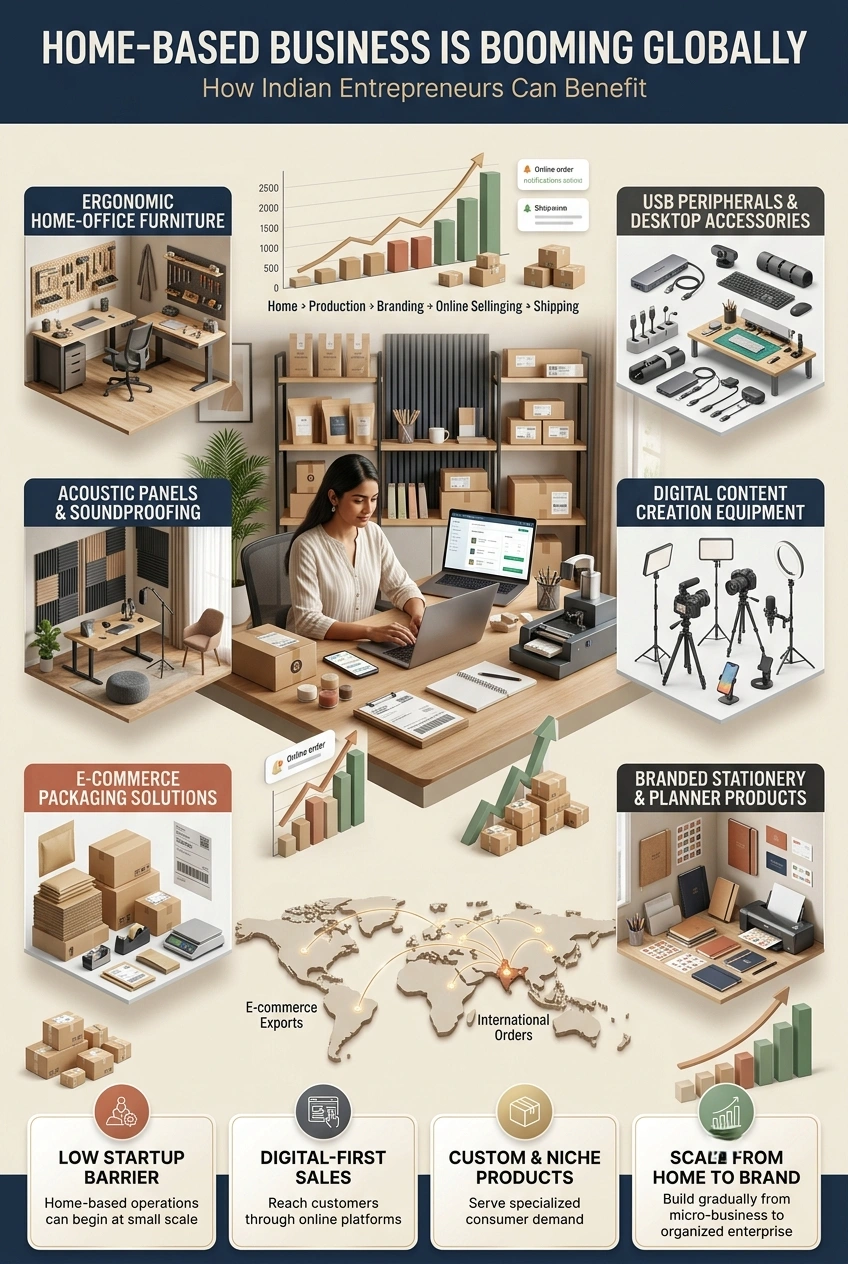
4. Digital Content Creation Equipment — Entry-Level Range
Home-based content production equipment that is affordable and easy to use is essential for the creator economy that is enabling millions of people to make a living from their work: ring lights, portable green screens, collapsible studio lighting packs, phone stabilisers and compact tripod systems. The product category has high dependence on imports in India with Chinese products occupying a significant proportion of the retail shelves.
An Indian manufacturer can go for the middle market, because they can focus on quality, warranty, and availability in their country. The raw materials used include aluminium tubes, LED strips, diffusion fabric and injection moulded plastic parts, which are all locally available. The intended audience for this product are aspiring content creators, online tutors, social media managers and small businesses establishing product photography. Channels are Amazon India, Flipkart, specialty photography retailers and direct B2B supply to digital agencies. Government schemes like PLI (electronics) can help lower inputs.
5. Packaging Solutions for Home-Based E-Commerce Sellers
Specialized, eco-friendly and customisable packaging is a growing market for home-based ecommerce businesses, whether for handmade or artisanal products, refurbished items, niche consumer goods. This segment uses a lot of kraft paper boxes, mailer envelopes, tissue paper wrapping, branded tape, and bubble mailers.
The packaging manufacturer can market itself as customised (with small order minimums), environmentally friendly and quick turnaround, which are all the strengths that large packaging manufacturers do not have for small buyers. Available local raw materials. The business can be started on a small scale and expanded as the demand increases and more machinery will be added. There is an export potential with supply to e-commerce companies owned by the Indian Diaspora in other countries. Government support for MSME packaging cluster schemes is available.
Read the Complete Book Here: Handbook on Modern Packaging Industries
6. Branded Stationery and Planner Products for Micro-Entrepreneurs
Home-based business owners, freelancers and micro-entrepreneurs are a unique and underserved segment of the market for premium, India-inspired desk productivity stationery like planners, journals, desk organisers, goal-tracking notebooks, and branded pen sets. The personalised stationery market is witnessing a worldwide growth due to the shift of consumers from digital to physical writing and planning, as a result of digital fatigue.
Paper and printing industry in India is well established and the raw material supply chain is simple. To stand out, a stationery company can leverage on design, meaningful messages, and cultural appeal to appeal to the micro entrepreneur audience. D2C (direct-to-consumer) e-commerce distribution is the main channel and corporate gifting is a secondary revenue stream. Low capital requirement and highly appropriate to women entrepreneurs and as a home-based industry.
Import-Export and International Market Opportunity
Export Opportunity
The India services export industry — encompassing IT, digital marketing, content creation, consulting, LPO, and accounting services — is ideally suited to the demand of the home-based business sector in the world economy. With millions of home-based entrepreneurs across the globe looking for professional services at a low cost, Indian service providers have a structural cost and talent edge.
On the manufacturing front, the country can export ergonomic furniture, acoustic products, creative lightings and eco-friendly packaging to Southeast Asia, Gulf Cooperation Council (GCC) countries, Africa and even to Europe, where the Indian preferences for the environment-friendly packaging make it a competitive offer. Various export promotion schemes by DGFT such as the Remission of Duties and Taxes on Exported Products (RoDTEP) are providing substantial fiscal assistance to exporters.
Import Substitution Opportunity
India imports a huge number of webcams, ring lights, USB accessories, ergonomic furniture components, acoustic foam and home-office accessories, which are mainly sourced from China. Localisation of these product segments is commercially viable due to the India-China trade relations and PLI incentives for electronics and furniture industries. An entrepreneur who can create a local supply chain for just one of these product categories, can tap into a large and expanding market, with natural immunity to import driven competition.
Indian MSMEs and Startups in Related Industries
Wakefit Solutions
Wakefit, founded in Bengaluru, started as a direct-to-consumer mattress brand and expanded into ergonomic furniture, study chairs, and work-from-home furniture. The company demonstrated that Indian consumers are willing to pay a premium for ergonomically designed, India-manufactured furniture. For entrepreneurs in the ergonomic furniture segment, Wakefit’s success proves that domestic brand building in this category is viable and that e-commerce is the primary growth engine.
Zoho Corporation
Zoho, a Chennnai-based SaaS company, has built a globally competitive suite of productivity, CRM, and accounting tools that directly serve the home-based entrepreneur and small business segment. Zoho’s product philosophy — affordable, feature-rich software for SMBs — aligns perfectly with the needs of the home-based business economy. Entrepreneurs building SaaS products for micro-businesses can study Zoho’s product strategy: focus on ease of use, multilingual support, and deep integration with existing workflows.
Peel-Works (Jumbotail)
Jumbotail, the B2B food and grocery marketplace, and similar platform businesses have demonstrated that technology-enabled supply chain platforms connecting small producers with buyers can scale rapidly in India. For entrepreneurs building platforms serving home-based sellers and micro-entrepreneurs, the playbook is clear: solve the distribution and working-capital problem, and the market will follow.
What Entrepreneurs Should Evaluate Before Investing
Any entrepreneur considering entry into the home-based business economy — whether through manufacturing, services, or platform development — should conduct a rigorous pre-investment evaluation covering the following dimensions:
- Market Demand Validation: Conduct primary research with actual home-based entrepreneurs and remote workers in your target geography to confirm demand for the specific product or service you plan to offer. Do not rely solely on global trend reports.
- Raw Material Supply Chain: Identify domestic suppliers for all key inputs. Evaluate lead times, minimum order quantities, quality consistency, and price stability. For manufacturing units, a multi-vendor sourcing strategy reduces risk.
- Technology and Machinery: Obtain quotations from at least three machinery suppliers and evaluate whether second-hand equipment can reduce initial capital outlay. Visit operational plants if possible before finalising equipment specifications.
- Location and Utilities: Assess availability of reliable three-phase power, internet connectivity, and proximity to courier/logistics hubs — critical for e-commerce-linked manufacturing businesses.
- Regulatory and Quality Requirements: Identify applicable BIS standards, GST implications, export compliance requirements, and any sector-specific certifications. Factor compliance costs into the project financial model.
- Working Capital: Home-based business supply chains involve fast-moving inventory and frequent small orders. Working capital management is critical. Evaluate MSME credit schemes and fintech-based supply chain financing options.
- Competition Analysis: Map domestic and imported competition. Identify where differentiation is possible — quality, customisation, turnaround time, eco-credentials, or pricing.
- Break-Even Analysis: Construct a conservative financial model with realistic price points, production capacity, and ramp-up assumptions. A break-even of 18–30 months is typical for small manufacturing ventures in this category.
- Export Potential: Identify target export markets early and understand certification requirements (CE marking for Europe, FCC for the US) if export is part of the business plan.
Discover business ideas that actually make money
How NPCS Can Help Entrepreneurs Evaluate the Opportunity
NPCS – Niir Project Consultancy Services is one of India’s most experienced industrial and business consultancy organisations, with a track record spanning hundreds of manufacturing and service sector projects. Entrepreneurs looking to enter the home-based business economy segment — whether through product manufacturing, platform development, or service exports — can benefit from NPCS’s structured project evaluation methodology.
NPCS prepares Detailed Project Reports (DPRs) that provide entrepreneurs with a comprehensive, investor-ready assessment of a proposed manufacturing or service venture. These reports cover market analysis, raw material sourcing, manufacturing process design, machinery requirements, utility and infrastructure needs, manpower planning, financial projections, break-even analysis, and risk assessment.
For entrepreneurs in the early stages of evaluation, NPCS offers market feasibility studies that help identify whether a proposed business has a commercially viable customer base, competitive positioning, and realistic financial returns. NPCS also assists with plant and machinery assessment, technology selection, and regulatory compliance mapping — services that are especially valuable to first-time entrepreneurs who may not have manufacturing experience.
Whether the business idea is ergonomic furniture, acoustic products, creator economy accessories, eco-packaging, or a digital services export venture, NPCS’s consultancy approach ensures that entrepreneurs make investment decisions based on data and analysis rather than assumption.
Business Opportunity Snapshot
| Industry | Home-Based Business Economy — Products & Services |
| Market Driver | Global shift to remote work; rise of home-based entrepreneurs; gig economy and creator economy expansion |
| Key Development | Majority of new small businesses globally are launched from home; 19 million+ home-based businesses in the US alone; structural demand for supporting products and services |
| MSME Opportunity | Ergonomic furniture, home-office peripherals, acoustic solutions, packaging, stationery, and digital services |
| Manufacturing Potential | High; multiple product categories currently import-dependent; domestic demand growing alongside India’s own home-based entrepreneur ecosystem |
| Export Potential | Moderate to High; target markets: GCC, Southeast Asia, Africa, UK/Europe for eco-friendly and affordable variants; services export potential very high |
| Import Substitution | Significant; webcams, ergonomic furniture, ring lights, acoustic foam, USB peripherals currently dominated by imports |
| Government Support | PLI for electronics and furniture; CGTMSE credit guarantee; Startup India; MSME innovation schemes; RoDTEP for exporters |
| Investment Consideration | Low to Moderate for most manufacturing sub-categories; High for technology platform development |
| Risk Level | Low to Moderate; demand is structural; competition from imports is the primary risk; mitigated by PLI and import duty policy |
| Growth Outlook | Strong; home-based entrepreneurship is a long-term structural trend, not a post-pandemic anomaly |
Conclusion
The global rise of home-based entrepreneurship represents one of the most significant structural shifts in the business landscape of the 2020s — and it is creating tangible, durable commercial opportunities for Indian entrepreneurs, manufacturers, and exporters. Whether the entry point is manufacturing ergonomic furniture, developing productivity SaaS tools, producing creator economy accessories, or providing specialised services to global home-based businesses, the opportunity matrix is wide and commercially substantive.
India’s combination of manufacturing capability, digital talent, cost competitiveness, and a supportive government policy environment positions the country exceptionally well to participate in and profit from this global transition. Domestic demand for home-office products and services is also growing as India’s own digital workforce expands, providing a dual market opportunity — domestic and export — for well-positioned businesses.
The most important step for any entrepreneur evaluating this space is to move from observation to structured analysis. Conducting a rigorous market feasibility study, preparing a detailed project report, mapping the competitive landscape, and building a financially grounded investment plan are the prerequisites for a successful venture. Entrepreneurs who act with discipline — beginning with data-driven evaluation rather than assumption — will be best positioned to capture the commercial potential this development offers.
The time to begin that evaluation is now. Engage qualified consultants, commission proper feasibility studies, and take a structured approach to project development. The home-based business economy is not a niche trend — it is the next major growth frontier, and India’s entrepreneurs are in an excellent position to lead it. Contact NPCS – Niir Project Consultancy Services for professional market research, feasibility reports, and detailed project reports tailored to this opportunity space.


