






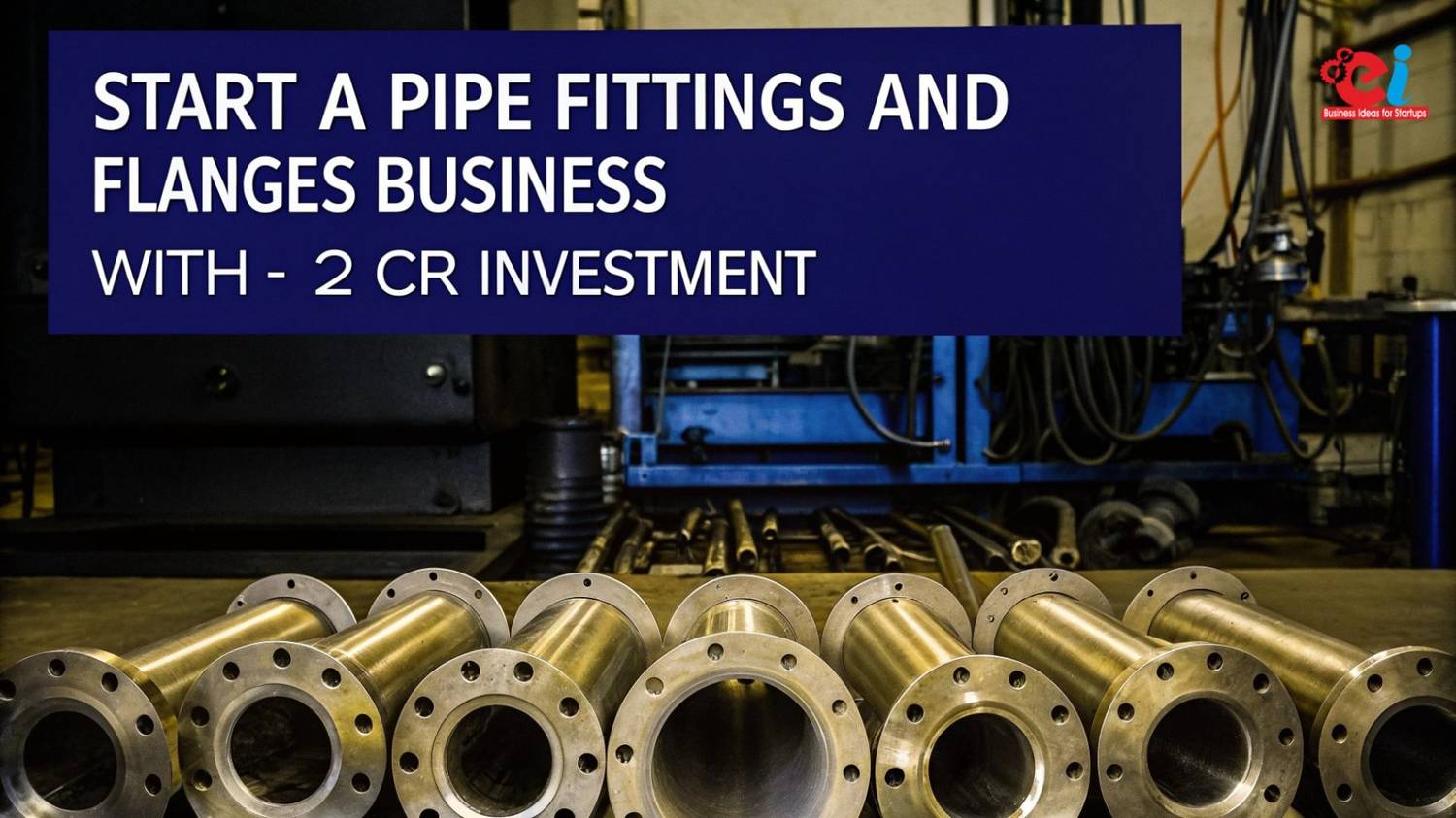
Revenue is projected to grow drastically within infrastructure industries that offer utilities and services. There remains a great potential for construction and manufacturing companies that offer power plants, oil refineries, and advanced cities alongside services like plumbing. These utilities need to be built smarter and more efficient. Pipes, pipe fittings and flanges are the basics that are needed in oil refining, power generation, plumbing, as well as the water distribution systems.
It is not guaranteed however, that there is a direct return of profit, but supportive government policies are able to shift this balance. India continues to be a promising sector for pipe manufacturing due to the policies set in place. There is also a need for competitive businesses that are able to target Indian and foreign markets. These businesses are incredibly profitable and allow for great acknowledgement in the industrial sector.
The Growing Demand for Pipe Fittings and Flanges in India and the World
The Indian manufacturing sector is experiencing rapid evolution because of government initiatives such as “Make in India,” “National infrastructure Pipeline (NIP),” ‘smart city mission,” and “Jal Jeevan Mission”. All these programs lead to an increase in the consumption of pipes, Pipe Fittings and Flanges in the country.
These parts are found in the utility systems of all Super skyscrapers and rural water supply schemes. Pipes serve as the highways of water, gas, oil, and chemicals. Fittings serve the functions of connecting, redirecting, dividing the flows, and flanges serve the purposes of reinforcement, structural, and sealing strength at the pipeline joints. Their demand spans across oil and gas, water treatment, chemical manufacturing, pharmaceuticals, food and beverage processing, construction, renewable energy, power plants, and even the defence sector.
As a result of infrastructure expansion in Africa, Southeast Asia, and the Middle East, the global markey for indutrial pipes and fittings is projected to grow in consant base with greater capital investment. Smart utilities, waste management, and clean energy are all undergoing various forms of new construction that require reliable piping systems. With the low labor costs and improving technical standards, Indian manufacturers are poised to take advantage of these opportunities, thus making the Indian piping indusry a viable export and investment sector.
Segmentation of the Product and Positioning Related to Business
Starting on the wider scope of the problem and moving gradually to its solution means that an expert does not have to begin by manufacturing everything at once to break into the industry. It is perfectly alright for such entrepreneurs to begin with a focused approach. Pipes are also classified as ERW (Electric Resistance Welded), seamless, spiral welded , or plastic extruded, and serve different sectors. For instance, Pipe Fittings and Flanges dominate oil, gas, construction while the agriculture, plumbing and water supply sectors predominantly utilize plastic pipes.
Pipe fittings involve elbows, tees, reducers, sockets, nipples, and end caps. These fittings are critical in directing the movement of materials through a complex system of pipelines. In contrast, flanges are circular disks that are used to join pipes to other equipment like pumps, valves, or even tanks. Oftentimes, covered flanges must comply to stringent international standards (ANSI, ASME, DIN) if they are to be used in high pressure or high temperature environments.
Your product mix is modular, allowing you to tailor it to the local demand. For instance, if your manufacturing facility is located near a city undergoing rapid infrastructural developments, you might want to focus on providing construction-grade fittings and flanges. Conversely, a unit placed near an industrial heart may want to specialize in components such as pharmaceutical or chemical-grade stainless steel parts.
Related: Strategic Opportunity for Tube Manufacturers by 2030
Sourcing of Raw Materials and Supply Chain Fundamentals
The raw materials, especially the carbon steel, stainless steel or alloy steel coils and billets make up the base for the productivity of your manufacturing unit. These are usually obtained from rolling mills or steel stockists. The specifications vary based on the steel’s grade and the products you plan to manufacture. For example, the fittings used for chemical or food grade applications utilize stainless steel 304 and 316.
The starting materials for manufacturing plastic Pipe Fittings and Flanges include polyvinyl chloride (PVC), chlorinated polyvinyl chloride (CPVC), high-density polyethylene (HDPE), and polypropylene random copolymer (PPR). Each of these is provided by a petrochemical manufacturer and may also be imported based on cost and quality.
Purchasing the correct grade of raw material impacts the mechanical strength, resistance to corrosion, and longevity of the finished product. Purchasing from dependable suppliers enables enforcing long term contracts to cut costs while maintaining uninterrupted production.
The Manufacturing Process: Technology First Strategy
The production of pipes and pipe fittings and flanges encompasses hardware and materials engineering guided by mechanical and metal works. For metal pipes, the process usually begins with coil slitting which is then followed by pipe forming using roll forming machines. Welding is accomplished through high-frequency electric resistance, after which the pipes are cut to length, straightened, and annealed for stress relief.
Fittings and flanges are generally made through hot forging or machining. The material is heated to suitable temperatures, forged into the required shape using hydraulic presses or forging hammers, and subsequently precision machined for threading, drilling, or facing. Surface pickling, sandblasting, powder coat, or even galvanization might be done as treatment depending on application.
Contrary to other industries, the production of pipes is done using extrusion technology. In this process, plastic granules are heated inside an extruder, then shaped into pipes by passing them through die heads. The subsequent steps involve cooling, cutting the pipes, and storing them. Plastic fittings are formed employing either injection molding or rotomolding.
To achieve both national and international compliance, every single process demands intense quality assessments at every level. A key part of your quality control system includes hydrostatic pressure testing, non-destructive testing (NDT), evaluation of tensile strength, determination of dimensions, and visual checks.
Setup Requirements of the Plant’s Infrastructure and Equipment
The area required to set up a manufacturing unit varies depending on the product line and the extent of automation used. A small-scale unit would need around 15,000 to 10,000 square feet of constructed area with spaces for storing raw materials, machining, inspecting, and dispatching. More advanced automated systems that produce both Pipe Fittings and Flanges may benefit from over 30,000 square feet of space.
Basic facilities consist of pipe mills, hydraulic presses, CNC machines, plastic pipe extrusion lines, and threading, welding, surface treatment, testing, and packaging. The building structure must include ventilation, water supply, EOT cranes, tool rooms, and space for forklifts. Additionally, you will require offices, quality control laboratories, and areas to unwind that employees can access.
Inspection, maintenance, welding, and other operations require a certain degree of skill or a specific level of training. To keep uptime and productivity on target, hiring along the value-chain spectrum including production supervisors, quality engineers, and maintenance workers should be prioritized.
Investment and Financial Feasibility
The anticipated capital investment for establishing a new unit for pipe, fitting, and flange manufacturing is scope and automation dependent. A micro-level unit concentrating on producing only plastic pipes is estimated to cost around ₹1.5 to ₹2 crore, whereas a mid-level steel Pipe Fittings and Flanges unit would need approximately ₹3–5 crore. Some rotary units that produce pipes and fittings in both metals and plastics stand to exceed ₹10 crore, considering they’re more sophisticated.
Start-up expenditures will include land, construction or leasing, machinery and installation, raw initial cycle materials, working capital, labor, electricity connection, licenses, pre-operative expenses, and building. Cost modeling must be conservative in estimating fixed and variable costs, costs per unit, break-even analysis, and working capital cycle.
Revenues from sales will differ based on the order volumes and product mix. For your plant servicing both individual and corporate clients at a 60-70% capacity utilization level, monthly revenues are estimated to be in the range of ₹20–30 lakh within the first year alongside a net profit margin of 12–18%. Operationally efficient businesses can expect to breakeven within two to three years.
Certifications, Licenses, and Compliance Requirements
Operating in the industrial component sector means dealing with clients that require strict adherence to quality standards. Most buyers, especially from oil and gas, water utilities, and export markets, will ask for BIS certification, ISO 9001 quality systems, and specific ASTM or ASME product standards. Flanges often need to meet ANSI B16.5 or DIN standards.
You’ll also need manufacturing licenses, pollution control approvals, fire safety certification, labor and factory registration, and possibly MSME registration to avail of subsidies and incentives. In export scenarios, CE marking, RoHS compliance, or UL certification may be needed.
Ensuring full compliance from day one not only builds customer trust but also unlocks opportunities to bid for government tenders or supply to high-value industrial projects.
Related: uPVC and CPVC Pipes Business
Role of NPCS in Building a Successful Business
Launching a manufacturing unit for pipes, pipe fittings & flanges is a high-value undertaking that requires a structured approach. This is where Niir Project Consultancy Services (NPCS) becomes a strategic partner. NPCS offers tailor-made Detailed Project Reports (DPRs) that provide comprehensive feasibility assessments, market analysis, technical specifications, investment requirements, and financial projections.
Their services include identifying suitable machinery vendors, helping with layout planning, guiding regulatory approvals, and offering post-launch business support such as export market linkage and process optimization. Whether you’re applying for a bank loan or approaching a venture capitalist, NPCS ensures your project is backed by reliable data and execution strategy.
Conclusion: Building a Future-Ready Industrial Brand
The manufacturing of pipes, Pipe Fittings and Flanges isn’t just a business—it’s a gateway to India’s infrastructure revolution. As cities grow, factories modernize, and industries upgrade, the demand for reliable fluid and structural systems will continue to surge. For entrepreneurs willing to invest in quality, innovation, and customer relationships, this sector offers a long-term, high-return opportunity.
With strategic planning, reliable execution, and expert guidance from institutions like Niir Project Consultancy Services, you can launch a business that doesn’t just survive—but thrives—in India’s new industrial age.


