





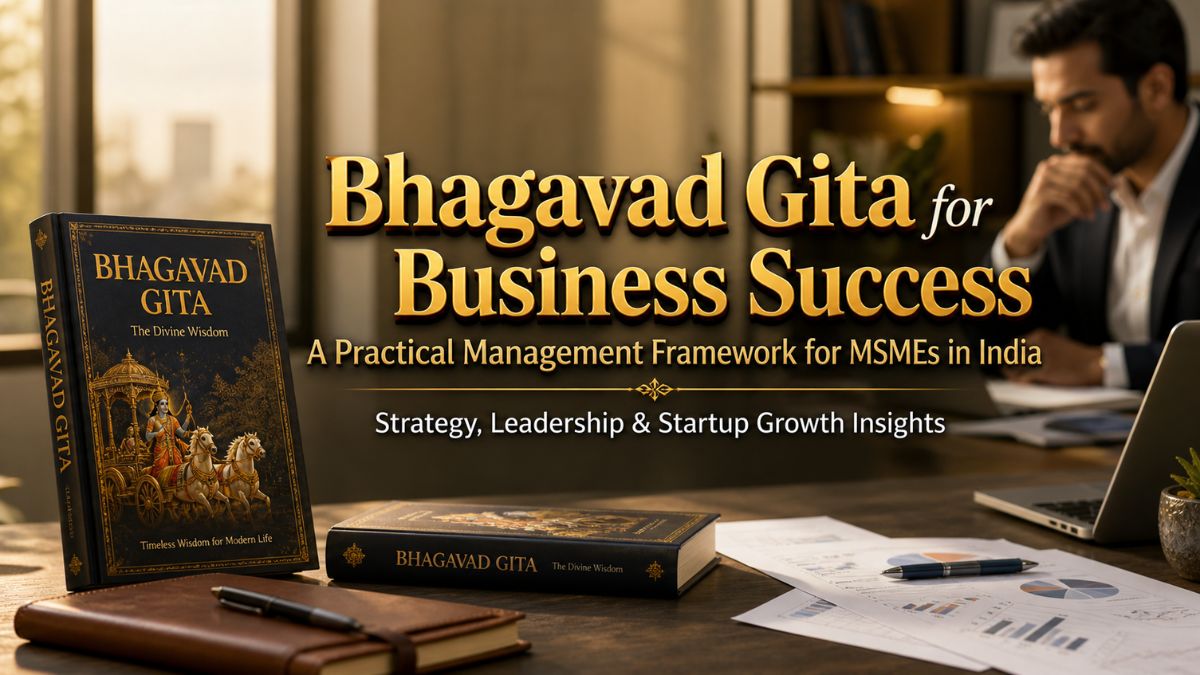
Introduction: Bhagavad Gita for Business Success
In this modern and very competitive and uncertain business world, the Micro, Small and Medium Enterprise (MSMEs) in India are under continuous pressure to expand, streamline business operations and remain profitable. Although there are numerous tools in the modern management theories, some entrepreneurs continue to grapple with the lack of leadership clarity, decision making stress, and operational inefficiencies.
Interestingly, one of the most effective and useful management systems is not new: it is an ancient Indian wisdom: the Bhagavad Gita.
The Bhagavad Gita is more than just a spiritual text; it contains profound information on leadership, decision-making, emotional intelligence, discipline, and performance management. These principles are quite applicable to the present-day MSME owners who have to operate under limited resources and contribute to sustainable development.
Table of Contents
ToggleRelated Article: Startup Success Lessons from the Bhagavad Gita Every Entrepreneur Should Know
Core Challenges Faced by MSMEs in India
The practical issues MSMEs have to deal with in reality should be known before implementing any management framework:
- Absence of clearly spelt out roles and responsibilities.
- Excessive reliance on the owner of the business to make all decisions.
- Emotional decision-making in times of financial stress or crisis.
- Weak process systems and unofficial workflows.
- Poor employee responsibility and performance.
The problems tend to cause stagnation, burnout among founders, and lower profitability. The Bhagavad Gita provides solutions to these dilemmas using eternal laws of action, discipline and clarity.
Key Bhagavad Gita Principles for Business Management
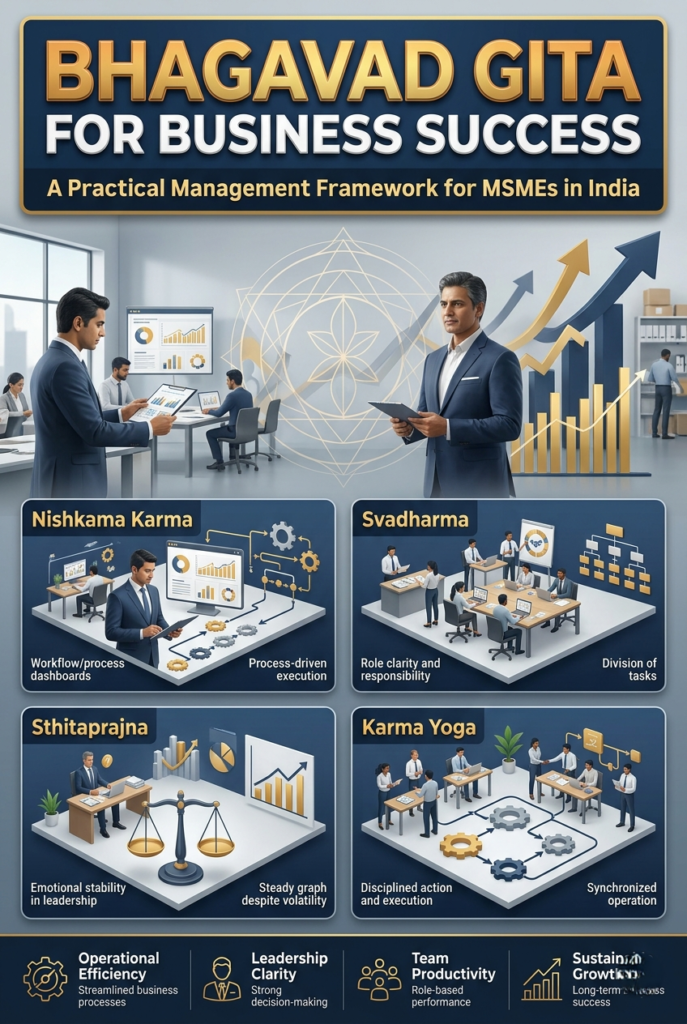
1. Nishkama Karma: Focus on Process, Not Just Results
Performing your duties without attachment to the results is one of the most significant teachings of the Bhagavad Gita, Nishkama Karma.
This in business terms means:
- Concentrating on systems and processes and not just on revenue targets.
- Creating routines of execution.
- Lessening the anxiety that comes with uncertainty of outcomes.
Performance can be more stable and scalable when MSME owners change their mindset towards long-term process excellence and away to short-term results.
2. Svadharma: Clear Roles and Responsibilities
The notion of Svadharma is doing one’s assigned duty in a clear and committed manner.
This implies:
- Each employee should have a well-defined role.
- Boundaries of decisions must be recorded.
- The accountability must be quantifiable.
In case of role ambiguity, the businesses experience duplication of efforts, confusion and delays. This chaos is removed through the use of structured systems of responsibility by Svadharma.
3. Sthitaprajna: Emotional Stability in Leadership
A Sthitaprajna is somebody who is neither excited nor tilted in success or failure.
To business leaders, this is a very important principle since:
- The situation in the market is always changing.
- Financial stress may make people make emotional choices.
- When one panics, there is poor choice of strategies.
When there is an organization leader who is steady, the organization tends to stay steady even amidst crises and therefore, decisions made in the long term can be made.
4. Karma Yoga: Disciplined Action and Delegation
Karma Yoga is focused on the selfless, disciplined action without being attached to the personal ego and the control.
In MSMEs, this translates to:
- Delegating responsibilities effectively
- Constructing systems rather than supervising activities.
- Employee ownership.
The principle assists the companies in expanding bigger than what is achievable by a single founder.
Get Detailed Insights from This Book: 50 Best Home Businesses To Start With Just 50,000
How to Apply These Principles in MSME Operations
The Bhagavad Gita has a real value on practical application. The owners of MSMEs can adopt the following ideas in the following way:
1. Introduce Process-Based KPIs
Businesses should monitor: instead of just sales or profit.
- Daily production output
- Customer response time
- Task completion rates
- Operational efficiency metrics
This guarantees concentration on the continuous enhancement instead of just final outcomes.
2. Define Written Role Descriptions
Each member of the team ought to possess:
- Well defined job requirements.
- Decision-making authority limits
- Performance expectations
This helps in cutting down confusion and enhancing accountability.
3. Build Simple Decision Frameworks
MSMEs need to develop:
- Standard operating procedures (SOPs).
- Crisis response guidelines
- Approval hierarchies
This makes it less dependent on the owner to make all decisions.
4. Implement Daily Review Systems
An easy yet effective habit is:
- 10-15 minutes in a review of performance per day.
- Follow up of actual and planned activities.
- Identifying bottlenecks early
This develops discipline and endless enhancement.
Access Complete Business Plan: Project Reports & Profiles
Business Benefits of This Approach
As Bhagavad Gita-based principles of management are put into practice on a regular basis, the MSMEs will see tangible improvements:
- Increased employee responsibility and involvement.
- Less confusion and delays in operations.
- Greater efficiencies in productivity and workflow.
- Improved management and decision-making in case of crisis.
- Greater leadership clarity and confidence.
On the financial aspect, businesses will tend to experience less losses in terms of inefficiencies and better profitability within months of a structured implementation.
Government Support for MSME Growth in India
The Government of India provides a number of schemes to help organized business development that are well aligned with the process-driven management:
- LEAN Manufacturing Scheme: It is aimed at reducing waste and enhancing efficiency.
- ZED Certification (Zero Defect Zero Effect): Promotes quality and sustainable practices.
- PMEGP Scheme: It supports new MSME establishment.
These programs assist the companies to implement organized systems at reduced prices to enhance sustainability in the long term.
Role of Professional Consultancy in MSME Success
Though principles give the guidance, there is frequently a need to have an expert guide them on the execution. Structured consultancy support is used in various areas like project planning, financial modelling, and operational set up by many MSMEs.
Professional advisory services such as NIIR Project Consultancy Services (NPCS) help the entrepreneurs with:
- Detailed Project Reports (DPRs).
- Feasibility studies and market analysis.
- Plant installation and operational design.
- Advice on MSME schemes and approvals.
This kind of assistance assists in putting strategic principles into a realistic business system.
Why This Framework Works in Modern Business
The management approach that is based on the Bhagavad Gita is effective since the attitude and discipline of the decision-maker is the most important part of business success.
When leadership becomes:
- Clear in thought
- Stable under pressure
- Structured in execution
This will make the whole organization more efficient and productive.
This strategy transforms businesses into a reactive management to a system driven growth.
Conclusion: Start Small, Scale Gradually
Applying the philosophical principles in business does not necessitate radical changes. Gradual transformation is the key.
MSME owners can begin with:
- Setting of clear roles of their teams.
- Implementation of daily review systems.
- Measuring performance by tracking processes.
In the long run, these minor changes produce powerful working systems that facilitate long-term development.
The Bhagavad Gita does not supersede the contemporary business strategy- it adds clarity, discipline and sanity to it. These attributes could turn out to be a real differentiator in the competitive MSME environment of India.
FAQs
Q1. Is it true that Bhagavad Gita principles can be applied in business?
Yes, they enhance leadership clarity, decision-making, and functional discipline.
Q2. What is the simplest principle to begin with?
First to Svadharma- establish roles and responsibility within your team.
Q3. What is the benefit of Nishkama Karma in the case of entrepreneurs?
It eases tension as it puts the emphasis on results instead of habitual effort and performance.
Q4. Is this a viable strategy to MSMEs?
Yes, particularly in small businesses where structure and discipline is not a common factor.
Q5. Is this useful in times of business crisis?
Yes, Sthitaprajna principle assists the leaders to remain cool and make more appropriate decisions in stressful situations.


