





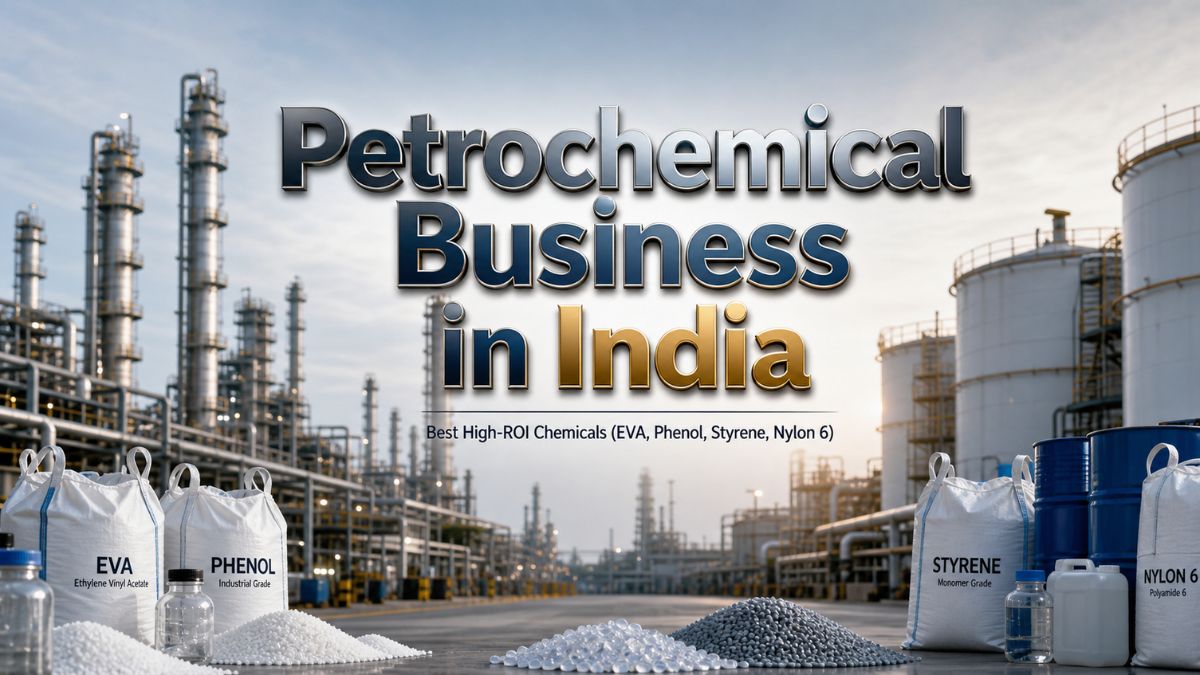
Petrochemical Business in India
The Indian petrochemical industry has the potential for high growth, with just one lacuna in the market – the high dependence on imports, that provides opportunity to new investors. NITI Aayog estimates that India spends over ₹23,000 crore annually on imports of critical intermediates such as EVA, phenol, styrene and nylon 6. This is an opportunity for manufacturing with a huge upside.
Unlike fledgling or new industries, these chemicals are already part of the Indian economy. They are critical for solar cells, cars, plastics, paper and textiles. There is a real and growing market. The one thing we don’t have is local supply.
This is a unique opportunity for investors, where there is high demand, low competition and the government is encouraging more production.
Table of Contents
ToggleDownload the Full Guide: Handbook On Chemical Industries (Alcohol Based)
Why Petrochemical Manufacturing is a Smart Investment
Industrialisation in India is creating a strong demand for chemical intermediates. But local supply has failed to keep pace, resulting in imports. Reasons why this sector is a great option.
There are a couple of reasons why this is an attractive sector:
- High and increasing demand from a range of sectors
- Large dependence on imports (70% – 85% for some chemicals)
- Government subsidies and support
- Domestic buyers with long-term contracts
The risk factor is reduced and profit margin increase as compared to other sectors.
Best Petrochemical Segments for Investment
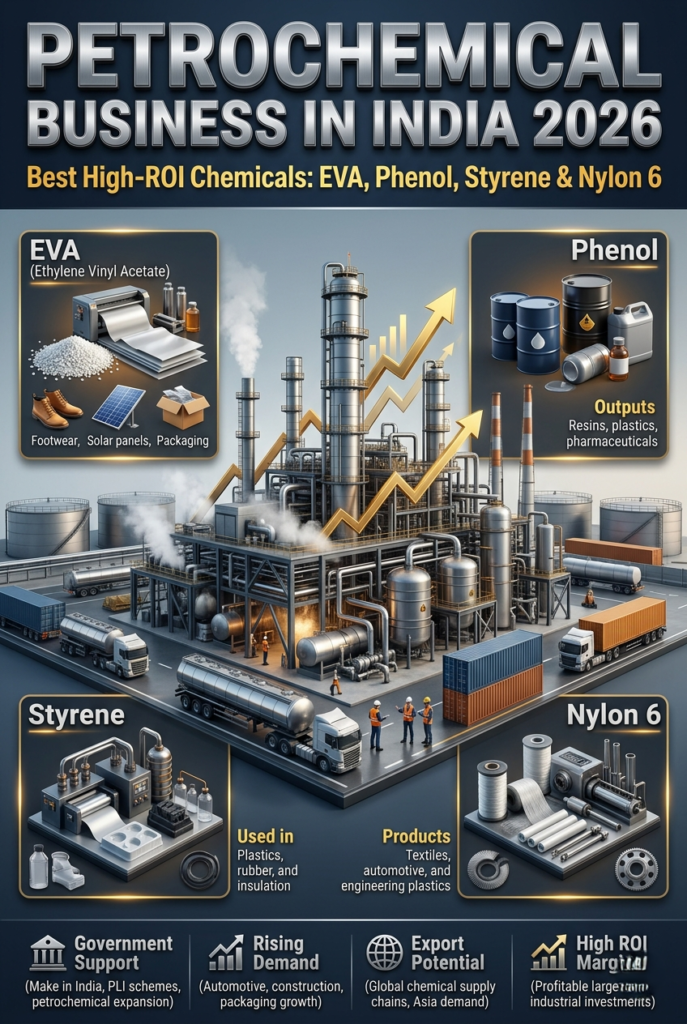
EVA (Ethylene Vinyl Acetate): Highest Growth Potential
EVA is a significant requirement in the Indian renewable energy sector. EVA is used to encapsulate solar panels, thereby protecting photo-voltaic cells and providing higher yield.
India has ambitious plans for solar capacity, and this is creating a huge market for EVA, which is in short supply. This means that new players enjoy a significant advantage.
In terms of economics, EVA is a very attractive investment. Medium-sized plant cost comes between 80-110 crore but on full utilization, the profit margin is as high as 24% that increases profit margin and decrease the risk. It also has a relatively short payback period of about five years.
Access Complete Business Plan: Phenol Moulding Powder Manufacturing Project Report
Phenol: Stable and Reliable Returns
Phenol is used extensively in laminates, adhesives, automotive parts and industrial resins. Phenol has broad market applications, unlike EVA, which has a more focused market.
A major strength is the process by which it is produced. Phenol production also produces acetone, which is also in demand. This is profitable and at low risk.
Key benefits of phenol investment:
- High demand from construction and automobile industries
- Co-product sales of acetone
- Less price fluctuation than other chemicals
This makes phenol an excellent choice for investors aiming for the long-term.
Styrene: High-Volume Market Opportunity
Styrene is an essential component for plastics, packaging, rubber and consumer goods. It is used for production of products like EPS foam, ABS plastic, synthetic rubber which have significant demand in India.
However, India still imports most of its styrene needs. This presents a huge opportunity to domestic manufacturers.
Although the margins are marginally lower than EVA or phenol, the high consumption level makes styrene very lucrative. Once running at full capacity, there is significant revenue opportunity given the high demand.
Nylon 6: Low-Cost Entry with Strong Margins
Nylon 6 is used in engineering plastics, automobile parts and textiles. Rather than starting a full-blown plant, many are opting for compounding, which involves turning raw nylon into grades.
This is cost-effective and involves low investment yet high returns.
Key advantages of nylon 6 compounding:
- Modest upfront cost (₹40-70 crore)
- Strong market in automotive, industry
- Higher prices for special grades
This provides an excellent opportunity for medium sized investors.
Government Support Boosting the Sector
The regulatory framework in India is getting more supportive of petrochemical manufacturing. The government is promoting indigenous manufacturing to cut imports.
Some key initiatives include:
- Proposed opex subsidy with incentives on incremental sales
- Production-Linked Incentive (PLI) schemes
- MSME credit and finance assistance
- PCPIR clusters with infrastructure
These ventures mitigate the financial and operational risks faced by the investors.
Best Locations for Setting Up a Plant
Location is of key importance in making the venture profitable, more so in the case of petrochemical plants depending on feedstocks.
In India, the best places to set up are:
- Gujarat (Dahej, Hazira) – the best petrochemical cluster
- Odisha (Paradip) – emerging industrial base
- Andhra Pradesh (Visakhapatnam) – great port access
- Tamil Nadu – demand for manufacturing
Closeness to raw materials like the refinery and the petrochemical plants helps in minimizing transport costs.
Startup Opportunities with Lower Investment
No entrepreneur has to set up 100 crore here, in reality; there is a whole slew of downstream possibilities with far lesser investments, still capitalizing on the downstream boom.
Some promising ideas include:
- EVA solar film production
- Phenolic resin production
- Nylon 6 compounding units
- ABS plastic blending
- Chemical testing laboratories
Low investment yet high margin businesses with growing demand.
How NPCS Can Help You Get Started
The setup of the petrochemical plant is a technically intensive and a regulatory hurdle which also requires careful financial planning, where NPCS can come in assistance.
NPCS offers total project support, which includes:
- Detailed Project Reports (DPR)
- Market research and feasibility studies
- Equipment selection & plant design
- Estimation and financial analysis
This ensures investors make the right choices and avoid pitfalls in establishing their projects.
Final Conclusion
The petrochemical sector in India is a unique combination of a high demand, low supply and strong government backing. This provides a strong growth opportunity for big and medium sized entrepreneurs.
To summarize:
- EVA has the highest growth and fastest returns on investment
- Phenol offers consistent steady returns
- Styrene is a great volume business
- Nylon 6 offers the cheapest way to get started
The market is still green but will soon be crowded. Investors who get in early will be rewarded by locking in supply agreements and building their market share prior to competition.
Frequently Asked Questions (FAQ)
Q1. Which petrochemicals business is most profitable in India?
EVA is the most profitable at the moment due to high demand from the solar industry and lack of supply in the country.
Q2. How much is needed to set up a plant?
Is from 40 cr for smaller plants to over 100 cr for petrochemicals plant.
Q3. Is government support available?
Yes, various schemes available such as Opex subsidy, PLI, funding for MSMEs etc.
Q4. How to build a plant?
Approx. 24-36 months to get all the approvals and construction completed.
Q5. Is this business for beginners?
Yes, in small downstream industries such as compounding or resin making.
Q6. How can NPCS help in this business?
NIIR Project Consultancy Services offer project reports, feasibility studies and turnkey solutions for plant establishment.


