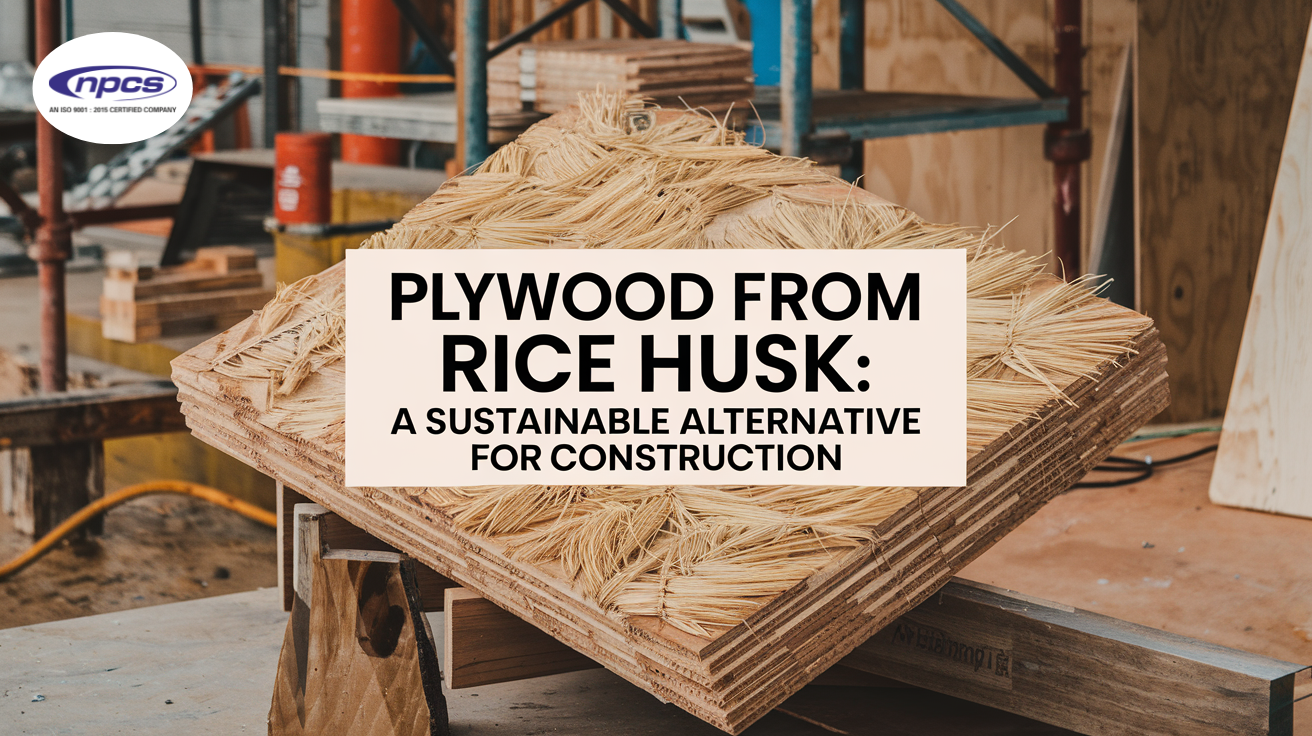






The world has witnessed a rapid increase in sustainable building material consumption because of growing problems related to deforestation, carbon emissions, and natural resources running out. Traditional plywood from rice husk that dominates construction and furniture production depends heavily on timber resources, which results in the destruction of forests alongside habitat destruction. Research institutions and industrial companies now develop rice husk plywood as an environmentally friendly alternative to combat current environmental challenges. Traditional plywood substitutes can use rice husk agricultural waste to create affordable sustainable plywood products that perform similarly to conventional plywood.
The Growing Demand for Sustainable Materials
The construction industry utilizes 3.7 billion cubic meters of timber for yearly projects, which leads to deforestation alongside biodiversity collapse. Plywood remains the essential product of this industry, yet it depends heavily on hardwood and softwood forest supplies, which experience sustained excessive harvesting beyond safe levels. The manufacturing process of plywood results in high greenhouse gas emissions because it requires considerable energy for timber processing along with formaldehyde-based adhesive usage that causes indoor environmental pollution.
The large quantities of rice husks available from agricultural waste operations remain mostly unused. The global production of rice yearly yields around 700 million tons, which results in nearly 140 million tons of rice husks as a leftover material. The discarded husks create environmental concerns because their burning or dumping results in air pollution together with carbon emissions. The production of plywood from rice husks creates a circular solution for disposal of agricultural waste while supporting sustainable practices for waste reduction.
Manufacturing Process of Rice Husk Plywood
Production of rice husk plywood follows multiple defined steps that focus on enhancing material strength while encouraging environmentally friendly practices. The primary process includes:
- Rice mills supply rice husks that require cleaning treatment to eliminate unwanted materials before processing. The process adds value by reducing the husk particles into smaller forms for improved bonding strength.
- Traditional manufacturing of plywood uses formaldehyde-based resins as adhesives, but these cause emission of volatile organic compounds (VOCs). Rice husk plywood production uses bio-based adhesives such as tannin and lignin resins due to their better environmental benefits.
- The adhesive mixture receives high-pressure compression molding with rice husk particles. The production method produces consistent density throughout the material while strengthening it while minimizing the presence of holes.
- The finished compressed boards receive surface treatments that involve sanding while also undergoing coating operations for gaining both durability and aesthetic appeal together with water resistance.
A high-strength, lightweight, water-resistant plywood substitute enables multiple building applications, from furniture to floors and wall panels as well as building structures.
Performance and Mechanical Properties
Plywood from rice husk exhibits extraordinary structural properties that stand out as its most important feature. Multiple research investigations have studied the mechanical capabilities of rice husk plywood relative to classic wood-based plywood products and found optimistic outcomes.
- Plywood from rice husk demonstrates density values between 600 and 800 kg/m³ that match the levels of medium-density fiberboard (MDF) as well as traditional hardwood plywood. The flexural strength measurements for it reach between 20–40 MPa after adhesive selection and production method optimization.
- The high silica content in rice husks (approximately 15–20% silica content) gives it outstanding resistance to moisture absorption suitable for use in wet environments.
- Rice husks contain natural silica content, thus offering panel protection against fungal growth together with total termite resistance which conventional wood-based materials lack.
- Rice husk-based panels exhibit better fire-retardant qualities compared to conventional plywood because silica content is resistant, according to recent scientific studies. The combination of silica content in rice husk makes these materials suitable for applications needing fire-resistant building materials.
Environmental and Economic Benefits
Construction benefits substantially from the environmental and economic advantages of it because it demonstrates sustainable material potential.
- Conservation of forests occurs through the replacement of timber plywood with rice husk plywood, thus preventing deforestation activities.
- The production of rice husk plywood uses less energy than traditional plywood does so it delivers lower carbon emissions to the environment.
- Rice husks serve as an advantage because their reuse for this application enhances waste valorization and supports a circular economy model.
- The premium supply of rice husks ensures cost-effective raw materials that lead to reduced manufacturing costs, which results in production prices below traditional plywood alternatives.
- Rice husk plywood benefits human health because formaldehyde-free adhesives create an environment with low VOC concentration levels, which leads to enhanced indoor air quality.
Read More About : Rice Husk – A Useful By-Product for Rice Growers.
Challenges and Future Prospects
For widespread commercial usage of rice husk plywood, these advantages need resolution of specific challenges.
- Rice husk plywood production establishments currently operate at a lower scale compared to traditional plywood industry factories. To satisfy existing market demands, it is essential to establish large manufacturing sites together with optimized supply chain networks.
- The mechanical characteristics of rice husk plywood show diversity based on what methods and formulas are used for adhesive preparation during the production process. The industry needs standardized production methods combined with quality benchmarks to accept this product.
- Many construction professionals, along with consumers, have low knowledge about the advantages it offers the market. A combination of certification initiatives along with incentive programs and pilot demonstrations will quicken the adoption rate of this product in market sectors.
Bio-based adhesive research continues despite evidence showing strength and durability weaknesses in substitute binder systems. Exponential research efforts on eco-friendly binders with high performance capability will develop products with better competitiveness.
Also Know More About : A Simple Guide to Rice Husk and Its Biofuel Potential
Conclusion
Plywood from rice husk serves as one of the modern sustainable alternatives to standard wood-based building panels and responds to contemporary initiatives for environment-friendly construction components. It has strong mechanical properties along with environmental advantages and cost-effective production, which makes it a suitable choice for interior applications including building construction and furniture manufacturing. Ongoing studies combined with increased sector funding will enable the complete development of rice husk plywood, which will ultimately decrease timber dependence for sustainable construction.