





Market Insight
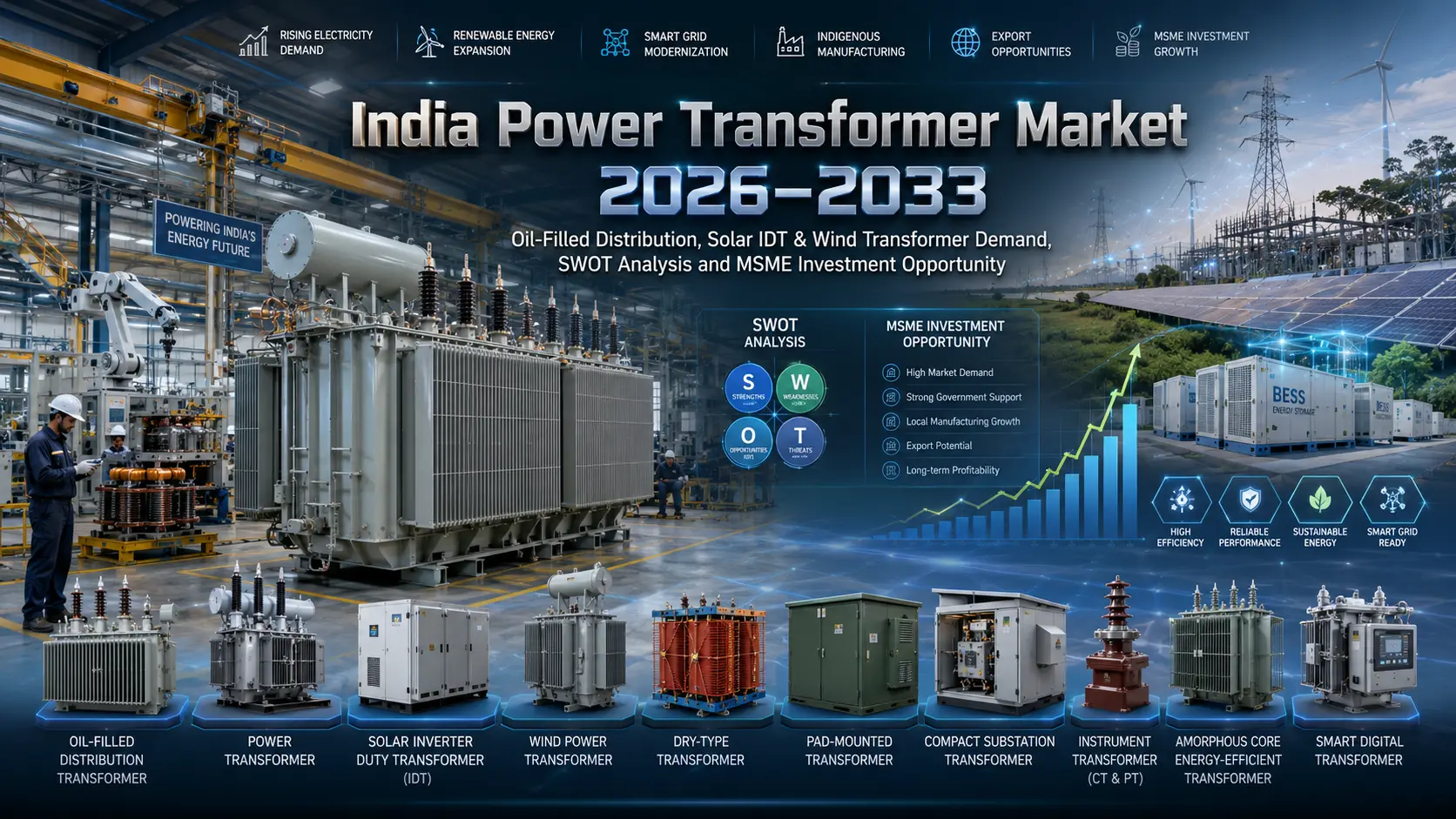
The Indian power transformer industry has now transitioned to a high growth cycle which is structurally different from other past cycles. What we are seeing is not just about incremental infrastructure spending, it is the simultaneous demand from three fronts; rapid growth of renewable energy, which is creating a need for transformers to integrate the grid; the Atmanirbhar Bharat and the ‘Make in India’ push creating a huge manufacturing push to replace distribution transformers at unprecedented domestic and foreign capital expenditure rate.
India Power and Distribution Transformer market is estimated to be valued at USD 3.97 billion in 2016 and is expected to grow at a CAGR of around 10.84% till 2030 due to the increasing installed power capacity, grid modernization requirement and integration of renewable energy. In this larger market, three distinct segments: oil-filled distribution transformers up to 2.5 MVA (36 kV class), solar Inverter Duty Transformers (IDTs) up to 20,000 kVA (36 kV class) and wind transformers up to 5.5 MVA (36 kV class) are the largest and most investable opportunity zones for MSMEs, first generation entrepreneurs and industrial investors considering new manufacturing projects.
Get Detailed Project Report (DPR): Power Transformer Manufacturing Project Report
India’s Power Infrastructure Push: The Context That Creates Demand
To comprehend the transformer market, one need to grasp India’s energy aspiration. The Ministry of Power (powermin.gov.in) states that India has installed a record 52,537 MW of power generation capacity in last only one year of FY 2025–26. Peak electricity demand jumped by 57 GW to 250 GW in just one calendar year, and was the fastest growing of any major economy in the world. The medium term is expected to see 1,23,577 circuit kilometres of new transmission lines, and more than 8,27,600 MVA of substation capacity added to the network, as planned by the National Electricity Plan. The pipeline needs to have power and distribution transformers at every substation.
On the distribution side, Government of India’s flagship ‘Revamped Distribution Sector Scheme’ or ‘RDSS’ run by Ministry of Power [1] of has allocated an outlay of ₹ 3,03,758 crore over a period of five years – from FY 2021-22 to FY 2025-26, in which the gross budgetary support (GBS) by central government amounts to ₹ 97,631 crore. RDSS necessitates DISCOMs to achieve an aggregate technical and commercial (AT&C) loss of 12-15% and an aggregate billings and collection accounting gap between aggregated claim submitted(ACS) and aggregate revenue realized(ARR) becomes zero. The key to meeting such goals is the mass replacement and upgrading of old distribution transformers nationwide—a clear and measurable procurement path for manufacturers.
Meanwhile, India’s Ministry of New and Renewable Energy (mnre.gov.in) is also creating a substantial demand for clean energy. By mid-2026, India’s renewable energy capacity is just past 226 GW, of which solar has more than 92 GW, and wind has about 47 GW. The government has promised a targeted installed capacity of 500 GW using non-fossil fuels by the year 2030 and that this is likely to take place through mass procurement of thousands of solar I-DGs and power-intensive energy storage solutions (wind transformers) – a lion’s share that need to be manufactured locally following their procurement policies and domestic content obligations, the report said.
Oil-Filled Distribution Transformers (Up to 2.5 MVA, 36 kV Class)
Market Dynamics and Application Scope
In India, the distribution network for delivering electricity to the consumers is created using oil-filled distribution transformers of the range 1-2.5 MVA. The function of these units is to reduce the medium voltage (normally 11 kV or 33 kV) to low voltage (0.4 kV) for powering domestic consumers, commercial consumers, rural irrigation and small industrial consumers. They are the state electricity distribution companies (DISCOMs) and rural electrisation agencies’ single most popular type of transformer.
Effective this January, all existing distribution transformers will be banned from being sold after they reach their star rating limits, forcing utilities to replace and phase out millions of units that are currently in place and do not meet minimum efficiency requirements by the BEE. The regulatory push, coupled with the proliferation of infrastructure projects driven by RDSS and the rural electrification targets and schemes under Pradhan Mantri Sahaj Bijli Har Ghar Yojana (Saubhagya), is creating a procurement wave of replacement as well as expansion which industry experts believe will ensure a flurry of order books for the distribution transformer manufacturers until 2030.
Key materials for oil-filled transformers are closely related to global commodity cycles: the core is made of Cold Rolled Grain Oriented (CRGO) electrical steel, windings are made of electrolytic copper, and transformer oil is used for insulation and cooling. The domestic production of CRGO is very much short of the requirement in India. The Global Trade Research Initiative (GTRI) says India was consuming around 400,000 tonnes of CRGO steel in the last fiscal year, according to Business Standard (business-standard.com).
This was in contrast to domestic production of just 50,000 tonnes, which accounted for only 10-12% of the country’s demand. Despite the exports, India’s structural deficit on imports from China, Japan, Russia and South Korea was 1,22,200 tonnes or 30.6% of the total demand for imports. The market for CRGO is projected to see 10–12% CAGR growth until 2030, attributed to the growing transformer market.
This CRGO gap is a two-sided coin: it’s limiting the capacity of current CRGO manufacturer and pointing to a huge opportunity in the upstream. JSW JFE Electrical Steel has made a historic investment at its Nashik plant, with an expansion plan that will increase CRGO capacity from 50,000 TPA to 2,50,000 TPA, which will help lessen the raw material constraint for the transformer industry.
Regional Demand Concentration
Western India, primarily Maharashtra and Gujarat, contributes almost 29-33 per cent of India’s total transformer consumption, owing to the presence of huge industrial clusters, renewable energy parks and infrastructure network of the two states. The other areas of demand are Tamil Nadu, Rajasthan, Uttar Pradesh and Andhra Pradesh. Gujarat state alone installed 7449 MW of new renewable energy generation capacity in 1 year, each of which needed step-up and distribution level transformers. These competitive factors can be especially important when it comes to selecting a location for your manufacturing operation, for manufacturers in Tier-2 towns in these states, because the location of the utility procurement office and other logistical benefits can make all the difference.
Solar Inverter Duty Transformers — IDTs (Up to 20,000 kVA, 36 kV Class)
Technical Nature and Why This Segment Is Distinct
Solar Inverter Duty Transformers are not a standard distribution transformer. They are application-specific units designed to manage the electrical stresses associated with the output of the solar inverter, which is non-sinusoidal in nature, has high total harmonic distortion (THD), suffers from voltage fluctuation due to intermittent generation and experiences thermal cycling due to solar generation ramps between zero and full capacity, and back again each day. The reason standard distribution transformers are not suitable for solar applications is that they are not designed to operate under these conditions for as long as the system will require.
IDTs feature k-factor rated designs, an improved insulation system, reinforced winding geometry and improved heat dissipation features. The demand for the large capacity IDTs (5,000–20,000 kVA) is fastest growing sub-segment in the Indian transformer market, as the projects of 100 MW and above are moving towards solar utility scale projects.
Market Size and Growth Trajectory
Inverter Duty Transformer is one of the fastest growing sub-segments in the Indian electrical equipment market and is expected to witness a CAGR of 11.1% from 2019 to 2023. The solar energy segment accounts for maximum share of the IDT market revenues, with the development of solar parks like Pavagada Solar Park, Bhadla Solar Park etc. and hundreds of distributed solar farms under the National Solar Mission and PM-KUSUM schemes.
As of latest milestone India has reached 203 GW of renewable energy capacity up to which solar has contributed 92.12 GW and wind has contributed 47.72 GW up to now. The government’s ambition to achieve 500 GW of non-fossil fuel energy by 2030 (as part of its Nationally Determined Contributions (NDCs) under the Paris Agreement) is a strong procurement pipeline for solar IDTs over several development lifetimes.
The Union Budget provided Rs 10,000 crore dedicated to solar projects and launched PM-Surya Ghar Muft Bijli Yojana, which has a target of Rs 75,000 crore to further promote solar power in homes and villages. The order flows generated by key Government initiatives such as PM-KUSUM, Solar Rooftop Phase II and the Solar Park Scheme, with a target of 38 GW of Solar Park capacity by 2026, through the Solar Energy Corporation of India (seci.co.in), are all active.
Application Segments and Buyer Landscape
Three-phase units are prevalent in the IDT market because of their high performance in large-scale solar projects, load balancing, low operating expenses and durability. The power band from 5.1 to 10 MVA is likely to produce the highest incremental revenue growth, as a result of the growth in mid-sized commercial and industrial solar projects, and captive solar projects by industrial consumers. Distributed solar (rooftop solar on commercial buildings, warehouses, factories) is adding another tier of demand for smaller IDTs ranging in size from 100 kVA to 2,000 kVA, offering a multi-tier market opportunity for manufacturers of different sizes.
Get Detailed Insights from This Book: Solar PV Power and Solar Products Handbook
Wind Transformers (Up to 5.5 MVA, 36 kV Class)
Wind energy transformers face one of the harshest operating environments in power generation, with vibrations, thermal stress, high humidity and the variable power production typical of wind energy generation in the nacelle of the wind turbines or the base of the turbine towers. The up to 5.5 MVA, 36 kV class is designed to meet the transformer needs of the present generation of onshore wind turbines dominating India’s wind energy park.
India has added close to 5GW of capacity to the wind energy market in FY20/21 on the back of the Offshore Wind Energy plans by the MNRE, and the National Wind-Solar Hybrid policy has led to additional impetus on wind- solar integration. The states of Rajasthan, Gujarat, Tamil Nadu, Maharashtra & Andhra Pradesh account for over 90% of total wind installation in India. Step-up transformer is essential with every wind turbine generator (WTG) as it steps up the WTG output from 690V to 33 kV grid infrastructure which are again linearly connected to the number of WTGs deployed.
The demand profile of wind transformers is gradually shifting towards the higher value of the capacity range as Indian wind turbine manufacturers are targeting to increase capacity utilisation factor of their existing wind installations by using higher capacity wind turbines ranging from 3 MW to 4 MW and 5 MW+ in the Indian wind market.
Demand–Supply Gap Analysis
The most significant commercial takeaway for investors considering this sector is the ongoing and growing demand-supply disconnect in the three sub-segments of the transformer market. This gap is cyclical, and is not the result of episodic demand peaks, but the result of multiple policy-driven demand vectors buoying markets simultaneously, and at a rate greater than capacity is being expanded.
| Parameter | Oil-Filled DTs (≤2.5 MVA) | Solar IDTs (≤20,000 kVA) | Wind Transformers (≤5.5 MVA) |
| Primary Demand Driver | RDSS distribution upgrade, rural electrification, BEE star-label compliance | 500 GW RE target, PM-KUSUM, Solar Park Scheme, rooftop solar | National wind energy addition, hybrid parks, higher-capacity WTGs |
| Market Growth Rate | ~10.84% CAGR (2024–2030) | ~11.1% CAGR (2024–2030) | ~9–11% CAGR (2024–2030) |
| Key Supply Constraint | 30.6% CRGO steel shortfall; limited large-capacity testing infrastructure in MSME segment | Limited specialised IDT manufacturers; OEM demand from solar developers outpacing supply | Nacelle-rated designs require specialised testing; limited number of certified wind transformer manufacturers |
| Import Dependency | ~90% CRGO import dependency; copper largely imported | High-capacity IDTs partly imported from Europe and China for premium solar park projects | Specialised wind transformer components (cast resin alternatives, high-vibration cores) partially imported |
| MSME Entry Feasibility | High — well-established manufacturing process, BIS-certified units procurable by state utilities | Moderate-High — IEC 61378 compliant production requires design investment but margins are superior | Moderate — requires WTG OEM approvals and type-testing; longer sales cycle but stable order contracts |
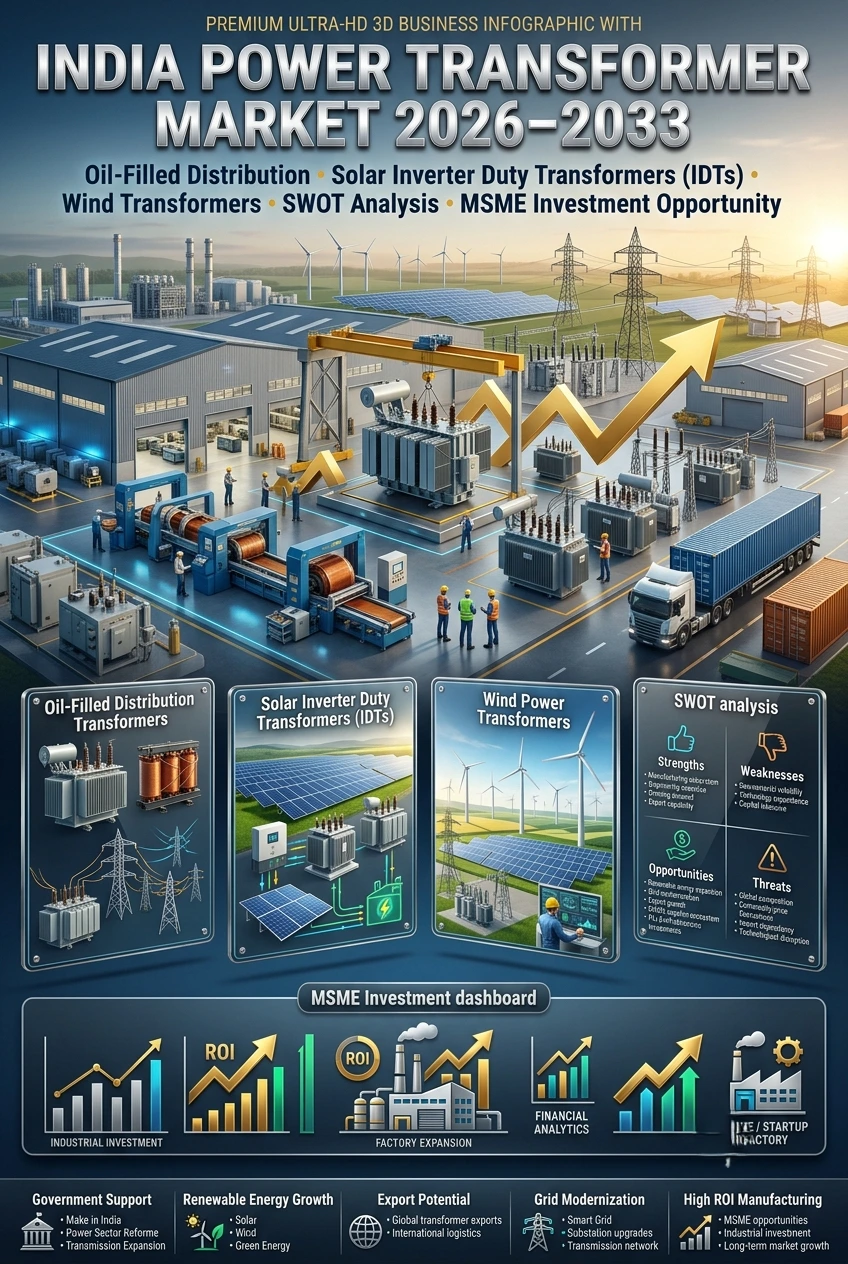
SWOT Analysis: India’s Power Transformer Manufacturing Sector
Strengths
India has a vibrant transformer manufacturing ecosystem. There are more than 500 transformer manufacturing companies in the country with capacity ranging from 15,000 to 45,000 MVA per annum or specialised MSME companies catering to regional utility tenders. The country has ample pool of electrical engineering talent and institutes like IITs, NITs and CPRI (Central Power Research Institute) have built research and testing facilities. The manufacturing of transformers is a well-developed industry, the process economics are well-known, supplier chains for copper, insulation materials and transformer oil are well established, and there are many existing machines in place, which makes it cost-efficient to scale up for experienced operators.
The cost advantage of India in domestic production over the European and Japanese transformer manufacturers is still considerable, generally 25 – 40% cheaper on a “production cost” basis, which makes Indian manufacturers naturally competitive against the other countries for exporting these transformers to countries like Africa, South East Asia, Middle East, South America etc.
Weaknesses
India’s dependence on imported CRGO electrical steel is the eye of the needle and is not a temporary condition, but a structural one. Domestic production meets only 10-12% of the demand, and hence, the whole transformer manufacturing industry is vulnerable to supply chain disruptions in the global market, BIS import license delays, and price volatility of Japanese, South Korea, and China’s export policies. The smaller MSME manufacturers are hit the hardest in times of tighter CRGO supplies, as they have lesser purchasing power to maintain a big buffer.
Quality inconsistency remains a challenge in the lower end of the MSME manufacturing segment. Several state utilities have reported premature transformer failures attributed to sub-standard lamination steel, thin winding conductors, or inadequate quality testing during manufacturing. The Bureau of Indian Standards (BIS) certification process and Quality Control Orders (QCOs) provide a regulatory floor, but enforcement gaps persist in some geographies.
Opportunities
It is a very broad opportunity map in this sector. Domestically, the distribution infrastructure component of the RDSS scheme, the renewable energy integration mandate, and the EV charging infrastructure build-out (PM E-Drive targets 72,000 public chargers by FY26, with each requiring a distribution-level transformer) are all three demand vectors in play at the same time. It’s export opportunities that are also very attractive, with India’s cost competitiveness and the Engineering Export Promotion Council (EEPC India) and make in India branding making the market in Sub-Saharan Africa, Bangladesh, Myanmar and electrifying or growing up grids in Middle Eastern countries very attractive.
The electrical equipment industry has both been identified as a focal area for industrial investments and transformer manufacturing as a component in which a higher level of home value addition is needed, according to both the Confederation of Indian Industry (CII) and the Federation of Indian Chambers of Commerce and Industry (FICCI — ficci.in). MSME-specific credit schemes, capital subsidy schemes under MSDE and other PLI schemes provide an enabling financial space for new players with viable business plans.
Choose the right startup backed by real market demand
Threats
The major challenge is from the Chinese manufacturers who have bid aggressively with competitive prices in the tenders for large capacity power transformers in India mainly. By having subsidiaries and manufacturing wing in India, Chinese OEMs, such as TBEA, are able to bid in the utility tender at prices that is hard to be matched by domestic manufacturers as it does not allow them to burn their margins. This is offset by the DGTR’s anti-dumping probe against Chinese imports of CRGO steel and the government’s preference in its tendering for Atmanirbhar steel manufacturers, but the pricing risk is very real for manufacturers who do not have scale benefits.
Falling margins can be significant if raw material prices fluctuate, especially as copper prices move in cycles and CRGO steel prices spike, as in the case of government contracts that are fixed in price and have lengthy lead times. Companies with less advanced hedging programs or without such provisions in their contracts on cost escalation are vulnerable.
Government Incentives and Policy Support
The policy framework for transformer industry has one of the most comprehensive policies in the history of the transformer industry in India. There is a cascade of incentives provided by several interlocking schemes:
RDSS (Revamped Distribution Sector Scheme): It is a Rs 3,03,758 crore total outlay scheme, which is fully funded by Central Government with Rs 97,631 crore, where DISCOM is directly procuring distribution transformers as part of the distribution infrastructure upgradation. Sustained and creditworthy demand for transformer manufacturers is created as state utilities under RDSS benefit from Central Government grants.
In the context of the agricultural pumps and the rural areas, IDTs have been requested for implementing the Solar Mission Schemes (MNRE) and PM-KUSUM. The latest of these is the PM-Surya Ghar Muft Bijli Yojana, which has been committed to with Rs 75,000 crore. SECI (seci.co.in) is handling project tendering, and has awarded 39,600 MW of solar manufacturing capacity (with an infrastructure of associated transformer capacity) under PLI Tranche II.
The PLI Scheme does not specifically address transformers, but it does address the surrounding solar PV module manufacturing ecosystem, which is fueling the demand for IDT. Under the PLI umbrella, led by DPIIT (dpiit.gov.in), Rs. 1.76 lakh crore of committed investments have been made in various sectors to establish an industrial ecosystem that purchases transformers. The PLI also has an indirect effect on transformer manufacturing: as solar manufacturing capacity is scaled, so is the number of manufacturers.
The Credit Guarantee Fund Trust for Micro and Small Enterprises (CGTMSE), the technology upgradation schemes and cluster development programmes under the Ministry of MSME (msme.gov.in) offer support to the small transformer manufacturers for accessing working capital and capex to upgrade to higher efficiency transformers, BIS-certified manufacturing equipment and renewable energy specific product categories.
BEE Energy Efficiency Mandates: BEE is introducing a star rating mandate for Distribution Transformers from 1 January 2025, which will also serve as a market creation tool. Leading state utilities can offer a price premium and preferred vendor status to manufacturers who invest in better grade CRGO and precision winding to make 5-star rated products.
Related Article: Riding India’s Power Surge: Why the Transformer Industry Is a ₹Billion Startup Opportunity Right Now — Business Ideas You Cannot Ignore
Major Indian Players
The Indian transformer market is segmented into three verticals:
Tier 1: Large Integrated Manufacturers
BHEL (Bharat Heavy Electricals Limited): India’s biggest public sector engineering company and the leading company for the procurement of central utility transformer in India. BHEL’s manufacturing expertise ranges from 500 kV to 800 kV, and it is ISO 9001 and ISO 14001 certified, with a proven history in national power grid projects and international power projects. The government relationships and ability of executing large projects have earned BHEL a reputation that sets the bar for other manufacturers in India. The BHEL-Hitachi consortium has recently been awarded the contract of an INR 1200 crore HVDC converter station.
CG Power and Industrial Solutions Ltd is known for a long time in the Indian electrical industry and produces the power transformers and distribution transformers and exports to more than 100 countries. The Rs 712 crore greenfield plant investment by CG is the most capital aggressive domestic capacity addition in this cycle with in-house CRGO slitting and resin-casting, which will bring 45,000 MVA of additional capacity by FY28.
Hitachi Energy India Ltd (formerly ABB Power Products India): A technology leader specializing in the premium transmission and HVDC transformer business. The advanced insulation technologies, eco-efficient transformer oils and digital monitoring by Hitachi Energy establish the benchmark for the industry. It is an ideal choice partner for Power Grid Corporation’s flagship projects involving HVDC converter units and smart grid integration.
Siemens Energy India and GE Vernova T&D India: Both have medium-sized manufacturing facilities and are playing in the transmission and distribution transformer business. Siemens raised the proportion of its stake in India’s business to 69% to make deeper strides into the country. Power Grid Corporation recently awarded GEL Vernova a contract for more than 70 extra-high voltage transformers and shunt reactors.
Startup Opportunity: Why This Sector Rewards New Entrants Now
The power transformer manufacturing sector presents a compelling startup opportunity for several non-obvious reasons that conventional market analysis often misses.
Order visibility is extraordinary. Unlike most manufacturing sectors where demand is uncertain and market development requires years of customer acquisition, transformer manufacturers have access to publicly announced government procurement pipelines running years into the future. RDSS project DPRs, SECI solar park tender documents, state utility annual procurement plans, and POWERGRID capital expenditure disclosures are all public documents that a credible startup can use to build a bankable demand projection. Banks and NBFCs lending to this sector are comfortable with the demand-side risk because of this visibility.
IDTs and wind transformers are underserved at the MSME level. While large manufacturers focus on high-capacity utility-scale transformers, the mid-range IDT segment (500 kVA to 5,000 kVA) and wind transformers for 2–4 MW turbines lack adequate domestic supply. Solar developers — who are procuring transformers in large quantities for distributed and commercial projects — frequently face 12–18 month order books from major manufacturers and are actively seeking qualified alternative suppliers. A startup that achieves IEC 61378 compliance and type-test certification for IDTs, or WTG OEM approval for wind transformers, is immediately addressable market.
Import substitution creates pricing power. High-capacity IDTs in the 10,000–20,000 kVA range are currently being partially imported from European and Chinese manufacturers by premium solar park developers who cannot source equivalents domestically at the required quality and delivery timelines. A manufacturer that develops type-tested products in this range and achieves IEC compliance can displace imports at a significant price premium over commodity distribution transformers.
Export market is open. The global IDT market, valued at approximately USD 3.72 billion, is growing at 6.1% CAGR globally, with Africa (7.5% CAGR), South America (6.8%), and the Middle East (6.2%) being the fastest-growing regions. Indian manufacturers with CRGO core designs optimised for 50°C ambient conditions hold a natural engineering advantage in these high-temperature markets over European competitors. The Engineering Export Promotion Council of India (EEPC India) and India’s bilateral trade agreements provide export facilitation support.
Capital investment is scalable. A distribution transformer manufacturing unit producing BIS-certified units in the 100 kVA to 2,500 kVA range can be established at a project cost in the range of Rs 5–25 crore depending on capacity, location, and the degree of vertical integration. This is within the financing range of MSME credit schemes, term loans from public sector banks, and SIDBI venture capital. An IDT-focused unit targeting the 1,000–10,000 kVA range would require higher investment in design capability, IEC testing, and quality systems — typically Rs 20–60 crore — but commands substantially better margins.
How NPCS Supports Entrepreneurs Entering This Sector
Niir Project Consultancy Services (NPCS) — www.niir.org — provides professional consulting services for entrepreneurs and investors evaluating industrial manufacturing ventures, including transformer manufacturing projects. NPCS prepares Market Survey cum Detailed Techno-Economic Feasibility Reports (DPRs) that equip promoters with the analytical foundation required for informed investment decisions, bank financing, and project execution.
For transformer manufacturing ventures — whether distribution transformers, solar IDTs, or wind transformers — an NPCS report typically includes a detailed manufacturing process description covering core winding, coil assembly, core-coil assembly, active part drying, tank fabrication, oil filling, and final testing procedures. Market research and demand analysis are anchored in actual utility procurement data, RDSS DPR disclosures, and renewable energy capacity addition plans published by MNRE and SECI.
Process Flow Diagrams (PFDs) and Block Flow Diagrams (BFDs) help promoters and their technical consultants visualise the manufacturing sequence and identify critical control points. Product mix optimisation and capacity planning sections guide entrepreneurs on which kVA rating bands offer the best balance of market access, equipment utilisation, and margin economics for their target geography and investment level.
Machinery and equipment specifications — including core slitting lines, CNC winding machines, vacuum oil impregnation plants, high-potential (HV) testing sets, and magnetic core annealing furnaces — are detailed with indicative sourcing options, both domestic and imported. Raw material specifications covering CRGO laminations, electrolytic copper conductors, mineral transformer oil, and insulation materials are provided with current sourcing channels and price benchmarks.
The import-export dependency analysis section is particularly valuable for IDT and wind transformer projects, where understanding the global competitive landscape and domestic import substitution opportunity is central to the investment thesis. Project financials — including project cost, means of finance, revenue projections, break-even analysis, internal rate of return (IRR), net present value (NPV), and payback period calculations — are prepared on conservative, moderate, and optimistic scenarios.
NPCS’s objective is to support entrepreneurs in evaluating the technical feasibility, financial viability, market demand, and scalability potential of new manufacturing ventures — giving first-generation promoters and expanding MSMEs the same quality of analytical rigour that large corporates apply to investment decisions. Visit www.niir.org for more information on available reports and consulting services.
Frequently Asked Questions (FAQs)
Q1. What is the minimum investment required to set up a small distribution transformer manufacturing unit in India?
A small-scale unit producing BIS-certified oil-filled distribution transformers in the 25 kVA to 1,000 kVA range can be set up at a project cost of approximately Rs 5–15 crore, depending on installed capacity, location, and the extent of in-house testing infrastructure. This range assumes procurement of a core cutting machine, manual or semi-automatic winding setups, a vapour phase drying system, and basic high-voltage testing equipment. Land and building costs vary significantly by state and industrial area. A techno-economic feasibility study specific to the promoter’s planned capacity and location is essential before finalising project cost estimates.
Q2. Can a new transformer manufacturer sell to government DISCOMs without prior experience?
Typical STATE DISCOM Tender stipulations demand Product (distribution transformer) to have a BIS specification (IS 1180), Manufacturing capacity via a factory inspection or a type test done by accredited labs viz., ERDA (Electrical Research and Development Association) or CPRI (Central Power Research Institute) and a track record of supplying the same size transformers to at least one Utility or an Industry. For new manufacturer a planning of 12 to 18 months including acquiring BIS license, type testing and developing a reference sales channel (normally through smaller industrial/commercial or cooperative customers) is required before a new manufacturer is ready for major state Discom tenders.
Q3. What makes Inverter Duty Transformers different from standard distribution transformers, and why are the margins better?
Regular distribution transformers are designed to use sinusoidal waveforms of 50Hz. Output from a solar inverter tends to contain a lot of harmonics which can cause a normal transformer core & winding to heat up disproportionally (eddy current losses). This leads to an early deterioration of insulation & shorter lifespan. IDTs address this through k-factor rated designs — higher-capacity neutral conductors, derating of core flux density, enhanced insulation thermal class, and robust bracing for winding geometry.
Additional design and material cost is in the range of 15 to 25 percent more than of standard transformer of the same kVA but these can be sold at 30 to 50 percent premium price from the project developer having sufficient knowledge regarding the implication of total cost of ownership for using substandard transformer in solar application
Q4. What government certifications and approvals are mandatory for a transformer manufacturing plant in India?
The mandatory certification for distribution transformers is the BIS licence under IS 1180 (oil-cooled) or IS 2026 (power transformers). The manufacturing facility requires factory inspection and approval by BIS. Products must be type-tested at BIS-accredited laboratories. For export markets, IEC 60076 compliance and country-specific approvals may be required. The plant itself requires standard industrial establishment permissions — factory licence under the Factories Act, pollution clearance, electrical installation approval, and GST registration. Transformer oil handling requires compliance with petroleum storage rules. Manufacturers targeting solar IDTs should additionally certify products to IEC 61378 (transformers for industrial applications, part 3 for converters).
Q5. How significant is CRGO steel supply risk for a new MSME transformer manufacturer, and how can it be mitigated?
CRGO supply risk is the single most operationally significant risk for Indian transformer manufacturers of all sizes, but it disproportionately affects MSMEs who cannot maintain large inventories or negotiate long-term supply agreements on favorable terms.
Practical mitigation strategies include joining industry associations like IEEMA (Indian Electrical and Electronics Manufacturers’ Association, ieema.org) to access collective procurement platforms and policy advocacy, maintaining a diversified supplier list with BIS-approved CRGO suppliers across multiple geographies, building buffer stock of 60–90 days of CRGO requirement when prices and availability permit, designing products across multiple CRGO grades to allow substitution when specific grades face supply disruption, and exploring amorphous core transformers as an alternative for specific applications where amorphous alloy cores (which use different raw materials than CRGO) are technically appropriate.
Q6. What is the export potential for Indian-made solar IDTs and wind transformers?
The export opportunity is substantial and growing. The IDT demand in these segments are driven by growth in renewable energy, industrial electrification and VFD usage in the quickest-growing markets globally such as Africa (7.5% CAGR), South America (6.8%), Middle East (6.2% CAGR). Indian manufacturers have a natural advantage in the high-ambient-temperature markets in terms of cost and climate-engineering. IEEMA and the Engineering Export Promotion Council (EEPC India) provide market development support, export certification assistance, and buyer-meet facilitation for electrical equipment manufacturers targeting international markets. Several mid-sized Indian transformer companies already generate 15–30% of their revenues from exports and report that international buyers are actively seeking to diversify away from Chinese suppliers in the current geopolitical context.
References and Citations
- Ministry of New and Renewable Energy (MNRE) — PLI Scheme for Solar PV Modules: https://mnre.gov.in/en/production-linked-incentive-pli/
- Solar Energy Corporation of India (SECI) — PLI Scheme for Solar PV Manufacturing: https://www.seci.co.in/pli-scheme
- Press Information Bureau (PIB), Government of India — PLI Scheme Progress Update: https://www.pib.gov.in/PressNoteDetails.aspx?NoteId=155082&ModuleId=3
- Business Standard — CRGO Steel Shortage Impact on India Power Sector (GTRI Report): https://www.business-standard.com/industry/news/crgo-steel-shortage-could-impact-india-s-power-sector-expansion-plans-gtri-124102800575_1.html
- FICCI (Federation of Indian Chambers of Commerce and Industry) — Electrical Equipment Sector Reports: https://ficci.in
- IEEMA (Indian Electrical and Electronics Manufacturers’ Association) — Industry Data: https://www.ieema.org
- DPIIT (Department for Promotion of Industry and Internal Trade) — Make in India and PLI Coordination: https://dpiit.gov.in


