





Solar Panel Manufacturing Plant
India’s Solar Bet: A ₹7 Billion Import Bill — and the Gap That Could Make You Rich
India has to pay about US$7 billion annually to the foreign vendors, primarily Chinese, to purchase solar cells and modules. The country which receives 300 days of sunshine per year is still unable to produce enough panels to satisfy the needs of the country. That irony is not merely a policy blunder. It’s a business opportunity that a well-positioned Indian manufacturer can walk through these days.
But the counter-intuitive twist here is that India now boasts of 74 GW of solar module manufacturing capability, nearly double that of just a year ago, as early as early 2025. Still, imports continue to rise. Why? The majority of the Indian plants are module builders and use imported cells and wafers. It’s nearly all Chinese for the upstream part, which is solar cells, wafers and polysilicon. The next big investment in serious manufacturing is coming down the stream. Even at the module-assembly level, demand is also exceeding supply in the country, which is aiming at installing 500 GW of non-fossil power by 2030.
You may have been waiting for the ‘right time’ to enter this space, but the government has already made an allocation of ₹24,000 crore under Production Linked Incentive (PLI) scheme for solar PV modules. The window is open. However, it won’t be open to everyone.
Get Detailed Insights from This Book: Solar PV Power and Solar Products Handbook
The Supply Gap India Cannot Ignore
India is big on solar dreams. The Ministry of New and Renewable Energy (MNRE) is pushing the country towards 500 GW installed renewable energy capacity, with the bulk of it solar energy. However, India has to install approximately 60-70 GW of solar power for each year.
The manufacturing reality? While the assembly capacity of India has grown quickly, the manufacturing of cells is still lagging behind. According to data from the Ministry of New and Renewable Energy As per the MOP particulars, the manufacturing capacity of the cells was 25 GW and modules were 74 GW by early 2025. This mismatch will make assemblers rely on imported cells, mainly from China. China supplied more than 90% of India’s solar cell imports even as recently as FY 2022–23, which has since reduced to 56%, but is still a dangerous single-source dependency.
The import bill speaks for itself: India Briefing reported that imports to India for the solar sector have increased to US $7 billion in FY 2024–25, of which US $3.89 billion was from China alone. The Global Trade Research Initiative (GTRI) estimates that if this import bill is not greatly scaled up in the domestic manufacturing sector, it could become as much as US $30 billion annually.
States with high unmet demand include the largest solar installed State of Rajasthan (~19 GW), Gujarat, Tamil Nadu and Uttar Pradesh with their ambitious solar power addition targets supported by state policy. These states are also the ones with the fastest developing manufacturing infrastructure.
Table 1: State-wise Solar Manufacturing Hubs & Demand Clusters
| State | Key Industrial Cluster | Installed Solar Capacity | Manufacturing Hubs | Policy Advantage |
| Gujarat | Surat, Ahmedabad, Vadodara | ~10 GW+ | Waaree, Adani Solar | GIDC plots, power subsidy |
| Rajasthan | Jodhpur, Jaisalmer | ~19 GW | Emerging cluster | Solar park proximity |
| Tamil Nadu | Chennai, Hosur, Sriperumbudur | ~8 GW | First Solar, Premier Energies | PLI, TIDCO support |
| Uttar Pradesh | Noida, Greater Noida | ~4 GW | SAEL Solar (5 GW planned) | State RE policy, land support |
| Telangana | Hyderabad | ~3 GW | Premier Energies, HVR Solar | TS-iPASS fast approvals |
| Haryana | Manesar, Faridabad | ~1 GW | HVR Solar (2 GW planned) | NCR proximity, logistics |
Sources: Mercom India; company announcements
Get Detailed Project Report (DPR): Renewable Energy Sector: Green Power, Solar, Wind & Bioenergy
Why This Is the Right Time to Enter Solar Manufacturing
The forces of policy protection, price parity and procurement mandates are coming together in a way that hasn’t happened before.
First is the import protection: The central government levied an import duty of 40% Basic Customs Duty (BCD) on imported solar cells and 25% for modules. This was the game-changer for the domestic industry economy. Indian manufacturers no longer can compete on an uneven playing field with cheaply made Chinese goods.
Second, Production Linked Incentive (PLI) scheme for High Efficiency Solar PV Modules: Under the PLI scheme, there is a total outlay of ₹24,000 crore over two tranches, and under which the manufacturers will receive incentive per unit for five years after the commissioning. So far, SECI has signed Letters of Award for 11 manufacturers for 39,600 MW in Tranche II alone. The scheme emphasizes fully integrated manufacturing but module-only and cell only units are eligible to benefit from allied schemes.
Third, compulsory domestic procurement: India has implemented certain government policies including PM-KUSUM, CPSU Phase II and Grid Connected Rooftop Solar Programme which stipulate the use of Indian manufacturers for solar PV cells and modules. To be considered for supply to any government-funded solar project, a model and manufacturer must be on the Approved List of Models and Manufacturers (ALMM). This makes it an assured market for the domestic manufacturers which are certified by the Bureau of Indian Standards.
The PMEGP scheme (Prime Minister’s Employment Generation Programme) provides MSMEs of module assembly level with a margin money subsidy of up to 15–35% on projects up to ₹50 lakh. The CGTMSE scheme provides for providing collateral-free credit guarantees up to Rs. 5 crore, thus making bank finance available even without pledging of properties.
How to Set Up a Solar Panel Manufacturing Unit: Step-by-Step
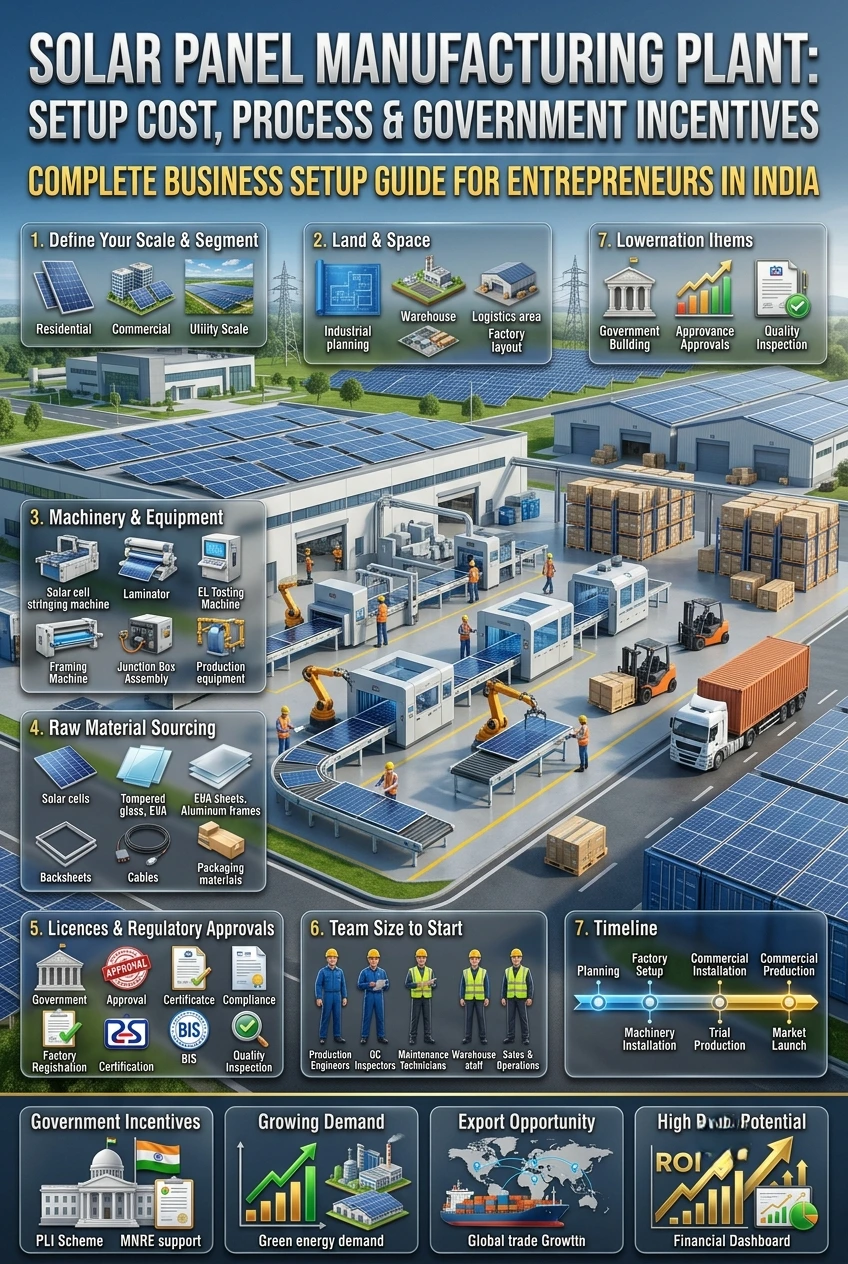
Define Your Scale and Segment
To begin with, entry-level entrepreneurs should go with module assembly, which is the most approachable portion. The minimum realistic size that can be started by an MSME investor having Rs. 8 to 12 crores would be 10 MW/year module assembly plant. Whereas those looking to take advantage of the PLI scheme require integrated cell + module capacity at the GW scale, which is a whole other ball game. It is assumed that the capacity of the module plant is 30 MW/year – a commercially viable and fundable MSME module size.
Land and Space
The requirement of 1.5 – 2.5 acres of industrial land is for a 30 MW/year module plant, which comprises a clean room manufacturing hall of 8000 – 12000 sq. ft., along with storage, testing lab and office space. The price of land in industrial plots in industrial estates like GIDC in Gujarat, RIICO in Rajasthan or TIDCO in Tamil Nadu ranges between ₹800 to ₹2,500 per square metre and has all utilities ready. Logistics costs are significantly lowered due to its close proximity to a major port (for imports of cell and glass) and its rail connections.
Machinery and Equipment
The key equipment of a core assembly plant of the module:
- Automatic Solar Cell Tabber-Stringer Machine (connects cells in series)
- Solar Module Laminator (vacuum lamination of EVA, glass and backsheet)
- Framing Machine (aluminium frame fitting)
- In-situ testing equipment: EL (Electroluminescence) Testing Equipment (defect detection)
- This is a new feature for the IV Curve Tracer / Flash Tester (power output verification).
- The conveyor system, soldering stations and a junction box attached will be required. A Conveyor system, soldering stations and a Junction box attached will be needed.
Estimated cost of machinery for a 30MW plant: ₹8-12 crores. Local suppliers in Gujarat and Tamil Nadu supplies the equipment, and Chinese OEMs supplies through recognized importers in the country. Provide minimum 500kva sanctioned load with 3 phase power supply.
Raw Material Sourcing
The six core raw materials are: monocrystalline/polycrystalline solar cells (mostly imported from China, Vietnam and Malaysia; domestic companies include Tata Power Solar and Premier Energies at commercial scale); tempered solar glass (Saint-Gobain India, Borosil Renewables – a Pune-based company that is a pioneer in the production of solar glass, and others); EVA encapsulant sheets; backsheet films; aluminium frames (abundant domestic supply from Gujarat and Rajasthan extrusion units); and junction boxes (sourced from domestic electronics clusters in Pune, Bengaluru and Chennai).
Licences and Regulatory Approvals
Clearances and registrations required: (approx. time: 4-7 months):
- Successfully Registering an MSME with Udyam is an online process that can be completed in 1–2 days.
- GST Registration — 5–7 days
- Factory Licence under Factories Act — 30–60 days
- BIS Certification (IS 14286 / IEC 61215) — mandatory for ALMM listing; 60–90 days
- MNRE ALMM Listing — required for government project supply
- Pollution NOC from State Pollution Control Board — 30-45 days
- Electrical Inspectorate approval – 15-30 days.
Team Size to Start
The staffing size for a 30 MW/year plant is about 30–40-line operators (soldering, lamination and EL testing), 5 QC engineers, 2-3 electrical/process engineers and 5-8 administrative & logistic staff.
Timeline
Registration to first production dispatch: 10-14 months. The longest time to acquire land and construct, is 4–6 months. The regulatory path that’s critical is BIS certification and ALMM listing — start early, parallel to construction.
Turn your budget into a successful business plan
Table 2: Capital Investment Breakdown — 10 MW vs. 30 MW/Year Module Plant
| Cost Head | Small Plant (10 MW/yr) | Medium Plant (30 MW/yr) | Notes |
| Land (1–3 acres) | ₹50–80 lakh | ₹1.2–2.5 cr | GIDC/RIICO plots cheaper |
| Factory Construction | ₹80 lakh–1.2 cr | ₹2–3 cr | Cleanroom + storage req. |
| Core Machinery | ₹3.5–5 cr | ₹8–12 cr | Stringer, Laminator, Tester |
| Utilities & Power | ₹30–50 lakh | ₹70 lakh–1 cr | 3-phase connection + backup |
| Working Capital (3 mo.) | ₹2–3 cr | ₹5–7 cr | Cells, EVA, glass inventory |
| Contingency (10%) | ₹70 lakh–1 cr | ₹1.7–2.6 cr | Regulatory, delays buffer |
| TOTAL CAPEX | ₹8–11 cr | ₹20–28 cr |
Sources: VMS Consultants; NPCS Project Reports; IMARC Group; industry estimates
Financial Snapshot: What to Expect at 30 MW/Year Capacity
Capital Expenditure: Rs 20-28 crore for the establishment of a module assembly plant of 30 MW/year with land, construction, machinery, working capital, contingency.
Monthly Operating Cost – ₹4.5–6 crore/month (at 60% capacity / ~18 MW annualised output). The OpEx for raw materials is the largest, making up 70-75% of total OpEx, mostly from imported solar cells, EVA and glass. The remainder is for labour, utilities and overheads.
Revenue Estimates: On a realisation of ₹22-26 per watt peak (Wp) on domestic market modules sales: Yearly revenue is around ₹39-46 crore at 60% capacity (18 MW). At 100% capacity (30 MW), revenue reaches ₹66–78 crore.
Gross Margin: 20-28% on full loads. Net Margin: at full capacity (including depreciation, interest and operating expenses): 10-15%
Payback Period: 4-6 years (full capacity, no PLI benefits). Effective payback can be achieved in just 3-4 years with PLI incentive payments for qualified units. The break-even point is generally at 55-60% capacity utilisation.
Table 3: Government Schemes, Eligibility & Benefits for Solar Module Manufacturers
| Scheme | Implementing Agency | Eligibility | Benefit |
| PLI – Solar PV Modules | MNRE / SECI | GW-scale integrated mfg. | ₹24,000 cr outlay; incentive paid for 5 yrs post-commissioning on sales |
| PMEGP | KVIC / State DIC | New units; max project ₹50 lakh (mfg.) | 15–35% margin money subsidy on project cost |
| MUDRA – Tarun | Banks / MFIs | MSMEs up to ₹10 lakh loan | Collateral-free working capital for small assemblers |
| CGTMSE | SIDBI / Banks | MSMEs up to ₹5 cr loan | Collateral-free credit guarantee; covers 75–85% of default |
| Make in India / DCR | DPIIT / MNRE | Domestic mfg. units | Mandatory domestic sourcing in govt. solar schemes; protects local market |
| Basic Customs Duty | Ministry of Finance | All domestic producers | 40% BCD on imported cells; 25% on modules — price shield vs. Chinese imports |
| ALMM Listing | MNRE | BIS-certified manufacturers | Eligibility to supply to all MNRE-funded projects; mandatory for government tenders |
Sources: KVIC PMEGP Guidelines; SIDBI CGTMSE scheme documentation
ENTREPRENEUR SPOTLIGHT
Indian Dinesh Patel, Gujarat Based Module Manufacturer (Representative Profile)
The first-generation entrepreneur from Surat, Dinesh began his module assembly business with ₹3.5 crore, part of which came from CGTMSE-backed bank loan, in 2019 with 5 MW/year capacity. His plant is now scaled to 25MW capacity and is listed in the ALMM, thus supporting three projects under the roof-top solar scheme sponsored by the DISCOMs of the state. Annual turnover: ~ INR 4.5 crores. His main takeaway: “Obtain BIS certification beforehand, as the ALMM listing is what opens up avenue for government tenders, and that is where the bulk of the volume lies.
Related Article: Solar Panel Manufacturing Business in India: Costs, Growth & Step-by-Step Setup
Where to Get Expert Guidance: NPCS Project Reports
Niir Project Consultancy Services (NPCS) provides detailed solar panel project reports, techno-economic feasibility studies, plant layout designs, plant machinery details, and solar panel project consultancy services for those entrepreneurs looking for solar panel plant project ideas to bankable project plan. They have prepared and release these reports which can be accessed at niir.org and are frequently cited on entrepreneurindia.co, including capital cost estimates, raw material sourcing strategies, regulatory filing checklists, and financial projections based on prevailing market conditions. NPCS also has databases of suppliers for solar cells, EVA sheets and framing all over India, which has saved first time promoters months of sourcing efforts. In case MSMEs opt for the CGTMSE or PMEGP route, an NPCS project report is generally considered as the techno-economic basis document for the bank loan officers at the bank.
Your Next Move
The problem of the gap in supply is a genuine problem. The policy protection is implemented. Financial channels are identified. There’s one thing that differentiates the next generation of solar manufacturing entrepreneurs from those on the sidelines: they get started.
The biggest thing you can do this week is to get your BIS certification process started. It is the prerequisite for all other steps (finance from banks, ALMM listing, government tender eligibility). Please get in touch with the Bureau of Indian Standards (BIS) and find an accredited testing laboratory for IS 14286 / IEC 61215 module testing. At the same time, hire a comprehensive project report (either a NPCS or an independent consultant) as your bank finance application document.
The module assembly window is available as of now. The window of opportunity for the manufacture of cells will broaden in the next 3-5 years. Begin at the module level, create the team, and develop the quality systems, and then work up the value chain. This is the route the most successful Indian entrepreneurs of the solar industry have taken.
Frequently Asked Questions
Q1. What is the minimum investment required to start a solar panel manufacturing unit in India?
A 10 MW/year module assembly line costs between 8-11 crore including land, building, equipment and three months working capital. A 5 MW/year pilot plant at the lower end may cost 4-6 crore – however margins will be lower and a plant of this scale may not qualify for government tenders until after ALMM certification.
Q2. Which licences are mandatory before starting production?
The absolute requirements are: Udyam/MSME registration, GST, Factory Licence, Pollution NOC from the state pollution control board, and BIS certification as per IS 14286. When supplies are to government projects, MNRE ALMM listing is also needed. Typically, it takes 60-90 days from the date of lab testing and inspection of the facility to get BIS certification.
Q3. Where should I source solar cells and other raw materials?
Domestic solar cells (Tata Power Solar, Premier Energies, Gautam Solar) would be the way to go in the near-to-short run, while in Vietnam and Malaysia, volumes could get cheaper to bring in large chunks. Solar glass must be tempered. They can be sourced locally from Borosil Renewables and Saint-Gobain India. Aluminium frames are readily available at any extrusion centre at Ahmedabad, Rajkot, and Jodhpur. EVA sheets, as well as backsheet films, are largely imported from Korea and China; the local conversion capacities are slowly setting up.
Q4. What profitability can a 30 MW/year module plant realistically expect?
At full capacity, a well-run 30 MW/year module plant can achieve gross margins of 20–28% and net margins of 10–15%. Annual revenue at full capacity runs ₹66–78 crore at current market realisation of ₹22–26/Wp. Payback period is 4–6 years without PLI benefits. Units with ALMM listing and government supply contracts tend to achieve full capacity faster, compressing payback.
Q5. How does the PLI scheme help solar module manufacturers?
The PLI scheme for High Efficiency Solar PV Modules — implemented through MNRE and SECI — provides manufacturing-linked cash incentives for five years post-commissioning, based on efficiency thresholds, domestic value addition, and modules sold. Tranche I and Tranche II together cover 48,337 MW of allocated capacity. Smaller MSMEs not in the PLI fold can still benefit from DCR protection, ALMM listing eligibility, and allied schemes like PMEGP and CGTMSE.
Q6. Can NPCS provide a detailed project report for a solar module manufacturing plant?
Yes. Niir.org has Project DPRs and all techno-economic feasibility reports including plant and machinary details, sourcing guides and financial models with project capacity specified. The bank loan will be taken based on the report submitted to MSMEs and accepted by the banks and Financial Institutes across India. Entrepreneurs getting in the business of Solar Manufacturing through entrepreneurindia.co can get an all-encompassing guide as part of DPR that covers all the necessary aspect starting from regulations to procurement and even calculating returns on Investment.


