





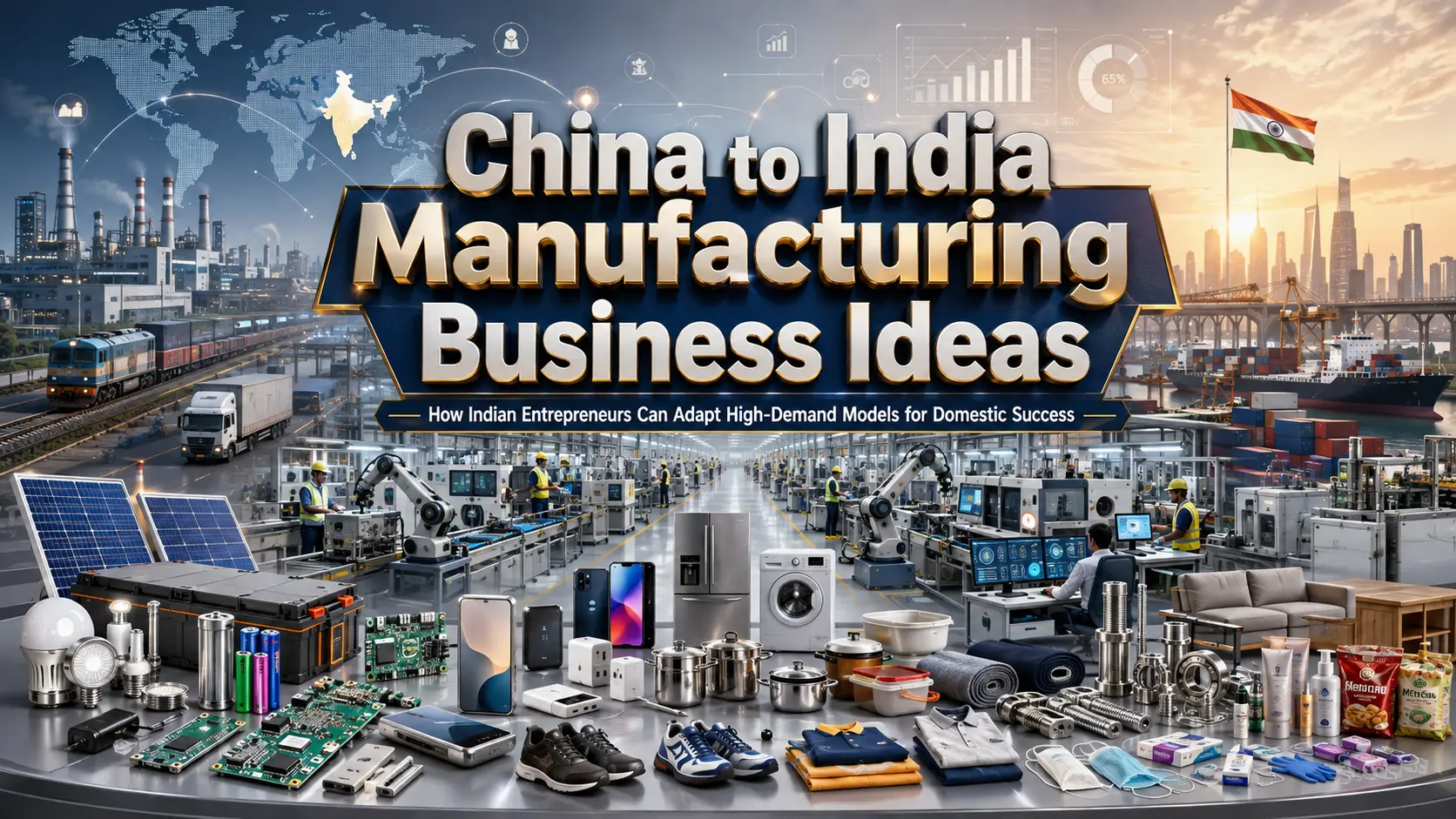
China to India Manufacturing Business
In the past 20 years China established one of the strongest manufacturing environments in the world. It controlled global supply chains, learned how to be competitive and transformed business ideas into billion-dollar export engines. India is today at a critical juncture. China’s cost escalation, disruption in global value chain, and a strong thrust towards Make in India and Atmanirbhar Bharat has presented an opportunity to make the most of it. Indian entrepreneurs, particularly MSMEs and first-generation manufacturers, are now able to learn from successful Chinese manufacturing business models and localise them to serve the domestic market and increase their export potential.
It’s not about copying a model. It’s about learning what works, understanding why it works and then adjusting it for the Indian cost structure, the availability of raw materials and the consumer behaviour. The China to India opportunity is timely for the startup founders and manufacturing investors to move on.
Why China-to-India Manufacturing Business Is a Smart Bet Right Now
Today, India has a major dependency on China on electronics, solar components, chemicals, toys, industrial hardware etc. This is an import dependence market signal, not only a trade statistic. It identifies the weaknesses in domestic manufacturing capabilities, and provides information to entrepreneurs about the opportunities for substitution business.
The data released by the Ministry of Commerce & Industry, Government of India, shows that China has been India’s largest import source country throughout the years. This presents a direct, and for Indian manufacturers, a window of opportunity on the import substitution front for quite a few product categories.
Further, the “China Plus One” policy, which aims to spread manufacturing investment across the globe from China, is actively working to bring investments to India. Countries and enterprises are looking for an alternative. India is making itself a viable alternative. This is making the manufacturing business ideas inspired by China not only relevant at the local level, but also appealing on a global scale.
Government Policies and Incentives Fuelling This Manufacturing Shift
The Indian government has launched several schemes to spur domestic production, particularly in areas in which China has overtaken:
Production Linked Incentive (PLI) is applicable to 14 sectors, such as electronics, pharmaceuticals and solar PV modules, as well as specialty chemicals – those all being key sectors with a strong manufacturing presence in China. The incentives range from a business’ incremental production over the base year, and are between 4% and 20% depending on the business.
The Ministry of MSME’s Credit Guarantee Fund Trust for Micro and Small Enterprises (CGTMSE) provides collateral-free loans for up to ₹2 crore to eligible micro and small manufacturing units. This will directly help first generation founders to start financially intensive businesses without providing security that is backed by assets.
Recognised startups in manufacturing are entitled to three years of income tax exemptions, ease of compliance of tax laws, and expedient patent examination under Startup India, a DPIIT initiative, especially for technology-driven or speciality manufacturing startups.
Moreover, the state governments of Gujarat, Tamil Nadu, Maharashtra and Telangana provide support to new manufacturing units via subsidies on power cost, access to land banks and capex grants. In short, the policy landscape is like it has never been before.
Manufacturing Business Ideas Inspired by the Chinese Model
1. Solar Panel Component Manufacturing
China produces more than 70% of the solar panels and components in the world. Polysilicon wafers, EVA film, Solar glass and Junction boxes need to be drawn from the local market in large quantities to help India reach its solar energy targets. The solar industry is a high growth area with a strong policy push and is a very attractive market for the entrepreneur who is starting a solar component manufacturing unit, even at the sub-assembly level.
The National Solar Mission by the government has created a consistent demand, and PLI incentives have made this business even more lucrative for those investors who have invested ₹50 lakh to ₹2 crore initially. Furthermore, anti-dumping levies on Chinese solar imports have now started to provide protection to domestic manufacturers, which has made a significant improvement in the margin’s viability.
Get Detailed Insights from This Book: Solar PV Power and Solar Products Handbook
2. LED Lighting and Fixtures Manufacturing
China has been providing LED chips, drivers and lighting products to the world market for more than 10 years. India has a good technology base to produce LED components locally but imports large quantities of LED components every year. A small to medium scale LED assembly and manufacturing facility can be set up at a project cost of ₹30-70 lakh. The domestic demand is strong, which is driven by the UJALA scheme, infrastructure projects and commercial real estate. In addition, for quality certified manufacturers, export markets are available to Southeast Asian countries, Africa and Middle East. One of those business concepts where it’s a low threshold and high ceiling.
3. Specialty Chemicals and Dyes Manufacturing
Many of the specialty chemicals, pigments, and textile dyes that India is importing are dominated by China. India has the raw material and technical workforce to produce these chemicals, which it imports from China, but China’s grip on them is dominant. The opportunity here is not in bulk chemicals, but in speciality batches, such as reactive dyes, optical brightening agents, construction chemicals, and water treatment chemicals. These are high margin niche segments.
The cost of establishing a manufacturing unit within this space is between ₹1 cr and ₹3 cr in a chemical industry cluster (GIDC, Gujarat or MIDC, Maharashtra) and the returns are in the excess of 20–25% net margins for established players. While environmental compliance is a non-negotiable, entrepreneurs have to take into account the cost of an effluent treatment plant (ETP) from the first day.
Related Article: Chemical Manufacturing in India: Reactive Dyes, Solvents & More
4. Electronic Components and PCB Assembly
Printed Circuit Boards (PCBs) and simple electronic parts are still among the top imports coming into India from China. The domestic electronics manufacturing ecosystem is expanding at a fast pace, supported by the PLI scheme for the Electronics industry, and fueled by the mushrooming of consumer electronics, electric vehicles and IoT devices. A PCB assembly unit with semi-automated SMT (Surface Mount Technology) lines can be used by OEMs of automotive, consumer and industrial electronics. The investment cost for a simple set up is around Rs 80 lakh and goes up to Rs 3-5 crore when it is automated. This is very hard, but is very defensible after quality certifications (ISO, UL) have been achieved.
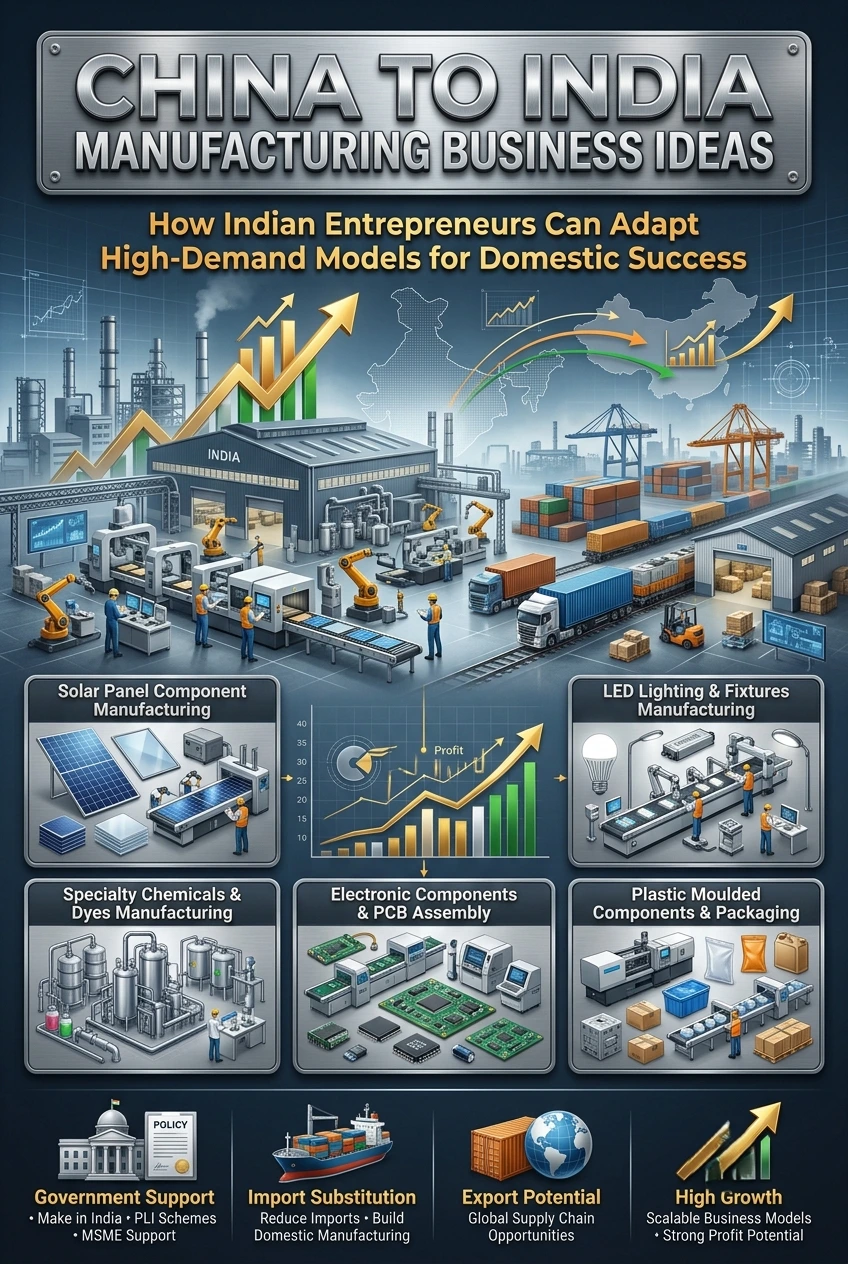
5. Plastic Moulded Components and Packaging
China’s dominance in injection moulded plastic components — from automotive interiors to consumer goods packaging — stems from highly optimised tooling and volume efficiencies. Indian entrepreneurs can replicate this model by focusing on specific verticals: automotive ancillaries, FMCG packaging, medical-grade plastics, or construction fittings. A plastic injection moulding unit requires ₹25–80 lakh depending on machine tonnage and product complexity. Margins are moderate but predictable, especially when supply contracts with FMCG or automotive OEMs are in place. The domestic market for quality moulded components is growing steadily, and export competitiveness is achievable with lean production practices.
Access Complete Business Plan: Plastics, Polymers & Resins Manufacturing Projects Book
Import–Export Opportunity: The Trade Arbitrage That Smart Founders Can Exploit
India’s trade deficit with China presents a direct roadmap for manufacturing entrepreneurs. Categories with high import volumes — electronics, solar hardware, chemicals, and industrial components — are the same categories where domestic manufacturing carries government backing and growing buyer interest. According to DGFT (Directorate General of Foreign Trade), several of these product categories are also among India’s top non-petroleum exports in emerging markets, suggesting that successful domestic manufacturers can pivot quickly into export supply chains.
Additionally, the India EXIM Bank provides export credit, working capital loans, and buyer’s credit facilities for manufacturing exporters entering new markets — reducing the financial risk of going international early.
The strategy for startups is to first achieve domestic price competitiveness, then leverage government export promotion schemes to access ASEAN, Africa, and Gulf markets — where Indian goods enjoy growing preference and trade agreements offer tariff advantages.
Indian MSME Success Stories: Learning from Those Who Got There First
Waaree Energies – Hitesh Doshi, Mumbai
Waaree Energies, founded by Hitesh Doshi, is today one of India’s largest solar panel manufacturers. The company began by identifying the gap between China’s global solar dominance and India’s rapidly growing renewable energy demand. Rather than importing finished panels, Doshi invested in backward integration — building domestic solar module manufacturing capacity when few others believed Indian manufacturing could match Chinese prices. The lesson for new entrepreneurs is clear: early-mover advantage in import-substitution manufacturing, backed by government policy tailwinds, creates durable competitive positions.
Dixon Technologies – Sunil Vachani, Noida
Dixon Technologies became India’s largest electronics manufacturing services company by doing what Chinese contract manufacturers perfected — volume-driven, multi-product assembly for global brands. Sunil Vachani built Dixon by partnering with major consumer electronics brands seeking Indian manufacturing alternatives. The company now manufactures LED TVs, mobile phones, washing machines, and lighting products. For MSME entrepreneurs, Dixon’s journey illustrates how technology-light assembly operations can scale rapidly when quality systems and supply chain discipline are maintained.
Archean Chemical Industries – Joban Bhatt, Gujarat
Archean Chemical Industries, led by Joban Bhatt, built a specialty chemicals and bromine derivatives business from Gujarat’s salt flats — directly competing with Chinese exporters in global specialty chemical markets. The company recognised that Gujarat’s natural brine resources gave it a feedstock cost advantage that China could not easily replicate. The business lesson here is about raw material arbitrage: Indian entrepreneurs should identify local resource advantages and build manufacturing businesses around them, rather than chasing sectors where China has no natural disadvantage.
Choose the right startup backed by real market demand
How NPCS Can Help You Enter These Manufacturing Sectors
At Niir Project Consultancy Services (NPCS), we provide professional consulting for the preparation of Market Survey cum Detailed Techno-Economic Feasibility Reports (DPRs) for setting up new industries. Our reports cover detailed manufacturing processes, market research and demand analysis, process flow diagrams, product mix and capacity planning, machinery and raw material details, and complete project financials with profitability analysis.
Whether you are evaluating a solar component unit, an LED manufacturing business, or a specialty chemicals plant, our objective is to help you assess feasibility, profitability, and long-term scalability before committing capital. We bring over two decades of project report experience across industrial sectors — so your business decisions rest on validated data, not guesswork.
Data Table: China-to-India Manufacturing Business Opportunities at a Glance
| Business Idea | Est. Project Cost | Key Import Substitute | Margin Potential | Policy Support |
| Solar Panel Components | ₹50L – ₹2Cr | Solar wafers, EVA films | 18–25% | PLI Scheme, MNRE |
| LED Lighting & Fixtures | ₹30L – ₹70L | LED chips, drivers | 15–22% | UJALA Scheme, PLI |
| Specialty Chemicals & Dyes | ₹1Cr – ₹3Cr | Reactive dyes, pigments | 20–30% | MSME Cluster Dev. |
| PCB & Electronics Assembly | ₹80L – ₹5Cr | PCBs, passive components | 14–20% | PLI Electronics |
| Plastic Moulded Components | ₹25L – ₹80L | Automotive plastics, packaging | 12–18% | MSME, Startup India |
Frequently Asked Questions (FAQ)
Q1. Which China-inspired manufacturing business idea requires the lowest starting investment in India?
LED lighting assembly and plastic injection moulding units can be started at ₹25–70 lakh, making them the most accessible entry points. Both sectors have strong domestic demand, predictable buyer profiles (FMCG, construction, retail), and straightforward manufacturing processes. Government schemes like CGTMSE also make collateral-free loans available for these setups.
Q2. Is it practical to compete with Chinese manufacturers on price?
Head-on price competition on commoditised goods will not be possible. Indian players could compete on import-substitute goods, where logistical costs and anti-dumping measures help offset the price differential, on customised product offering, speed of delivery and “Made in India” quality narrative. Indian manufacturers are already showing competitiveness across certain niches like specialty chemicals, solar components and electronic assembly.
Q3. What government schemes are most useful for these manufacturing startups?
The PLI Scheme is available in electronics, solar and specialty chemicals through incentives for improved performance. Under CGTMSE, banks provide collateral-free working capital and term loans against guarantees. DPIIT recognition of your startup under Startup India is essential to claim tax holiday and ease your compliance burden. Further, industrial policies in Gujarat, Maharashtra and Tamil Nadu offer cash subsidies on capital spending and on power tariffs.
Q4. How long does it typically take to set up one of these manufacturing units?
Projects like the assembling the LEDs and molding of plastic parts may take 6 to 12 months to commission after sanction of the project. Projects such as those like some specialty chemical plant or PCB manufacturing units might take longer for 18-30 months, due to environmental permits and clearance from government regulatory body, lead-time for procurement. DPR should give details on feasibility on the timelines before invest any capital.
Q5. Can these manufacturing businesses generate export revenue early?
Yes — particularly for sectors like specialty chemicals, solar components, and electronics, where Indian manufacturers have begun establishing quality credentials in ASEAN, Africa, and the Gulf markets. EXIM Bank financing, DGFT export licences, and trade agreement benefits under ASEAN-India FTA and Gulf Cooperation Council frameworks provide early-stage export enablement for new manufacturers.
Q6. What is the role of a feasibility report (DPR) before starting one of these businesses?
A Detailed Project Report (DPR) is the foundational document that maps out investment requirements, raw material sourcing, production capacity, market demand, financial projections, and break-even analysis. For first-generation entrepreneurs entering manufacturing, it reduces investment risk significantly. Banks and financial institutions also typically require a DPR for loan sanctions above ₹25 lakh.
Conclusion: The Window Is Open — Act with Intelligence
The China-to-India manufacturing opportunity is neither a fleeting trend nor a speculative bet. It is a structurally driven shift, backed by global supply chain realignment, domestic policy support, and India’s own consumption-driven growth. For entrepreneurs with the right business ideas, sufficient planning, and access to credible feasibility intelligence, the timing is genuinely compelling.
The businesses that will win are those that enter with clarity — understanding their cost structures, supply chain dependencies, and market positioning from day one. That discipline, combined with the right sector choice and government support, is what separates a successful manufacturing venture from a costly experiment. India’s manufacturing decade is already beginning. The question is whether Indian entrepreneurs will lead it — or watch it from the sidelines.
References & Further Reading
- Ministry of Commerce & Industry, Government of India — commerce.gov.in
- Make in India – PLI Schemes — makeinindia.com/schemes
- CGTMSE – Credit Guarantee Scheme — cgtmse.in
- Startup India – DPIIT — startupindia.gov.in
- DGFT – Directorate General of Foreign Trade — dgft.gov.in
- India EXIM Bank — eximbankindia.in


