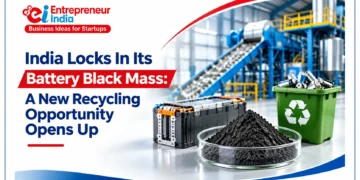







India has stopped the export of lithium-ion battery black mass. From 10 November 2026 the black mass (the dark powder left after end of life Li-ion batteries and cell manufacturing scrap are shredded) is no longer permitted to leave the country. Its export status under ITC(HS) code 85491400 has changed from ‘Free’ to ‘Prohibited’ until further orders.
The timing is important. Black mass contains recoverable lithium, cobalt, nickel and manganese (the very same metals that India imports to make its EV batteries and grid storage). Domestic recyclers have built the capacity but have struggled to utilise it and some have actually had to import scrap just to keep their plants going. Keeping the black mass in-house is a game changer in that respect.
The shift is from shredding and shipping to refining and material recovery within India. That creates space for hydrometallurgical refiners, battery salt producers, cathode material manufacturers, equipment makers and specialist logistics providers. For the entrepreneur, the MSME, the manufacturer, the investor and the startup, this is a very rare instance where policy has guaranteed the feedstock and is now just waiting for the processing capacity to come online. (Lithium-Ion Battery Recycling)
The Announcement in Detail: What the Central Government Has Approved
The Central Government have now formally announced this. In a press release issued by the Press Information Bureau (PIB) on 11th November 2026 the Ministry of Commerce & Industry stated that the Directorate General of Foreign Trade (DGFT), Department of Commerce has banned the export of lithium ion battery black mass. The key points of the announcement are as follows:
- Notification: DGFT Notification No. 49/2026-27 dated 10th November 2026.
- Product covered: ITC (HS) Code 85491400 which covers waste and scrap of primary cells, primary batteries and electric accumulators and spent cells, batteries and accumulators which are unsorted and do not contain lead, cadmium or mercury. The notification describes the item as Lithium-Ion Battery Black Mass.
- Policy change: export policy changed from ‘Free’ to ‘Prohibited’ effective immediately and until further orders, subject to the transitional arrangements under Para 1.05 of the Foreign Trade Policy 2023.
- What black mass is: it’s the powdery stuff you get when you shred end of life Li-ion batteries and battery manufacturing waste. It contains recoverable lithium, cobalt, nickel and manganese.
- Why did the government act? Because critical minerals are fundamental inputs for electric mobility, batteries, energy storage, electronics and renewable energy and India is extremely dependent on imports. Domestic recycling capacity has been under-utilised due to lack of feedstock and some of the recyclers have had to import the material themselves.
- Objectives: ensure that the black mass generated in India is recycled and refined in India; improve the capacity utilisation of the recyclers; attract investment and employment; increase recovery of critical minerals; reduce import dependence and foreign exchange outflow; and support the battery, EV, energy storage and clean energy supply chains under Aatmanirbhar Bharat.(Lithium-Ion Battery Recycling)
- Circular economy: the measure encourages urban mining and environmentally sound recycling in accordance with the relevant regulations, thereby reducing the need for primary mining.
- Link to existing schemes: the ban dovetails with the National Critical Mineral Mission (NCMM) and the ₹1,500 crore Incentive Scheme for Critical Mineral Recycling which was approved by the Union Cabinet in September 2025. It provides the domestic feedstock for the recycling capacity that is being developed under that scheme.
- Global context: the government has noted that a number of the major economies have taken a similar approach in that they are retaining the battery waste and black mass for their own processing.
- Where to read it: the notification is available on the DGFT website.
Reference: Press Information Bureau (PIB), Government of India — DGFT prohibits export of Lithium-Ion Battery Black Mass to ‘strengthen domestic recycling and critical mineral recovery’
What This Development Means for Indian Businesses
Until now Indian shredders could sell the black mass to the highest bidder overseas (often to the refiners in East Asia). That route is now closed. Every tonne of black mass generated from the shredding of discarded phones, laptops, e-scooters, EV packs and factory rejects must now find a buyer in India.
Three things follow. Firstly, domestic refiners get assured access to feedstock which improves plant utilisation and bankability. Secondly, black mass prices are likely to realign to domestic demand (this will squeeze the pure play shredders who have relied on exports, and will be a benefit to the integrated recyclers). Thirdly the bottleneck moves downstream: India will need more capacity to turn the black mass into battery grade salt. (Lithium-Ion Battery Recycling)
The ban is designed to work in conjunction with the Government’s Rs 1,500 crore Incentive Scheme for Critical Mineral Recycling (a key element of the National Critical Mineral Mission). A very important point for investors: the scheme is only going to incentivise those units that actually go on to extract the critical minerals. It’s clearly a policy that is directing capital towards the refining stage.
For the manufacturers and MSMEs the opportunity is in the refining, the consumables and the equipment. For the investors it’s a feedstock secured asset class. The exporters can shift from shipping the raw black mass to shipping the value added metal salts. For the startup founders there are opportunities in process chemistry, traceability software and collection networks. The service providers have a range of opportunities in the area of testing, compliance and safe transport.
Why This Industry Could See Stronger Growth
Demand for recycled battery materials is linked to India’s own battery build-up. The PLI scheme for Advanced Chemistry Cell (ACC) battery storage is driving giga scale cell manufacturing with a strong focus on domestic value addition. The cell plants that are being built will require cathode inputs and recycled nickel, cobalt and lithium salts are a very natural local source. (Lithium-Ion Battery Recycling)
Feedstock will grow organically. Every EV, every e-rickshaw, every inverter battery and every phone that’s sold today will become feedstock for recycling in a few years time. Production scrap from the new cell lines will be added to that immediately. Regulation will also drive the flow as per the Battery Waste Management Rules, 2022 which require producers to take on extended producer responsibility for the batteries they sell and to meet collection and recycling targets.
The National Critical Mineral Mission has a very clear target in terms of material that it wants to be recycled via its incentive scheme and recycling is absolutely a pillar of the mineral security strategy alongside exploration and overseas acquisition. With the export door now firmly shut, the structural drivers of domestic feedstock (policy support, import substitution and new cell capacity) all point in the same direction.
Government Policies and Incentives
Beyond the central recycling incentive there are a number of layers of support that entrepreneurs can take advantage of. The recyclers themselves will need to register and file their returns on the CPCB’s Battery EPR portal. The CPCB’s Guidelines for the Recycling of Waste Batteries specify the facilities that are required for the shredding and hydrometallurgical processing of Li-ion batteries. It’s worth reading those early to avoid the cost of having to redesign. (Lithium-Ion Battery Recycling)
States are also moving. Tamil Nadu’s Pollution Control Board has put out a handbook on EPR guidelines for battery waste which covers the registration process and obligations of recyclers and producers. Telangana’s Electric Vehicle and Energy Storage Policy 2020-2030 states that urban mining and the recycling of cells and batteries will be incentivised in exactly the same way as EV and ancillary manufacturing.
For finance, the Micro and Small Enterprises Credit Guarantee Scheme can be used to access credit without any collateral. Early stage ventures working on new recovery chemistries can go to the incubators under the Startup India Seed Fund Scheme for funding for proof of concept and prototype. Exporters looking at value added salt shipments should be keeping a close eye on the DGFT notifications page as that’s where the black mass amendment is listed.
Manufacturing Business Opportunities Emerging From This Development
1. Hydrometallurgical Black Mass Refining
Product is battery grade nickel sulphate, cobalt sulphate, manganese sulphate and lithium carbonate, recovered via leaching, solvent extraction and precipitation. The demand for this is up as black mass can no longer be exported so domestic refining is the only way to get any value out of it and it is the segment that the recycling incentive is aimed at. The customers are the cathode and pCAM producers, the cell makers and the chemical traders. The raw materials are domestic black mass, sulphuric acid, hydrogen peroxide, extractants and soda ash. It’s a capital intensive proposition with very strict effluent control requirements. MSMEs can get in with one or two products and scale from there. The export potential is very high for the refined salts. The main risks are metal price volatility, the mixed chemistries (LFP versus NMC) and yield control. (Lithium-Ion Battery Recycling)
2. Integrated Discharge, Dismantling and Shredding Units
Product: Black mass plus separated copper foil, aluminium foil and plastics. Reason for the demand: EPR obligations and the need of domestic refiners for a reliable, chemistry sorted feed. Concept: sorting, electrical discharge, inert atmosphere shredding, sieving and magnetic separation. Good MSME fit for a regional collection hub. Note: standalone shredding doesn’t qualify for the recycling incentive and export is now closed so the model is best suited to operate with an offtake contract to a refiner or by integrating downstream. Risks: fire safety and price pressure on the black mass.
3. Precursor Cathode Active Material (pCAM) from Recycled Salts
Product: Nickel manganese cobalt hydroxide precursors from the recovered sulphates. Reason for demand: the new cell plants coming on stream under the ACC programme will require local cathode inputs. Customers: cathode and cell manufacturers. Key considerations: very tight particle size and purity specs and very long customer qualification cycles. Best suited to well-capitalised players or consortia. Export: very strong given the global nature of the precursor trade.
4. Recovered Graphite Purification
Product: Purified graphite recovered from the leach residue of the black mass (for anode re-use or industrial purposes such as refractories and lubricants). Demand is up because every tonne of refined black mass produces a tonne of graphite as a by-product and there’s a market for it which improves the economics of the plant. MSME fit: could be an add-on. Risks: getting to the required battery grade purity is a big technical challenge; industrial grade is much easier to sell.
5. Safe Battery Storage and Transport Containers
Product: Fire resistant, certified containers and storage enclosures for damaged and end of life lithium ion batteries. The demand for this is increasing as more of the material is now going to be moved domestically from the collectors to the refiners and the CPCB guidance is very clear on the need for safe collection, safe storage and safe transport. The customer base is recyclers, OEMs, dealers and logistics companies. Very much an MSME product (using sheet metal fabrication and insulation materials). The risks are certification costs and competition from imports. (Lithium-Ion Battery Recycling)
Import-Export and International Market Opportunity
Export opportunity. The ban is on black mass not on refined products so there is an opportunity to export the value added outputs (nickel and cobalt sulphates, lithium carbonate and the precursor materials) to the battery hubs in Asia, Europe and North America. Selling the refined salts is obviously a lot more value per tonne than shipping the powder and the market is increasingly looking to recycled content.
Import substitution. India is very reliant on imports of lithium, cobalt and nickel chemicals for use in the cell and cathode manufacturing process. Some of that demand is met by domestic recovery from black mass. Li-ion battery scrap is one of the items which is now duty exempt under the recent budgets so refiners can use imported scrap as a supplement to their domestic feedstock whilst the domestic collection side of the business is still developing. Localisation of the chemicals, reagents, filter presses, reactors and shredders provides a further layer of supply chain development.
Indian MSMEs and Startups in Related Industries
Attero Recycling is in the e-waste and lithium-ion battery recycling space, taking end of life electronics and batteries and recovering the metals from them. The relevance of that is in the integration aspect; it’s a perfect example of a business where collection, processing and metal recovery are all part of the same operation. That’s precisely the model that the new policy is incentivising. The takeaway for the entrepreneur is that feedstock access and process know how are the real moats.
LOHUM is in the business of battery recycling and the repurposing of used batteries for second life. It’s a case in point of how reuse and recycling can work hand in hand, enabling a business to get value from a pack that still has life in it before it goes in for material recovery. It’s a lesson for entrepreneurs in the value of having a range of revenue streams across the battery life cycle.
What Entrepreneurs Should Evaluate Before Investing
- Market demand and pricing: secure offtake for the recovered salts and understand how the domestic black mass price is likely to settle post ban.
- Raw materials: map the feedstock sources by chemistry as the LFP and NMC streams are very different in terms of recoverable value.
- Technology and machinery: either hydrometallurgy or other routes; budget for inert shredding, leaching reactors, filter presses, crystallisers and effluent treatment.
- Location and utilities: prefer notified industrial areas with power, water and hazardous waste infrastructure and close to collection centres.
- Manpower and working capital: chemical engineers, safety people and lab analysts are all essential. The feedstock inventory is a major hog of working capital.
- Quality and regulation: battery grade specifications, CPCB and SPCB registration, consent to operate and EPR reporting.
- Competition, break-even and scalability: model break-even across all metal price scenarios and design a modular plant that can scale.
- Risk management: cover yourself against fire hazards, price swings and policy changes via insurance, hedging and flexible process design.
How NPCS Can Help Entrepreneurs Evaluate the Opportunity
NPCS (Niir Project Consultancy Services) is the firm that supports the entrepreneur at the pre-investment stage. They do the DPRs and techno-economic feasibility studies, do the market research, look at the various technology options and the plant and machinery requirements, and then go on to plan the manufacturing project with full financials. In the case of a battery recycling project that would mean a fully bankable view of the process routes, capacity, capital cost, operating economics and returns prior to any machine being ordered.
NPCS have put out a very comprehensive printed reference book on the subject, covering the technology, the market, the investment parameters and the manufacturing processes in great detail. You can download the printed book here: Handbook on Production, Recycling of Lithium Ion and Lead-Acid Batteries (with Manufacturing Process, Machinery Equipment Details & Plant Layout)
For a full techno-economic Project Report on the setup of a manufacturing venture in this sector (including plant economics, list of machinery, financials and all the relevant government incentives) please see the NPCS Project Report here: Recycling Plant for Lithium-Ion Batteries with Black Mass processing for the recovery of Lithium, Cobalt and Nickel.
Business Opportunity Snapshot
| Parameter | Snapshot |
| Industry | Lithium-ion battery recycling and critical mineral recovery |
| Market Driver | Assured domestic black mass, EV and storage growth, cell manufacturing build-out |
| Key Development | Export of lithium-ion battery black mass (ITC(HS) 85491400) prohibited from 10 Nov 2026 |
| MSME Opportunity | Shredding hubs, graphite recovery, safe containers, equipment fabrication |
| Manufacturing Potential | High: metal sulphates, lithium carbonate, pCAM |
| Export Potential | Moderate to high for refined salts and precursors |
| Import Substitution | Strong for lithium, nickel and cobalt chemicals |
| Government Support | ₹1,500 crore recycling incentive, NCMM, ACC PLI, CGTMSE, Seed Fund, state EV policies |
| Investment Consideration | Refining is capital-intensive; effluent and safety systems are critical |
| Risk Level | Medium to high (metal prices, technology, compliance) |
| Growth Outlook | Strong over the medium to long term |
Conclusion
By prohibiting the export of lithium-ion battery black mass, India has turned a tradeable waste stream into a captive domestic resource. The policy secures feedstock for recyclers, aligns with the ₹1,500 crore recycling incentive and the National Critical Mineral Mission, and nudges investment toward the higher-value end of the chain.
The industry outlook is strong. Feedstock will grow with every EV, storage system and electronic device sold, while new cell plants create local buyers for recovered materials. Manufacturing potential spans metal sulphates, lithium carbonate, precursors, graphite and specialised equipment. MSMEs have clear entry points, refined salts carry export potential, and import substitution for battery chemicals is a long-term prize backed by central and state support.
The window to act is now, while capacity is short and policy is supportive. Entrepreneurs should move methodically through Market Research → Feasibility Study → DPR Preparation → Investment Planning before committing capital.
Your Investment Deserves the Right Opportunity
Every serious investment begins with choosing the right sector and the right business model. With hundreds of industrial opportunities available across India’s manufacturing and clean-energy landscape, making the most informed choice is critical. NPCS Startup Selector tool helps entrepreneurs, MSMEs, and investors identify the most suitable business opportunities based on their investment capacity, location, and interests — so your capital is directed toward a venture with the strongest fit and potential.


