




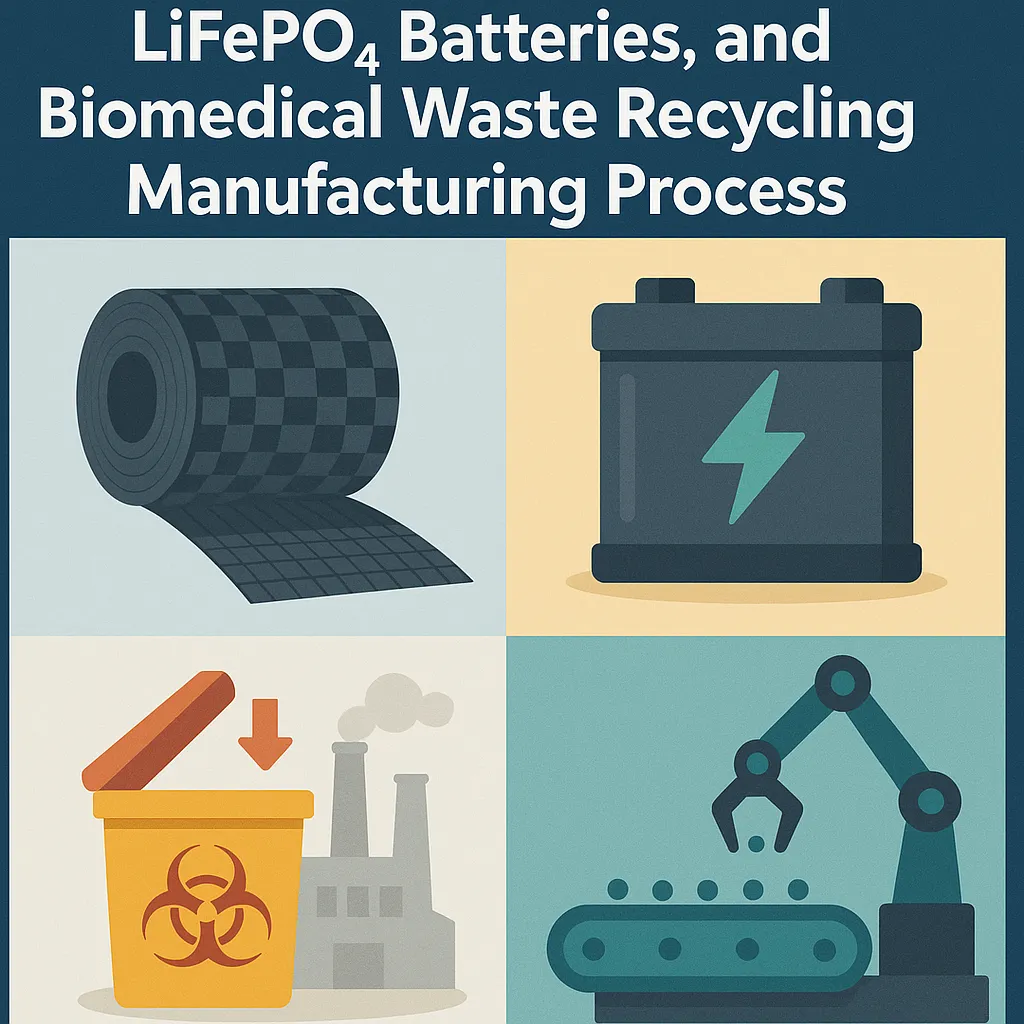
Profitable Manufacturing Process: The selection of industries in question is likely to vary significantly, but will most often include carbon fiber fabrics, LiFePO4 battery fabrication, and biomedical waste operations.
There will be these industries, differentiated according to their critical requirements for lightweight materials for aerospace and EVs, safe and long life span batteries, and eco-acceptable means of disposal.
| Sector | Current Size of Market | Projected Size of Market | CAGR |
|---|---|---|---|
| Carbon Fiber Fabric | ~$3.5–4 billion | ~$6–7 billion | ~7% |
| LiFePO4 Battery Manufacturing | ~$8.3 billion | ~$17+ billion | ~10–11% |
| Biomedical Waste Management | ~$37 billion | ~$80 billion | ~7–8% |
Rather, the fast-growing market gives the widest scope for some handiwork by the start-ups.
Manufacturing Process of Carbon Fiber Cloth-Profitable Manufacturing Process
Carbon fiber cloth is a type of fabric formed by weaving fiber that is ultra-light and very strong. Carbon fiber fabric has a number of uses in aerospace, automotive, renewable energy sports, and also in industrial products.
Step-Wise Manufacturing Process
Raw Material Selection
- Most often, they start using polyacrylonitrile (PAN) as raw material for carbon fibers. Some use pitch or rayon.
- It is said PAN gave the optimal strength at the minimum weight.
Precursor Spinning
- A thick solution is prepared by dissolving the PAN in a solvent.
- Then, relatively fine fibers (~5 – 10 microns) are formed by extruding through spinnerets.
- The resultant fleece is washed and elongated to align the polymer chains and thus augment the tensile strength.
Stabilizing
Here the air is heated at a temperature of about 200-300 °C, along with the fibers for several hours.
Oxidative stabilization prepares the fibers for high-temperature carbonization.
Carbonization-Profitable Manufacturing Process
- The fibers are then sent into an inert atmosphere (nitrogen or argon) at the temperature range of 1,000-2,000 °C, which burns out non-carbon components leaving 90-99% carbon fibers.
- The graphite fiber is optionally made during 2,500-3,000 °C to obtain ultra-stiff fiber that may be required for aerospace-grade materials.
Surface Treatment and Sizing
- The surface of the fibers is mechanically or chemically roughened to promote bonding to the resin.
- Sizing makes the coating on these fibers thin so that it protects the fibers during weaving and promotes adhesion to the composite.
Weaving the Fabric
- Carbon fiber strands or tows are to be woven into the fabric on special looms dedicated to this particular use.
- Common weaving patterns include plain, twill, and satin.
- Very carefully handled by the manufacturer, since these fibers are brittle and tend to break.
Composite Fabric Preparation
The woven fabric can either go to market as is or undergo preparation for composite manufacture through resin impregnation (so-called prepreg). These prepregs are cured under heat and pressure to yield extremely populated structures for aerospace, automotive, and wind turbine applications.
Key Notes:
Woven fabrics or prepreg sheets for small startup opportunities are targeting the raw carbon fiber specially sourced from eminent producers. Recycled carbon fibers fast developing into shredding and weaving spent fibers into either non-woven mats or low-cost fabrics.
Read More: Starting a Lithium-Ion Battery Assembly Business: Key Considerations and Challenges
Manufacturing Process of LiFePO4 Batteries-Profitable Manufacturing Process

Besides only in electric vehicles, demand for the LiFePO4 battery has continued to grow in energy storage for solar plants and other industries. The market has grown because of its safety, long life, and stability for performance.
Stepwise Process in Manufacture
Preparation of Cathode
- LiFePO4 powder undergoes blending with conductive carbon (for current flow) and polymer binder, after which the slurry is coated on aluminum foil and dried in a factory oven.
- Subsequent to the drying process, the coating becomes impregnated (calendar) for uniform-thickness and density settings.
Preparation of Anodes-Profitable Manufacturing Process
- Graphite powder mixed with binder is coated onto copper foil.
- Thereafter the wet sheet is dried and pressed to gain enough density.
Separator Preparation
- A thin porous polymeric membrane (either polyethylene or polypropylene) is a separator.
- It must prevent any possibility of direct contact so that cathode cannot touch the anode to short-circuiting.
Cell Assembly
- All the sheets of the cathode and anode are cut to size.
- These are stacked or wound with the separator and anode into layers, depending on the type of cell (cylindrical, prismatic, or pouch).
- All of this happens as dry as possible to avoid moisture ruining the cells.
Electrolyte Filling and Sealing-Profitable Manufacturing Process
- The cell is filled with electrolyte made of lithium salts in organic solvents.
- Leakage is prevented by crimping the cans or heat sealing the pouches.
Formation & Aging
- New cells are charged and discharged to activate the chemistry.
- They are then tested for capacity, voltage, and safety parameters.
- The cells are aged under controlled conditions to detect any failures at an early stage.
Battery Pack Assembly (Optional)-Profitable Manufacturing Process
This is many cell batteries forwarded with a Battery Management System (BMS), which can thus monitor the performance of the pack as a whole.
Key Notes:
- Commercialization can start with the assembly of the battery pack even before the cell manufacturing plants are established.
- Controlled working conditions, dry rooms devoid of moisture with certain precautionary measures during chemical handling need maintenance.
Read More: Wealth from Waste. Production of Activated Carbon from Natural Sources
Biomedical Waste Recycling
Biomedical waste is classified into three parts: Infectious materials, Chemicals and Sharps. Recycling is compulsory before disposal in a safe manner to prevent further disease transmission and environmental pollution.
Methods of Recycling
- Collection and Segregation are the processes that follow one after the other in recycling.
- Infection waste collection-red; pathological waste-yellow; blue for sharps; and white for pharma wastes-bins.
- This means that wastes should be transported in vehicles that are seal and sign-marked..
Sterilization
- Infectious waste is sterilized through application of steam at high pressure by an autoclave.
- Microwave or chemical kind with the type of waste would kill pathogens.
SHREDDING-After sterilization so that further processing will not be done to the wastes.
Read Our Project Report: Click Here
Materials Recovery-Profitable Manufacturing Process
- Plastics-melted and molded into commercial products such as bins and pallets.
- Recovery of Metals-from decontamination for recycling in scrap.
Glass-clean and recycle. - Organic waste-processed for biogas production through bio-digestion with guaranteed safety.
Recovery of Energy
- For high-temperature controlled incinerators disposing of wastes, it is non-recyclable.
- Waste-to-energy systems using steam or Electricity.
Hazardous Residues Disposal
Fly ashes, chemical residues, along with remaining non-recyclables would be disposed to landfills in secured landfills.
Points for Consideration
- Know the environmental regulations of waste disposal.
- These are some of the technical plants for evaluation: autoclave, shred, incinerators, vehicles, and waste record systems.
- Service contracts have been signed with hospitals for short- or long-term agreements, as such a system will be very beneficial because they will have the option to sell recyclables and energy.
Read Our Book: Click Here
How NPCS Would Help You-Profitable Manufacturing Process
Market surveys are done to process the detailed project report along with technical know-how and plant-long establishment together with finance projections in the scope of growing sectors such as Carbon fibers, Battery Manufacturing, and Biomedical Waste Management.
Many NPC-backed entrepreneurs will have a road map for the initiation, planning, and scaling up of their manufacturing venture. We mold business ideas into the real organization.
Find the Best Idea for Yourself With our Startup Selector Tool
Conclusion
LiFePO4 batteries and recycling of biomedical waste would form a very promising yet dynamic future in carbon-fiber fabric. The key materialization would be technology and most importantly the heavy requirements of capital to cater to such enormously lucrative markets.
Public health services along with renewable energy perennially will ignite innovations in industries by entrepreneurs.
FAQs with brief Answers-Profitable Manufacturing Process
Which industries need carbon fiber fabric?
Aerospace, automotive, wind energy, sports, marine and allied sectors.
Does that mean a small startup can venture into manufacturing lithium-ion batteries?
Start small; do pack assembly or play at the cell niche; then do full manufacturing of cells.
What are the benefits of LiFePO4 battery to humankind?
Long term; safety; cheap for electric vehicles; renewable energy storage.
How is biomedical waste recycled?
Waste is collected, sterilized, shredded, and sorted. Plastics, metals, and glass are recovered, while the rest is safely disposed or used for energy.
Will it be costly to manufacture carbon fibers?
Yes. Capital price on one-side has been very sky-high to a greater level for raw fiber production, but for a small startup, weaving fabrics or making prepregs is mere pocket money.


