







Ship Repair Industry in India
The maritime sector of India now stands ready to undergo fundamental changes which will occur because of increasing trade volume and new infrastructure development and government policies that promote sustainable practices. The Indian government aims to establish its country as a worldwide maritime canter through its Maritime India Vision 2030 (MIV 2030) initiative which will develop shipbuilding facilities and ship repair operations and environmentally friendly ship production.
For entrepreneurs, MSMEs and industrial investors, this is a more than incremental growth – it is a long-term infrastructure opportunity supported by policy incentives and global decarbonization trends.(Ship Repair Industry in India)
India's Maritime Advantage, Policy Framework
Ministry of Ports, Shipping and Waterways has prepared a strategic roadmap under Maritime India Vision 2030, to harness full potential of India’s coastline and position in trade.
India is well situated on one of the most heavily used east-west routes of international trade. With more than 7,500 km of coastline and access to key global shipping routes, the country processes over a billion tonnes of cargo annually at ports throughout the country. However, despite this scale, a significant amount of ship repair and high value vessel construction work is still carried out overseas.
Maritime India Vision 2030 centres around:
- Expanding domestic shipbuilding capacity
- Attracting ship repair activity currently taken abroad
- Promoting the use of green fuels for maritime transport
- Creating hydrogen and alternative fuel hubs at ports
Strengthening of coastal shipping and inland waterways
This alignment in the direction of policy and of market demand creates a rare window of opportunity for private participation.(Ship Repair Industry in India)
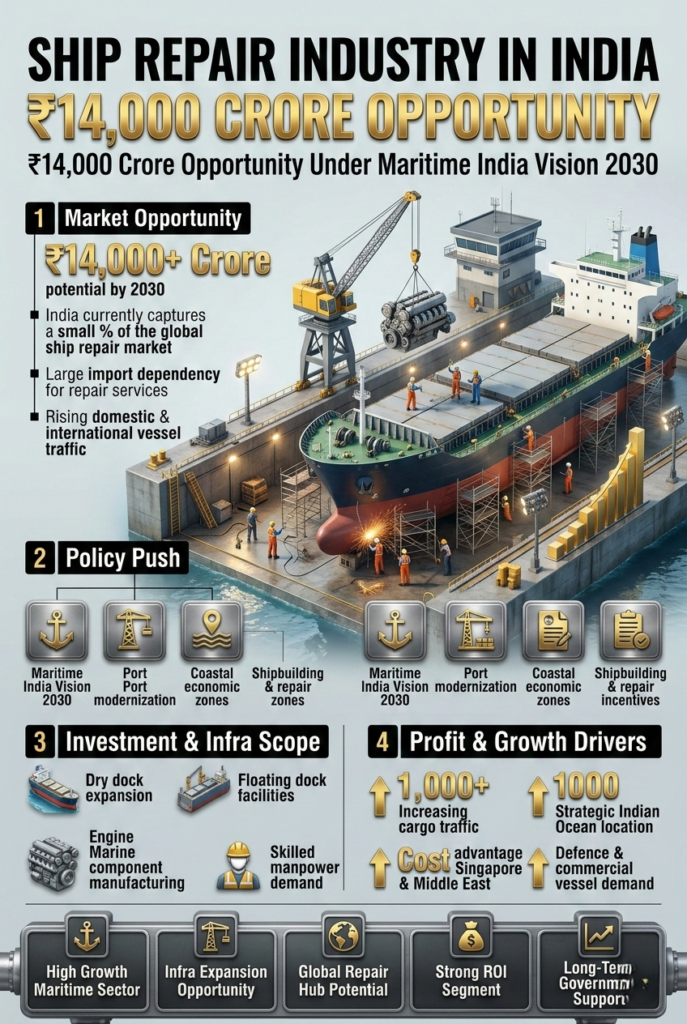
The Ship Repair Industry in India - A High Potential Segment
India’s ship repair market is estimated (as of 1999) at around Rs 2,000 crore, with near-term potential of reaching Rs 6,000 crore. Over the next decade, the market may grow up to more than ₹14,000 crore if there is scale in domestic capabilities.(Ship Repair Industry in India0
Every ship calling at Indian port requires:
- Periodic dry docking
- Hull inspection and coating
- Overhaul, engine and mechanical servicing
- Compliance upgrades
- Safety system checks
These repair cycles are required by international maritime laws which guarantee recurring demand independent of speculative market cycles.(Ship Repair Industry in India)
Read More: Business Plans / Project Profiles
Why Ship Repair Is a Good Business Model
- Recurring Revenue Streams
Vessels require periodic upkeep which generates business that occurs at regular intervals.
- Demand Related to Trade Volumes
As the movement of cargo increases, so does the amount of shipping traffic.
- Lower Entry Barrier than Full Shipbuilding
Mid-sized repair yards, floating docks and specialized service facilities need less capital than greenfield shipyards.
- Strong Ancillary Ecosystem
Repair operations support fabrication units, marine engineering workshops, electrical specialists and equipment suppliers.
Strategically located repair facilities close to high-traffic ports may attract large market share that is currently lost to Singapore, Dubai and other international repair hubs.(Ship Repair Industry in India)
Green Vessel Manufacturing: The Future of Maritime Growth
Global shipping is in the midst of decarbonization. The International Maritime Organization (IMO) has established ambitious emission reduction goals and this has led to the adoption of cleaner propulsion systems by shipowners around the world.(Ship Repair Industry in India)
India has maintained its compliance with current global standards through its Shipbuilding Financial Assistance Policy (SBFAP) which provides funding support for shipping enterprises.
Key Incentives Under SBFAP
- 20% financial support to normal vessels
- 30% aid to vessels running on green fuels, such as methanol, ammonia or hydrogen
- 20% assistance to electric and hybrid propulsion vessels
The subsidies reduce the financial burden of different ship categories which results in faster green ship implementation.
Cochin Shipyard Ltd. has already proved India’s technical capabilities having supplied hybrid electric vessels and developed hydrogen fuel cell powered ship prototypes. This is an indication of India’s willingness to compete in sustainable shipbuilding.(Ship Repair Industry in India)
Read More: Project Reports & Profiles
Opportunity for Startups and MSMEs
Startups should start their business operations when they enter shipbuilding.(Ship Repair Industry in India)
- Entry Points For High Growth Include:
- Marine batteries system manufacturing
- Electric Propulsion Motors Development
- Hybrid Energy management systems
- Retrofitting diesel vessels for green fuels
- Hydrogen-ready fuel storage modules
- Smart monitoring and compliance systems
The business model of component manufacturing and systems integration enables companies to grow their operations while maintaining lower costs and higher profit margins.
Global shipping companies seek to develop localized supply chains which helps them decrease geopolitical risks. Indian manufacturers can establish themselves as trustworthy partners who provide long-term support.(Ship Repair Industry in India)
Why the Timing Is Strategic
Several structural drivers make this right time to enter:
- Clear Policy Roadmap
Maritime India Vision 2030 gives a long-term clarity and decreases regulatory uncertainty.
- Strong Subsidy Framework
Financial assistance reduces the capital expenditure and enhances the viability of the project.
- Rising Cargo Volumes
The expanding Indian economy drives higher import and export activities which increases shipping traffic through Indian ports.
- Global Net-Zero Push
The requirements for sustainability which demand green ship construction and retrofitting activities will continue to create a steady demand for these products.
- Localization Imperative
Supply chain interruptions have catalysed the demand for domestic maritime capabilities.
Infrastructure industries reward those who get in early and invest ahead of demand. Companies that build operational capacity now can scale up quickly as policy support translates into execution.(Ship Repair Industry in India)
Lessons from Maritime Masters of India
Adani Ports and Special Economic Zone Ltd. took the scaling by ahead of the projected demand by building port infrastructure. Through operational efficiency and strategic acquisitions, it was able to position itself as the largest private port operator in India.
Shreyas Shipping & Logistics targeted coastal as well as feeder services as opposed to competing directly with global liner giants. By focusing on a specific niche, it developed a sustainable and profitable business model.
These examples point out three key lessons:
- Defensibility driven by specialization
- Long-term capital deployment builds scale
- Operational efficiency – Keeps the business profitable
Any entrepreneur getting into ship repair or green manufacturing has to be similarly strategic.(Ship Repair Industry in India)
Investment Considerations & Financial Planning
Ship repair yards and green manufacturing facilities require a disciplined financial planning.
Key Capital Components:
- Industrial access to land and waterfront
- Fabrication and docking infrastructure
- Heavy machinery and marine equipment
- Skilled workforce training
- Environmental compliance systems
Potential Funding Sources:
- SBFAP Government subsidies
- Commercial banks: – Term loans
- Private equity and infrastructure funds
- Strategic partnerships with shipping companies
- Consortium financing models
The process of obtaining institutional funding demands a rigorous feasibility study and demand assessment along with a financial projection model, which serves to both attract funding and mitigate risk.(Ship Repair Industry in India)
Market Outlook: 2025–2035
Over the next decade, India’s maritime sector will be dominated by three forces:
- Growth in flows of international trade
- Decarbonisation of the world’s shipping fleets
- Policy driven industrial self-reliance
Ship repair provides recurring, consistent revenue based on obligatory maintenance schedules. Green vessel manufacturing is a high growth opportunity associated with sustainability requirements
Together, these segments form a balanced industrial opportunity – a combination of stability and expansion.
As emission regulations become stricter in the global market and the level of vessel traffic at Indian ports goes up, domestic capabilities in repair and green propulsion will change from being optional benefits to being strategic requirements.(Ship Repair Industry in India)
Conclusion
India’s maritime transformation under Maritime India Vision 2030 is not a one-time policy announcement – it is a structural transformation supported by capital allocation, regulatory clarity and sustainability commitments.
The ship repair industry is a scalable recurring revenue model with high domestic demand. Green vessel manufacturing has high growth potential aided by subsidies and international environmental trends.
For startups and MSMEs that are willing to take a long-term approach, invest in technology and align with the policy direction, this is an attractive infrastructure opportunity.
The entrepreneurs who move early, specialize intelligently and build the operational excellence today are likely to become the maritime industry leaders of tomorrow.(Ship Repair Industry in India)
Frequently Asked Questions (FAQ)
What is the size of India ship repair market?
India’s ship repair market is currently worth around Rs 2,000 crores, which can be increased to Rs 6,000 crores in the near term with a potential of Rs 14,000 crores in a decade.
What are the incentives for green shipbuilding?
Under the Shipbuilding Financial Assistance Policy, shipbuilders receive up to 20% for conventional vessels and up to 30% for vessels using green fuels such as methanol, ammonia and hydrogen.
Is ship repair a stable business?
Yes. Ships require mandatory periodic maintenance and therefore create consistent demand and recurring revenue opportunities.
Can it be for startups to get into green vessel manufacturing?
Yes. Startups can start with component manufacturing, propulsion system integration, retrofit services or marine technology solutions instead of full-scale shipbuilding.
Why is MIV 2030 important?
Maritime India Vision 2030 is a structured roadmap for growth of ship building, increasing repair base and also promoting green maritime technologies, which reduces the guess work for investors.


