





Introduction: Battery Chemicals Manufacturingin India
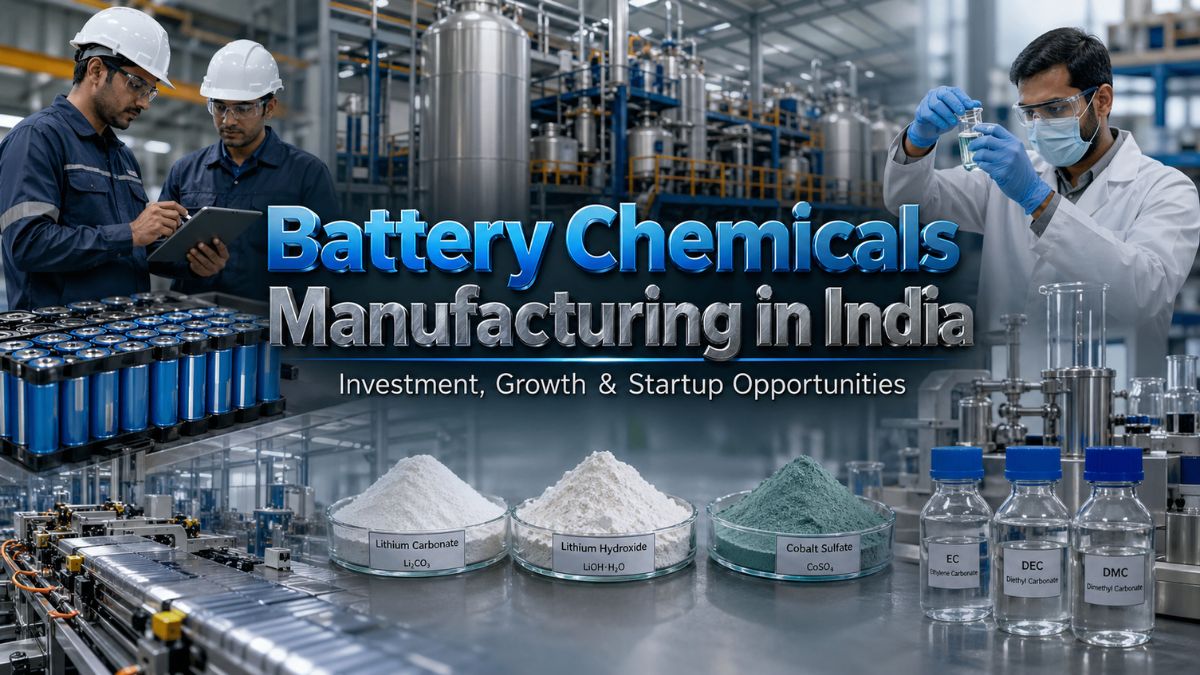
India is on the brink of the electric mobility, renewable energy and industrial revolution. A key constituent of these industries, batteries, are produced using specific chemicals such as lithium salt, electrolyte solvents, conductive materials etc. While demand is on the rise, the majority of these chemicals are imported which consequently create an artificial shortage within India.
NITI Aayog has identified battery chemicals as one of the manufacturing components of high priority in India. The body has identified that the local manufacturing capacity is still low in this sector, presenting a huge opportunity for early entrants. If you’re a business owner seeking a profitable manufacturing investment for the long haul, this sector is one with high demand, government incentives and high profit margins.
Table of Contents
ToggleWhy the Demand for Battery Chemicals Is Increasing Rapidly
Battery chemicals are in demand because various sectors are growing simultaneously. The automotive, solar, and electronics industries all require batteries for their products. High demands for battery chemicals would also emerge due to India’s green energy initiatives and focus on smart manufacturing.
This growth is being driven by a number of factors:
- Growing use of electric vehicles in India
- Growth in solar and energy storage technologies
- Growing manufacturing of consumer electronics
- Government support for local battery production
These developments suggest that the battery chemicals market will continue to thrive for decades, offering sustainable business opportunities.
Get Detailed Insights from This Book: India Lithium-Ion Battery Market Analysis & Forecast
Why 2026 Is the Right Time to Start a Battery Chemicals Business
This is an ideal time to start a business in this field because policy and market interest are aligned. Those who begin now can establish themselves as first suppliers to emerging battery manufacturers.
The commercial landscape has some key benefits:
- Encouragements from government subsidies and incentives
- Increasing local consumption of battery materials
- Low local manufacturing competition
- Future growth prospects from renewable energy
This makes battery chemicals manufacturing a highly attractive investment opportunity for Indian industry.
Popular Business Ideas in Battery Chemicals Manufacturing
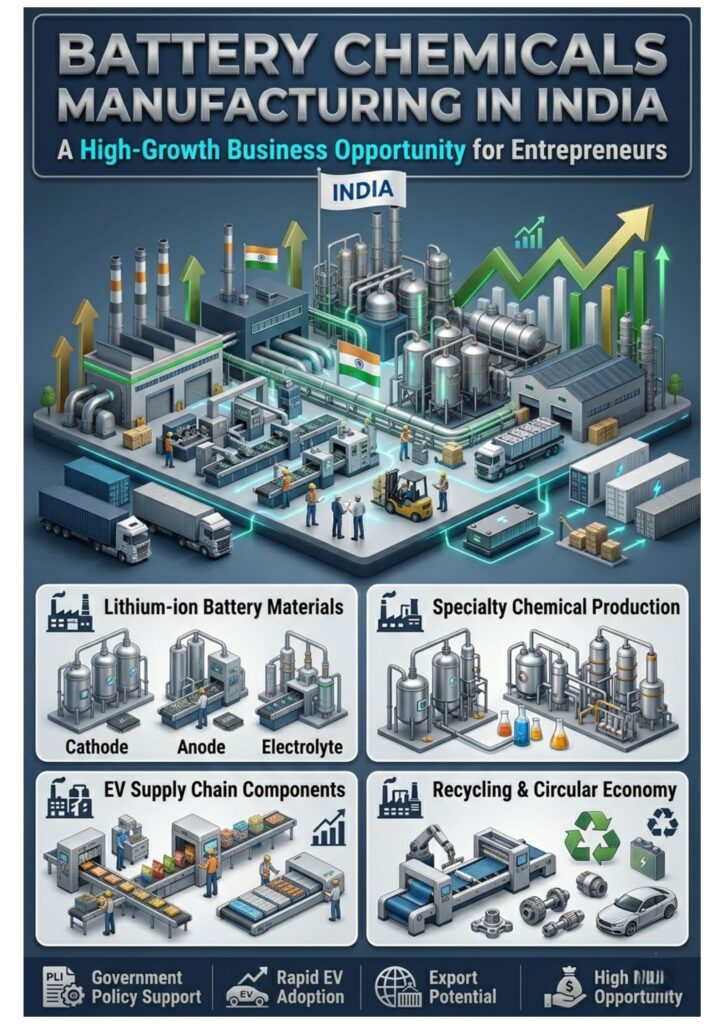
Battery chemicals manufacturing is a product segment comprising of several products, with varying investment and technical requirements. Selecting an appropriate segment is the key to developing a viable business.
Some highly profitable business ventures are:
- Lithium Salt Purification Unit – purifying lithium salts for batteries
- Electrolyte Solvent Production – chemicals for lithium-ion batteries
- Conductive Carbon Additive Processing – enhancing battery performance by adding materials
- Cobalt and Nickel Sulphate Processing – providing key battery chemicals
- Battery Chemical Testing Laboratory – testing and certifying quality
Both items mentioned above are on a high demand. The expansion potential is high and the output can scale as per need.
Get Detailed Project Report (DPR): Lithium Battery & E-Waste (Electronic Waste) Recycling Industry
Investment Required to Start a Battery Chemicals Manufacturing Plant
Capital for manufacturing battery chemicals requires the highest level of expenditure for the creation of the manufacturing plant, but is highly rewarding in the long run. Investment outlay depends on the size of plant and manufacturing unit, output capacity and the technology that is utilized.
Rough estimates are:
- Small plant: ₹6-8 crore
- Medium-scale plant: ₹10 crore to ₹25 crore
- Large-scale plant: ₹30 crore or more
This capital will consist of Land & building, machinery and equipment, utilities and initial working capital. Strategic financial planning prior to commencement is a must to keep the operations running in the initial few months.
Machinery and Equipment Required for Production
To maintain purity and safety of the product, one must select equipment capable of achieving such ends. Selection of the correct equipment ensures a high-quality product.
Key equipment required includes:
- Chemical reactor vessels
- Distillation and filtration equipment
- Drying and crystallization equipment
- Quality testing instruments
- Effluent treatment plant (ETP)
- Packaging and storage systems
The legal compliances for a chemical manufacturing unit are extensive. The primary among them will be environment clearance. This might take months to procure, hence planning for this phase is very important.
Licenses and Approvals Required for Battery Chemicals Manufacturing
Chemical manufacturers must meet a host of legal requirements to operate. Securing approvals not only keeps businesses compliant, but instils confidence in consumers and investors.
The most important licenses include:
- Udyam Registration for MSME status
- GST Registration for taxation
- Labor department’s Factory License
- Pollution Control Board approval
- Environmental Clearance certificate
- Fire safety and industrial safety certificates
Of the above, the one taking the longest time is the environmental clearance, and this normally takes several months to get approved.
Government Subsidies and Financial Support Available
The Indian government is introducing various incentives in priority sectors like battery chemicals to facilitate local manufacturing, and these can contribute to reduce the capital investment and also improve profitability.
Key incentives include:
- CGTMSE loan guarantee without collateral
- PMEGP subsidy for new manufacturing units
- Startup India tax breaks
- State government industrial subsidies
- Production Linked Incentive (PLI) scheme
They also facilitate the raising of finances and control costs.
Expected Profit and Return on Investment
Economical production of battery chemicals is highly profitable and the income is generated through the quantity and quality of the production and also based on the demand in the market. Efficiency and profitability increase with scale.
Common financial performance ratios are:
- Gross profit margin: 28% to 38%
- Net profit margin: 18% to 24%
- Payback period: 4 to 6 years
These rates are competitive with many other manufacturing industries.
Why a Detailed Project Report Is Essential Before Starting the Business
The detailed project report is the backbone of manufacturing business. It outlines the technical, financial and operational details of the business. An ad-hoc approach of the project may lead to high costs and also development of the project may be prolonged during the project development stage.
A professional project report helps with:
- Getting loans from banks and funding from investors
- Project costing
- Identifying potential risks
- Planning production capacity
- Meeting regulatory requirements
Banks generally ask for a project report for loans to finance industrial projects.
How NPCS Helps Entrepreneurs Start Manufacturing Businesses
NIIR Project Consultancy Services (NPCS) is a reputed consultancy firm that assists entrepreneurs in setting up manufacturing businesses in different sectors. NPCS is a group that is expert in the preparation of project reports and technical consultancy services for industrial projects.
NPCS also provides end-to-end services to simplify the project development process, which may include feasibility studies, cost estimations, equipment selection and layout designs, etc. They also assist entrepreneurs with regulatory compliance and bank loan applications.
The reports developed by NPCS can be utilized by the banks and the governments to analyse projects and banks approve the loans based on them to a large extent, which will further make project proposals acceptable to the banks and consequently lead to approval of project proposal. Similar to how consultants can guide SMEs for risk management in starting a business.
Future Growth Potential of the Battery Chemicals Industry
The prospects for the battery chemicals industry in India are very bright. The advent of electrical vehicles and increased installation of renewable energy projects will further increase the demand of batteries and consequently the demand for locally manufactured battery chemicals in India.
Industry experts predict that this industry will be crucial to India’s manufacturing sector. Early entrants in the market can develop good customer relationships and gain a competitive edge.
Conclusion
The manufacturing of battery chemicals is the most promising business proposition in India. The business is lucrative with the burgeoning demand, various government incentives and lack of local competition. While the initial investment is expensive but the potential of the business over the years are very high in terms of profit and growth.
Through diligent research, a planned project and an investment in good practice entrepreneurs can improve their probability of succeeding in the market. The manufacturing of battery chemicals can be profitable through a planned business approach.
Frequently Asked Questions (FAQ)
Q: What is the investment required for establishing a battery chemical manufacturing plant in India?
A: Typically, an investment for the setting up of a small to medium-scale plant would range between 6 and 25 crores. The investment varies based on the size and technology used.
Q: Is manufacturing battery chemicals a profitable venture in India?
A: Yes, manufacturing battery chemicals in India is very profitable due to a very high demand and a supply gap in the country.
Q: What is the duration of the setting up process for a battery chemical manufacturing plant in India?
A: The general duration for setting up a battery chemical manufacturing plant is between 18 and 24 months, this includes the time for approvals and construction of the plant.
Q: Which are the easier battery chemical businesses in India?
A: Some of the easy battery chemical businesses that could be established include manufacturing electrolyte solvent, purifying lithium salts, and setting up a battery testing laboratory.
Q: Does NPCS offer any manufacturing project reports?
A: Yes, NPCS also offers manufacturing project reports and technical consultation that can assist entrepreneurs in obtaining bank loans and in establishing their own manufacturing plants.


