





Contract Manufacturing Business
Most people think the key to success is to build a brand. Yet, some of the most lucrative businesses are backroom operations. One of these is contract manufacturing.
Thousands of small factories in industrial cities such as Pune, Chennai and Ahmedabad make products for big brands without stamping their own labels. These companies invest nothing in advertising but many make regular monthly profits.
The contract manufacturing industry in India is valued at more than ₹4.2 lakh crore and growing fast. Big businesses are outsourcing more to save costs and be agile. This represents a major opportunity for small manufacturers.
Table of Contents
ToggleGet Detailed Insights from This Book: Select & Start Your Own Industry (4th Revised Edition)
Why This Is the Right Time to Start
This is an opportune time to start a business. The world is moving offshoring and India is quickly emerging as a manufacturing hub. Meanwhile, there is growing local demand in the FMCG, food and apparel industries.
The government is also more favourable, enabling new entrepreneurs to set up their own manufacturing ventures.
The main growth factors are:
- China+1 strategy increasing global demand
- India’s strong consumption growth
- Programs to assist MSME’s subsidies and loans
These reasons have made contract manufacturing more cost-effective.
Understanding the Business Model
Contract manufacturing is a form of manufacturing where you manufacture other company’s products and they brand them as their own. You are only responsible for the production, quality assurance and shipping.
This approach is low risk – you don’t have to worry about branding and marketing. You simply focus on efficiency.
For instance, you might produce packaged food, plastics or textiles for another company. They sell the product, and you get paid per unit produced.
Access Complete Business Plan: Project Reports & Profiles
Choosing the Right Sector
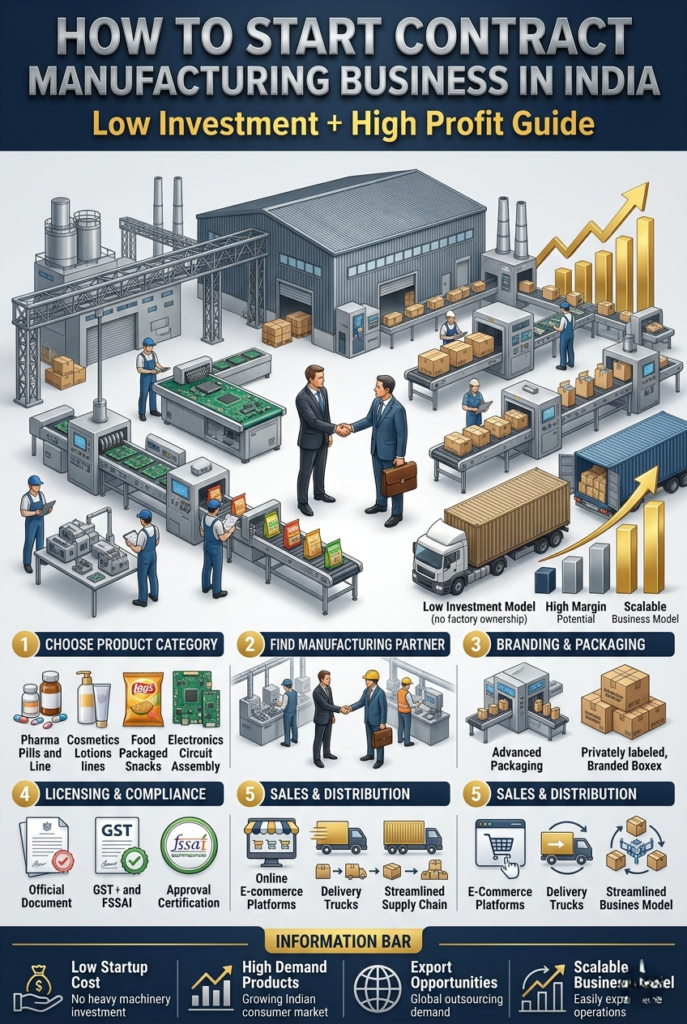
It’s important to find the right sector. New entrepreneurs should look for industries that are less competitive and have medium levels of investment.
Good starting sectors include:
- Food (spices, snacks, packaging)
- Garments and textiles
- FMCG packaging
- Plastic and simple engineering
The more lucrative but more complicated industries are pharmaceuticals and electronics.
Ideally, you should consider a sector in which you have some prior experience or advantage.
Secure a Client Before You Invest
This is the key and often overlooked.
Don’t establish a factory before identifying customers. Talk to companies, suppliers, distributors. Attempt to obtain a Letter of Intent (LOI) or start-up order.
This will minimise your risk and increase your likelihood of securing a loan.
Registration and Compliance
All manufacturing businesses need to undertake basic registrations. It may seem overwhelming, but it can now be done online.
Essential registrations include:
- Udyam Registration (for MSME benefits)
- GST Registration
For some businesses you may need:
- FSSAI license (food business)
- Drug license (pharmaceuticals)
- Pollution control approval
- Factory license
Compliance allows the company to run efficiently and also obtain big contracts from large corporations.
Setting Up Your Manufacturing Unit
Keep it small and simple. It’s common for manufacturers to start in rented facilities to minimise overheads.
The typical equipment includes machinery, utilities and a couple of employees.
The team structure will be:
- 1 production supervisor
- 4–6 machine operators
- 1 quality control staff
- 1 admin/logistics person
This is sufficient to run a micro or small unit initially.
Investment and Profit Potential
Start-up costs vary with size and sector. A micro unit would cost about ₹15-20 lakh to start, while a small unit would cost about ₹45-60 lakh.
The business is financially appealing.
At full capacity:
- Monthly revenue: ₹15–20 lakh
- Net profit margin: 16–22%
- Monthly profit: ₹2.5–4 lakh
Investment generally recoups within 24-36 months, this varies depending on the efficiency and output of the company.
How to Get Clients Quickly
Acquiring your first client can be most difficult, but also the most rewarding. There is a lot of demand for manufacturers.
Here are some effective avenues to find clients:
- Attend MSME buyer-seller meets
- Email or LinkedIn companies directly
- Join industry associations
- Work with an export or distribution company
The ability to fill small orders with high-quality products can set you apart.
Government Schemes You Should Use
The Indian government has schemes to help manufacturing businesses, particularly startups.
Some key schemes:
- PMEGP (subsidy for capital up to 35%)
- CGTMSE (collateral-free loans up to ₹2 crore)
- MUDRA loans (working capital support)
- PLI scheme (subsidies for output growth)
These schemes could save a lot of financial pressure on your part.
Why Proper Planning Is Critical
Many new manufacturing facilities don’t make money, not because of a lack of orders but because of poor planning. Choices of machinery, plant design and financial resources need to be made wisely.
That’s where the experts can help. Companies that provide these kind of reports are NIIR Project Consultancy Services. The reports cover everything such as technically set up, analysis of finance and law etc.
They are also useful in obtaining bank finance, with reports providing reliable information.
Common Mistakes to Avoid
The opportunity is great, but errors can be fatal if not caught quickly.
Some key mistake are made:
- Starting without confirmed clients
- Overspending on machinery
- Ignoring quality standards
- Relying on one supplier or purchaser
The slow approach and the patience is needed to grow and prosper.
Final Thoughts
Contract manufacturing is not about marketing. It is about predictability, reliability and process. You are not in a growth business – you are serving an existing market.
With quality, reliability and efficiency, this business can build sustainable and scalable revenues.
The market is there. It’s your turn.
FAQs
How much money is needed for this business?
You could start with a small unit of investment of around 15-20 Lakh and with investments ranging to about 45-60 Lakh in every industry respectively to get stability.
Is contract manufacturing profitable?
Yes, it’s a good source of steady 16-22% returns. In some industries (such as pharmaceuticals), it can be higher.
How do I get my first client?
By reaching out, attending industry events, and MSME networks. All you need is a small trial order.
What industry is good to start in?
Food processing, garments and packaging are relatively easy to start due to low investment and easy compliance.
Must I have prior experience?
Not necessarily. If planning and technical advice is sought early, this business can be taken up by novices.
How can NPCS help me?
NIIR Project Consultancy Services offers project reports, plant layouts and financial planning assistance for establishing and obtaining loans.


