





Introduction: India pump manufacturing business
The pump industry in India is emerging as one of the most desirable manufacturing industries to the entrepreneurs and MSMEs. The industry is expanding very fast because of the increasing demand in agriculture, development of infrastructure, water supply systems in cities and industrial growth.
Meanwhile, India is experiencing an apparent demand-supply mismatch in high-technology pumps, particularly in the industrial and energy-efficient markets. The gap is providing good opportunities to new manufacturing units, particularly those that are specialized and innovation oriented.
As a long-term, stable and policy-backed manufacturer, the pump industry is a good candidate in the next ten years among investors.
India Pump Market Growth Outlook (2026–2032)
Indian pump market is enjoying a positive upward trend. It has a market size of USD 2.9 billion (2024) and is estimated to reach USD 4.1 billion by 2030. The entire industry and industrial and specialized pumps are likely to grow even more in the early 2030s.
This consistency is what is significant about this growth. The pump demand is directly attributed to key sectors like water supply, agriculture and industrial production which guarantees a stable long-term consumption even when the economy is in a fluctuation.
Key Growth Drivers of the Pump Industry
The growth of the Indian pump industry has several powerful structural factors and does not have one point of demand.
Government infrastructure investment is one of the most potent drivers. Massive initiatives are underway to boost the demand of pumps in urban and rural India.
The major government programs are:
- Jal Jeevan Mission of the rural drinking water supply.
- AMRUT program of urban infrastructure development.
- Smart Cities Mission of smart water systems in cities.
- Large-scale industrial and water projects: National Infrastructure Pipeline (NIP).
All these programs involve a lot of water distribution, sewage management and pressure systems which involve the use of pumps.
Another huge pillar of demand is agriculture. There are millions of users of irrigation pumps in India, and the transition to solar energy is changing the industry.
- More than 21 million irrigation pumps have already been put into practice.
- Solar pumps are being propelled by PM-KUSUM scheme.
- Diesel and electric pumps are being substituted with energy efficient pump systems.
There is also a strong contribution of the industrial growth. Industries like chemicals, pharmaceuticals, food processing and oil and gas are becoming more reliant on high-performance pumping systems.
Moreover, wastewater treatment is also emerging as an important long-term growth sector. India has massive amounts of wastewater, yet there is a lack of treatment capacity and this is driving up the need to have sewage and effluent management systems.
Get Detailed Project Report (DPR): Industrial Pumps Manufacturing Plant Project Report & Market Analysis
Demand–Supply Gap in India’s Pump Industry
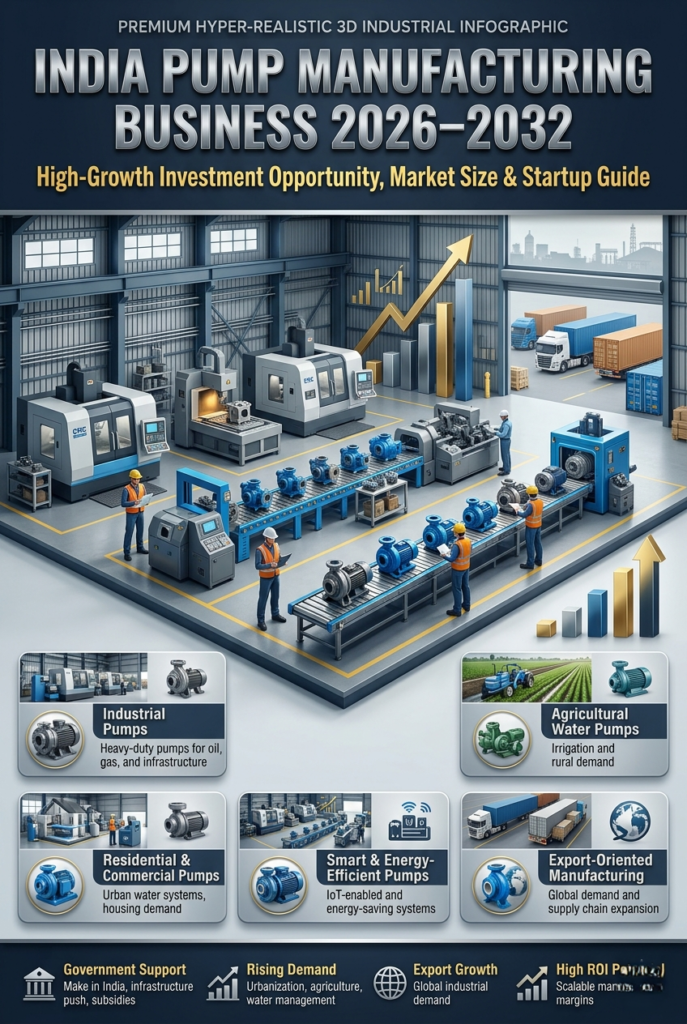
Even though India has good domestic production capacity, the country still relies on imports of sophisticated pump technologies.
Domestic manufacturers are strong in:
- Agricultural pumps
- Basic centrifugal pumps
- Domestic water supply systems.
Yet there is a big disparity in high-performance categories including:
- Industrial process pumps
- Oil and gas API-standard pumps.
- Precision pharmaceutical pumps.
- Intelligent pumping systems through IOT.
Production volume is not really the problem but technological capability. Most of the sophisticated systems continue to depend on imports or MNC suppliers.
This gives a good chance to new entrants that can specialize in technology and energy-efficient production of pumps.
Competitive Landscape of the Industry
The Indian pump market can be classified into two categories of companies: domestic and multinational manufacturers.
The agricultural and middle range industrial segments are controlled by domestic firms like Kirloskar Brothers, CRI Pumps, Shakti Pumps, Texmo Industries and WPIL. These firms enjoy good distribution channels and brand names.
The high-end market in industrial pumps is dominated by Global corporations such as Grundfos, KSB, Xylem, and Flowserve because they have advanced technology and international certifications.
Nonetheless, the mid-to-premium segment remains a huge gap, notably in:
- Energy-efficient smart pumps
- IoT-enabled monitoring systems
- Special industrial pumps.
This is a good entry point by MSMEs and startups.
Startup Opportunity in Pump Manufacturing
The manufacture of pumps presents one of the most viable ways through which industrial entrepreneurs can venture in India since it enables low entry through gradual scaling and specialization.
A new business may start with rather simplified manufacturing or assembly systems and grow to sophisticated systems.
The areas that have high potential in entry include:
- Farm pumping unit.
- Solar pump integration systems:
- Sewage and wastewater manufacture of pumps.
- Motor-pump combinations, and spare parts.
The following is what is appealing about this sector, the demand is not seasonal and speculative, it is continuous and is associated with vital services.
Moreover, the government-supported procurement systems offer long-term visibility which decreases the risk of new entrants in the market.
Regional Manufacturing Opportunities
The demand of pumps in India is highly decentralized although some areas present better manufacturing benefits.
Western India, in particular Maharashtra and Gujarat, boasts of industrial demand and good logistics connectivity. The pump manufacturing ecosystem is highly developed in Southern India especially Tamil Nadu, where Coimbatore is a major production center.
Eastern India is becoming a high growth region because of the rising infrastructure development and a reduction in the operating costs. This area will experience an accelerated growth rate compared to the national average in the next few years.
Export Potential of Indian Pump Industry
India is gradually emerging as a competitive supplier of pump systems. Diversification of the global supply chain has created new opportunities to Indian manufacturers.
Indian pump systems are being highly demanded by countries in the African continent, Middle East and Southeast Asia particularly in agriculture and water management.
The best export opportunities are in:
- Solar pump systems
- Agricultural irrigation pumps
- Water management systems in industries.
Nevertheless, global certification standards and technology integration will be necessary in order to increase the share of exports even more.
Role of NPCS in Pump Manufacturing Projects
To initiate a business of producing pumps, one needs to plan technically, analyze the finances and understand the market. It is here that NPCS (Niir Project Consultancy Services) has a significant role to play.
NPCS, through its reports on project reports (DPRs), assists entrepreneurs to consider the viability of their business concept prior to investment.
An average NPCS report consists of:
- Manufacturing process details
- Machinery and equipment need.
- Sourcing of raw materials direction.
- Estimation of costs and investing.
- Break-even and profitability analysis.
- Market demand assessment
Such reports assist in assuaging investment risk and give a roadmap to establish a successful manufacturing unit.
NPCS has decades of experience in industrial consultancy and has helped thousands of entrepreneurs to start manufacturing companies in India.
Conclusion
The Indian pump market is on its way to a robust growth stage due to the infrastructure development, agricultural modernisation and industrialisation. In the simple types of pumps, competition is quite intensive although there is a high gap in sophisticated, energy-efficient and intelligent pumps.
To the entrepreneur and the MSMEs, this industry promises long-term stability, solid governmental backing, and increasing export potential. Through proper planning and technical advice, the production of pumps can be a very lucrative and expandable business in India.
Frequently Asked Questions (FAQ)
Q1. Is it a profitable business to manufacture pumps in India?
Yes, it is a steady and expanding business that is based on agriculture, infrastructure, and industrial demand.
Q2. What is the area of greatest potential growth of the pump segment?
The future potential is highest with solar pumps, industrial process pumps, and smart pumps which are controlled by IOT.
Q3. What is the demand in the pump industry?
Major drivers include government infrastructure investments, modernization of agriculture and industrial growth.
Q4. Is it an easy industry to venture into by MSME?
Yes, MSMEs may begin with assembly units or with niche production and expand.
Q5. What is the benefit of NPCS to the entrepreneur?
NPCS offers elaborate project reports, feasibility studies, and financial planning assistance in establishing manufacturing units.


Strong manufacturing, quality engineering, and reliable industrial solutions are key drivers for success in the pump industry. Well explained.