







Introduction: Karnataka energy manufacturing opportunities
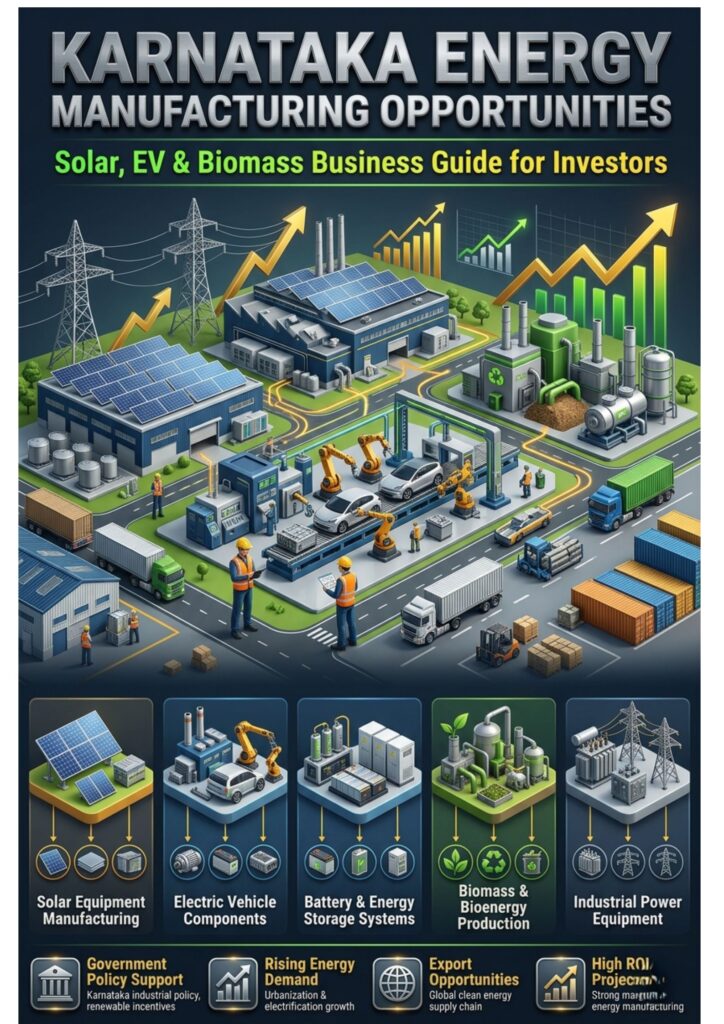
Karnataka is no longer the India IT capital. Although Bengaluru remains the technological powerhouse, the state is secretly creating a presence in the energy production and clean energy sector. Karnataka is emerging to be one of the most appealing locations of new-age industrial entrepreneurs with solar power systems, EV components, and bio-mass fuel production.
What is significant about this shift is that it is not speculative. It has good fundamentals such as government policies, industrial infrastructure, potential of renewable energy, and increasing demand in India.
Karnataka also provides scalable and viable opportunities in various energy sectors to entrepreneurs who have an investment capacity of between ₹50 lakh to ₹25 crore.
Table of Contents
ToggleKarnataka’s Natural Strength in Solar Energy
Karnataka has good solar irradiation all year round and particularly in the north and central districts. This renders solar energy harnessing and production very feasible in the state.
There is over 9,000 MW of installed solar capacity in the state already, and this figure is ever increasing. As India drives towards local solar production through PLI schemes, Karnataka is experiencing increased demand among local suppliers.
The opportunities in solar-related are:
- Assembling solar panels and manufacturing components.
- Inverter and battery systems.
- Mounting structure fabrication
- Solar EPC (Installation and execution of the project)
Due to the regular availability of sunlight and the increasing use thereof, solar energy is one of the most predictable industries in the state.
Rooftop Solar: A Fast-Moving Business Segment
One of the most dynamic and fast developing markets in Karnataka is rooftop solar. With the increasing electricity costs and government subsidies, households and industries are moving towards solar power.
The PM Surya Ghar Muft Bijli Yojana has also increased the pace of adoption among residential segments, and the industries are considering reducing costs by integrating solar.
Why rooftop solar works well in Karnataka:
- City high commercial electricity consumption.
- Good MSME and industrial base.
- Government subsidy support
- Rapidly-increasing consumer awareness.
An EPC company managed well in this area has potential to expand rapidly, due to the demand throughout the areas of urban and semi-urban areas, not only Bengaluru.
Get Detailed Insights from This Book: Solar PV Power and Solar Products Handbook
Biomass Energy: A Hidden High-Profit Opportunity
One of the least recognized industries of Karnataka is biomass energy. Agricultural residue is produced in large quantities annually in the state through crops such as sugarcane, rice, maize and cotton.
This waste can be converted to biomass pellets or briquettes that can be used as industrial fuel instead of burning them.
Key advantages of biomass business:
- Extremely low cost of raw materials in villages.
- Strong demand by the brick kilns and industries.
- Potential to export to such countries as Japan and South Korea.
- Renewable fuels support by the government.
The average profit margins of a pellet unit of biomass could be healthy, provided they are effectively managed, particularly on sourcing of raw materials.
Access Complete Business Plan: Biomass Pellets from Bio Waste – A Green Gold Opportunity for Startups
EV Manufacturing Ecosystem: Rapid Expansion
Karnataka is also becoming a powerful centre of production of electric vehicles. EV startups are already high in Bengaluru, and the ecosystem has spread to industrial clusters, such as Tumkur and Dharwad.
Nevertheless, the greatest prospect is not the manufacture of complete vehicles but in the support components.
High-demand EV segments include:
- Battery casings and enclosures.
- Precision parts and motor housing.
- Charging station hardware
- Wiring systems and connectors.
These parts remain highly import-intensive, which presents a good chance of local manufacturers of MSME.
Government Support and Policy Environment
The stable and investor-friendly policy regime is one of the greatest strengths of Karnataka. The government has been encouraging the use of renewable energy and MSME development.
Some of the main support mechanisms are:
- Capital subsidies of renewable energy projects.
- Subsidy on the interest of MSME loans.
- Fast-track single-window approvals
- EV and solar production incentives.
- Central schemes, such as PLI and PM-KUSUM.
Such a mix of state and central assistance helps to decrease considerably the financial risk of new businessmen.
Investment Cost Advantage in Karnataka
Karnataka has a moderate price regime in contrast with the other industrial states. Bengaluru is costly; however, there are Tier-2 and Tier-3 industrial areas that have significantly better economics.
The most common cost benefits are:
- Reduced prices of industrial land in the non-metropolitan regions.
- Availability of skilled labor at low costs.
- Competitive electricity tariffs
- Good logistic connectivity through highways and ports.
This renders Karnataka particularly appealing to manufacturing based companies where cost effectiveness is a consideration.
Profitable Energy Business Opportunities
Karnataka has various entry points to the entrepreneur who may be based on the size and experience of investment.
Some of the business potentials are:
The most rapid entry point is still solar EPC businesses since the setup needs are minimal, and projects can be completed within a short time frame. Manufacturing of biomass pellets has high margins and can be exported. The manufacturing of EV components offers an opportunity to scale in the long term since the EV market in India is growing. Another high-growth segment that is fuelled by import substitution is solar equipment manufacturing.
All these industries have the advantage of an increasing demand and thus they can be viable to small and large investors.
Why Karnataka is Better Positioned Than Many States
Although such states as Gujarat and Rajasthan are the leaders in solar production, Karnataka is a unique state because of its diversified industry.
Its advantages include:
- Good combination of IT, manufacturing and energy.
- Availability of ports such as Mangalore to make exports.
- Skilled engineering workforce
- Even supply in urban and rural markets.
- Increasing EV and renewable energy hubs.
This heterogeneity renders Karnataka less risky and more favourable to long-term investments.
Role of NPCS (Niir Project Consultancy Services)
When one wants to start an energy business, he must plan the technical and financial aspects. This is where the NPCS (Niir Project Consultancy Services) comes in.
NPCS is among the most popular consultancy organizations in India that assists entrepreneurs in establishing industrial and manufacturing enterprises.
They provide:
- Detailed Project Reports (DPRs)
- Market research and feasibility studies.
- Plant and machinery set up instructions.
- Financial planning and cost estimation.
- Documentation of loans and subsidies.
Why NPCS is useful for entrepreneurs:
- Reduces project risk
- Enhances the chances of approval of bank loans.
- Offers systematic business planning.
- Assists in determining the profitable opportunities.
In the case of first-time entrepreneurs, NPCS is an intermediary between an idea and a business that is fully functional.
Conclusion
Karnataka is quickly developing into one of the most significant energy production centres in India. Solar potential, biomass resources, EV ecosystem development, and effective policy support provide a strong platform to support industrial growth.
To entrepreneurs it is a structural opportunity that is not a short-term trend but long-term. It could be solar EPC, biomass fuel production, EV components, or solar manufacturing, but Karnataka has several entry points, based on the size of investments.
Through proper planning and well-organized direction by agencies such as NPCS, these opportunities could be turned into lucrative and expandable businesses.
Karnataka is not merely the IT capital of India anymore; it is turning out to be a key to the clean energy future of India.
FAQs
Q1. Is Karnataka a suitable state to manufacture energy?
Yes, it has good demand, infrastructure and favourable government policies.
Q2. How much is the minimum investment?
Starting with 50 lakh solar EPC businesses, and depending on the size, manufacturing units need more investment.
Q3. Is biomass business profitable?
Yes, the production of biomass pellets presents high margins because of the low cost of raw material and the demand by industries.
Q4. Is EV and solar business supported by Karnataka?
Yes, along with subsidies, incentive schemes and swift clearances.
Q5. What is the benefit of NPCS to entrepreneurs?
NPCS provides project reports, feasibility studies and planning assistance for setting up industries.


