




Source: Annual Report 2025-26 of Ministry of Chemicals and Fertilizers, Government of India
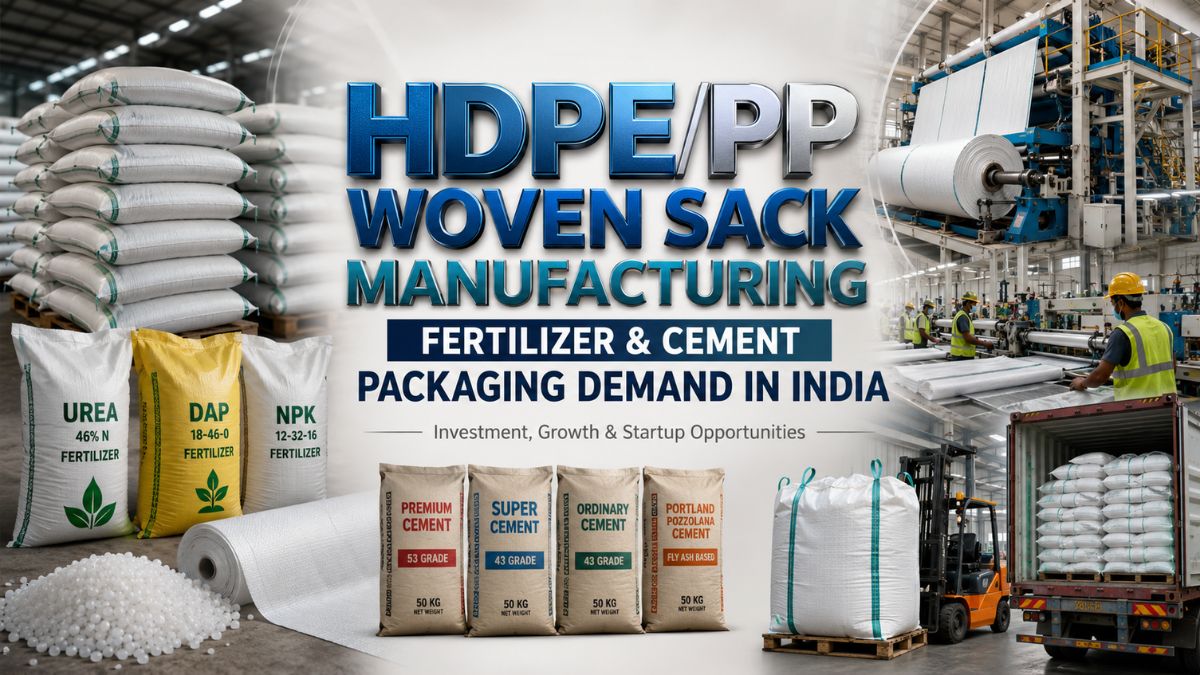
The HDPE and PP woven sack is one product which most people don’t realize is crucial to the industrial economy in India. Industrial packaging is crucial in every fertilizer bag supplied to farmers, every sack of cement in a construction project and every tonne of food grain bought by a government agency. Hence, HDPE PP woven sack manufacturing has been one of the quietest yet stable and scalable manufacturing opportunities for Indian MSMEs.
Unlike the trend businesses woven sack demand is directly related to the vital business sectors including agriculture, infrastructure, cement, chemicals and foodgrain storage. The packaging business is much more predictable than much of the consumer business, since these sectors are active in all economic cycles.
The Ministry of Chemicals and Fertilizers, Government of India, states that the distribution and polymer manufacturing industry in India is growing steadily and there is an increasing amount of packaging by the industries. Simultaneously, government norms are encouraging the market to go towards certified and organized manufacturers. Meanwhile the government regulations are forcing the market towards certified and organized manufacturers. This growth of demand with growing compliance is giving great opportunities to the entrepreneurs entering in the field these days.
Get Detailed Insights from This Book: Biofertilizer and Organic Farming Technology Book
Why the HDPE PP Woven Sack Industry Is Growing Fast
India manufactures over 400 million tonnes of cement annually and distributes huge amounts of fertilisers season-wise. Almost all of these materials need to be packaged in a durable manner. Due to their lightweight, waterproof and strong properties, they are lightweight, moisture-resistant, strong and economical, making them the preferred choice of material for sacks, such as an HDPE sack or a polypropylene woven sack.
For all the above reasons, the industry is expanding:
- Expansion of infrastructure and real estate projects
- Growth in fertilizer consumption and distribution
- Government foodgrain procurement programs
- Rising polymer and chemical packaging demand
- Increasing shift from jute and paper packaging to woven sacks
The major benefit for MSME entrepreneurs is that the buyers buy in bulk and make regular purchases throughout the year.
BIS Certification Has Changed the Market
It was an unorganized woven sack market before. Many manufacturers would only offer products on a low price, which meant they had to offer a low standard of quality. This is a very different picture today, given the new requirements for BIS Quality Control Orders (QCOs).
There are now a number of categories of sacks which are subject to compulsory BIS standards:
| Product Category | BIS Standard |
| Fertilizer Sack | IS 9755:2021 |
| Cement Sack | IS 11652:2017 |
| Cement Valve Sack | IS 16709:2017 |
| Foodgrain Sack | IS 14887:2014 |
| Polymer Material Sack | IS 16703:2017 |
This is a tremendous benefit to organized manufacturers as certified suppliers are the only ones preferred by institutional buyers. It also curtails import competition by non-compliant foreign manufacturers at a low cost.
Fertilizer Packaging: One of the Biggest Opportunities
One of the best prospects in the woven sack market is the packaging of fertilizer. It is a fact that urea, DAP and complex fertilizers are in demand by large fertilizer companies and Cooperatives in millions of bags per month.
The top institutional buyers are:
- IFFCO
- Coromandel International
- Chambal Fertilisers
An investment of Rs. is required in a medium scale fertilizer sack unit. The numbers are 3–5 crore based on the capacity and machinery configuration. Manufacturers whose products have constant quality can obtain long-term supply contracts, as this is typically a contractual process.
Get Detailed Project Report (DPR): Inorganic Fertilizers and NPK Projects Guide
Cement Bag Manufacturing Is Expanding Rapidly
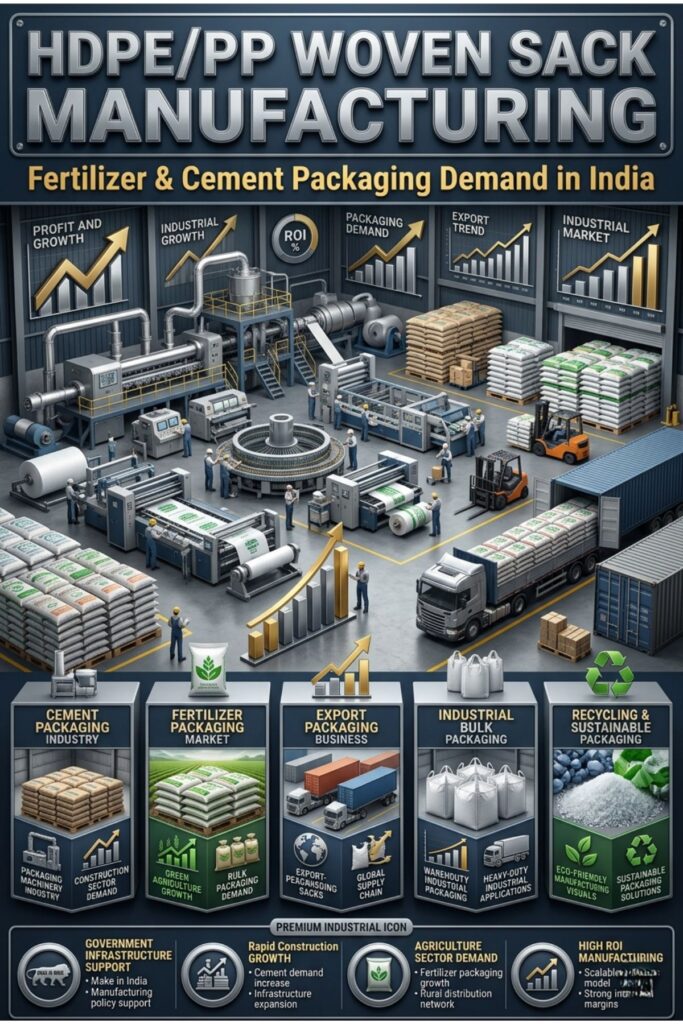
The demand for cement sacks is directly connected with the infrastructure boom in India. The cement sack demand is directly proportional to the infrastructure boom in India. Huge quantities are shipped by the big producers yearly, thus forming a regular demand for woven packaging.
The big cement customers are:
- UltraTech Cement
- Shree Cement
- ACC Limited
This is because the PP valve sacks can be used in automated filling systems, making the handling process more efficient, and are being used with increasing frequency in modern cement plants. These bags also have greater margins than regular sacks.
The average project economics for a cement sack plant:
- Estimated Investment: Rs. 4–7 crore
- Expected Margin Range: 12–20%
- Preferred Locations: Near to the cement manufacturing centres
Raw Materials and Manufacturing Process
The main raw materials used are the polypropylene (PP) and HDPE granules. Raw material sourcing is a critical element to profitability because polymer cost is the most significant component of the production cost.
Typically, the manufacturing process consists of:
- Tape extrusion
- Circular weaving
- Lamination
- Printing
- Cutting and stitching
- Quality testing
Entrepreneurs at the polymer hubs of Gujarat, Andhra Pradesh, or Odisha may benefit from transportation and supply benefits.
Choose the right startup backed by real market demand
Profitability and Investment Outlook
The strong profitability of a professionally managed HDPE PP woven sack manufacturing unit is possible with optimal capacity utilization and institutional buyers’ support system.
Common business metrics are:
- Net Margins: 12–18%
- EBITDA Margins: 14–20%
- Capacity Utilization Target: 65–75%
- Project payback period: 4-6 years
Profitability, however, is very dependent on price stability of raw materials and good relationships with the buyer.
Major Risks Entrepreneurs Should Understand
While the business has good demand prospects, entrepreneurs need to be thorough in their preparations before investing in the business.
Important risks include:
- Volatility in PP & HDPE granule prices
- The situation where the market requires a limited number of significant institutional purchasers.
- Effective record-keeping systems for the BIS compliance and audit requirements
- The length of the payment cycles inflicts working capital pressures.
Fertiliser, cement and foods grain packagers typically face less risk in their businesses if they diversify their portfolios.
Export Opportunities for Indian Manufacturers
Indian woven sack makers are making more and more effort to provide to the international markets particularly Africa, Southeast Asia and Middle East. Demand is growing due to the shortage of packaging capacity in many developing countries.
The first step for many companies is to ensure they have a solid foundation in their domestic business before making the move into exports and higher-dollar items such as FIBCs.
Related Article: Organic Fertilizer & Bio-Stimulant Manufacturing Business in India: Cost, Profit & Market Opportunity
How NPCS Helps Entrepreneurs
Niir Project Consultancy Services (NPCS) is one of the premier consultancy firms in India to guide entrepreneurs in setting up manufacturing enterprises in various fields.
NPCS’s support is through:
- Detailed Project Reports (DPRs)
- Techno-economic feasibility studies
- Machinery selection guidance
- Market demand analysis
- Financial projections and profitability analysis
- Plant layout and process planning
For first-time entrepreneurs, professional feasibility planning can minimize investment pitfalls and enhance project management.
Future Outlook of the Woven Sack Industry
The future of the HDPE PP woven sack industry is quite promising, as the sector is directly linked to the infrastructure, agriculture and industrial development of India.
The following are some key future growth drivers:
- Expansion of cement production capacity
- Rising agricultural subsidy distribution
- Growth in industrial packaging demand
- Increasing BIS-led market formalization
- Strong domestic polymer production base
The increasing regulatory requirements will favour the share of organised and BIS-certified manufacturers.
Entrepreneurs who are willing to invest in quality, compliance and institutional supply relationships will have the opportunity to explore a long-term, stable and scalable business opportunity in the manufacture of HDPE PP Woven Sacks.
FAQ
Q1. How much is the most basic investment amount for manufacturing HDPE PP woven sack?
Usually, a setup is considered to be commercially viable if invested money is Rs. 3.5 crore and Rs. To include machinery and certification, 5 crore working capital.
Q2. Do you need to have BIS certification?
Yes. In the event of the woven sacks falling under the Quality Control Order such as polymer sacks, foodgrain sacks, fertilizer sacks, and cement sacks, then the BIS certification is required.
Q3. In terms of margins, which segment is more profitable?
Typically valve cement sacks and specialized polymer packaging sacks provide better margins compared to woven sacks.
Q4. What are the most significant threats to this business?
The primary risks are fluctuations in raw materials prices, buyers concentration, working capital pressures and compliance costs.
Q5. Is it possible for Indian manufacturers to export woven sacks?
Yes. Not just woven sacks, Indian manufacturers sell other handicrafts like mats, bags, and shoes to these regions and other markets in Africa, Southeast Asia and Middle East, which is experiencing a steady demand.
Q6. What is the mean of the project payback periods?
Most units which are professionally managed will have a recovery time of 4 to 6 years depending upon the utilization and buyer contracts.
Q7. What makes this business appealing to MSMEs?
The sector has recurring industrial demand, scale of production, institutional buyers and high long term growth potential with government regulations.


