





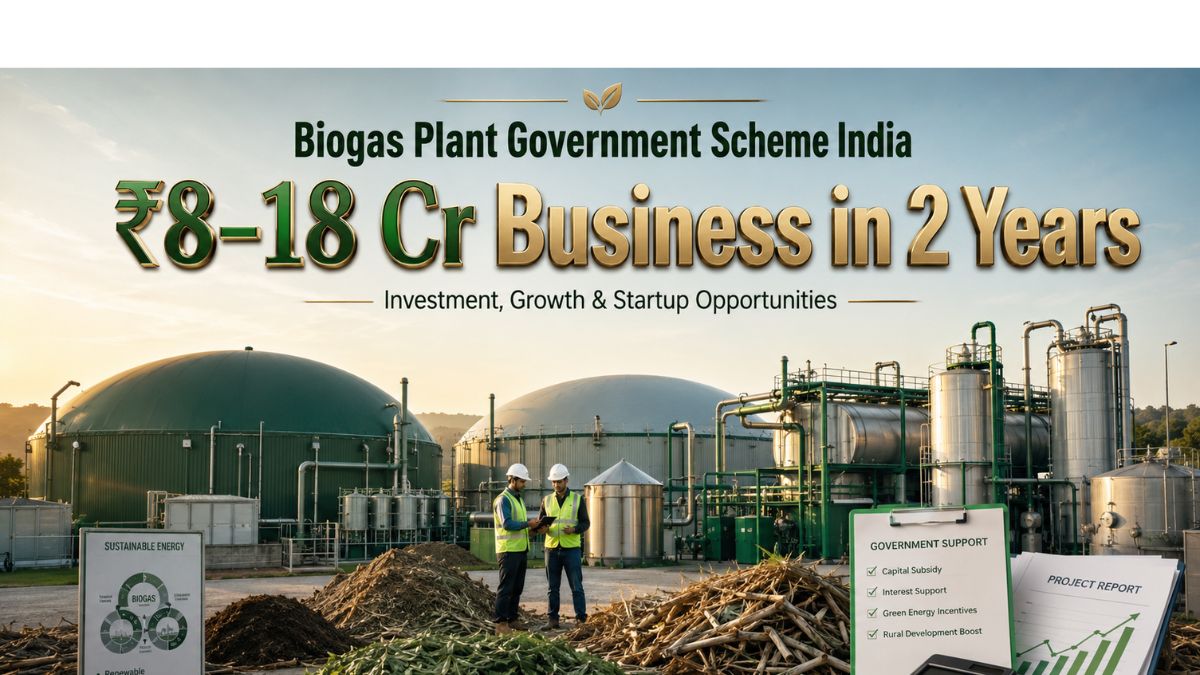
Biogas Plant Government Scheme India
The window is not opening for India’s biogas entrepreneurship — it has already opened. The policy framework is in place, procurement obligation is real, and the institutional finance is now categorically available. What’s the difference between serious founders and fence-sitters? Today, not information. It’s the ability to read the numbers accurately.
Compressed Bio Gas (CBG) fulfils four critical national needs: Waste management, Energy security, Farmers income and Emission reduction. The smart money gravitates to government departments that are crisscrossing the same sector, from coordinating subsidies to mandating loans to blending requirements to pipeline facilities. With government schemes in place—such as the SATAT for construction and CBG-CGD synchronization for supply and RBI’s priority sector classification for finance—the government has created a procurement supported entry point for the entrepreneurs, which was not possible five years ago.
Why This Sector Is a Strong Startup Opportunity
The Demand Side Is Not Speculative
It’s not a business where you make something, wait for someone to purchase it, or a line of work that entails selling or renting things and hoping they are bought. The Sustainable Alternative Towards Affordable Transportation (SATAT) was aimed specifically to establish an institutionalized bottom. Oil and Gas Marketing Companies (OGMCs) such as Indian Oil, HPCL and BPCL are actively encouraging Expressions of Interest (EOI) from the entrepreneurs to purchase CBG under the scheme of SATAT. The purchaser comes first before the building of the plant. It is uncommon in manufacturing for this to be the case.
As per the Annual Report 2024-25 of Ministry of Petroleum and Natural Gas (MOPNG), Government of India, 100 CBG and Biogas plants with an installed capacity of approximately 700 MT per day have been commissioned till the month of March, 2025. CBG is now available in some 315 retail outlets and delivered to industrial customers. CBG-CGD synchronization scheme has started sales in 54 Geographical Areas of the City Gas Distribution network. These are operational numbers — not projections.
The demand forecast becomes more positive from that point on. The National Biofuels Coordination Committee (NBCC) has granted approval for compulsory blending of CBG for CNG and PNG. The CBG Blending Obligation (CBO) will be 1% of total CNG and PNG consumption in FY 2025-26, rising to 3% in FY 2026-27, 4% in FY 2027-28, and 5% from FY 2028-29 onwards. This is a requirement, not a charity and not an aspiration, but a requirement on which CBG is a fundable project.
The Policy Stack Is Unusually Deep
There is no single ministry taking this sector. All CBG and biogas plants receive Central Financial Assistance from Ministry of New and Renewable Energy through the National Bio-Energy Programme. The Ministry of Housing and Urban Affairs provides an extra Central Assistance for Municipal Solid Waste Based CBG plants under the Swachh Bharat Mission Urban 2.0. The Department of Fertilizers gives Market Development Assistance of ₹1,500 per MT for the Fermented Organic Manure, a by-product of the CBG projects.
In addition, there is also a 100% exemption from excise duty on the GST payable on CNG blended with compressed bio gas (CBG). CBG projects have been classified as ‘White category’ based on case-to-case basis by the CPCB, which means that the plants that meet the criteria will face reduced environmental compliance standards. The stacking of enablers from 5 different departments is a clear indication that the government considers CBG as more than a niche energy sector, but rather as a mainstream industrial sector.
The Ministry of Petroleum and Natural Gas has also sanctioned a scheme for the Development of Pipeline Infrastructure for injection of CBG into the City Gas Distribution network, thereby directly removing last-mile challenges to CBG commercialization.
Get Detailed Insights from This Book: Handbook on Biogas and Its Applications (recommended)
Priority Sector Lending: The Finance Gate Opens
The classification of CBG projects by RBI under PSL is no doubt the most structurally important enabler for the first-generation entrepreneurs. It is to ensure that scheduled commercial banks have to make preferential loans for CBG projects. This classification leads to interest subvention and eased up collateral requirements. A founder, who was unable to access institutional credit for a biogas business before, now has a definite lending channel.
The four-year biomass aggregation machinery scheme (FY 23-24 to 26-27) and the financial assistance provided for the procurement of equipment for collecting biomasses at the entry stage significantly reduces the cost of machine acquisition.
Business Selection Logic
Margin Structure and Profitability Patterns
The CBG plant is feasible in MSME scale with 2-5 MT/day capacity. The dual product model enhances project economics significantly when coupled with OMC procurement price bands and the extra revenue from Fermented Organic Manure (FOM) for which market development assistance is provided at ₹1,500 per MT. An additional tipping fee from the state is available when agricultural residues and municipal waste are processed in the same plant.
Plant gross margins rely on a significant degree on sourcing costs and logistics for feedstock. EBITDA margins in plants in the vicinity of sugarcane mills, poultry clusters or urban waste aggregation points range between 25–35%. If long-distance transport of biomass is required, the margins can be compressed to 15–20%. The biomass aggregation machinery subsidy is directly solving this logistics cost issue.
Scalability Logic
CBG pilot-to-scale roadmap is cleaner than most manufacturing sub-sectors. It is possible to operate a plant of 2 MT per day within 18 months after it is commissioned. The technology (anaerobic digestion and gas upgrading) has proven commercialization. The expansion to 10–20 MT/day capacity is achieved through modular digesters’ addition and upgrading equipment. While technology and market access may be a problem, the major scalability constraint is the availability of feedstock supply agreements.
Risk Awareness
There are three risks that deserve a frank discussion. The first is feedstock price volatility; the price of agricultural residues varies in accordance with crop cycles. The mitigation option is through long-term supply contracts with farmer producer organisations or agro-processing units. Secondly, off-take price risk: OMC procurement can guarantee the demand, but prices are not necessarily fixed in the long term. Conservatism should be the basis for the scenarios that entrepreneurs set. Third, delay in regulatory time frame: Plant commissioning is often delayed in India due to statutory approvals. Use this in your feasibility model — it’s not pessimism, it’s math’s.
Project / Product Opportunities
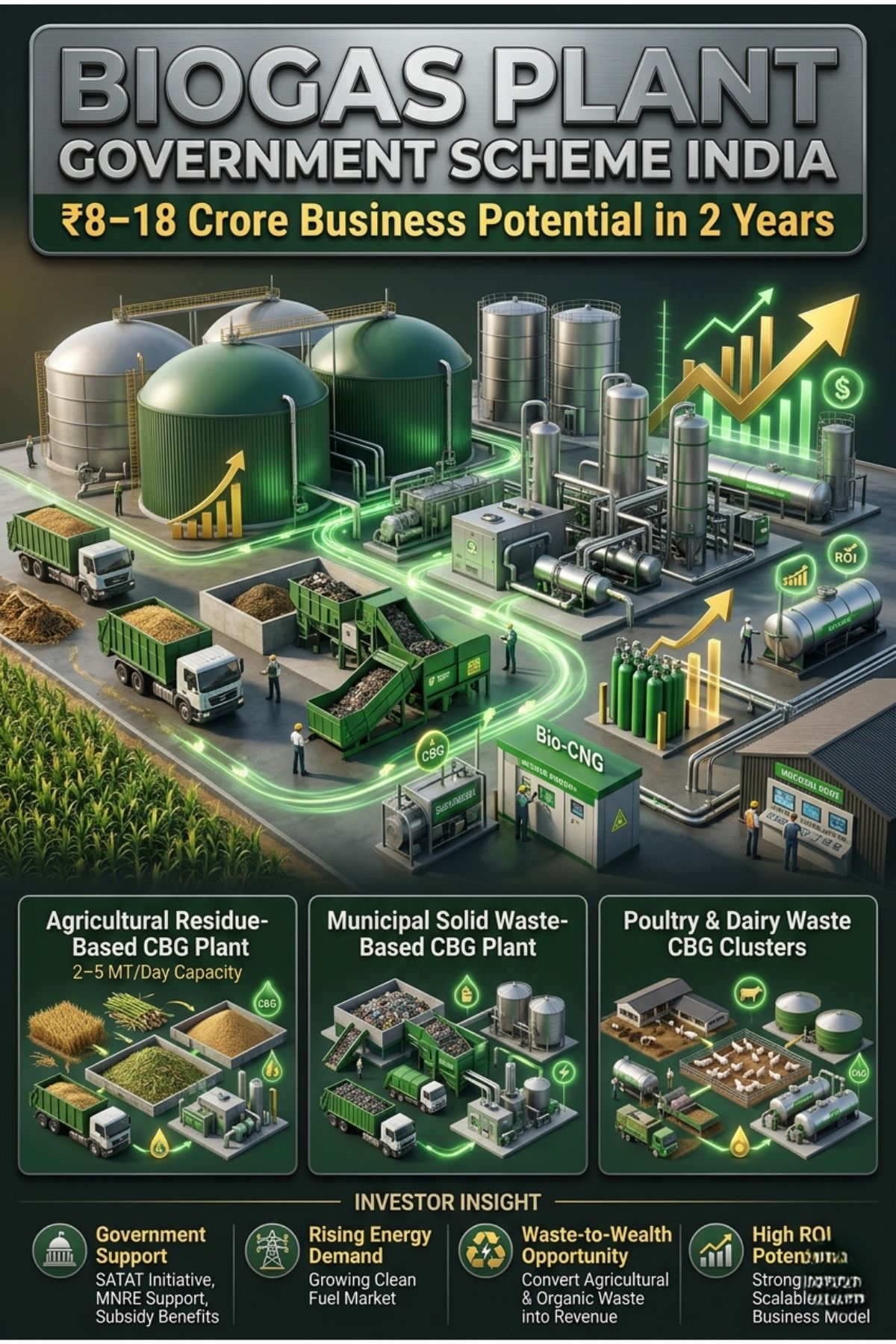
1. Agricultural Residue-Based CBG Plant (2–5 MT/Day)
This is an entry format which is most accessible for first generation entrepreneurs in Tier-2 cities of Punjab, Haryana, UP and Maharashtra. The feedstock such as paddy straw/bagasse/press mud is available locally in most agri-processing belts. Target buyer is the closest OMC under the SATAT off-take arrangement. The capex of the plant is in the range of ₹8 crore to ₹18 crore, which varies with the size of the gas upgrading plant and the type of configuration used. If CBG revenue is combined with dual FOM revenue, margins of 22-28% can be achieved by Year 2 at 2 MT per day. This format is also advantageous due to MNRE’s Central Financial Assistance and subsidy on biomass machines, which brings down the net cap-ex significantly.
Related Article: Compressed Biogas (CBG) Plants: A Bankable Green Energy Business for New Entrepreneurs
2. Municipal Solid Waste-Based CBG Plant
In Tier-2 and Tier-3 towns, urban local bodies are holding unprocessed waste material in their possession without any market. An entrepreneur who is structuring a tipping fee agreement with the municipality, setting up an MSW-based CBG plant, and selling the output to the CGD network is leveraging three support streams: MSW Central Assistance – from MoHUA, MNRE support – and CBG-CGD off-take. Capex is higher, which is typically ₹25 crore to ₹60 crore, because of the waste pre-processing equipment. So is the revenue base, too. Target buyer represents the local CGD licensee, who is now required to comply with blending requirements.
3. Poultry and Dairy Waste CBG Clusters
Poultry belt areas such as Namakkal in Tamil Nadu, Jalgaon in Maharashtra and Unnao in UP produce huge quantity of poultry manure which is a liability as well as a feedstock opportunity for these regions. A cluster model spreads the capex and feedstock risk by having five to ten small producers share the waste with a centralized 3–6 MT per day plant. The promoter entity deals with the management of the plant and off-take, individual farmers provide waste and share the revenue. Cap Ex (per cluster): INR 12-22 crore. With low-cost or zero-cost feedstock procurement, the margins are 25-32%.
Indian Entrepreneur Case References
Manas Agro Industries and Infrastructure Ltd. (MAIIL), Nagpur. From the research and development aspects, MAIIL has been directly used by the HPCL for the validation of their enriched fermented Organic manure made from the CBG plants. They prove that the economic analysis of their project can be done without relying on the co-product revenue earned from FOM (particularly enriched FOM with higher NPK content). The take-home message: FOM is no afterthought. It’s a parallel business line.
CBG Plant of Indian Oil Corporation in Gorakhpur, Uttar Pradesh. The Gorakhpur plant is a reference plant for HP-RAMP derived rice straw-based CBG, whereas it is a PSU. It can process 80 tonnes of rice straw feed per day. Similar but smaller plants have started to be organised in the region by private entrepreneurs in the region with the same feedstock availability. The lesson: Technology selection is not the only important consideration — geography and availability of feedstock matter.
Pristine Organics, Pune. It is in CBG space that the CBG promoters switched gears from the composting side to the biogas side upon the availability of CGD offtake. The plant was located in a CGD geographical area on purpose, as it decreased infrastructure costs by around 30% due to its location near the injection network. The lesson: Do not make CGD network coverage maps the afterthought, but rather the first document that you place on your site selection desk.
Get Detailed Project Report (DPR): Industrial Biotechnology Handbook: Enzymes, Biofertilizers and Biogas
Import–Export Opportunity Analysis
India presently imports gas to satisfy about 50% of the gas demand. Domestically produced CBG is a direct replacement of LNG which is priced as an import, thus creating a real macroeconomic play. At scale, this puts CBG not only in the clean energy product space, but also in the foreign exchange savings category, which aligns with the DPIIT and MoPNG.
Exports include emerging markets for food-grade applications, greenhouses, and industrial gases, all of which are by-products derived from the gas upgrading process, dubbed bio-CO2. There are buyers in the industrial gas sector for small-volume entrepreneurs who produce 100–200 tonnes per month of bio-CO2. This is still in the process of development, but will become a regular revenue line in three to four years when the CBG sector will scale.
The CBG plants have the scope to produce Fermented Organic Manure (FOM) and enriched bio-fertilizers for export to the market of organic farming of Europe and Middle East countries where Indian organic inputs are traded. This requires export certification and quality standardization – once-for-all investment to create an alternative premium revenue stream.
Feasibility Planning and DPR Preparation
The quality of the Detailed Project Report (DPR) is the key factor for entrepreneurs who are considering approaching banks, OMCs (off-take agreements) or state-level implementing agencies. The banks still assess the viability of the project before releasing the loan under PSL. Niir Project Consultancy Services (NPCS) also prepares techno-economic feasibility reports comprising of production process flows, market demand analysis, raw material and machinery specification, complete financial projections and profitability, and break-even analysis. A generic template DPR will not pass the scrutiny of the lender in a business where project-specific parameters – feedstock type, close to CGD, waste processing configuration – influence financial outcomes. A structured feasibility report provides a reflection of site-specific and market specific reality, exactly what the DPR needs.
Discover business ideas that actually make money
Conclusion
In India, the biogas plant government scheme environment has solved the two key uncertainties that have always halted biogas projects in the early stages: Where can I sell? How can I finance it?
What’s left is execution risk which is a solvable issue for any entrepreneur with disciplined project management, a solid DPR, and realistic feedstock agreements.
Current commissioned CBG capacity is insufficient to structurally meet the 1% now, 5% by FY 2028-29 required blending obligation, for at least the next five years. There is a gap in the market as several thousand MT of blending will be required per day, when the obligations take effect, while 100 plants are putting out 700 MT per day – that is the business opportunity.
The first-mover advantages in specific geographies, especially in agri-processing and waste management active districts in CGD, will shorten with time. Those entrepreneurs who migrate in the next two to three years will get feedstock partnerships, CGD injection points and OMC off-takes that will not be available for the next players to win.
Numbers are real, buyers are legally compelled, finance period is institutionally dictated. The question to any entrepreneur assessing the opportunity is not whether it is real; the question is the quality of the project preparation needed to seize it.
SATAT & CBG Sector Data Table
Key metrics for startup evaluation — sourced from Annual Report 2024-25, Ministry of Petroleum and Natural Gas
| Parameter | Data / Range |
| Commissioned CBG/Biogas Plants (as of March 2025) | 100 plants, ~700 MT/day capacity |
| Retail Outlets Selling CBG | ~315 outlets |
| CGD Geographical Areas with CBG Sales | 54 areas |
| CBG Blending Obligation (CBO) FY 2025-26 | 1% of CNG/PNG consumption |
| CBO Target from FY 2028-29 onwards | 5% of CNG/PNG consumption |
| FOM Market Development Assistance | ₹1,500/MT on Fermented Organic Manure |
| Biomass Machinery Scheme Duration | FY 2023-24 to FY 2026-27 (4 years) |
| Priority Sector Lending Classification | Yes — RBI designated |
FAQ Section – 5 Founder Questions
Q1. What is the minimum capex to start a CBG plant under the SATAT scheme?
In case of a small size (2 MT/day), agri-residue based CBG plants costing between Rs.8-12 crore and including gas upgrading & civil works, the net cash out-lay for the developer can be substantially reduced with the MNRE CFA and machinery subsidies. These subsidies are to be suitably structured based on the type and location of the project.
Q2. How do I secure a buyer for CBG before the plant is commissioned?
Obtain a confirmation for offtake from one of the OMCS-IOCL, BPCL, HPCL. through the SATAT EoI mechanism. The proposal is examined by OMC- on site, feed stock, production, and based on this, an in-principle acceptance letter will be issued by the OMC. This acceptance letter from an OMC would likely be a pre-condition and not post-script to arranging finance from bank.
Q3. What is the break-even timeline for a SATAT-linked CBG plant?
A well-located 2-5 MT/day plant with consistent feedstock supply should reach operating breakeven by Year 1.5-2. Complete project payback, considering debt repayment, will be between 5-7 years. This depends heavily on financing structure, feedstock costs, and the dual-product (CBG and FOM) revenues earned.
Q4. What licenses and approvals are required to commission a CBG plant?
Essential approvals include state/CPCB environmental clearance, building permission from the local governing authority, a PESO explosion permit, and an OMC offtake agreement. The Municipal solid waste CBG plant will need to have a tipping fee agreement with the ULB.
Q5. Can a first-generation entrepreneur from a Tier-3 city access Priority Sector Lending for a biogas project?
Absolutely. The RBI’s Priority Sector definition ensures your Scheduled Bank is obliged to lend for your project type. Poor project preparation, rather than lending policy, is typically the barrier for entrepreneurs from Tier-3 cities. Bankable DPR, an offtake Loi, land docs and feedstock docs are the first stage hurdle.


