




Crumb Rubber Powder Business
The Business Opportunity Nobody Talks About
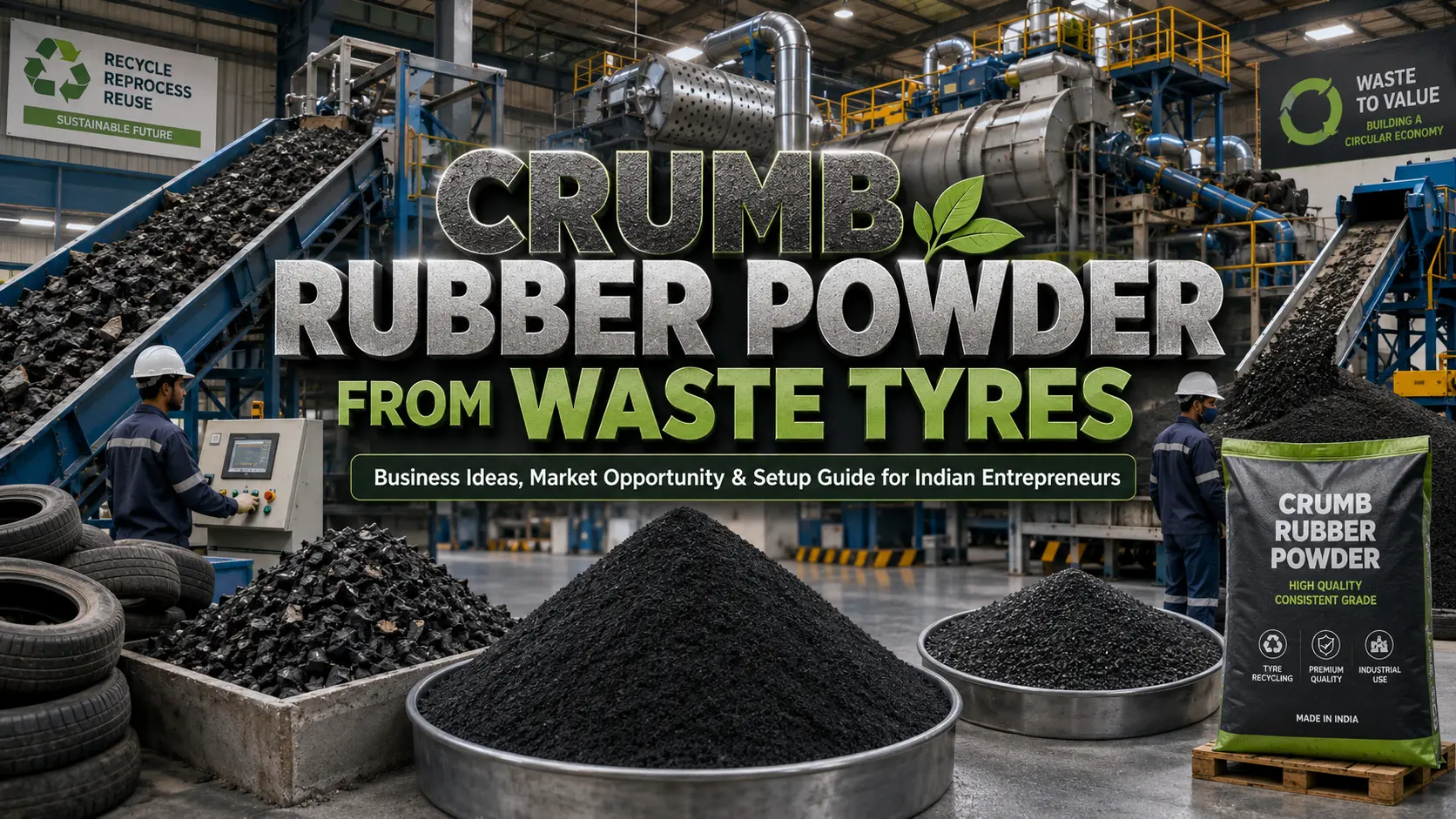
Each year, India gets rid of more than 1.1 lakh metric tonnes of end-of-life tyres. The majority is lost to illegal dump yards, cement kilns, or just open burning — a loss of resource with specific industrial uses. In this mess, one of the most under-mentioned business ideas in the Indian manufacturing sector is the conversion of waste tyres to Crumb Rubber Powder (CRP). This is not a bit of an niche play. It is at the nexus of waste management, circular economy and high demand industrial inputs and the timing, quite simply, couldn’t be better.
This is a timely industry to get in on because entrepreneurs are entering it now. Pressure on disposal of tyres is increasing. Demand is picking up speed from road construction, sports and automotive OEMs. So, what is this raw material? It is commonly available and inexpensive, and often free from tyre dealers, transport companies, and municipalities.
Why the Crumb Rubber Powder Sector Is Growing Fast
Indian rubber recycling industry is expanding at a CAGR of more than 8% with the growth of infrastructure, increasing construction of sports facilities and the trend of sustainable procurement in manufacturing. The most commercially appealing product from tyre recycling is crumb rubber powder used in road construction, the manufacture of playground flooring, production of automotive part components and waterproofing membranes.
Get Detailed Insights from This Book: The Complete Book on Rubber Processing and Compounding Technology
Demand Drivers Worth Understanding
The National Highways Authority of India (NHAI) has been calling for rubberised bitumen on high traffic corridors, which has been a massive demand in terms of crumb rubber. The consumption of crumb rubber powder per km of rubberised road is approximately 1 tonne. The numbers don’t lie as India constructs more than 10,000 km of national highways every year.
Likewise, the Sports Authority of India (SAI)’s Khelo India initiative has also been acquiring artificial turf and rubber surface tracks throughout the country, thereby ensuring regular demand for CRP. This demand is growing organically in private sport complexes, schools and in residential townships.
In the export segment, Southeast Asian countries like Vietnam, Bangladesh, and Indonesia have become more inclined to purchase processed crumb rubber from India, which is being done at cheaper rates. This allows a dual-revenue model – a service to domestic customers and a service to export customers.
Government Policies and Incentives Supporting This Business
The Ministry of MSMEcategorizes rubber recycling units under manufacturing which makes them eligible for Credit Guarantee Fund Trust for Micro and Small Enterprises (CGTMSE) Credit facilities up to ₹2 crore with no collateral. It’s a big entryway for a first-generation business owner who doesn’t have the assets to offer to guarantee the loan.
Rubber processing falls under the ‘Make in India‘ priority manufacturing sub-sector. The government of the state provides various capital subsidy schemes of 15% to 25% on the cost of plant and machinery as per the state to entrepreneurs. Gujarat, Maharashtra and Tamil Nadu are among the states that have robust MSME subsidy schemes that disburse subsidies rapidly.
The Department of Promotion of Industries and Information and Technology (DPIIT) has launched the Startup India scheme, which includes a subsidy for income tax exemption for the first three years of profit-making for startups in the environment sector. Additionally, entrepreneurs establishing tyre recycling units under the compliant model with Central Pollution Control Board (CPCB) can avail green business grants from the National Clean Energy Fund (NCEF).
Also, the framework for the end-of-life tyres (EoL tyres) implementation, known as Extended Producer Responsibility (EPR), in the context of the Environment Protection Act, is being reinforced. Manufacturers of tyres are increasingly being mandated to pass a larger share of their tyres through certified recyclers. This is establishing long-term procurement contracts for structured units of certified crumb rubber, a major commercial benefit.
Get Detailed Project Report (DPR): Setup Industry Of Crumb Rubber Powder from Waste Tyre (with Shredding Process)
Multiple Business Ideas: Specific Projects for Startup Founders
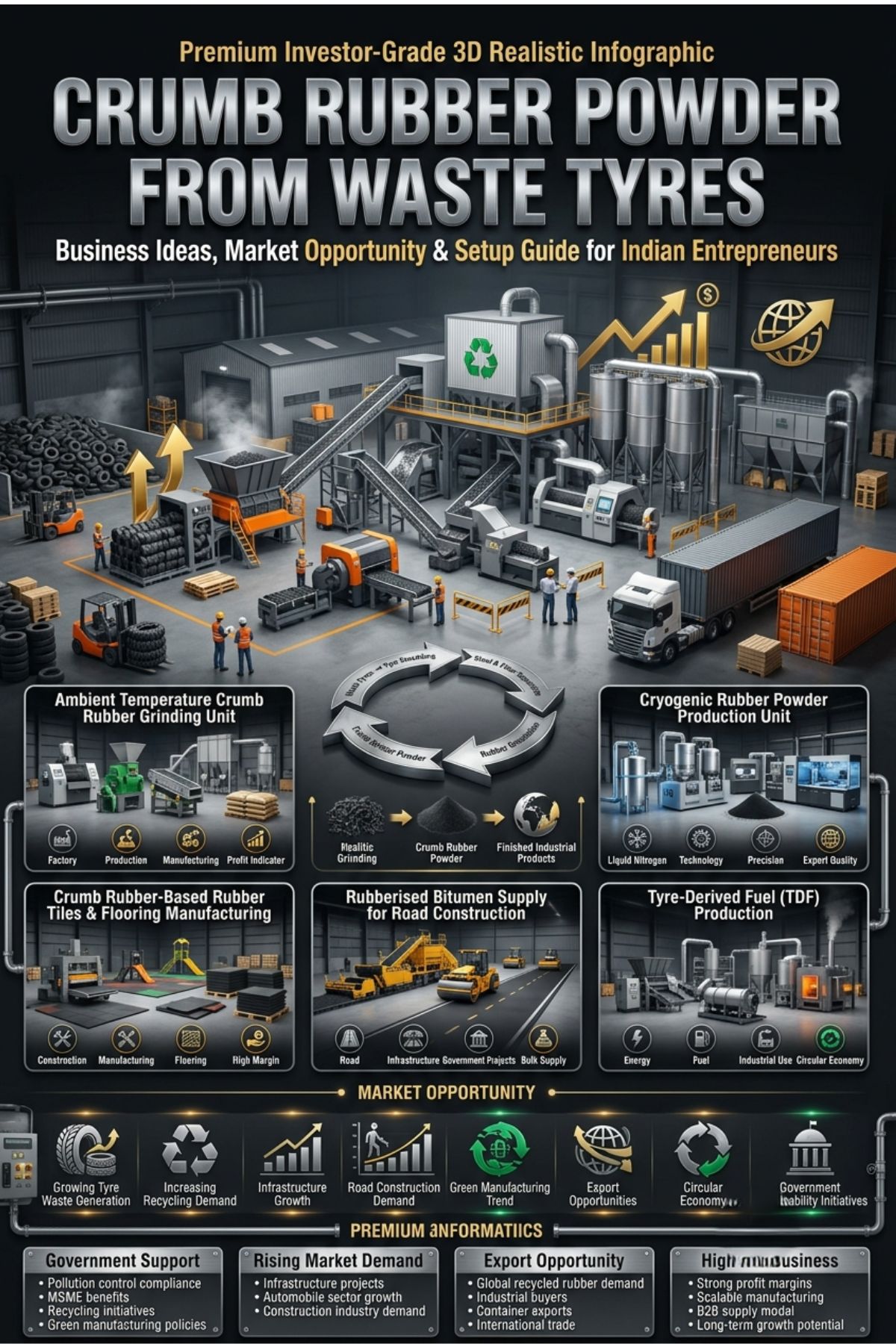
1. Ambient Temperature Crumb Rubber Grinding Unit
This is the easiest way for a first-time entrepreneur with some level of capital. Ambient temperature processing is a mechanical shredding process which is currently performed in three steps: From whole tyre to chips, from chips to granules and from granules to fine powder, using a dual-roll mill. The machinery is available mostly from the local suppliers in Rajkot, Coimbatore and Pune and this makes the cost of the machinery competitive. For a medium scale unit ranging from 2 tonne/day to 3 tonne/day a unit can be established at a cost of approximately ₹80 lakh to ₹1.2 crore (excluding land development cost/working capital). The product, usually an 80-mesh to 30-mesh crumb rubber, is sold to road construction firms, rubber mat makers and paint makers. These margins are generally between 22% and 30% of revenue, which means that payback is possible in 30-36 months with regular use.
2. Cryogenic Rubber Powder Production Unit
Cryogenic processing involves embrittling the rubber by using liquid nitrogen at temperatures below -70°C so that it can be fractured instead of torn. What this means is that the final particle is much smaller and cleaner, usually smaller than 100 microns, and is able to be sold at a much higher price than ambient-ground particle. It aims at tyre companies that are recycling rubber for new tyre compounds, high-performance automotive seals and specialty coatings. The capital needed is higher too, around ₹3 crore to ₹5 crore per a commercially successful plant comes with a higher margin. The selling price of fine powder is ₹60 to ₹110 per kg for cryogenic grade and ₹20 to ₹35 per kg for general grade. When the liquid nitrogen supply infrastructure exists, near industrial gas plants, that gives a natural cost advantage to the entrepreneurs.
Discover business ideas that actually make money
3. Crumb Rubber-Based Rubber Tiles and Flooring Manufacturing
This model is not just selling crumb rubber powder, but applying value added technology to convert it into finished rubber tile flooring, playground matting, gym flooring and road dividers. The process uses crumb rubber in hydraulic presses to combine it with polyurethane binders or virgin rubber and produces coloured, durable tiles for the retail and institutional markets. This type of business generates a much larger margin than the raw powder business and establishes brand power directly with end-users such as schools, real estate developers and municipal bodies. The investment cost for a small tile manufacturing line (500 sq. meter per day) can be ranged between ₹1.5 crore to ₹2.5 crore. The product is sold at the rate of ₹250 per sq metre to ₹800 per sq metre (As per specification) and the raw crumb input cost is ₹20 per kg to ₹30 per kg.
4. Recycled Rubber for Rubberised Bitumen Supply to Road Contractors
Rubberised bitumen, a bitumen compound with crumb rubber powder, is becoming a more popular and essential component in India’s road construction industry, as it is working to create longer-lasting roads that are less prone to cracking and quieter. Entrepreneurs can establish processing and supply chain business through which they can procure crumb rubber, process it according to the specification and supply it to the bitumen blending companies or road contractors under the state PWD/NHAI projects. It is basically a B2B supply chain that needs approvals, quality certification and the capability of providing bulk orders consistently. There is a high working capital requirement in comparison to plant investment, but order size is large and repeated order bookings do occur after a relationship has been built with a company for the road project.
5. Tyre-Derived Fuel (TDF) Production as a Value-Added Business
TDF production from waste tyres is not crumb rubber in the true sense of the word, but it is rather a related business which can be integrated into a rubber recycling unit by an entrepreneur. Tyres are used as a coal replacement at cement kilns, paper mills, and industrial boiler facilities as steel-free tyre chips. The calorific value of tyre chips is approximately 7,500–8,000kcal/kg, which is higher than that of coal, and its price to the buyer is often around 15–20% lower than the price of coal. TDF is a disposal route for the fibres and the lower quality rubber fractions that are too coarse for fine grinding for a recycling entrepreneur. This blended approach (CRP for road and floor markets / TDF for fuel markets) fully optimises the use of raw materials and enhances unit economy.
Import–Export Opportunity Analysis for New Startups
Crumb rubber powder is exported mostly to Bangladesh, Vietnam, Egypt and UAE. They have an increasing road infrastructure programme in these markets and limited domestic tyre recycling capacity. The competition in labor and raw material expenses in India and its proximity to major shipping ports, JNPT (Mumbai) and Chennai ports, are also advantages for Indian exporters.
Rubber based industrial goods are included under favourable export incentive schemes in DGFT (Directorate General of Foreign Trade). The HS Code products of the crumb rubber industry are eligible for Merchandise Exports from India Scheme (MEIS) and are exempt from export duty.
India is currently importing some ultra-fine devulcanised rubber from Europe. The cryogenic processing or microwave devulcanisation technology is a welcome alternative to these imports for entrepreneurs, who can invest in such technology and replace the imports —which is significant as the import volume and rupee depreciation risk are borne by the importer at present.
It is suggested that the recommended sequence for start-ups is: develop domestic B2B relation first, achieve consistent quality and delivery performance and get quality certificate from BIS or International Quality Certifiers within 18-24 months and then move towards export markets through Trade Councils organised by Chemicals and Petrochemicals Manufacturers’ Association (CPMA) and buyers’ meets organised by the Rubber Board of India.
Related Article: Rubber Granules from Waste Tyre: A High-Growth Green Manufacturing Business in India
Indian MSME Success Stories in Rubber Recycling
Genan India — Scaling with Technology
Genan India, a part of Denmark-based Genan Group, set up one of the most technologically advanced tyre recycling plants in Pune, India. In a conscious choice to build cryogenic processing equipment of European standard rather than ambient-temperature equipment for the premium clean-room crumb market, the promoters opted for a 200-tonne capacity unit. The promoters chose to invest in European standard cryogenic processing equipment and not in ambient-temperature equipment with the target market of the premium clean-room crumb market a 200-tonne standard was chosen. Their reasoning was simple: cut out on price to become better. If there is a lesson to take away from the story, it is that technology differentiation provides margin protection. The buyers requiring crumb rubber of a specified grade are very price sensitive compared to the commodity buyers who require certified crumb rubber.
Polyhose Group — Vertical Integration as Strategy
Under the leadership of T. K. Ramaprabhu, Polyhose Group developed a rubber hose and rubber processing enterprise which integrated recycled rubber materials as raw materials for lower-grade product lines. Their model is an example of the potential of vertical integration in the rubber industry, not a pure play tyre recycler. They reduced raw material costs by controlling the raw material inputs and converting it into finished goods using recycled inputs. For those new to the business, it’s important to note that the most successful rubber recycling operations migrate to the downstream side of the rubber industry, away from being raw material suppliers.
R. Rubber Products — MSME Scale, Real Margins
R. Rubber Products, a small-scale enterprise in Tamil Nadu developed a successful enterprise providing crumb rubber mats and tiles to schools and municipal corporations on state government tender. The promoter, who began with a rented plant and second-hand granulation unit, has grown into a ₹2.5 crore revenue-based business within five years. The approach was simple: to concentrate on one buyer segment, to secure repeat business by providing good documentation, and to purchase additional machines in the surplus funds generated. Now the business is becoming a vendor of several Khelo India stadium projects. The lesson, even a small basic scale can create a substantial business, but if the market is kept in mind.
Project Feasibility Support from NPCS
The quality of the pre-investment analysis is the determining factor for making or breaking a crumb rubber powder business within three years of its execution. We at Niir Project Consultancy Services (NPCS), prepare detailed Market Survey cum Techno-Economic Feasibility Reports (DPRs) for manufacturing businesses from all over India. Our reports for rubber recycling and crumb rubber units have full manufacturing process documentation, options for sourcing the machinery, capacity planning, raw material logistics, analysis of demand and pricing per geography, complete project financials including profitability projections, and scalability scenarios. We’re here to provide promoters with the facts and framework to determine the specifics of whether a project is financially feasible before investing funds.
Crumb Rubber Powder: Key Business Parameters at a Glance
| Parameter | Ambient Grinding Unit | Cryogenic Fine Powder Unit | Rubber Tiles Unit |
| Approximate Capital Investment | ₹80L – ₹1.2 Cr | ₹3 Cr – ₹5 Cr | ₹1.5 Cr – ₹2.5 Cr |
| Production Capacity (per day) | 2–3 tonnes | 1–2 tonnes | 500 sq. m. tiles |
| Selling Price Range | ₹20–₹35 per kg | ₹60–₹110 per kg | ₹250–₹800/sq.m. |
| Primary Buyers | Road contractors, mat mfrs. | Tyre mfrs., auto OEMs | Schools, infra developers |
| Gross Margin (approx.) | 22%–30% | 35%–45% | 40%–55% |
| Payback Period (at 70% utilisation) | 30–36 months | 36–48 months | 24–36 months |
| Key Input Material | End-of-life tyres | End-of-life tyres + LN2 | Crumb rubber + binders |
| MSME Subsidy Eligibility | Yes (CGTMSE, state schemes) | Yes | Yes |
Frequently Asked Questions
Q1. What is the minimum investment to start a crumb rubber powder unit in India?
A realistic minimum for a commercially viable ambient grinding unit — one that can supply consistent quality in meaningful volumes to road contractors or mat manufacturers — is around ₹80 lakh to ₹1.2 crore inclusive of machinery, civil work, and initial working capital. Smaller setups exist, but they often struggle to meet bulk buyer specifications or pass quality audits. Capital should not be the only limiting factor; adequate raw material sourcing infrastructure and at least one confirmed buyer or distributor relationship are equally important before committing investment.
Q2. Where do I source raw material (waste tyres) for the business?
The most dependable raw material channels include tyre dealers, car repair and servicing centres, trucking fleet operators, and municipal solid waste management contractors. In big towns, aggregators for waste tyre collection have developed who collect tyres in bulk, package them, and sell them in large volumes. Some states have official waste tyre collection programs under the CPCB EPR regulation, offering a well-defined supply stream. Entrepreneurs ought to plan the supply environment of their local space thoroughly prior to selecting a web site for his or her plant. The closeness to raw material reduces the logistics prices to a big extent.
Q3. What approvals and licences does a crumb rubber powder unit need?
Key approvals required will be Consent to Establish and Consent to Operate from State Pollution Control Board (for the activity of waste tire processing, which falls under the definition of hazardous activity under Hazardous waste management Rules), GST registration, Factory Act licence and MSME Udyam registration for claiming subsidies. An Importer Exporter Code (IEC) would be needed if you intend to export, the license comes under the DGFT department. Approval from an EPR certified player will lend credibility to the processing and might be a prerequisite for few institutional buyers.
Q4. What is the market selling price of crumb rubber powder in India?
Prices vary significantly by grade and particle size. Standard ambient-ground crumb rubber (30-mesh to 80-mesh) typically trades at ₹20 to ₹35 per kg in bulk. Fine mesh powder (80-mesh to 200-mesh) commands ₹35 to ₹55 per kg. Cryogenically processed fine powder below 100 microns can fetch ₹60 to ₹110 per kg from tyre manufacturers or specialty coating companies. Devulcanized rubber — the highest value form — is priced from ₹100 upward, though devulcanization technology adds significant capital cost.
Q5. Can a crumb rubber powder business be run profitably as a small MSME unit?
Yes — and there are real examples of profitable MSME operators in Tamil Nadu, Maharashtra, and Gujarat running units at ₹1–2 crore revenue with healthy margins. The key is product focus: serving a specific buyer segment with consistent quality, rather than trying to produce all grades for all markets. Small units that supply rubber tiles to schools and municipal bodies under government tenders have found particularly predictable demand. The business rewards discipline in quality control and logistics more than scale alone.
Q6. Is crumb rubber powder export viable for a new startup?
Export is a realistic medium-term goal for an Indian crumb rubber business, but not an ideal starting point. First-year efforts are better directed at building domestic buyer relationships, stabilising quality, and building production consistency. Export- readiness includes quality certification (like ISO 9001 or buyer specific), regular supply of consistent quality rubber, and the funds to support the payment terms of exporters. Entrepreneurs can start researching opportunities from Rubber Board of India and CPMA buyerseller meetings while focusing on domestic production and scale up in the local market first.
Conclusion: The Window Is Open — Act Before It Gets Crowded
The crumb rubber powder business is not a theoretical opportunity. It has real buyers, proven margins, government-backed raw material policy, and a regulatory environment that increasingly favours structured recycling over open dumping. The combination of cheap feedstock, growing infrastructure demand, and active MSME incentives creates a compelling case for entrepreneurs willing to put in the groundwork.
What separates successful operators from those who struggle is not capital — it is market intelligence, quality discipline, and buyer relationship focus. The promoters who have built serious businesses in this space did not start with the most money. They started with the clearest understanding of who their buyer was and what quality that buyer demanded.
For entrepreneurs ready to take that step, the fundamentals are in place. The next move is yours.


