





MSME Manufacturing Business Ideas
Why Manufacturing Business Ideas Are Winning Right Now
The manufacturing sector in India is on the cusp of a turning point. Domestic usage is increasing. The world’s supply chains are reshaping. The government is also investing in the MSME segment to develop a self-reliant industrial base. It is definitely the best time in decades to venture out into manufacturing business ideas, be it for a first-timer or an established investor to invest in a business with an investment amount of up to ₹85 lakhs.
The significant interest of this window is the confluence of three factors: (i) growing demand of the middle class, (ii) pressure for import substitution by government policy, and (iii) the availability of formal credit with MSME dedicated schemes. These have resulted in a highly favourable situation, allowing small manufacturing units to become profitable in 18–30 months after installing the plant.
The present article reviews 42 business ideas from major manufacturing clusters, explores the government support mechanisms, identifies successful MSMEs in practice and offers a structured outlook for investing in a new business.
Why Indian Manufacturing Is a High-Opportunity Space Right Now
MSME plays a key role in the industrial economy of India, accounting for more than 30% of the GDP and employing more than 110 million people. Even with its size, the sector is small and very fragmented, leaving a lot of room for small and well-capitalized manufacturers.
New demand is being led by a number of macro level shifts. First, there is an acceleration in consumption of consumer goods in Tier 2 and Tier 3 cities compared to metros. Second, the multinational companies are actively pursuing Indian suppliers for diversification from being dependent on one country. Thirdly, ecommerce has created distribution routes that would have otherwise needed a lot of capital to reach.
Moreover, the import bill of various industries in India, such as chemicals, packaging, electronics components and agro-processing is still huge. This is not a drawback; it is an opportunity signal directly. Every rupee invested in imports is a rupee which a domestic manufacturer can capture with often a cost and logistic advantage.
Sectors With Consistent Demand Growth
Demand for food processing, packaging materials, chemical intermediates, personal care products, construction materials, agricultural materials and light engineering components always outstrips GDP growth. These do not refer to speculation industries. They enter into the daily food chain and industrial food production, making it more predictable for new entrants to earn a profit.
Government Policies and Schemes Supporting New Manufacturers
The government has introduced an effective policy framework to promote MSME manufacturing. One of the primary challenges for first-generation entrepreneurs who do not have assets to secure their loans is the collateral requirement. The Credit Guarantee Fund Trust for Micro and Small Enterprises (CGTMSE) under the Ministry of MSME’s is addressing the issue by offering collateral-free loans up to ₹5 crore.
The Prime Minister’s Employment Generation Programme (PMEGP) provides project funding of up to ₹50 lakhs to manufacturing units and the subscribers are provided with subsidy of 15 to 35 per cent based on the category of the applicant and the geographical area. Higher subsidy percentages are given to entrepreneurs of rural areas and SC/ST and women entrepreneurs.
MSMEs can avail financial incentives based on performance under the Production Linked Incentive (PLI) scheme under DPIIT for various sectors such as food processing, pharmaceuticals and textile products. The scheme provides good incentive to manufacturers to expand production and quality of their products.
The initiative Make in India has simplified the compliance by introducing single window clearance portals and minimizing the approvals to be given for new manufacturing units. This administrative streamlining has greatly reduced the time lag between plant development and market introduction.
The NSIC (National Small Industries Corporation) provides raw material support, marketing support and technology partnerships to registered MSMEs. These advantages can be used by new manufacturers to lower input costs and to participate in government procurement tenders.
Plus, the Udyam Registration portal facilitates the formalisation process. Registered MSMEs are eligible for priority sector lending, access to lower interest rates and government subsidy schemes; which are unavailable for informal businesses.
42 Manufacturing Business Ideas Up to ₹85 Lakhs: A Segment-Wise Analysis
The following are ideas for food processing, chemicals, packaging, personal care, agro-processing and light engineering. All ideas have been chosen due to demand fundamentals, investment feasibility (within the allotted budget range), and revenue potential.
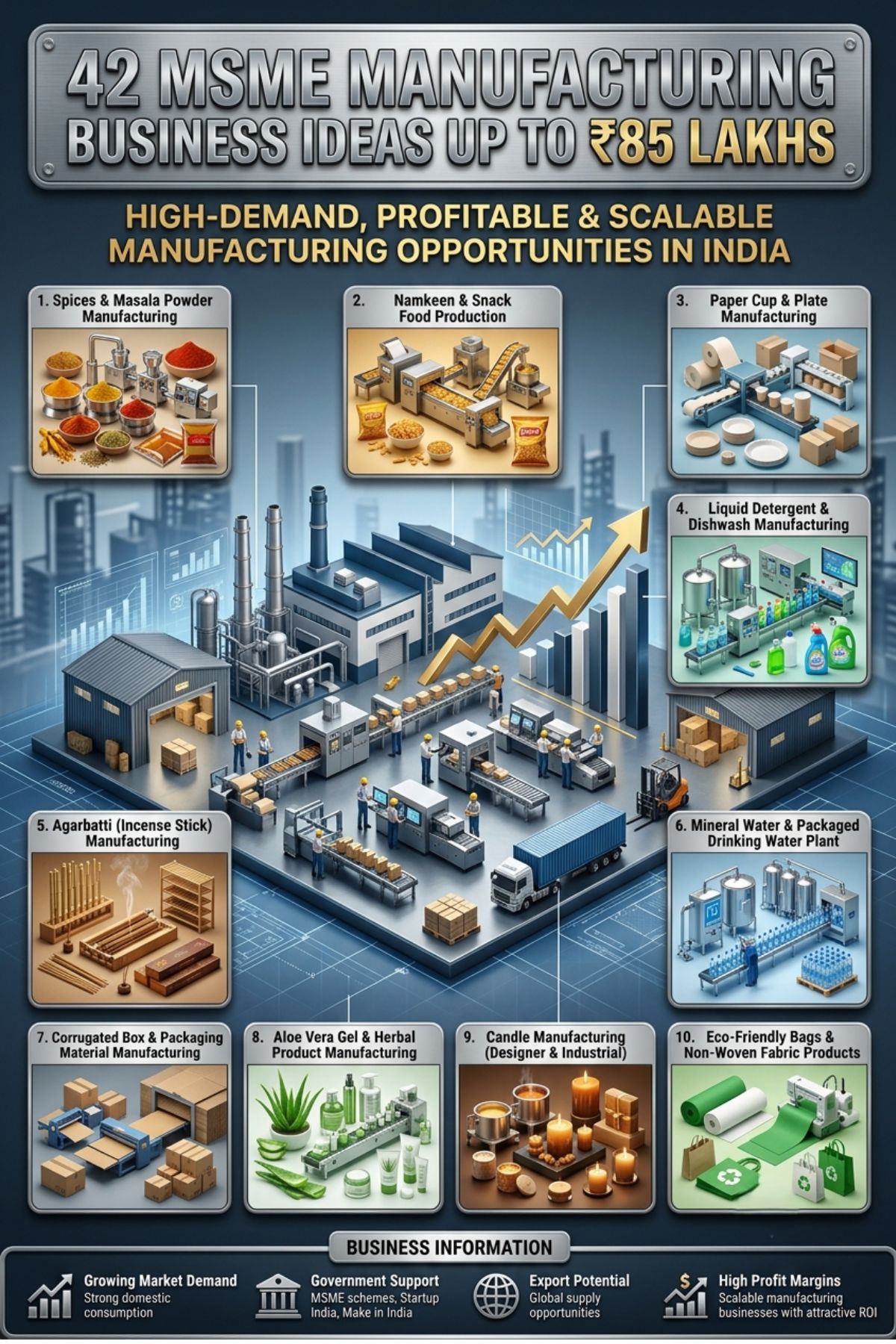
1. Spices and Masala Powder Manufacturing
India is the largest producer as well as consumer of spices; however, there is still a huge under-penetration rate of branded spices in the rural and semi-urban geographies. Cost of commissioning a small-scale spice grinding and blending unit is around ₹30-50 lakhs which includes cleaning machine, pulverisers, blenders, packaging line and cold storage. The raw material base is available on the agricultural markets. The margins of branded blended masalas are in the range of 18-28% while off-take for private label contracts with regional food chains are stable.
Explore This Book: Handbook on Spices, Seasonings and Condiments Processing, Extraction with Kitchen Spices Manufacturing
2. Namkeen and Snack Food Production
There is a growing organised namkeen and savoury snack market as people avoid consuming unbranded local snacks. The investment required for setting up an entry level production line for extruded snacks/bhaji/fried namkeen is in the range of ₹40-70 Lakhs. The competitive advantage is the ability to distinguish on the basis of flavour; packaging has to be hygienic and there is a need to distribute the product locally. There is a lot of equipment around here that is used to fry, season and seal pouches. The segment also has fast inventory turnover – production can be adjusted to market demand on a weekly basis.
3. Paper Cup and Plate Manufacturing
Single use paper cups and plates have registered explosive demand as the demand for plastic alternatives has been stifled by regulatory pressure. A mid capacity paper cup making machine now has the capacity to make 60,000 to 80,000 cups per shift and investment in the raw material inventory of a two-machine set up is between ₹50 to 75 lakhs. Institutional buyers – corporate canteens, airlines, hospitals, quick service restaurants – make up a group of buyers with consistent purchases. PE coated paper rolls are the raw materials that are imported in large quantity, providing logistics cost advantage for the domestic manufacturers.
4. Liquid Detergent and Dishwash Manufacturing
Liquid detergents, dishwash products, and other such products are a ₹3,000 crore+ domestic market where a few national players hold a leading position in the branded category. Regional/private label manufacturing is expanding rapidly, however. The formulation is not complicated and a production unit can be set up with the investment of ₹ 20–35 lakhs in batch processing mode. The profitability in this is in the distribution: getting the contracts from modern trade chains, FMCG distributors or institutional cleaning services. There are fewer SKUs available for commodities but much more for premium or herbal varieties.
5. Agarbatti (Incense Sticks) Manufacturing
Agarbatti is one of the oldest cottage industries in India and the industry is quickly professionalising. The output volume is stable and the product quality is uniform, which has been achieved by the introduction of automated rolling machines and the substitution of manual production. A semi-automated plant which can include drying infrastructure and fragrance blending can be setup in the range of ₹ 25-45 lakhs. There has been an increase in export demand, especially from Southeast Asia, the Middle East and Africa. There are niche variants such as charcoal-free, bamboo-based or aromatherapy sticks which are sold with a 30-40% premium over regular ones.
6. Mineral Water and Packaged Drinking Water Plant
Packaged drinking water is an industry that is consumed throughout the year and is growing in institutional demand from schools, offices, and hospitality units. The installation of a BIS certified Plant equipped with Filtration, RO Plant, UV treatment and automated bottling can be done in the range of ₹55–80 lakhs. Compliance with regulations (BIS IS:14543) is compulsory but can be achieved in 3-4 months. The other option is the “franchise” business model where they franchise under the national brands Bisleri or Kinley for marketing support.
7. Corrugated Box and Packaging Material Manufacturing
In many industrial clusters, demand for corrugated packaging is now well ahead of the domestic supply due to its rapid growth rate and volume, which exceed 25% per year. A corrugated box manufacturing unit with slitter and scorer machines, stitching machines with 3 plies can be established with a cost of ₹60-80 Lakhs. Customers are diversified from electronics, pharma, agriculture and hence there is less concentration risk. In the food and pharma sector, many MSMEs in the industrial estates are actively looking for box manufacturers in the area and the business development is relatively easy.
8. Aloe Vera Gel and Products Manufacturing
Aloe vera is now no longer part of the niche wellness industry, but is becoming a part of the mainstream personal care and nutraceutical raw material market. India has a large crop of these grown in Rajasthan and the state of Gujarat and offers access to raw materials. A small aloe processing unit with the production of standardised gel, juice concentrate and topical preparations can be set up with a cost of ₹40 – 65 lakhs. It can be sold as raw material to cosmetic companies as B2B or directly to customers in the products under a private label. There is good potential in export, mainly towards EU and Middle East for certified organic varieties.
9. Candle Manufacturing (Designer and Industrial)
Industrial paraffin candles continue to be a favourite in rural markets and in backup power. But it’s the designer, scented and soy wick candles for urban gifting, decor for hospitality, or wellness retail that is the true growth area. A manufacturing set-up that consists of moulding, pouring and packing can be started with ₹15-30 Lakhs. There is a high export potential – Indian decorative candles are exported to Europe and the US with high value premium. The raw material base of paraffin, stearic acid and fragrance oils is guaranteed to be sourced domestically.
10. Eco-Friendly Bags and Non-Woven Fabric Products
Overall, the plastic bag ban has transformed the retail packaging market. The new non-woven polypropylene bags are quickly replacing them. A non-woven bag making line (fabric rolls, bag making machines, printing machines, handle attachment machines) can be set up at a cost of ₹35-55 Lakhs. Supermarket chains, garment exporters and logistics firms are among the institutional clients who make huge repeat purchases. Printed promotional bags for corporate events and political campaigns give a seasonal boost to revenue.
11. Chalk and White Crayon Manufacturing
School chalk and school stationery are still vital educational commodities and continue to be purchased by the government on a regular basis via the state education departments. An investment of between ₹ 15–25 lakh is needed for a chalk manufacturing unit having mixing, moulding, drying and packaging lines. Off take is guaranteed through the government tenders under Samagra Shiksha Abhiyan and government board procurement. Dustless chalk variants and colour chalk sets are designed for the higher margin private school and stationery retail markets.
12. Ayurvedic and Herbal Skincare Products
The herbal and Ayurvedic personal care products segment is one of the fastest-growing FMCG sub-segments in India, owing to the shift in consumer preferences to use of natural ingredients post-pandemic. A small scale manufacturing unit with a license to manufacture face wash, creams, oils and hair care products can be established with a capital investment of ₹45-75 lacs. Drug and Cosmetics Act and AYUSH certification pave the way for institutional tenders and distribution in pharmacy. E-commerce channel means no investment in retailing, direct-to-consumer sales.
Get Detailed Project Report (DPR): Herbs and Herbal Based Products: Ayurvedic Medicines and Herbal Cosmetics
13. Mosquito Repellent Coils and Liquid Vaporiser Manufacturing
The market size of mosquito repellents in India is more than ₹4,000 crore and coils are a major shareholder in the rural and semi-urban market. Regional brands can open up for new MSME manufacturers through third-party or contract manufacturing. A business line for coil production along with mixing, pressing, drying and packing facility can be established in ₹50-75 Lakhs. The ingredients (d-allethrin, metofluthrin) are sold commercially and the packaging machines are manufactured in the country.
14. PVC Pipe and Fittings Manufacturing
Demand for PVC pipes and fittings for plumbing, irrigation, and electrical conduit continues to grow in Tier 2 and Tier 3 cities as construction activity picks up. A small scale PVC pipe making plant having two to three extrusion lines can be started with investment of ₹65-85 Lakhs. ISI mark certification is imperative for market acceptance and helps contribute towards the credibility of new market entrants. Government infrastructure projects such as Jal Jeevan Mission, Smart Cities and PMAY in particular provide huge demand in the institutional sector, which can be tapped through participation in tenders.
15. Bamboo Products Manufacturing
The manufacture of bamboo products has been given a boost by the government by establishing the National Bamboo Mission for providing direct grants and subsidies to bamboo processing units. Demand for products, including bamboo furniture & panels for flooring, toothbrushes, straws, and handicrafts, is high at home and abroad. The cost of medium scale bamboo processing unit is between ₹40-70 lakhs including treatment, drying, cutting and finishing equipment. There is access to raw material in the North-Eastern states and also extra funding assistance from NEC (North East Council).
16. Fly Ash Brick Manufacturing
Fly ash bricks are one of the environment-friendly bricks of the old red clay bricks. They are less expensive and have better compressive strength with industrial waste as raw material. Their use is encouraged by the Central Pollution Control Board. The cost of a fly ash brick plant equipped with hydraulic press machine, curing tank and material handling is around ₹35 to 60 Lacs. Low-cost raw material supply is provided due to thermal power stations. The key buyers are the urban construction clusters, and government housing project tenders are possible.
17. Paper Stationery and Notebook Manufacturing
The notebook and school stationery industry is a volume-oriented industry with a high seasonality in the demand during the academic buying period of April-July. A Rule and Fold, Stitch and Cover Binding manufacturing line can be used to manufacture 20,000 to 30,000 Notebooks per day. The investment price range of a small-scale unit is ₹40 – 65 lakhs. State education boards’ government procurement ensures the volume and retail channels and private school supply contracts ensure the premium price.
18. Handmade Paper Manufacturing
Handmade paper, which is usually made from cotton rags, agricultural wastes or recycled paper, can be used in niche and high-margin paper uses such as stationery, gift wrap, art papers, export gift packaging, etc. The minimum mechanisation requirement in the production is about ₹15–30 lakhs, which includes a rag cutter, beater, mould and drying area. There is good export potential to Europe and North America where premium ecological stationery is sold at a high price compared to its machine-made competitor.
19. LED Light Assembly and Manufacturing
Government initiatives and commercialisation through EESL has greatly contributed to the growth of India’s LED lighting market. The large-scale LED chip manufacturing units need huge investment but small-scale LED driver assembly and LED luminaire manufacturing unit can be established with a capital investment of ₹50-75 lakhs. Domestic or import SMD LEDs, drivers, heat sinks, housings, etc. are used. Volume and margin stability can be achieved in B2B supply to builders, real estate developers, infrastructure contractors and commercial fit-out companies.
20. Solar Energy Component Manufacturing
The solar industry is demanding a huge, increasing number of mounting structures, cables, junction boxes and BOS (balance of systems) which are currently being imported into the country from various sources or sourced from a handful of domestic suppliers. Solar mounting structure or DC cable manufacturing unit can be set-up in a range of ₹60-80 lacs. The government’s Solar addition targets and rooftop solar programmes of PM Surya Ghar Muft Bijli Yojana provide a multi-year demand runway for the new manufacturers.
21. Rubber Band and Rubber Products Manufacturing
Rubber bands, rubber gaskets and industrial rubber parts are mass consumer and industrial items. A small rubber vulcanisation equipment with mixing mills, hydraulic press and cutting equipment can be installed at an investment cost of ₹30-50 lakhs. Agricultural usage of rubber bands, especially in rubber banding produce, is a steady demand. Automotive ancillary, plumbing and electrical provide parallel revenue streams, minimizing business risk.
22. Essential Oils Distillation Unit
India is one of the major producers of essential oils like lemongrass, menthol, eucalyptus and vetiver oils. Oils can be extracted from agricultural produce using a small steam distillation or cold-press facility and sold to the cosmetic manufacturers, aromatherapy product companies and fragrance houses. The extraction and distillation basics investment ranges from ₹35 – 60 lakh. Organic certification opens up higher FOB prices to European buyers.
23. Tile Adhesive and Construction Chemical Manufacturing
Waterproofing compounds, tile adhesive and grout are key consumables for the ceramics and tiles installation segment. At the moment, there are only a handful of players in the branded segment, whereas the market of distributors and hardware retailers is very fragmented. A small blending and packaging plant to manufacture dry-mix construction chemicals can be set up for ₹40–60 lakhs. Technical partnership or licences are formed with construction chemical producers to further minimize product development expenses.
24. Biodegradable Packaging Manufacturing
As the regulations become stricter on single-use plastics, biodegradable packaging, such as cassava-based bags, sugarcane bagasse food containers, and paper-pulp trays, are emerging as a fast growing solution. The food service enterprise, quick service restaurant and retail sectors actively look for certified biodegradable packaging suppliers. The cost of setting up a manufacturing unit for moulded pulp products or for cassava bags ranges from ₹45–75 lakhs. As sustainability requirements are increasingly being applied to packaging supply chains, export opportunities towards the EU and the Gulf are growing.
25. Pharmaceutical Nutraceutical Product Manufacturing
The nutraceuticals – which cover vitamins, proteins, herbs, immunity supplements and other products – is one of the fastest-growing areas of the Indian consumer health market. A small-scale manufacturing unit for capsules, tablets or powder sachets can be setup in just ₹60-85 lakhs which is the GMP complianter. The contract manufacturing solution could also be a way to bring in a business model for D2C health brands without the investment in their own brand. The main regulatory requirements are licensing by FSSAI and registration by AYUSH.
26. Tarpaulin and HDPE Woven Fabric Manufacturing
Woven bags (HDPE) and tarpaulin are required products in agriculture, construction, packaging and disaster management. Weaving can be done on a small HDPE tape extrusion and circular loom system at competitive prices. The cost of investment in a two loom unit, which has a tape extrusion and lamination line, ranges from ₹55 lakh to ₹80 lakh. The main institutional buyers are agricultural marketing boards, civil contractors, and e-commerce logistics companies.
27. Organic Fertiliser and Vermicompost Manufacturing
The market pull towards reduced use of chemical fertilizers due to government policy has given rise to the emergence of organic alternatives. The production unit for vermicompost/bio-fertiliser needs low level mechanisation, which is mainly composting beds, shredders and sieving equipment, making it one of the most capital efficient agricultural input businesses. The investment should be around ₹15-35 lakh in a medium scale unit. The state agriculture departments and cooperative societies are actively purchasing the organic inputs and the PM Pranam Yojana also provides incentive to the adoption of organic inputs at the state level.
28. Cattle Feed and Poultry Feed Manufacturing
While India’s dairy and poultry sectors are one of the biggest in the world, the use of formulated compound feeds has been limited in the rural areas of the country. A small feed pelletising unit, mixing and pressing and cooling and packing line can be used by the dairy farmers and poultry integrators in a radius of 100 to 150 km. The cost of investment for a simple 2 tonne per hour unit is estimated at ₹45 to ₹70 lakh. Raw materials, such as soya DOC, rice bran, maize and mineral premixes are sourced locally and procurement logistics are manageable.
29. Wire and Nails Manufacturing
Applications in agricultural, packaging and construction include cold-drawn wire, binding wire, nails and barbed wire. A wire drawing mill with annealing facility and nail making machines can be established with investment of ₹60-80 Lakhs. The medium is available from primary producers and local steel stockists, as raw material — mild steel wire rods. Reliable off take due to its close proximity to construction clusters / industrial estates. In the branded hardware trade, consistency of quality and ISI certification are the factors that set products apart.
32. Tomato Ketchup and Sauce Manufacturing
Processed tomato products are sold in both B2C retail and B2B food service channels and include products such as ketchup, sauce, puree, and paste. A modest processing unit equipped with pulping, concentration, filling and pasteurisation equipment can process tomatoes at an appropriate rate during the season and can result in a year-round production from concentrate. The investment varies between ₹40-65 lakh based on the capacity. Private label supply to QSR chains and hotel chains and institutional caterers offers steady off-take volumes without significant retail marketing spend.
31. Biscuit and Bakery Product Manufacturing
While large brands dominate the market for biscuits, there are many small brands and private label biscuit manufacturers serving local demand and institutional markets like schools, canteens and export markets. A small-scale biscuit manufacturing unit can be set up at an investment of Rs. 55 – 80 lakhs, comprising of dough mixing, forming, baking, packaging lines. The critical success factor is the variety of flavour and to ensure good hygiene standards, which can be accomplished in the investment window.
32. Pickle and Chutney Manufacturing
Indian pickles and chutneys are shooting up as they are being exported from the country due to the need for authentic flavors by the diaspora and food lovers in the west. A small scale pickle manufacturing unit can be established with investment of ₹20-40 Lakhs with mixing, filling and sealing equipment. Regional specialty pickles like Andhra avakaya, Gujarat methia keri, etc. offer geo-indication opportunities for market differentiation. APEDA-registered exporters help exporters to export to the US, UK and Gulf markets.
33. Rubber Stamp and Office Supply Manufacturing
There is an emerging market for self-inking rubber stamps, pre-inked stamps and office supply products fuelled by the business formalisation and the need for GST compliance. A small polymer etching or vulcanised rubber small scale producing unit can be set up for ₹15-25 lakh. Recurring stamp replacement and printing supply contracts between businesses generate steady revenue without sales and marketing investments.
34. Roof Tiles and AAC Block Manufacturing
Because of its excellent thermal insulation and light weight, the use of Autoclaved Aerated Concrete (AAC) blocks has become widespread in urban housing and office buildings. The investment in an AAC block plant depends on the scale of the plant and ranges from ₹70–85 lakhs per mini-scale plant, it needs Autoclave equipment, moulds and infrastructure to cure the blocks. The housing market is the primary market of the government housing project and private developer project in Tier 2 cities. Another product opportunity is the manufacture of roof tiles for rural houses – within the same investment range.
35. Paper Bag Manufacturing (Kraft and Art Paper)
Since the ban on plastic bags, Kraft paper bags and art paper carry bags have become the ‘old’ packaging solution for retail, pharmacy and food service. A paper bag manufacturing unit can be established within ₹25-45 lakhs with the machines such as cutting, pasting, folding and making handles. Large repeat orders are made by retail chain accounts, pharmacies and bakery chains. The price of custom printed bags for boutiques and high quality food brands is 30 to 50% more expensive than plain kraft bags.
Related Article: How to Start a Paper Bag Manufacturing Business in India (High-Demand Business Guide)
36. Synthetic Hair Extension and Wig Manufacturing
The market for synthetic hair products that are used in extensions, wigs, and braids is expanding owing to the online sales and the export demand for the products. Madurai and Ahmedabad are two locations in India that have a huge hair industry. A small line of synthetic hair manufacturing with fibre extrusion line, dyeing line and hair bundling line can be established with an investment of ₹50-75 lakh. The export potential to Africa and Middle East is large and domestic D2C channels are available, which allows D2C sales without a significant distribution investment.
37. Fire Safety Equipment Manufacturing
Growing awareness in tier 2 cities and National Building Code compliance requirements are driving institutional demand for Fire Extinguishers, Fire Hoses and Safety Signage. Establishing a small fire extinguisher refilling and assembly unit can be done at a cost of ₹30–50 lakhs, for which government tender can be won by having the unit BIS certified. The relationships with fire safety training companies or facility management companies generate additional revenue from partnerships.
38. Coconut Shell Charcoal and Activated Carbon Manufacturing
Activated Coconut Shell Carbon is used in water clarification, air filters, pharmaceuticals, and gold mining. The agriculture wastes of coconut shell is large volume of them produced in India especially in state of Kerala, Karnataka and Tamilnadu. The cost of setting up a charcoal kiln and activation furnace is in the range of ₹35–60 lakh. The export market, especially the European one for application in water treatment, is more lucrative than the domestic industrial market.
39. Solar Dryer and Farm Equipment Manufacturing
Solar dryers, seed treatment units, portable irrigation accessories are vital to India’s vast agriculture industry where post-harvest losses continue to be a concern. The welding and sheet metal forming and powder coating facilities are required for the small agricultural equipment fabrication unit which can be established in ₹40–65 lakhs. The government procurement through tenders by the Agriculture Department and supply from FPO (Farmer Producer Organisation) act as institutional revenue anchors.
40. Diaper and Sanitary Napkin Manufacturing
The personal hygiene products market, especially that of sanitary napkins which are expensive for rural women, is still poorly served in India. Domestic machine manufacturers in the range of ₹30–50 lakhs are now supplying affordable packages of machines for producing sanitary napkins on a small scale. There is infrastructure off take channels under the government scheme Pradhan Mantri Bhartiya Janaushadhi Pariyojana. The products are exported with ethical and women empowerment brand positioning and are also sold in the emerging economies FMCG networks.
41. Matchbox and Safety Match Manufacturing
The industry of match is well entrenched in Tamilnadan and West Bengal but demand is steady in semi-urban markets. A small safety match manufacturing unit for making splints, mixing of tip composition, box making and filling activities can be set up within ₹20-35 lakhs. It is available from domestic raw material sources. Organised off-take channels are available in government canteen contracts and partnerships for the distribution of FMCG. Marketed branded safety matches can be exported to Africa and the Middle East for additional income.
42. Reusable Metal Container and Industrial Drum Manufacturing
Industrial steel drums, jerry cans, and intermediate bulk containers (IBCs) are used in the chemical, paint, oil and food processing industry. A roll forming, welding and surface treatment sheet metal fabrication unit can be established at a cost of ₹65–85 lakh. Industrial buyer base is well defined and demand is non-seasonal. Reconditioning and refurbishment of used industrial containers represents an alternative source of income that will have a lower raw material cost structure.
Import–Export Opportunity Analysis for New MSME Manufacturers
With the Indian target of exporting merchandise, it is more of a compelling call for MSME manufacturers to sow the seeds of global penetration from the beginning. The several products mentioned earlier – agarbatti, essential oils, coconut shell activated carbon, organic food products, handicrafts – have already developed export corridors for small manufacturers to join.
There has been considerable growth in exports of agarbatti to Southeast Asian countries and the Middle East. Essential oil is exported to the fragrance houses and cosmetics factories in Europe through APEDA and state spice boards. There are receptive markets in Japan, Germany and the US for activated carbon, bamboo products and handmade paper, where sustainability credentials justify price premium.
Import of packaging materials, construction chemicals, PVC products and nutraceutical raw materials is still a major import of the country on substitution side. The domestic manufacturers who can match quality with foreign suppliers will be able to secure supply contracts with large buyers that prefer domestic suppliers for their logistics cost and delivery schedule reliability.
The overall risk of entry into export markets is minimized by a combination of Government export support programs like the Remission of Duties and Taxes on Export Products (RoDTEP), Market Development Assistance from APEDA and export credit insurance under ECGC.
Indian MSME Success Stories: What Founders Can Learn
Everest Spices – Vadilal Gandhi
The Vadilal Gandhi-owned company Everest Masala started as a small grinding shop in Mumbai catering to the local market. The company already had a strong market position due to its focus on quality and hygienic packaging for the customers and its extensive distribution reach before others. Everest is one of the biggest brands of spices in India, today. New MSMEs: It’s better if you differentiate yourself by quality and consistency of packaging rather than price in the consumer food segment.
Shakti Pumps – Dinesh Patidar
Dinesh Patidar has established Shakti Pumps with a tiny solar submersible pump factory in Indore, which has now expanded to a global solar pumping company. The company’s timely switch to solar powered agricultural pumps matched the government initiatives and electrification of rural areas. Currently Shakti Pumps exports to more than 50 countries. The take away for MSME manufacturers: If they keep an eye on government procurement trends and develop products according to them, disproportionate growth can be achieved.
Paper Boat (Hector Beverages) – Neeraj Kakkar
Paper Boat started as a small food and beverage processing unit exploring traditional Indian drinks. The founders recognized a consumer desire for authentic regional tastes and created a high quality beverage company based on “nostalgia” and natural ingredients. The company’s manufacturing process is very much entrenched in small batch formulation and controlled supply chain. The takeaway: MSME food manufacturers need to invest in brand storytelling in addition to creating a quality product to be able to sell it for retail pricing, not generic contract manufacturers.
How NPCS Supports New Manufacturing Entrepreneurs
Niir Project Consultancy Services (NPCS) offers professional services to prepare a Market Survey cum Detailed Techno-Economic Feasibility Reports (DPRs) for establishment of a new industry/business. In our reports, the manufacturing processes are described in detail, market research and demand analysis is carried out, process flow diagram is provided, product mix and capacity planning, all machinery details and raw material details are provided, complete project financials with profitability analysis is provided.
We aim to assist in the feasibility, profitability, and long-term scalability assessment of entrepreneurs prior to their investment. These 42 business ideas are for the first-time founder, or they’re for the investor who wants to be certain that they invest in a good project evaluation partner with an analytical rigor.
Reference Data: Estimated Investment and Revenue Profile
| Business Idea | Investment Range (₹ Lakhs) | Margin Range (%) | Payback Period | Export Potential |
| Spices & Masala | 30–50 | 18–28% | 18–24 months | High |
| Paper Cups & Plates | 50–75 | 15–22% | 20–28 months | Medium |
| Liquid Detergent | 20–35 | 12–18% | 15–20 months | Low |
| Agarbatti | 25–45 | 20–30% | 18–24 months | High |
| Packaged Water Plant | 55–80 | 18–25% | 24–30 months | Low |
| Corrugated Boxes | 60–80 | 14–20% | 22–30 months | Medium |
| Aloe Vera Products | 40–65 | 22–35% | 18–26 months | High |
| LED Assembly | 50–75 | 15–22% | 20–28 months | Medium |
| Organic Fertiliser | 15–35 | 25–40% | 12–18 months | Medium |
| Biodegradable Packaging | 45–75 | 18–28% | 20–28 months | High |
| Nutraceuticals | 60–85 | 25–40% | 24–36 months | High |
| Fly Ash Bricks | 35–60 | 20–30% | 18–24 months | Low |
| Essential Oils | 35–60 | 28–40% | 18–24 months | High |
| PVC Pipes | 65–85 | 12–18% | 24–30 months | Low |
Frequently Asked Questions (FAQ)
Q1. What is the best business idea with a capital of less than ₹25 lakhs?
Some of the businesses listed here can be started with only ₹25 lakh investment such as candle manufacturing, vermicompost, rubber stamp manufacturing, handmade paper and matchbox manufacturing. They are service businesses that have little need for mechanisation and cater to a steady flow of demand in local and institutional markets.
Q2. What’s the procedure for obtaining any aid from government for starting a new manufacturing plant?
Most convenient options include project loans up to ₹50 lakhs offered by PMEGP with subsidy ranging between 15 and 35 per cent with KVIC and collateral-free credit with CGTMSE. First step towards Udyam Registration is to access all MSME benefits. The District Industries Centre (DIC) in your locality may advise you on the eligibility and application process of the scheme.
Q3. What certification should a small food or FMCG manufacturer have?
Food product manufacturers must have FSSAI license. Herbal and Ayurvedic products must have AYUSH registration. Products such as drinking water, PVC pipes, and electrical products require BIS mark certification. For export of food products, which are certified as organic, it is mandatory for them to obtain organic certification from APEDA. The majority of these certifications are available in 2-6 months.
Q4. Is it better to start with a single product or multiple products?
A single product approach is often more suitable for MSME manufacturers with small capital investment. It enables you to gain operation expertise, maintain quality uniformity and secure a loyal customer base before increasing the portfolio. Diversification is more effective once the initial product line may be breaking even and providing cash generation.
Q5. Who are my manufactured product’s potential buyers?
The best options that are available for new MSME manufacturers are: NSIC’s trade fairs and buyer-seller meet, GeM portal registration with government procurement, APEDA with agro-food exports, and India Mart or Trade India with B2B lead generation. The first stage of creating distributor relationships is the physical travel to industrial clusters and trading hubs as the most reliable way.
Q6. About how long does it take for a small manufacturing business to begin?
In the majority of projects in the range of ₹30 to ₹85 lakh, it takes 6-18 months to go from project finalisation to commercial production. This involves land identification, shed building (or hiring), equipment buying and setting up, connection to utilities, obtaining permits and licenses, and pilot production. The businesses based in the industrial estate sheds that have the ready utilities can greatly shorten this time frame.
Conclusion: Choosing the Right Idea and Acting with Analytical Discipline
The 42 manufacturing business ideas covered in this article represent genuine, demand-backed opportunities — not speculative ventures. Every fall falls into an 85 lakh investment ceiling accessible through a mix of MSME loans, government subsidies and individual capital. But in the difference between a founder whose company rises to the occasion, and those whose does not, the company idea rarely plays a role.
Discipline in site selection, strict cost controls, robust quality systems and pre-emptive marketing of sales partnerships are keys to small-scale manufacturing success. Founders who invest in a detailed feasibility study before committing capital — covering process costs, market demand, machinery specifications, and financial projections — consistently outperform those who begin without analytical grounding.
India’s manufacturing decade is underway. The question for every entrepreneur reading this is not whether the opportunity exists — it clearly does. The question is how well you have validated your chosen idea before you invest.


