





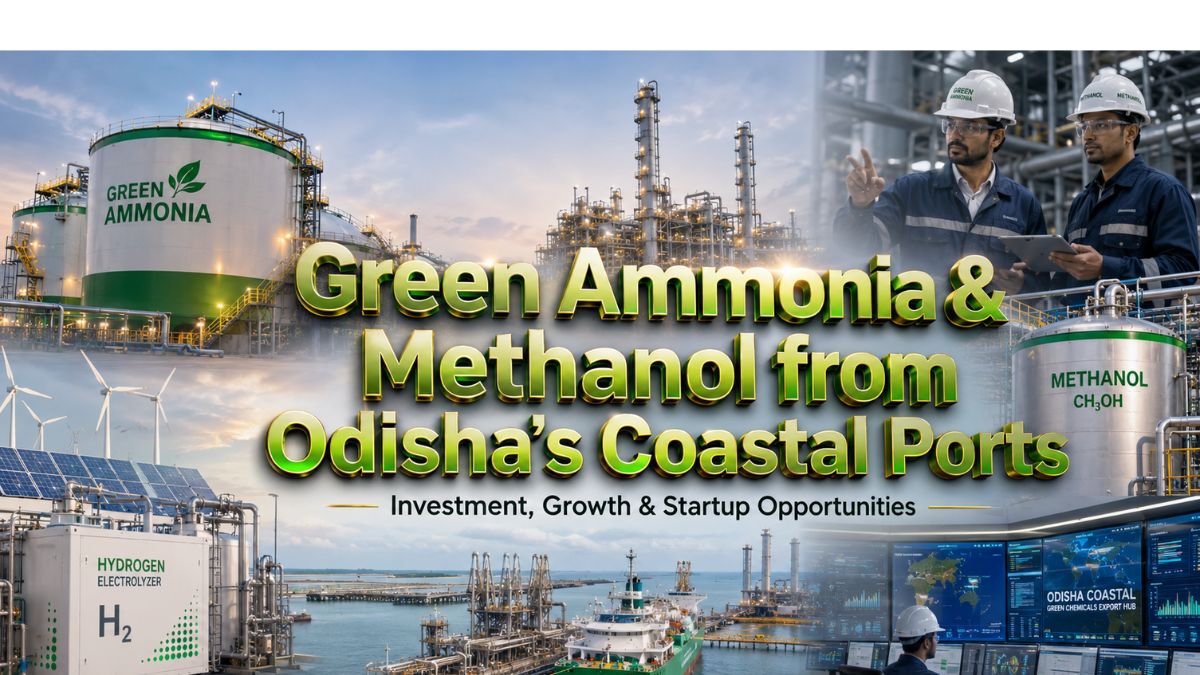
Green Ammonia and Methanol Are the Business Ideas of the Energy Transition
Two chemicals are the backbone of today’s world and will be the backbone of tomorrow’s decarbonised economy. The first is ammonia, which is used in 80% of the world’s fertilisers, industrial refrigeration and explosives used in the mining industry. Methanol is the second, a feedstock chemical used for formaldehyde, acetic acid and now more and more as a clean shipping fuel. Both are fossil-fuel-based at this time. They are both produced from renewable energy and green hydrogen. The green ammonia and green methanol market is one of the most strategically important business concepts of the next 20 years, not just for energy producers, but also for chemical and logistics investors, and companies connected to ports. Odisha is already ahead of all the states of the east in this race. The eastern part of India has been appointed as the Green Hydrogen Hub with the help of the port of Paradip. India has been officially named the eastern Green Hydrogen Hub with the assistance of the port of Paradip. ACME Group has signed a 200,000 TPA green methanol plant and 370,000 MT per year green ammonia offtake agreement in Odisha. The basic groundwork has been laid. There is a chance.
Why Green Ammonia and Methanol Are Becoming Mainstream
The conventional method of ammonia production is by the Haber-Bosch process, which involves reacting atmospheric nitrogen with hydrogen obtained from natural gas. It is one of the most energy-consuming industrial activities on earth and produces about 1.8% of global CO2 emissions every year. Green ammonia uses electrolytic green hydrogen (from renewable electricity) to replace fossil hydrogen. The chemical product is the same. Near zero carbon emission.
Similarly, conventional methanol is produced by reacting natural gas with steam to produce synthesis gas (syngas) and reacting the syngas with water to produce methanol. Green methanol involves using green hydrogen and reclaimed CO2 to replace fossil syngas — or using biomass gasification. This product has the same industrial uses as formaldehyde — as a feedstock for chemicals, as a source for acetic acid, and for use in fuel blending — and a carbon neutral life cycle.
The worldwide shipping business has turned into the primary new demand driver for both. The International Maritime Organisation (IMO) has set a 50% emission reduction target for the shipping sector by 2050. Maersk and green ammonia fuelled ships from NYK Line are already in operation. The Fuel EU Maritime Regulation helps to speed up this shift. Consequently, the maritime demand for green methanol is expected to grow to 5–10 million tonnes per year by 2030.
Source: MNRE – National Green Hydrogen Mission
Related Article: Green Hydrogen Plant Setup in India: Technology, Cost & Policy
Government Policies That Make This Viable in Odisha Now
The National Green Hydrogen Mission (NGHM) offers fiscal support, viability gap funding, and infrastructure assistance to the production of green hydrogen in India. Government offtakes to support early-stage green hydrogen and ammonia projects, with the SIGHT Scheme (Strategic Interventions for Green Hydrogen Transition) significantly mitigating revenue risk. It was in this manner that ACME Group got offtake contracts with the big four Indian agri-chemical firms for 10 years.
The port of Paradip has been one of the three Green Hydrogen Hubs under the umbrella of the NGHM, which gives the regulatory and infrastructure support for bunkering, storage and export of green hydrogen derivatives. There are also R&D and infrastructure grants available to businesses in hub areas under the Hydrogen Valley Innovation Clusters (HVIC) scheme. These central initiatives are complemented by the policy of Odisha state that waives electricity duty and provides capital subsidy for manufacturing with renewable energy.
Source: Invest India – Green Hydrogen Hub
Source: DPIIT – Investment Policy
Green Ammonia and Methanol Business Ideas in Odisha
Business Idea 1: Green Ammonia for Fertiliser and Industrial Supply
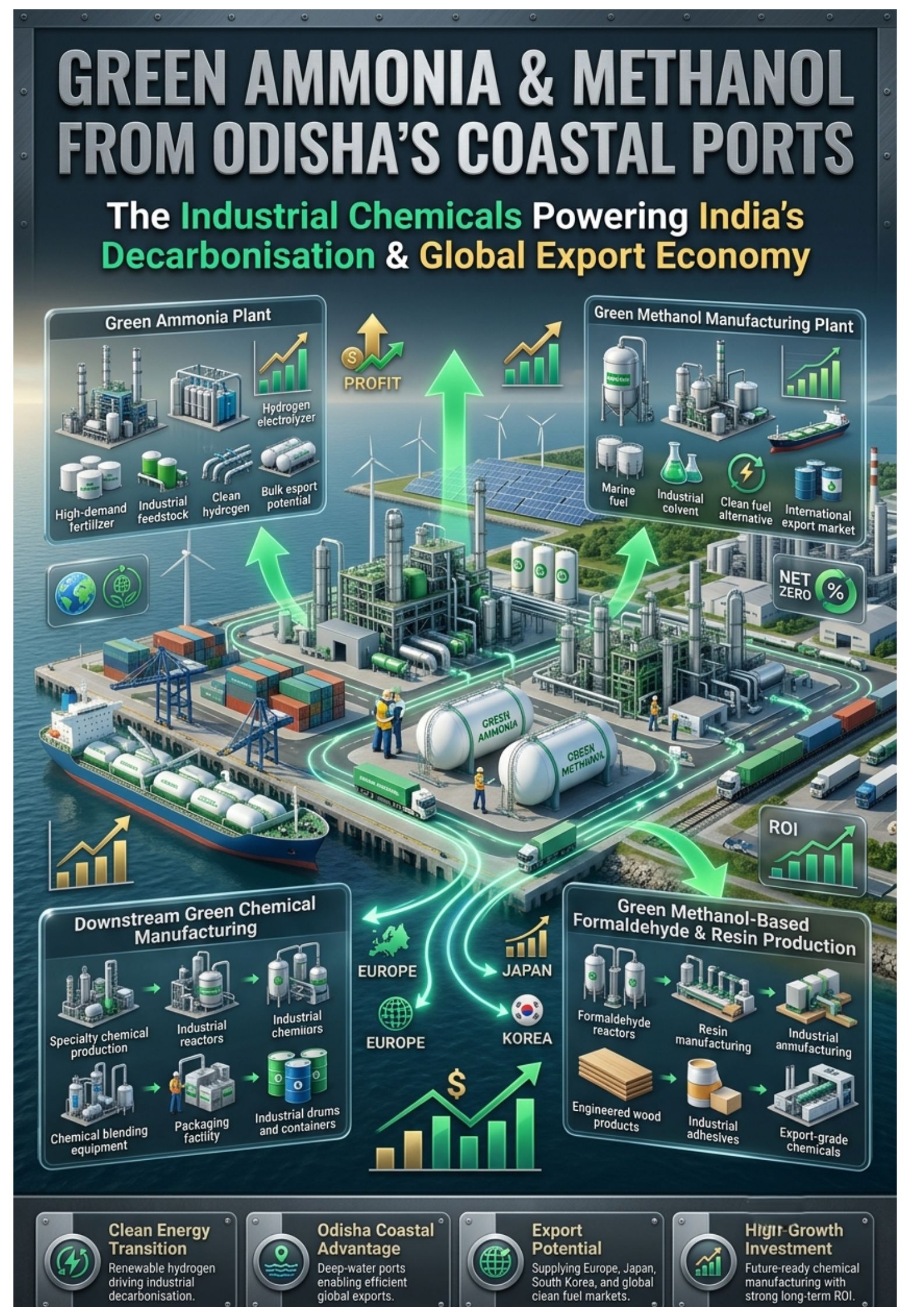
Detailed with the Indian companies that purchase fertilizers, the agreement to supply 370,000 metric tonnes per year of green ammonia to these companies by the ACME Group, under an SECI scheme, marks the commencement of actual and funded offtake infrastructure for green ammonia in the Indian state of Odisha. An entrepreneur starting out at a smaller commercial scale (20,000 to 100,000 TPA) can explore the market for industrial refrigeration, a market for ammonium nitrate for use in the large mining industry in Odisha, as well as a market for specialty nitrogen chemicals for agriculture. Green ammonia has a high price premium compared to fossil ammonia and demand for it with ESG mandates is rising. The enabling conditions – renewable energy potential, port access for feedstock and export – are already available in Paradip, while the NGHM hub status is yet to be established. The investment will range between ₹80 and 300 crores based on the electrolysis capacity and level of integration.
Identify high-growth industries before others do
Business Idea 2: Green Methanol Plant for Export and Industrial Use
The 200,000TPA green methanol plant by ACME group in Odisha is a commercial standard. The market for methanol is quite big, however, and it can be served by a number of methanol producers, especially those who serve specific downstream applications. An entrepreneur can build a smaller plant of 20,000–50,000 TPA green methanol plant for the production of formaldehyde, biodiesel plants and methanol-to-olefin (MTO) plants. Green methanol has a higher price premium of 40-70% compared with fossil methanol for export markets. The global operational capacity will be limited at 6–12 MTPA by 2030, which will result in a major mismatch between supply and demand over the decade. A manufacturer that places orders before 2028 will have the ability to secure long-term offtake contracts at favourable rates, without facing competition from other buyers.
Business Idea 3: Downstream Green Chemical Production Using Green Ammonia
Green ammonia is a fuel and a fertilizer precursor; it is not just that. It is the origin of a chain of nitrogen-based chemicals used in industry. If an entrepreneur can acquire green ammonia from the production facilities in Paradip he can create downstream facilities to produce ammonium nitrate (for making mining explosives), nitric acid (for various industrial applications, agrochemicals), amino acid (from the ammonia and carbon sources from renewable resources) and specialty nitrogen-based chemicals for pharmaceutical industry. Convertibility downstream of green ammonia to higher value industrial chemicals offers much better returns than selling green ammonia. This use case is the most profitable use of the green hydrogen set up in Odisha for a specialty chemistry entrepreneur, where the green ammonia produced at Paradip acts as feedstock for a specialty chemistry plant. The capital requirement is between ₹30–200 crore based on the product selection.
Explore This Book: Fertilizers Manufacturing Handbook
Business Idea 4: Green Methanol-Derived Formaldehyde and Resins
Formaldehyde is indeed among the widely used industrial chemicals in India, which is directly produced by the catalytic oxidation of methanol. It is used in urea formaldehyde resins (plywood and particle board), phenol formaldehyde resins (electrical insulation, brake linings), and melamine formaldehyde compounds (coatings and laminates). Formaldehyde containing resins are used in huge amounts in construction and furniture industries in India. A low-carbon certified formaldehyde for export furniture and panel manufacturers for the European market is produced in the green methanol-to-formaldehyde unit located near Paradip where green methanol is used as feedstock. Mid-scale capital requirement: ₹25–80 crore
Import–Export Opportunity Analysis
Huge amount of methanol is currently imported in India for industrial and fuel blending. It is also building capacity to produce domestic fertiliser (which uses ammonia). The transition to green variants of both creates a big opportunity in import substitution. On the export side, the Japanese and South Korean power generators, who are switching to ammonia co-firing for decarbonization in power sector, is one of the biggest near-term export opportunities for green ammonia from India.
The other export priority is green methanol for European shipping companies, which are required to have methanol-ready vessels under the FuelEU Maritime Regulation. Paradip Port’s strategic position on the shipping lane to the East, Japan, South Korea and Southeast Asia provides freight competitiveness for green fuel exports to those destinations. Moreover, Middle Eastern fertiliser companies are also starting to explore the possibility of procuring green ammonia from India, as part of their own ESG transition targets.
Source: IBEF – Indian Chemicals & Energy
Indian Leaders in Green Hydrogen and Clean Chemicals
ACME Group — Odisha’s First Green Methanol Pioneer
Manoj Upadhyay, the Indian CEO of ACME Group, has carved out a niche for itself as the most daring green hydrogen and ammonia developer in India. The company’s plan to install a 200,000 TPA green methanol plant in Odissa with SECI offtake shows not only that it is a viable business model, but also that it is a good location for producing green methanol. The project’s work validates the feasibility of the green ammonia and methanol feedstock supply ecosystem for smaller entrepreneurs looking to explore the use of these fuels downstream. The successful model of ACME: get the government offtake first, infrastructure second which means minimise demand risk before putting capital into infrastructure.
NTPC — India’s PSU Green Hydrogen Pioneer
NTPC has been carrying out various green hydrogen and green ammonia pilot projects in India, including in coastal areas. NTPC’s participation proves the commercial viability and technology maturity. It also allows for a partnership between private businessmen who wish to transform NTPC’s green hydrogen production into feedstock for downstream green chemical production. The lesson for entrepreneurs: Early days of green hydrogen market – feedstock risk and capital requirement reduced through partnership with PSUs and IPP first movers.
Get Detailed Project Report (DPR): Best Business Opportunities in Odisha (Orissa)
Tata Chemicals — Industrial Chemistry Transitioning to Green
Professional management team within the Tata Group, Tata Chemicals has made an investment of ₹8,000 crore in sustainable capex for making its chemical manufacturing footprint lower carbon. The fact that its business lines are related to soda ash, specialty chemicals and food ingredients, all of which are undergoing a transition to green chemistry, indicates that large industrial chemical companies in India are actively pursuing sustainability transitions. With green ammonia downstream chemistry, Tata’s supply chain demands are a potential large scale industrial customer.
How NPCS Supports Green Chemical Project Development
Niir Project Consultancy Services (NPCS) has been developing complete Market Survey cum Techno-Economic Feasibility Reports for green hydrogen, green ammonia, and green methanol projects with all sizes. Our reports include details of electrolyser technology options, renewable energy source strategies, full process flow diagrams, infrastructure options and requirements, regulatory and permitting pathways, and detailed financial analyses such as DSCR, IRR, and payback analysis. We engage with entrepreneurs with targets of ₹50 crore downstream green chemistry units and investors who are considering investments in green ammonia production units with a cap of ₹500 crore.
Green Ammonia and Methanol — Key Market Indicators
| Parameter | Green Ammonia | Green Methanol | Conventional Price | Premium (Green) |
| Current Global Capacity | Limited (<5 MTPA) | Very Limited | — | — |
| Demand by 2030 | 40–50 MTPA | 6–12 MTPA | — | — |
| Price Premium (Green vs Fossil) | — | — | ₹15–20/kg | ₹25–40/kg |
| Odisha Specific Project (ACME) | 370,000 MT/yr | 200,000 MT/yr | — | — |
| Min. Commercial Scale | 20,000 TPA | 20,000 TPA | — | — |
Frequently Asked Questions (FAQ)
1. What is the difference between green ammonia and conventional ammonia?
Both are chemically identical — NH3. Conventional ammonia relies on hydrogen made from steam-reforming natural gas, whereas green ammonia is manufactured with hydrogen produced via electrolysis of water driven by renewable power. With a virtually non-existent carbon footprint, the latter sells for a premium in jurisdictions where mandates and/or ESG rules require low-carbon inputs.
2. Is green methanol viable as a business in India without export contracts?
Onshore, the use case for replacing fossil-based methanol include formaldehyde production, biodiesel production and blended fuels to provide better value. So domestic market is do-able but the offshore contract for sale to European shipping companies or for delivery to Japanese power generators gives substantially better pricing, and a long-term duration. Entrepreneurs should take a dual approach: sell the production for domestic industrial applications and then export to these offshore contracts for much better revenue.
3. What renewable energy source is best for green hydrogen production at Paradip?
Solar is the most cost-competitive option in Odisha given high irradiation levels. Wind — particularly offshore or near-coastal — provides better capacity utilisation (higher load factors). A hybrid solar-wind configuration gives the most stable hydrogen output. Paradip’s NGHM hub status facilitates access to renewable energy wheeling and open access arrangements for electrolysis facilities.
4. Can an MSME enter the green ammonia business, or is this only for large corporates?
The green ammonia production business at full scale (100,000+ TPA) is indeed a large-industry play requiring ₹200–500 crore. However, downstream green chemistry — using green ammonia as a feedstock for ammonium nitrate, amino acids, or specialty nitrogen chemicals — is accessible to mid-scale manufacturers at ₹30–100 crore. MSMEs should target the downstream value chain rather than primary production.
5. How long does it take to commission a green ammonia plant in Odisha?
A mid-sized green ammonia or methanol project at Odisha – ranging from land acquisition and EC to equipment procurement to commission – takes 36 to 48 months, he said. This may shrink to six to 12 months due to benefits like access to shared infrastructure and quick clearances available for projects in the PCPIR area.
6. Where can I find government offtake support for green ammonia production?
The SIGHT Scheme (Mode 1 and Mode 2) is a part of the National Green Hydrogen Mission, where a central government-provided offtake for green hydrogen and its products is made available. SECI manages the tender processes. Information on the active tenders is made available along with permissible project types by the Ministry of New and Renewable Energy (MNRE) in their website.
Conclusion: Odisha’s Green Hydrogen Hub Is a Manufacturing Launchpad
The commitment to Odisha as the Green Hydrogen Hub in the Eastern regions of India is no mere label. It includes fiscal incentives, infrastructure grants, and government offtakes that render the investment in these green ammonia and methanol production more risk-free. The dedicated project at 200,000 TPA green methanol has proved that commercial projects are already in motion at ACME. The entrepreneurs and the investors who enter now, in the downstream area of green chemistry, the formaldehyde industry, specialty nitrogen chemicals or port-linked green fuel distribution will build businesses on the infrastructure that the government and the NTPC are investing a fortune to create.
First-mover advantage in India’s green industrial chemical economy is measured in years and not decades. With its port, policy and feedstock advantages, Odisha is the most logical place in eastern India to establish such a business. Now the only question is who the entrepreneur is that decides to relocate, and when.


