





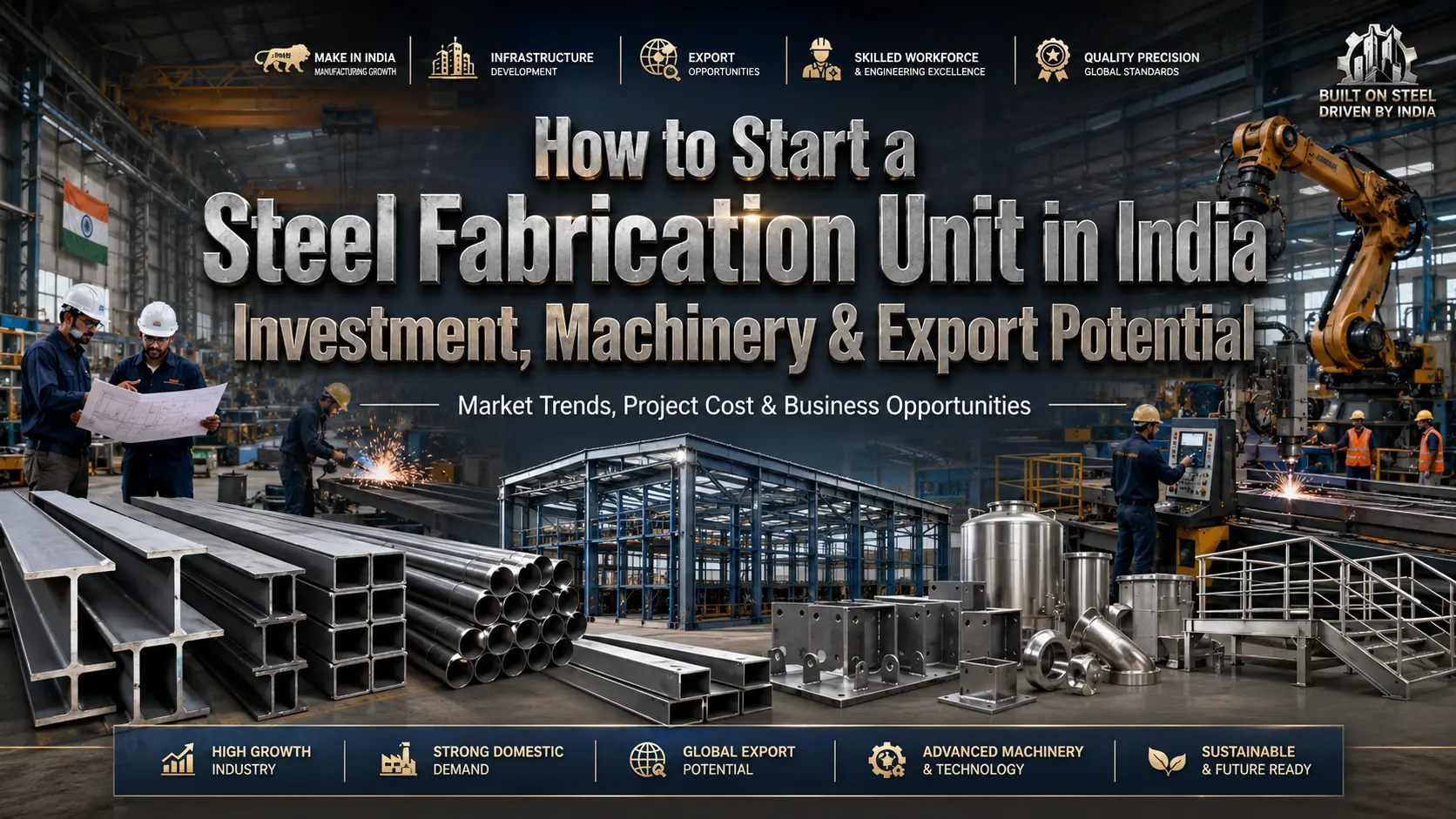
Steel Fabrication Unit in India
Steel fabrication is one of the oldest and most continuous manufacturing businesses available in the world, and even more pertinent in the present India. The nation is the world’s second largest steel producer, and government investment in infrastructure is soaring, as fabricated steel components are being used in almost every facet of the economy from roads and bridges to solar energy parks, industrial warehouses, defence facilities and affordable housing. A steel fabrication unit would generate a variety of revenues, be relatively easy to master and would represent a scalable business model option for the first-generation entrepreneur or an established manufacturer seeking diversification.
This article discusses all you need to know – the products that can be produced, the investment needed, the machines required, the regulations, and how to address the domestic and export markets. From scratch with Rs 80 lakh to expanding an existing shop to Rs 5 crore, steel fabrication opportunities are very real and rising.
Why Steel Fabrication Is the Right Business in 2026
The Union Cabinet-approved National Infrastructure Pipeline (NIP) is expected to invest Rs 111 lakh crore in the country’s infrastructure through 2025-30 in the sectors of roads, railways, ports, airports, energy, and urban development. Whether it’s steel beams for a new overpass, steel containers for a new warehouse, steel solar panels for a new solar park or steel metro columns for a new metro station, each project in this pipeline needs fabricated steel elements in one way or another. Meanwhile, the manufacturing industry in India is expanding with the Make in India campaign and is a need for industrial structures, equipment supports, and machinery bases, which only fabrication units can provide.
Currently, India’s steel consumption is more than 125 million tonnes per year. Much of this (around 30 to 35 million tonnes) is used in value-added fabricated products and not directly in the construction of structures. This is an increasing number. The government’s Production-Linked Incentive (PLI) scheme for specialty steel, which was introduced in 2021, is geared towards value addition in steel and favouring new entrants in the field of fabricated products.
In addition to exports to domestic market, India’s exports of engineering goods were valued at USD 109 billion in 2023-24 of which fabricated steel products accounted for a large share. The Middle East, Southeast Asia, Africa and a section of Europe are actively importing Indian steel fabrications due to the mix of competitive cost and engineering ability along with rising quality standards. If the fabrication unit is well managed, export orders can provide margins of 15 – 25 per cent above the purely domestic supply.
Get Detailed Insights from This Book: Steel and Iron Handbook
Key Products You Can Manufacture in a Steel Fabrication Unit
The great thing about steel fabrication as a business is the value of the items you are able to produce by using just about the same basic equipment. This will give manufacturers flexibility as to diversifying their client base and mitigating against slowdowns in any one sector.
- Structural steel work for industrial/commercial structures, such as beams, columns, trusses, rafters and purlins.
- Pre-Engineered Building (PEB) components – primary frames, secondary members, roof purlins
- In the logistics and industrial sector, storage racks, shelving systems and warehouse racking.
- Steel almirahs, lockers and storage furniture to suit institutional customers such as schools, offices, government departments etc.
- Solar panel mounting structures, one of the fastest-growing sub-segments, as India’s solar energy goals are being pursued.
- Steel doors for buildings, window frames, grilles and security shutters for construction projects
- Roofing and cladding for industrial sheds and cold stores.
- Structural supports for pipes and equipment in process industries
- Metal parts and specialty fabrications for original equipment manufacturers
- Applications of industrial containers, bins, hoppers and material handling structures e.g., for industrial use
Investment Requirements; How Much Money Do You Really Need?
Land and Civil Works
A minimum of 3,000 to 5,000 covered workshop area and open yard for storing raw material and doing large assembly work is required to make a functional fabrication unit. The lease cost in Tier-2 industrial area or in MIDC/ GIDC notified industrial area is in the range of Rs 15 to Rs 30/- per square foot per month. The cost of self-made sheds is Rs 20 to Rs 50 lakh depending on the size and area. For a new enterprise, renting in an established industrial estate is the most economical option as well as ready infrastructure (power, water, drainage).
Plant and Machinery
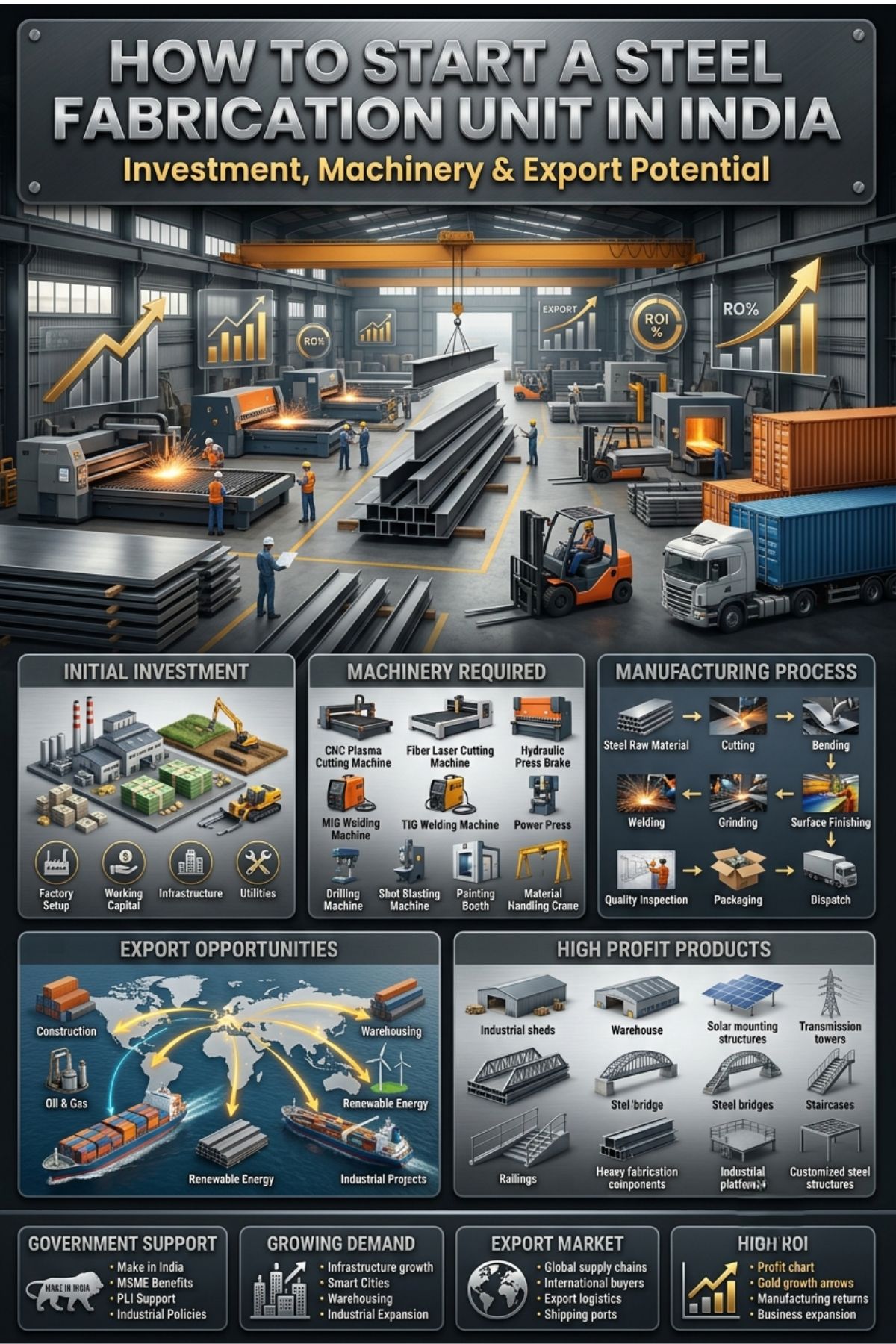
Equipment for a mid-scale unit with capacity 150-300 tonne/month will involve: a plasma or oxy-fuel cutting machine (Rs 8-15 lakh); a material handling equipment such as forklift or conveyors (Rs 5-12 lakh); at least 6-8 workstations with MIG and TIG welders (Rs 1.5-2.5 lakh each); a drilling and tapping machine (Rs 3-5 lakh); a hydraulic press brake for bending (Rs 10-20 lakh); a plasma or oxy-fuel cutting machine (Rs 8-15 lakh); an overhead gantry crane of 3-5 tonne capacity (Rs 10-18 lakh); and a shot blasting machine for surface preparation (Rs 15-25 lakh). The cost of investment in the machines of medium scale ranges from Rs 50 lakh to Rs 90 lakh.
Get Detailed Project Report (DPR): Complete Guide to Steel and Ferrous Metal Products
Working Capital Requirements
The steel is a high-value raw material, the typical fabricator needs 60-90 days of working capital to go from the purchase of raw material and the realization of an invoice from the customer. Working capital requirement varies from Rs 40 lakh to Rs 80 lakh for units with a monthly turnover of Rs 80 lakh to Rs 1.5 crore. The regular process to avail working capital facilities from any bank against the inventory of steel is by providing a project report to SIDBI or any of the nationalized banks (Cash Credit, Bill Discounting) — the working capital facilities are offered against the steel stock and receivables.
Total Project Cost Summary
- The small unit (50–100 TPA) comes with a total project cost of Rs 40 lakh to Rs 80 lakh.
- Mid-scale unit (150 – 300 TPA): Rs 1 crore to Rs 2 crore total project cost
- The total project cost for large unit (500+TPA) with PEB is in the range of Rs 3 crore to Rs 6 crore.
Raw Material Sourcing Strategy
The basic raw materials include mild steel (MS) plates and sheets, HR (Hot Rolled) coils and strips, structural sections (angles, channels, I-beams, H-beams, etc.), ERW pipes, hollow sections and SS (Stainless Steel) for specialty applications. They can be bought directly from primary players like SAIL, RINL (Vizag Steel), Tata Steel, JSW Steel and JSPL via their dealer networks. The cost of service centres that provide cut-to-length and slit-to-width services results in cost efficient, as it reduces waste and working capital. Purchasing in bulk at lower steel prices and having 30-45 days’ stock will be a good way to reduce the volatility of raw materials.
Find the most profitable startup for your investment range
Licensing and Regulatory Requirements
A proper structure from the start prevents on-going delays and penalties. The following registrations/licenses are mandatory or recommended:
- This step is essential for MSMEs to avail the benefits of MSME credit, subsidies, and priority sector lending’s Udyam Registration is a crucial step for MSMEs to access MSME credit, subsidies, and priority sector lending.
- Factory License under the Factories Act, 1948 — If you are employing 10 or more workers having power or 20 or more workers without power, you need Factory License under the Factories Act, 1948.
- GST Registration — it is mandatory for any business with turnover of more than Rs 40 lakh (Rs 20 lakh for services)
- Pollution Control Board NOC — fabrication includes the emission of welding fumes, surface treatment chemicals and shot blasting dust; a NOC from the State Pollution Control Board needs to be obtained
- Electrical Inspector Certificate — Components in relation to installation of high voltage machinery and welding equipment
- Details about IEC (Import export code) from DGFT — which is needed to start exporting.
- Joining the membership with RCMC from EEPC India to get export incentives and market information.
- ORC — for some structural products in government contracts, by obtaining BIS Certification.
Government Support Schemes You Must Know
There is substantial support provided by the government to steel fabrication MSMEs through various channels. PLI Scheme for Specialty Steel offers incentives to the producers of Value Addition Steel products on production linked basis. The Credit Guarantee Scheme for Micro and Small Enterprises (MSME) is a scheme introduced by the Micro and Small Enterprises Development Bank of India (SIDBI) and CGTMSE, which provides collateral-free loans up to Rs. 2 crore to eligible units. Interest subsidy on machinery loan is provided under the Technology Upgradation Fund Scheme (TUFS). The state governments provide industrial plots at subsidised rates, power tariff concession and exemption from stamp duty for the first time industrial builders through state industrial development corporations (SIDCs) like Maharashtra Industrial Development Corporation (MIDC), Gujarat Industrial Development Corporation (GIDC) and Tamil Nadu Industrial Projects Corporation (SIPCOT). These incentives can cut the cost of your project by as much as 15 to 25%, so don’t pass them up.
Domestic Market Strategy
Mostly, the first step for a new fabrication unit is to find two or three anchor customers who will give the base load of orders, like construction companies, industrial project EPC contractors, solar developers, or logistics warehouse builders. The advantage of registering as a vendor with large infrastructure developers and Tier-1 EPC companies (L&T, NCC, Shapoorji Pallonji, KEC International) is the availability of regular orders for projects. Another important channel is government tendering – Ministry of Housing, Railways and Defence are the regular buyers of fabricated steel products from GEM.
Related Article: Top 10 Profitable Steel Manufacturing MSME Business Opportunities in India
Export Market Opportunities
India’s engineering goods export ecosystem provides ample support to the owners of fabrication units who want to go on the international stage. International Trade Fairs, Buyer Seller meetings and Reverse buyer delegations are organised by the Engineering Export Promotion Council (EEPC India) which is unique in providing direct linkage between the Indian manufacturers and the overseas buyers. The UAE and the wider GCC region (industrial and construction steel), Bangladesh and Southeast Asia (structural sections and roofing systems), Africa (agricultural storage and industrial infrastructure) and Australia and Europe (solar mounting structures and precision fabrications) are the main export markets for fabricated steel. To begin with 1 or 2 export customers and produce good quality on time is the best method to create a growing export book.
Profitability and Returns
Monthly turnaround of 200 tonnes with realization of Rs 80,000 to Rs 1,00,000 per tonne at the average (depending on the product mix and value addition) is Rs 1.60 crore to Rs 2 crore for the mid-scale fabrication unit. Raw material cost (steel Rs 55,000 – 65,000/tonne accounts for 60 to 65 percent of revenues. Additional costs of labour, power, overheads and finance cost 15 to 20 per cent. For well managed units the operating profit is in the range of Rs 20 to Rs 35 lakh per month, resulting in net EBITDA margins of 12-18 percent. Higher margins for specialty fabrications, export orders and PEB work. Normally the breakeven point is reached in 18-30 months from the start.
Conclusion
Steel fabrication is not a glamorous business — it’s more of a hands-on, hard-working manufacturing enterprise that places a premium on discipline, quality consciousness and relationship-building. However, this is also one of the most dependable and growing manufacturing concerns that a businessperson in India can jump into today. In an India where infrastructure investments are at all-time highs, renewable energy is growing at a rapid pace and export markets are looking for Indian suppliers, the opportunity to establish or expand a steel fabrication unit has never been better. This is an attractive prospect for any entrepreneur in India, given the support provided by the government, easy access to the technology and demand in the market.
FAQs: How to Start a Steel Fabrication Unit in India
Q1. What is a steel fabrication unit?
Steel Fabrication Unit – An Introduction A Steel fabrication unit refers to an industrial facility where steel is cut, bent, welded and assembled into a completed product including structural steel items, solar panel installation racks, pipe supports, industrial sheds, storage racks, custom engineering items etc.
Q2. Why is steel fabrication considered a promising business in India?
The increasing manufacturing activity, massive investments in large scale industrial and energy infrastructure projects in India have translated into significant opportunities for fabricated steel products. The increasing demand of these buildings has leaded into the boom of fabricated steel products which is a direct result of the government schemes like “Make in India”, infrastructure growth and others.
Q3. What are the major products manufactured in a steel fabrication unit?
Some of the products available are Structural steel products, PEB building structures, Warehouse racks, solar mounting structures, Steel furniture, industrial sheds, Roofing system, Pipe racks, Sheet metal components and material handling equipment.
Q4. What is the minimum space required for a steel fabrication unit?
Typically, a unit requires 3,000-5,000 sq. Ft. Of covered workshop space along with an open yard for raw material storage and assembly operations.
Q5. Which machinery is essential for a steel fabrication business?
The main equipment we have consists of plasma cutting machines, hydraulic press brakes, plate rolling machines, MIG/TIG welding machines, drilling machines, shot blasting equipment, gantry cranes and forklifts.
Q6. What is the approximate machinery cost for a mid-sized fabrication unit?
A well-equipped mid-scale steel fabrication unit generally requires machinery investment ranging from 50 lakh to 90 lakh.
Government & Institutional References
- Ministry of Steel, Government of India: https://steel.gov.in
- EEPC India — Engineering Export Promotion Council of India: https://www.eepcindia.org
- MSME Udyam Registration Portal: https://udyamregistration.gov.in
- SIDBI — Small Industries Development Bank of India: https://www.sidbi.in
- CGTMSE — Credit Guarantee Fund Trust for MSMEs: https://www.cgtmse.in
- ECGC — Export Credit Guarantee Corporation: https://www.ecgc.in
- GEM — Government e-Marketplace: https://gem.gov.in


