





Manufacturing Business Ideas in India
The manufacturing landscape in India is evolving rapidly. The funding sources, subsidies and policies available to today’s entrepreneurs did not exist 10 years ago. Manufacturing is among the few safest and most rewarding areas to look to for viable business ideas with strong government support. The government has created an authentic ecosystem for the entry, competition and growth of first-generation industrialists from electronics to agro processing.
Why Manufacturing Is the Right Sector Right Now
India desires to cut on imports. That’s the one priority that has been influencing policy developments over the past several years. Further, the global companies are also rebalancing their supply chain from China and India is emerging as the natural choice.
This change opens up the doors of profitability logic to small manufacturers. The electronics, renewable energy, pharmaceuticals and food processing sectors are growing in demand. In the meantime, labour costs are also competitive to those of many export-based economies. Consequently, the margins of some manufacturing niche sectors are in better shape than in trading or purer services.
Related Article: 35 MSME Manufacturing Business Ideas Up To Rs 70 Lakhs: New & Upcoming Opportunities
Government Policies and Incentives Backing New Businesses
A number of schemes are now specifically geared towards supporting manufacturing start-up ventures. The Government’s Production Linked Incentive (PLI) scheme provides incentives for companies to increase their domestic production of electronics, pharma, textiles and solar manufacturing.
The Ministry of MSME also has Prime Minister’s Employment Generation Programme (PMEGP), which provides subsidy backed loans for fresh manufacturing enterprises. In the same way, the Credit Guarantee Fund Trust for Micro and Small Enterprises (CGTMSE) waives the requirement of collateral for loans up to a fixed amount – the major hurdle for first generation entrepreneurs.
In addition to the power tariff concessions, capital subsidy and exemption from the stamp duty under Make in India, state governments provide additional incentives. These policies can reduce the effective project cost by 15-30% for qualified projects.
Multiple Manufacturing Business Ideas for New Entrepreneurs
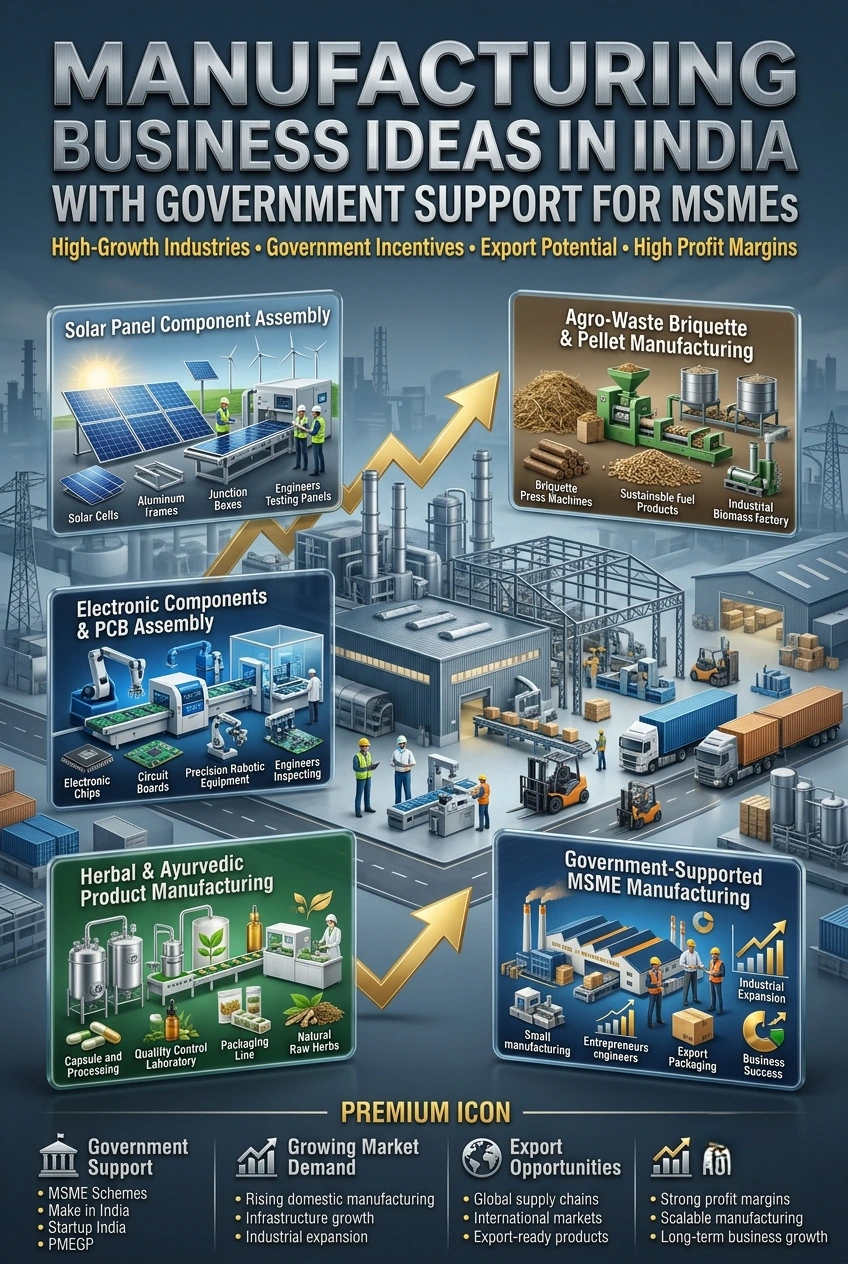
Solar Panel Component Assembly
Currently, one of the best prospects is solar module and component assembly. India has agreed to make significant investments in renewable capacity and the majority of the renewable panel market, inverter market and mounting structure market requirements are fulfilled from imports. A small assembly unit, supported by PLI packages for solar PV assembly, can cater to government tenders and the private rooftop solar PV installers. The investment can begin small, and gradually grow when you start to acquire customers from EPC contractors.
Explore This Book: Solar PV Power and Solar Products Handbook
Agro-Waste Briquette and Pellet Manufacturing
Each season large amounts of crop residues are produced in rural India and nearly all of them are either burnt or lost. This residue can be used for briquette or pelletize so as to provide an industrially better, less polluting fuel source for industrial furnaces and boiler systems. The raw material cost is lower, the machinery is simple and it is a good category to have PMEGP funding. Demand for this product is expected to continue to rise steadily as norms for pollution control from industrial fuels become increasingly stringent.
Electronic Components and PCB Assembly
A significant percentage of Indian PCB and electronic sub-assemblies are imported. The Ministry of Electronics has been working on the Scheme for Promotion of Manufacturing of Electronic Components and Semiconductors (SPECS) and the PLI scheme in general to fill this gap. The steady contract manufacturing business is an option for a component assembly unit whose target is consumer electronics or automotive electronics customers, particularly when they secure quality certifications which are sought by bigger OEMs.
Herbal and Ayurvedic Product Manufacturing
The preference for natural and Ayurvedic products is gaining momentum with the consumers in India and abroad such as in the Middle East and in the Southeast Asian countries. The Ministry of AYUSH helps small manufacturers with quality certification assistance and cluster development schemes. Compared to a chemical-based manufacturing operation, the capital requirements are also lower for entrepreneurs entering this area, and the margins in branded herbal products are also attractive, after distribution is established.
Get Detailed Project Report (DPR): Herbs and Herbal Based Products: Ayurvedic Medicines & Herbal Cosmetics
Import-Export Opportunity Analysis for New Manufacturers
Some of these are real export opportunities. Upon certification, solar components and electronics assembly units are able to produce their products for neighbouring markets in South Asia and Africa, where local production is still underdeveloped. Herbs have already good movement into the Gulf countries. At the same time, agro-waste fuel products remain more domestic, catering to those entrepreneurs who would prefer to not deal with export paperwork during their initial years.
Indian MSME Success Stories Worth Studying
It was a small sweet shop in Bikaner, but it became one of India’s biggest packaged food manufacturers because its promoters’ model of disciplined quality control keeps them alive even when they are beaten by bigger, better and better-financed rivals. The founders of MTR Foods have similarly transformed an unassuming South Indian restaurant into a food manufacturing giant that is ready to eat, through the process of standardisation, and uniformity of recipes and packaging.
How NPCS Supports Entrepreneurs Entering Manufacturing
Niir Project Consultancy Services (NPCS) prepare Market Survey cum Detailed Techno-Economic Feasibility Reports for the entrepreneurs who are looking to start-up the new manufacturing units. Our reports include manufacturing processes, market and demand analysis, process flow diagram, product mix and capacity planning, machinery and raw material sourcing, and project financials with profitability analysis. A proper feasibility study validates assumptions with regards to cost, demand and returns, before investing capital into any of the above ideas.
Discover business ideas that actually make money
Manufacturing Business Ideas: Investment and Support Snapshot
| Business Idea | Approx. Investment | Govt Support Available | Target Market |
| Solar Panel Component Assembly | ₹25 Lakh – ₹1 Crore | PLI for Solar PV, MSME loans | Domestic + Export |
| Agro-Waste Briquette Manufacturing | ₹8 Lakh – ₹25 Lakh | PMEGP, CGTMSE cover | Domestic industrial fuel buyers |
| Electronic Components (PCB Assembly) | ₹30 Lakh – ₹2 Crore | PLI for Electronics, SPECS | Domestic + Export |
| Herbal & Ayurvedic Product Units | ₹10 Lakh – ₹50 Lakh | MSME schemes, AYUSH support | Domestic + Export |
Frequently Asked Questions
What is the quickest industry to be approved by the government?
Agro-waste briquette units clear the approvals much quicker as they have much simpler clearances for pollution and safety as they do not handle electronics or chemicals.
Is it possible for someone without the ability to put up any collateral to secure a loan from a first-generation entrepreneur?
Yes. Loans under CGTMSE will not require collateral up to the limit applicable and can be availed by new manufacturers who do not possess any assets.
Does PLI support just big companies?
No, there are a number of categories of PLI that have provisions for smaller units, although this varies from industry to industry with a scale requirement.
The typical time estimate for a feasibility report is about how long?
The time required to generate a detailed techno-economic feasibility report is dependent on the availability of site and machinery data, and is usually two to three weeks.
Is it necessary for export-oriented units to be registered by the government separately?
Yes. In addition to MSME registration, most of the units involved in exports require Importer Exporter Code and other quality certifications.
Conclusion
Manufacturing in India is no longer a high-risk bet reserved for large corporations. Between PLI incentives, MSME credit support, and state-level subsidies, the government has built genuine runway for new entrants. The ideas above are not theoretical; they map directly to policy priorities and real demand gaps. What matters next is disciplined execution, starting with a proper feasibility assessment before you commit capital.
Reference Sources
Department for Promotion of Industry and Internal Trade (DPIIT)
Federation of Indian Chambers of Commerce and Industry (FICCI)


