





Forest Based Products Manufacturing
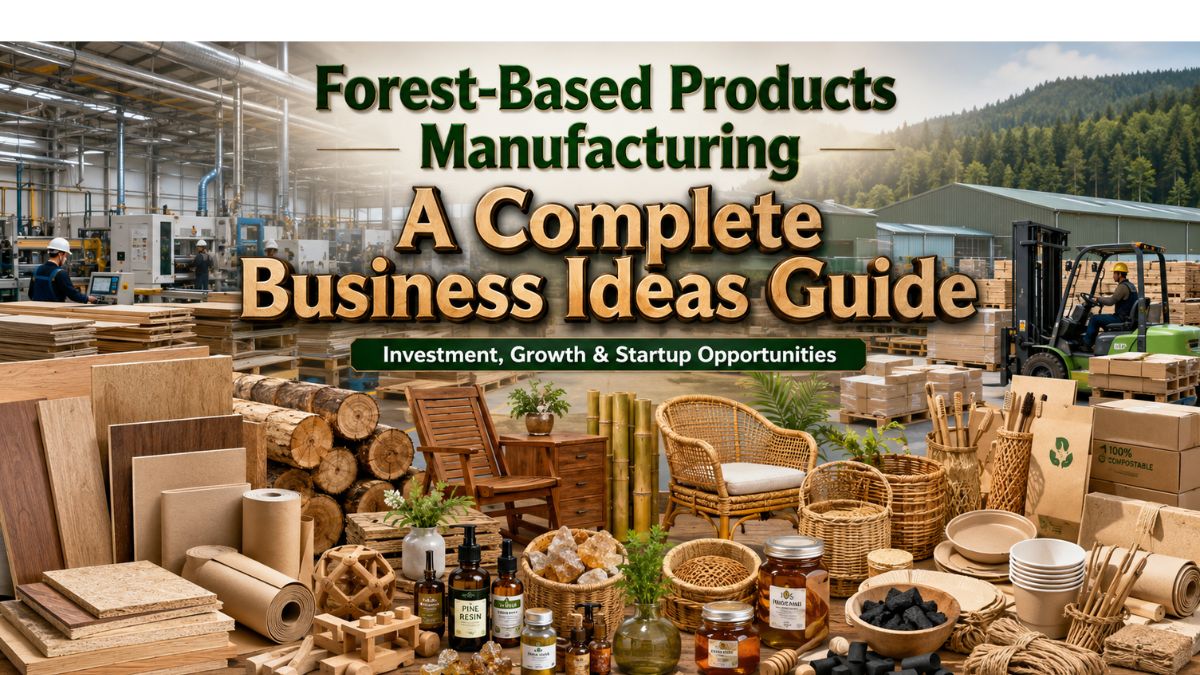
India has approximately 20% forest land and the produce of the forests has a direct impact on almost every home in India. Everything from plywood to paper, Ayurvedic extracts and Ayurvedic sticks (agarbatti) can be traced back to forest raw materials. This sector is a unique combination of good raw material availability, a stable domestic market demand, and a genuine export market, which makes it appealing for entrepreneurs looking for practical business ideas. Forest related manufacturing seems traditional and the many first-generation founders forget. But lately, that image is going out of the window. This article is about the importance of the sector, the government schemes that support it, and what really works in terms of business ideas.
Why This Sector Is Growing Fast
In the face of India’s modernisation, demand for forest-based products continues to grow. Wood, bamboo and non-timber forest produce is used as raw materials in the furniture, packaging, paper and personal care industries etc. In addition, India is a significant importer of wood and pulp, thereby reducing the price pressure on domestic manufacturers as compared to other industries for their products. Also, with the move to a single-use plastic ban and off, packaging manufacturers are turning to paper and bamboo packaging. Consequently, sustainable forest products continue to be in steady demand.
A Raw Material Advantage Few Countries Can Match
India is the second largest diversity country of the world and has almost 14 million hectares of bamboo cover. This provides the manufacturers with a raw material basis which few other competing countries can boast. In the same way, the non-timber forest produce like lac, sal seed, mahua and tendu leaves provides niche manufacturing which does not require large quantities of imported inputs. As a result, working capital needs remain low and profit margins remain fairly stable despite general increases in the cost of inputs.
Rural Employment Meets Industrial Scale
Forest based manufacturing is applicable to both micro units and large factories. A bamboo craft unit can be operated by one artisan in a village shed, and a larger promoter can establish a plywood or paperboard unit. This flexibility is also good for banks and government schemes to consider the sector as a real source of employment; therefore, it increases the chances of approving loans to new entrepreneurs.
Government Policies Supporting New Businesses
The government has created a genuine helping system for entrepreneurs to take to forest based manufacturing. However, if you know the right scheme, it’s more important than just knowing that you have a scheme available.
National Bamboo Mission
The National Bamboo Mission under the Ministry of Agriculture provides financial support to the manufacture of products, primary processing units and nurseries. It also helps in skill building of entrepreneurs in the furniture, Agarbatti stick and handicraft sector. As the mission is in close collaboration with the Ministry of MSME, the applicants are frequently provided with both raw material assistance, and manufacturing subsidy.
Van Dhan Vikas Yojana
The Van Dhan Yojana of TRIFED has specifically targeted the tribal entrepreneurs engaged in minor forest produce like honey, lac and medicinal herbs. Van Dhan Kendras are Village level processing centres that are funded under the scheme. This program significantly reduces the upfront capital requirement for tribal cooperatives, especially for founders.
PMEGP and MSME Support Schemes
In order to promote new manufacturing enterprises including forest-based enterprises, the Prime Minister’s Employment Generation Programme provides subsidy-linked loans. In the meantime, Udyam registration with the Ministry of MSME allows collateral-free loans from CGTMSE, priority sector finance, and delayed payments. It is thus, one of the best initial steps a founder can take, to register as an MSME, early.
Support Through DPIIT and Make in India
The Department for Promotion of Industry and Internal Trade attempts to promote domestic manufacturing under the Make in India initiative, which covers ease-of-doing-business reforms that include those for the wood, paper and bamboo processing units. Further, technical consultancy is also available in the paper sector from various sector related institutions like Central Pulp and Paper Research Institute.
Multiple Business Ideas for Startups
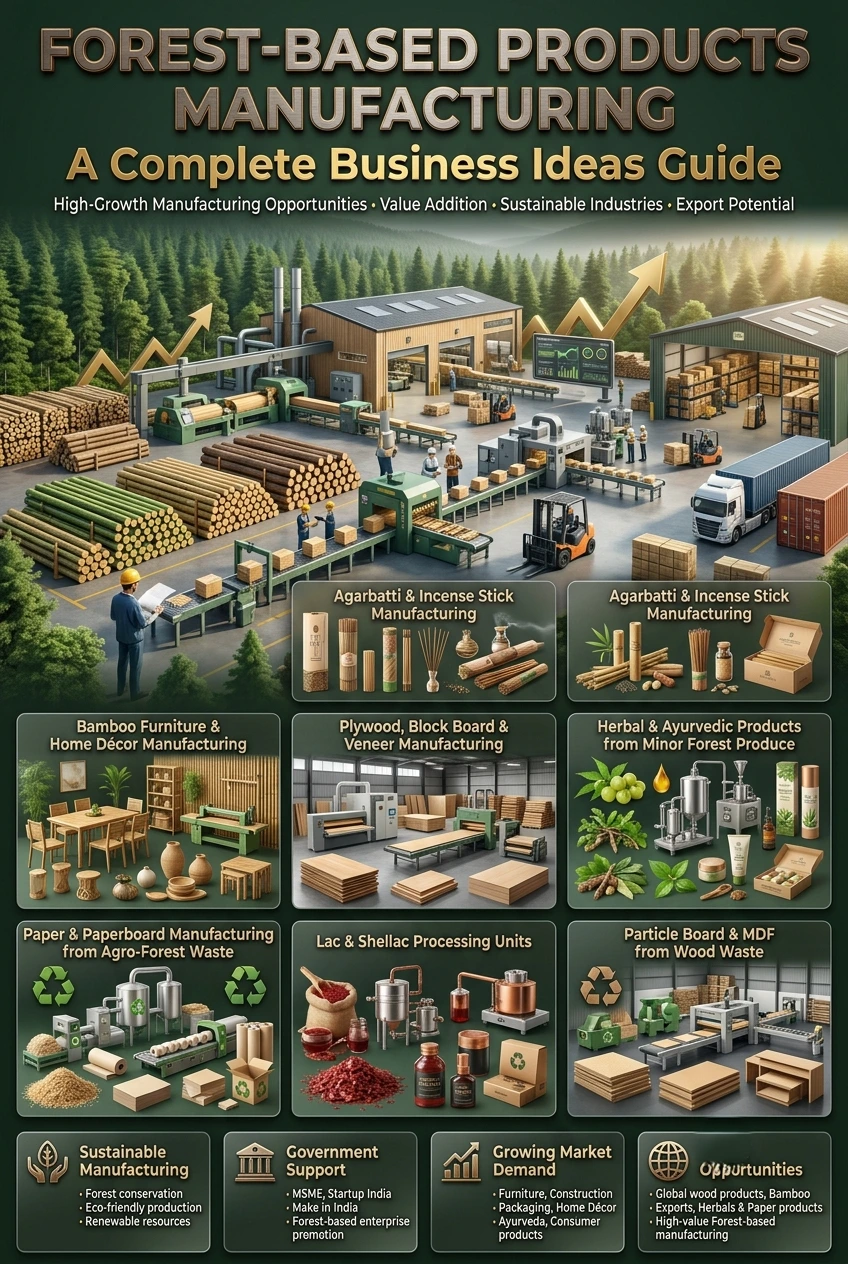
Not all forest business requires huge sized factory unit and huge investment. The small-scale business ideas listed below are from the smaller artisan enterprise level to the mid-scale industrial enterprise level, allowing the business owner to select one based on budget and market access.
Bamboo Furniture and Home Decor Manufacturing
The manufacture of bamboo furniture has come a long way from baskets and stools. The bamboo dining set, bamboo partition and bamboo lighting fixtures, all of which blend sustainability with modern design, are now sought after by urban buyers. The minimum equipment needed to do this job is a simple workshop, a few basic pieces of treatment equipment to prevent fungal decay and two or three trained artisans. Unlike hardwood, it is easy to predict the raw material supply since bamboo grows within 3-5 years. Furthermore, the National Bamboo Mission fully funds the primary processing units, and this significantly decreases the initial cost.
European and American export buyers are more inclined to purchase bamboo products than plastic and metal products, and the reason is because they are more conscious of sustainability issues than bamboo and plastic products. This section is a unique combination of low capital entry, government support and a real growing export channel for a new entrepreneur. This is a possibility of having modular bamboo housing panels scaled later when the core furniture line is stabilized.
Related Article: The Bamboo Billionaire: How a Manipur Tribal Entrepreneur Created a Global Eco-Furniture Brand
Plywood, Block Board and Veneer Manufacturing
Plywood continues to be one of the biggest and more stable forest-based manufacturing sectors in India. A stable supply of plywood and block boards is crucial for the real estate market, for the demand to make modular kitchens and for the export of furniture. A mid-scale unit requires a hot press, a veneer peeling machine and a reliable wood or poplar supply chain. The cost of any investment for a small plant begins from ₹50 lakh to ₹1.5 crore depending on the planned capacity. New entrants may find success to start in the regional or budget market, before competing in the more premium market dominated by branded products like Century Plyboards or Greenply.
Furthermore, plantation woods like poplar or eucalyptus are used instead of woods used from the natural forest, making the business compliant and truly sustainable. Those founders who monitor quality control and adhere to the same glue-bonding standards are able to develop repeat business with furniture manufacturers and contractors relatively quickly.
Herbal and Ayurvedic Products from Minor Forest Produce
A wide variety of medicinal and cosmetic raw materials come from India’s forests, including amla extract, sal extract, tendu extract, and the mahua extract. Under Van Dhan Yojana, a manufacturing unit to manufacture herbal oil, Ayurvedic tablets or natural cosmetic can obtain this raw material directly from the tribal cooperatives. This way it is easy to control expenses and create a truly sustainable narrative that today’s consumers are receptive to.
The demand for natural personal care products continues to grow in domestic and export markets, resulting in strong pricing power in this segment. Founder should have the basic extraction and processing machinery, FSSAI/Ayush license (according to the product category) and a quality testing arrangement. Associating with a Van Dhan Kendra for sourcing raw materials also assures additional government support and significantly minimises the risk at the initial stage of the business.
Read the Complete Book Here: Handbook on Herbal Products (Medicines, Cosmetics, Toiletries, Perfumes)
Agarbatti and Incense Stick Manufacturing
The round sticks of bamboo are an important requirement of the agarbatti industry for which India is still importing substantial quantities. The absence of this creates an opportunity for local manufacturers to expand their business with a good idea. The bamboo stick and agarbatti rolling unit involves a bamboo stick manufacturing machine, a rolling and drying system, and the availability of dependable supply of bamboo from farmers supported by the missions. The National Bamboo Mission has a dedicated tracking portal of the units of agarbatti, so that new players can get raw material information and support earlier than before.
The business is also a good fit for rural clusters as it creates employment for local residents – particularly women – resulting in a more sustainable rural economy. Later, adding a fragrance blending unit to the production will enable the founder to move up the value chain from raw sticks to branded finished agarbatti, which will have significantly higher margins.
Paper and Paperboard Manufacturing from Agro-Forest Waste
Demand for paper-based packaging has surged after the ban on single use plastic. Bamboo pulp can be used in a manufacturing unit to produce kraft paper, specialty packaging boards, or corrugated boxes, depending on the manufacturing process, using bamboo pulp, agricultural residue or recycled fibre from forests. Due to the ban on some plastic goods and packaging materials, packaging companies seek suppliers of paper-based goods and packaging materials. Medium sized to large paper units require pulping equipment, a paper machine, and a reliable supply of raw fibre. Founders can avail technical support from the CPPRI, Saharanpur for selection of appropriate process and machine for their desired grade.
Since specialty and coated paper grades are more import-dependent, those entrepreneurs interested in specialty grades may be better suited for the margins and less competition from large integrated mills than those interested in commodity paper.
Get Detailed Project Report (DPR): Paper Products Manufacturing Guide
Lac and Shellac Processing Units
Though India is still the largest producer and exporter of lac and shellac, the processing facilities are still inadequate in many tribal belts in comparison to the raw production. A shellac processing unit is used to refine the raw stick lac into shellac which is used in cosmetics, food glazing, electrical insulators and wood polish. The basic crushing, washing and melting equipment is required to set up this unit, also continuous supply tie-up of the growing area of lac in the rural areas of Jharkhand, Chhattisgarh, and West Bengal.
The IBEF sector data shows that India is the biggest exporter of Guar Gum and Shellac in the world, thus providing new manufacturers a ready market as opposed to having to create one from scratch. This niche is ideal for business owners who want to be more focused and export their product versus playing a wide domestic game.
Particle Board and MDF from Wood Waste
There are significant amounts of wood waste generated at sawmills and furniture units which are not put to use. This waste can be transformed into a marketable panel product with a particle board or medium-density fibre board unit which can be used for agricultural residues such as rice husk or bagasse. In both urban and semi-urban markets, the consumption of particle board has been on the rise, with the demand for construction and modular furniture continuing to rise. This unit requires a chipper, a resin mixing system and a hot press, and may require a greater investment than a simple plywood unit as it involves the use of specialised equipment.
Founders which tie up with local sawmills and agro-processing units for supplying of the waste can have low and predictable raw material costs. It also meets increasing circular-economy targets, increasingly important for institutional buyers and government tenders that favor sustainable sourcing certifications.
Import–Export Opportunity Analysis
The forest-products trade of India is a fascinating subject. The country is a net importer of wood pulp and paper and is a net exporter of lac, shellac, guar gum and handicrafts. In fact, this imbalance is the best indicator for new manufacturers to look at the best market gaps.
IBEF data also indicates that India continues to be the top exporter of guar gum, shellac and 2nd largest exporter of medicinal plants in the world. Demand for wood-carved goods from Saharanpur and the northeast is also steady in the U.S. and U.K. A foundry that focuses on handicrafts, lac or herbs can thus be connected to an existing export chain rather than create a new one.
India imports hundreds of millions of dollars’ worth of wood pulp, solid wood products and special paper grades annually. This is a real opportunity for local paperboard and pulp producers, particularly in coated, pharmaceutical-grade and hygiene paper, which continue to have the highest dependency on imports. By analysing the information on imports before selecting a product line, entrepreneurs can put their business in a good position to replace imports, instead of only competing with local businesses that are already saturated.
Indian MSME Success Stories
Century Plyboards and a Backward-Integration Story
The Century Plyboards started with a small business of selling Plywood and later grew them into one of the biggest plywood manufacturing firms in India, by Sajjan Bhajanka and his family. The trading company’s thinking was based on backward integration, where the emphasis was on procuring veneer, manufacturing laminate and MDF and investing in its own production facilities. This meant that they were less reliant on third-party suppliers and had better quality control throughout their product lines.
The lesson remains easy for new entrepreneurs. Focused at the beginning but invest early profits in the control of more of the supply chain. The diversification from related into unrelated sectors was not the only option available to Century, as an example of a forest-based manufacturer diversifying in a different end product within the same raw material base.
Greenply Industries and the Branding Push
Greenply Industries built its name by treating plywood, historically a commodity product, as a brand. Under the Mittal family’s leadership, the company invested heavily in advertising, quality certification, and a dealer network that smaller manufacturers had largely ignored. This decision paid off because customers began asking for Greenply by name instead of buying generic plywood. The lesson for new founders is that even traditional forest-based products can support strong branding when quality stays consistent. A regional manufacturer does not need Greenply’s scale to apply this logic; a recognisable local brand name can build similar customer loyalty within a district or state market.
Ranga Rao and Cycle Pure Agarbathies
Cycle Pure Agarbathies – Born out of N. Ranga Rao in Mysuru, the business started out small with family incense production and then expanded to become one of India’s better-known agarbatti brands. The founder’s main insight was standardising fragrance quality, but staying committed to old methods of rolling incense sticks using a bamboo core.
Rather than breaking down the artisan production model, Rao expanded production by improving process, rather than by centralizing and over-mechanizing.
For nascent founders of forest product businesses heavily reliant on artisans, this demonstrates an avenue to scale nationwide without compromising on their origins and artisanal value proposition. A direct takeaway for today’s entrepreneurs in the agarbatti and handicraft industry is to safeguard that artisanal customer trust, and scale sourcing and distribution around it rather than rushing into over-mechanisation too early.
Choose the right startup backed by real market demand
About NPCS: Feasibility Support for Forest-Based Ventures
Turning any of the business ideas above into a bankable venture requires more than enthusiasm; it needs a proper feasibility study. This is where Niir Project Consultancy Services (NPCS) supports entrepreneurs. NPCS prepares detailed Market Survey cum Techno-Economic Feasibility Reports for setting up forest-based and other manufacturing units. Such reports will outline manufacturing processes, market research & demand forecasts, process flow charts, product mix & capacity plan, machinery & raw materials requirements, and detailed project financials & profitability calculations.
If you are an entrepreneur with absolutely no prior experience of starting business, the type of report that can make or break your loan application at a bank is this kind of financial document. A bank will expect details like detailed, realistic projected figures and an experienced consultancy during the planning process can save you costly mistakes down the line.
Forest-Based Products Manufacturing: Data Snapshot
The table below summarises key numbers across major forest-based manufacturing segments, useful for quick comparison while evaluating business ideas.
| Segment | Approx. Market Size / Scale | Growth Outlook | Key Raw Material |
| Shellac and lac products | Around US$165 million market | Steady, modest CAGR | Stick lac |
| Bamboo sector (overall) | Over ₹25,000 crore industry | Rapid, mission-backed growth | Bamboo culms |
| MSME manufacturing (all segments) | Around 35% of manufacturing output | Consistent expansion | Diverse |
| Paper industry contribution | Around ₹8,000 crore tax revenue; 5+ lakh jobs | Growing with packaging demand | Wood pulp, agro residue |
| Forest product imports | Around US$666 million | Import-substitution opportunity | Wood pulp, solid wood |
Frequently Asked Questions
How much investment does a small forest-based manufacturing unit need?
The investment amount differs significantly between product industries. The approximate investment for setting up a bamboo craft or agarbatti rolling unit may range from 5 lakh to 15 lakh. A unit for plywood or paper board will be 50 lakh and can go up to several crore depending on your production capacity.
Which government scheme suits a bamboo-based business best?
Surely, the National Bamboo Mission stands at a closest, due to its support, in setting up nurseries, processing plants, and production units which specifically go to bamboo entrepreneurs.
Do I need a forest department license to manufacture forest-based products?
It depends on where the timber comes from: Wood that comes from farmed forests such as poplar or eucalyptus or farmed timber such as bamboo requires less documentation than that that the timber used from a wild and undisturbed forest requiring transits, and state forests acts.
Is export demand realistic for a new entrant, or only for large companies?
With support from export promotion councils to provide them with market intelligence and access to trade fairs, even units manufacturing small items from categories of goods such as shellac, handicrafts and herbal extracts, have realistic export opportunities.
Which forest-based business idea has the lowest entry barrier?
Bamboo craft, agarbatti sticks making, some simple herbal units represent entry to manufacturing generally with minimum risk/requirement in machines and scale. A household level or cluster level production is quite possible in such case.
How do I know if my business idea is financially viable before investing?
To really understand how technically possible a new business idea is, prior to invest any significant money and risk money a techno-economic feasibility study would be more efficient that would cover machinery capital expenses, raw material suppliers, target market size as well as profitability projections.
Conclusion
Manufacturing of forest-based products is an exciting space in the Indian manufacturing story. Raw material supply chains remain abundant, new players have ample support from the government scheme, and the import data offers large opportunities for Indian manufacturers. Whether it is a founder manufacturing bamboo furniture, plywood, herbal extracts, agarbatti, paper or shellac – this sector provides a great advantage to those who can marry old knowledge of raw materials and supply chains with new age quality parameters and branding.
Century Plyboards, Greenply, Cycle Pure Agarbathies’ growth story follows this paradigm – find one focused value chain, add quality and infrastructure to supply chains and grow systematically.
A founder exploring manufacturing business ideas today cannot afford to simply dismiss this sector, the feasibility study on these products would bring a refreshing perspective on manufacturing business opportunities, ensuring consistent rural employment and good long-term growth prospects for the business.


