





Global buyers India manufacturers
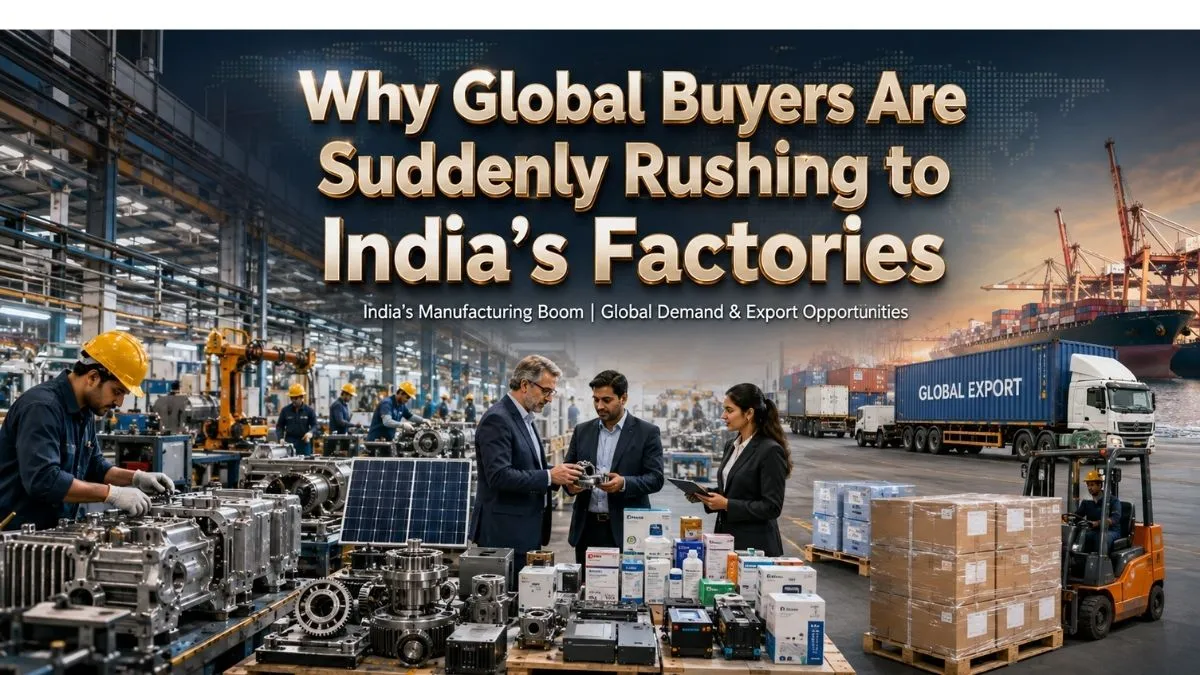
The world’s biggest manufacturing buyers are changing the way they plan their supply chains, and the name of the change is China+1. Initially it was a risk management exercise, ensuring that no complete product line was wagered on a single country. It has now evolved into more of a restructuring of global sourcing, and India is one of its biggest beneficiaries. Over half of U.S. executives surveyed believe that they will be sourcing or manufacturing more in India in the next five years.
From Contingency Plan to Default Strategy
China’s infrastructure and supplier density and its sheer production scale for more than 20 years made it the obvious first choice in essentially every product category. The dominance remains unaffected: China still contributes around 35% of the value-add of manufacturing, comparable to the contribution of the US, Germany and Japan. That dominance is complemented by a risk calculus which has changed. Diversification has moved from a ‘boardroom discussion’ to now a necessity for just about every multinational manufacturer given sustained trade tension between the US and China, growing wages in the coastal manufacturing provinces and lessons learnt from supply chain fragility in the pandemic.
India, Vietnam and Mexico have become the three biggest winners of this trend, each of which are best positioned to serve different buyers’ needs: Vietnam for its low labour costs and proximity to China’s component supply chains, Mexico for its USMCA nearshoring to North America and India for manufacturing scale and rapidly expanding electronics manufacturing capability. Of the three, India is the only place with a wide range of manufacturing industries, as well as huge domestic market size, making it more of an attractive option for buyers who are not only looking for a cheaper option than China, but someone who can provide them with a more varied choice than just electronics.
Related Article: Manufacturing Business Ideas for Export in India: How Indian Brands Are Going Global
The Numbers Behind the Shift
The manufacturing sector in India added around USD 447 billion to the GDP growth in 2024 and with a national industrial policy of 25% of GDP, the manufacturing sector has been brought into the spotlight. Electronics has been the league leader with production crossing ₹13.11 lakh crore in FY26, with cumulative investment in the Production Linked Incentive (PLI) scheme for large scale electronics manufacturing exceeding ₹20,600 crore, and cumulative production in the scheme alone exceeding ₹11.62 lakh crore, exports of which are over ₹6.53 lakh crore.
Electronics exports specifically climbed to roughly $22.2 billion in the first half of FY26, a 42% year-on-year increase, putting the sector on track toward a government target of $300 billion in electronics production and $120 billion in exports. Across all PLI-covered sectors combined, investment has surpassed ₹2.16 lakh crore, generating over 14.39 lakh direct and indirect jobs and average annual export growth of around 10.6% between FY21 and FY25.
Which Sectors Are Actually Moving
| Sector | What’s driving the shift |
| Electronics & mobile manufacturing | PLI incentives, Apple supply chain diversification (Foxconn, Pegatron, Tata Electronics expansion) |
| Auto components | Cost competitiveness plus PLI incentives across 14 sectors including automobiles |
| Pharmaceuticals & APIs | Import-substitution push and existing generic drug manufacturing base |
| Textiles & leather/footwear | Duty-free input schemes and extended export timelines introduced in Budget 2026-27 |
| Industrial & precision components | Semiconductor ancillary demand plus broader electronics component localisation |
What’s Actually Different This Time
Previous rounds of diversification-away-from-China discussion did not always result in actual volumes — buyers were looking around, but for some, the pressure subsided and they remained with their Chinese suppliers. In the current cycle, the change is being supported by structural policy changes from both sides—the Electronics Components Manufacturing Scheme (ECMS) aims to boost the value addition of components in the country from about 19% to 30% over four years, as against the erstwhile mobile phone PLI scheme, which was more of a financial support mechanism.
This is significant as it indicates that India is not just a manufacturing hub where components are imported and then assembled into products, but is also fostering an ecosystem of components for indigenous manufacturing that would make the supply chain resilient rather than just re-located. The policy direction is clear and is designed to enhance the latter question, ‘how much of this can you actually make here?’, in the coming years, as buyers are increasingly questioning whether they can assemble it.
Read the Complete Book Here: Book
The Honest Caveat: Execution Still Varies
None of this means every Indian manufacturer is automatically export-ready. Sourcing specialists working directly with global buyers are candid that success in India “is not automatic” and “demands local intelligence, structured quality control, and disciplined execution from day one”. The most resilient global sourcing strategies emerging in 2026 aren’t binary China-versus-India choices — they’re India-plus-China strategies where each geography contributes according to its strengths, with India integrated deliberately into specific product categories rather than treated as a wholesale replacement.
For an Indian manufacturer, it is the opportunity and the bar that is both: global buyers are actively searching for alternatives, but they are comparing the quality, documentation and consistency with which many have worked for 20 years with the Chinese market — and they are not comparing it with what they have experienced in the domestic market.
How Buyers Are Actually Finding Indian Suppliers
The one structural change to note is that sourcing itself has gone digital. Today the Cloud manufacturing platforms allow international buyers to access manufacturers’ profiles, receive instant quotes within 24 hours, and validate capabilities and certification remotely, rather than the long in-person vetting trips that were once required prior to starting a new supplier relationship. For a medium-sized Indian manufacturer, this means that a first-time global buyer’s first impression will now likely be of a company’s documentation, certifications, and professional online presence, rather than their factory or products.
What This Means for a Manufacturer Deciding Whether to Chase Export Orders
The most realistic first move towards securing China+1 demand, for a unit whose only object is to sell locally, is making sure the documentation is of a consistent quality, the standards are relevant (ISO and industry-specific, such as IATF 16949 for auto components, or WHO-GMP for pharma), and the history of on-time, on-spec delivery is documented and verifiable by a buyer who has never visited the unit in person.
Buyers that are pursuing a true China+1 diversification are actively seeking this type of supplier — the type that they can rely on, is properly documented and easily assessed remotely, because otherwise they’re taking on the very risk they are looking to diversify away from is the one they are trying to create with a new supplier that has no documentation history.
Get Detailed Project Report (DPR): Detailed Project Report (DPR) Consultants in India
Where India’s Component Gap Still Bites
The semiconductor and electronics component space is the best example of the actual but not finished diversification opportunity in India. India semiconductor industry is expected to grow to ₹5,44,572 crore (US$63 billion) by 2026, but still a significant portion of the semiconductors, PCBs, and precision components used for electronics manufactured in India are still imported. That’s the space where schemes such as the India Semiconductor Mission and Electronics Components Manufacturing Scheme will incentivize manufacturing in the coming years — and where the most long-lasting manufacturing opportunities remain for entrepreneurs entering the market today, not in the final assembly, but in the component level, which still has a significant gap to be filled.
It is becoming increasingly apparent to buyers that this is the difference in the case of serious diversification programmes. A supplier that can only provide end assembly of imported parts is a shallower protection against supply chain risks than a true component supplier because either way a disruption to the supply chain will impact the buyer. Pure assembly firms tend to lose the loyalty of their customers quicker than manufacturers who can prove they can integrate back. Manufacturers with some level of real backward integration are more likely to retain customers’ loyalty.
What Sector Leaders Are Actually Saying
The electronics industry has seen its value increase by six times in a decade, from approximately $21.4 billion in 2014-15 to $125 billion in 2024-25, while the proportion of electronics’ contribution to India’s total export basket has increased from 3% to 10% during the same period. Industry leadership is perhaps more of a decade-long pressure that has now reached a point where global buyers are no longer considering India as a viable alternative, but rather, a viable base for entire product lines.
Build a profitable business with the right idea
How NPCS Can Help You Get Started
Getting export orders is not just about your ability to make products, it’s all about your documentation, your readiness to be certified and a project report that your foreign buyer’s procurement and compliance teams can handle. NPCS develops export oriented Detailed Project Reports (DPRs) and feasibility studies incorporating the certification route (ISO, Sector specific standards such as IATF 16949 or WHO-GMP), realistic capacity planning based on export order volumes and financial models that consider export incentive schemes.
Business opportunities include: Contract manufacture and OEM-ready production of auto components, electronics assemblies, precision engineering components for export; ISO/IATF certified precision machine shops for various anchor industries (auto, semiconductor ancillary, aerospace); Export-oriented textile and technical fabric plants for EU/UK tariff advantageous export categories; Pharmaceutical intermediate and API manufacture, and testing and quality certification laboratories for multiple anchor businesses in one industrial cluster.
The Bigger Pattern
China+1 is not a short-term geopolitical flash in the pan that fades away once the trade war is over. It is a new mindset of global manufacturers in thinking “concentration risk” and India is therefore becoming the primary structural beneficiary (it is not a claim that Indian manufacturing has become the world’s cheapest but it is the combination of scale, policy support and depth of the component ecosystem that no other destination could offer anywhere else).
It’s open and it’s big enough for large PLI scale manufacturers, and for mid-sized first-generation exporters, but it’s not open for eternity. Individuals who successfully diversify their suppliers also tend to retain them for years, rather than quarters, leaving the manufacturers who manage to get in on the action with a disproportionately large amount of the durable, repeat business. If, when a buyer needs the information, the basics — certification, documentation and consistency — are not in place, then it’s up to individual manufacturers to catch a piece of that when it’s offered.


