





Sulphuric Acid Market in India
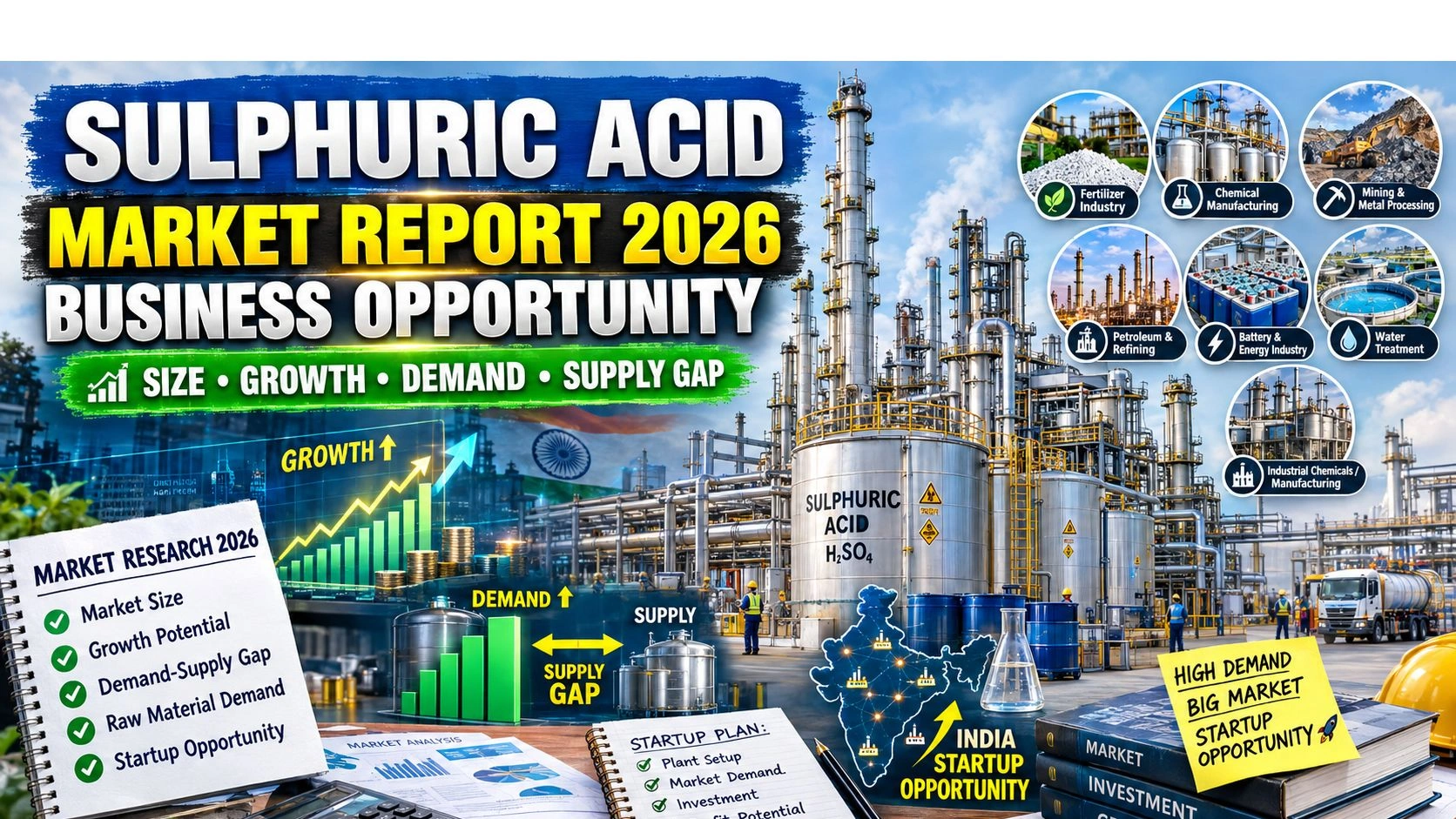
There is hardly anyone who pays attention to sulphuric acid alone — it is the chemical that does all the work. Sulphuric acid is used in almost all of the significant industrial value chain in India, including fertilizers, metal processing, batteries, water treatment, refining, etc. And 2026 has been quite a year for the category as a whole, as a real global shock to the sulfur feedstock market has coincided with the transition in India towards battery-grade and semiconductor-grade acid production. To an entrepreneur, that is a combination of basic demand and evolving supply base that’s worth studying.
Get Detailed Project Report (DPR): Sulphuric Acid Manufacturing Project Report
What Is Sulphuric Acid?
Sulphuric acid (H₂SO₄) is a colourless, corrosive inorganic acid, and is one of the largest volume industrial chemicals produced on Earth, produced mostly by the contact process (and its optimised variant, the Double Contact Double Absorption or DCDA process), using either elemental sulphur, pyrite ore, or smelter off-gas. Its industrial significance is related to an extremely broad range of end-use industries, as an intermediate product:
- Phosphate fertilizers – the highest consumption in the whole world and in India for producing phosphoric acid for DAP (diammonium phosphate), SSP (single super phosphate) and other phosphoric acid fertilizers.
- Metal processing and metallurgy – copper and zinc leaching/refining, steel pickling, base metal smelting
- Civil engineering – plastics, rubber, asphalt, cement, concrete products, and foundry, refractories, and other metal products
- Petroleum refining – alkylation and other refining processes
- Lead-acid batteries – and, more particularly, battery-grade high purity acid for lithium ion and EV battery material production – battery manufacturing
- Semiconductor and electronics manufacturing – ultra-high purity acid for silicon wafer cleaning
- Water treatment – pH control; pulp and paper; textiles – pH control, bleaching, processing applications
Sulphuric acid comes in several grades based on purity, application and market size, with industrial grade being the largest market share (accounting for more than 95% of global usage), reagent grade, battery grade, and semiconductor grade being smaller markets and higher margins.
Global and India Sulphuric Acid Market Size and Growth
Estimates of the amount of acid produced range widely, depending on scope and methodology (some estimate only merchant or traded acid, others estimate all acid produced that is made in fertilizer complex facilities). 2026 global market-value estimates range between USD 14.5 billion and USD 36.6 billion, with the majority of estimates predicting continued growth in the early-to-mid 2030s between USD 20.8 billion and USD 52.9 billion, at an average of 3.3% to 5.3% CAGR. The global production of these materials in 2023 was over 260 million metric tonnes, with Asia Pacific representing more than 58% of production.
The domestic market is estimated to be about USD 528 million in 2025 and is expected to increase at a modest rate of ~1.29% by 2034 (low value growth, as sulphuric acid is a low-cost bulk commodity).
Note on figures: The size of the actual production and consumption volume of sulphuric acid is underestimated because it is a low valued bulk chemical. NPCS can create a customized techno-economic feasibility study, with grade (fertilizer/industrial or battery/electronic-grade) and capacity (investor grade numbers) being customizable.
The 2026 Sulfur Feedstock Shock
One structural development that needs to be highlighted directly is the severe constraint on global sulfuric acid supply as a result of the ‘triple shock’ on the sourcing of elemental sulfur, which makes up about 80% of the cost of sulfuric acid production, caused by disruption to the export of sulfur from the Persian Gulf via the Strait of Hormuz (roughly half of seaborne sulfur trade), combined with export restrictions from China, Russia and Turkey. This has led to an increase in the global price of sulfur and sulphuric acid, with Indian prices reaching approximately USD 99/MT in Q1 2026 as the phosphoric acid and DAP sector started to procure fertilizer before the kharif season begins.
This volatility of the feedstock has direct consequences for the Indian producers as well as for the cost of downstream fertilisers as India relies heavily on sulphur imports (more than 90% of the sulphur supply comes from imports to India for sulphuric acid production).
Policy Tailwinds
- Fertilizer sector budget support: The Government of India’s Department of Fertilizers budget allocation (over ₹1,91,000 crore in recent estimates) provides strong fiscal backing for the phosphate fertilizer value chain that anchors sulphuric acid demand.
- Significant capital investment in domestic capacity: IFFCO’s ₹400 crore, 1650 MTPD sulphuric acid plant at Paradip (Odisha) and Coromandel International’s ₹400 crore, 1.1 MTY sulphuric acid plant at Visakhapatnam (Odisha) are examples.
- Reducing dependence on importer for high value acid segment – Indian manufacturers are now producing custom-made, high purity electron grade sulphuric acid, thereby reducing the dependence on imports in this high value segment.
- Rock phosphate feedstock security agreements: Government-backed import arrangements (including from Mauritania) support new capacity for phosphoric acid reactors, which directly stimulate demand for sulphuric acid in the downstream.
- Capital subsidy for MSME and chemical cluster incentive: Incentive schemes for MSME capital subsidies and state incentive schemes for industrial clusters can be accessed for smaller size sulphuric acid units which serve the regional industrial clusters (metal finishing, textile processing, water treatment).
Explore This Book: Industrial Chemicals Technology Hand Book
India Demand-Supply Gap: Sulphuric Acid
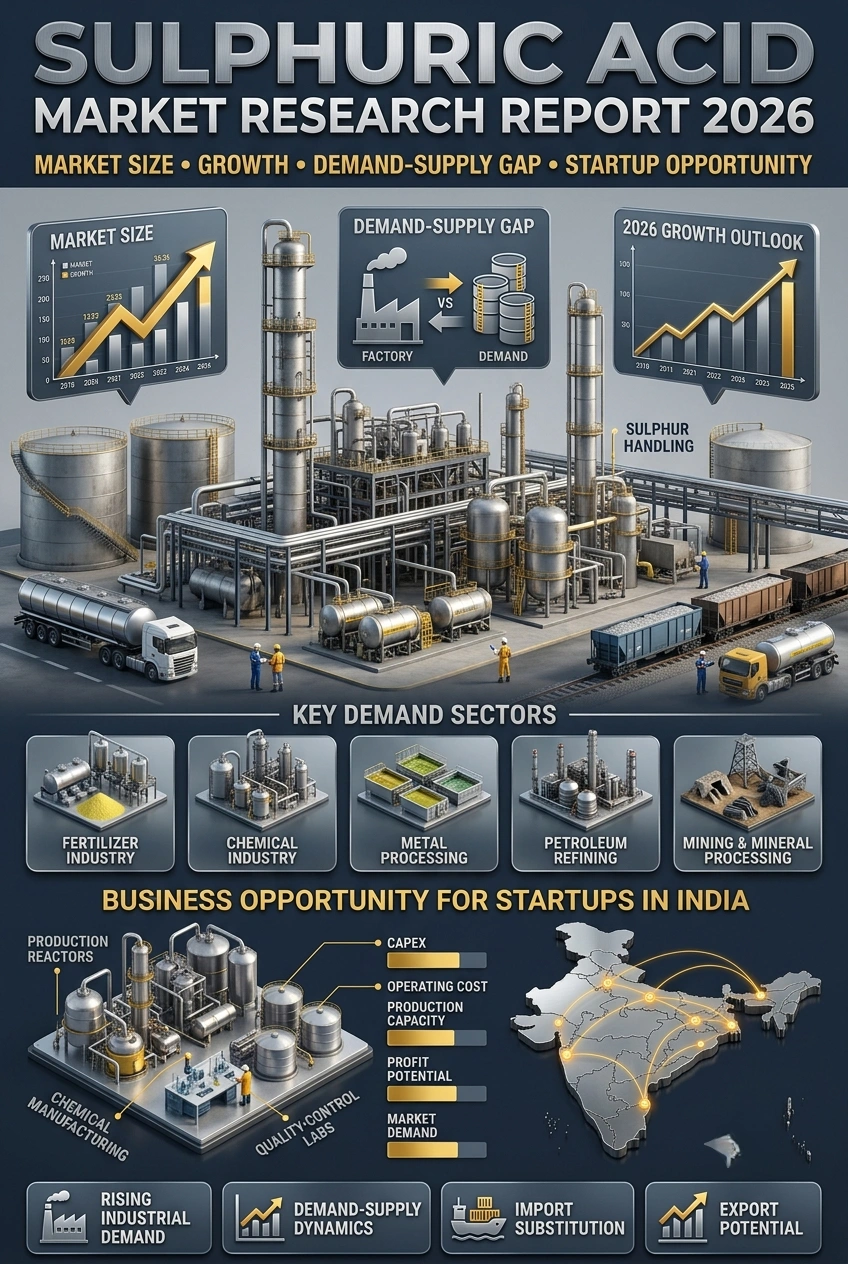
| Parameter | Current Position |
| Domestic production route | A mix of smelter acid (byproduct of copper/zinc smelting), captive fertilizer-complex acid, and merchant sulfur-route production — over 90% of India’s domestic sulphur supply is directed to sulphuric acid manufacture |
| Feedstock dependency | India relies significantly on imported elemental sulphur, exposing domestic production to the 2026 global feedstock volatility described above |
| Dominant application | Fertilizers account for roughly 42–60% of India’s sulphuric acid consumption depending on the study, driven by DAP and SSP production |
| Emerging high-value segment | Battery-grade and semiconductor-grade acid represents a small but rapidly growing segment where India has historically imported specialty high-purity grades, now being addressed by domestic capacity additions |
| Nature of the gap | A feedstock security and high-purity-grade capacity gap — India has strong bulk/fertilizer-grade production capability anchored to major integrated players, but remains more exposed on imported sulfur feedstock and on the newer battery/electronic-grade specialty segment |
| Opportunity for new entrants | Concentrated in regional merchant acid supply for metal processing/water treatment clusters, and in the emerging high-purity grade segment tied to India’s expanding electronics and battery manufacturing base |
Reading the gap: Bulk fertilizer-grade sulphuric acid in India is dominated by large, vertically-integrated fertilizer and chemical majors — not a segment where a new entrant competes easily. The more open opportunities sit at the edges: regional merchant acid supply to metal finishing and water treatment clusters not well served by large integrated producers, and the newer high-purity battery/semiconductor-grade segment where India is actively building capacity to reduce import dependence as its electronics and EV battery manufacturing sectors scale up.
Major Indian Sulphuric Acid Manufacturers
| Company | Base/Region | Route | Notes |
| Indian Farmers Fertiliser Cooperative Ltd. (IFFCO) | Paradip, Odisha (and other locations) | Fertilizer-complex integrated | Recently commissioned its SAP III sulphuric acid plant at Paradip, expanding domestic fertilizer production capacity |
| Coromandel International Ltd. | Visakhapatnam, Andhra Pradesh | Fertilizer-complex integrated | Commissioned a ₹400 crore, 1,650 MTPD plant in 2023, nearly doubling capacity to 1.1 million tonnes per annum for backward integration into phosphoric acid |
| Hindalco Industries Ltd. (Birla Copper) | Gujarat | Smelter acid (copper) | Major byproduct sulphuric acid producer from its copper smelting operations |
| Tata Chemicals Ltd. | Multiple locations | Integrated chemical production | Established Indian chemicals major with sulphuric acid manufacturing capacity |
| Gujarat State Fertilizers & Chemicals Ltd. (GSFC) | Gujarat | Fertilizer-complex integrated | Major public sector fertilizer and chemicals producer |
| Tanfac Industries Ltd. | Tamil Nadu | Specialty/industrial chemicals | Recognised Indian sulphuric acid and fluorine chemicals manufacturer |
| Aarti Industries Ltd. | Gujarat/Maharashtra | Specialty chemicals integrated | Major Indian specialty chemicals company with captive sulphuric acid production |
| Khaitan Chemicals and Fertilizers Ltd. | Uttar Pradesh | Fertilizer-complex integrated | Established regional fertilizer and chemicals producer |
| Sree Rayalaseema Hi-Strength Hypo Ltd. | Andhra Pradesh | Merchant/industrial | Recognised Indian merchant sulphuric acid and chlor-alkali producer |
| Paradeep Phosphates Ltd. | Odisha | Fertilizer-complex integrated | Major Indian phosphatic fertilizer producer with sulphuric acid capacity |
Major International Sulphuric Acid Players
| Company | Country | Notes |
| The Mosaic Company | United States | Major global fertilizer and phosphate producer with substantial integrated sulphuric acid capacity |
| Chemtrade Logistics Inc. | Canada | Major North American merchant sulphuric acid and sulfur products producer |
| BASF SE | Germany | Global chemicals major, including new semiconductor-grade sulphuric acid capacity at its Ludwigshafen facility |
| AkzoNobel N.V. | Netherlands | Major global specialty chemicals company with sulphuric acid production |
| Ecovyst Inc. (Eco Services) | United States | Major North American merchant sulphuric acid producer, recently expanded via acquisition of production assets in Louisiana |
| PVS Chemical Solutions | United States | Recognised North American merchant sulphuric acid producer and distributor |
| Nornickel | Russia | Major global metals producer with substantial byproduct sulphuric acid capacity from its smelting operations |
| Sumitomo Chemical Co. Ltd. / Sumitomo Corporation | Japan | Major Japanese chemicals conglomerate, recently expanded its US sulphuric acid business via acquisition |
Market Segmentation
By Raw Material
- Elemental sulphur (dominant route, ~53% share) — cost-efficient but exposed to feedstock price volatility
- Pyrite ore
- Smelter/byproduct acid (copper, zinc smelting)
By Manufacturing Process
- Single Contact Process
- Double Contact Double Absorption (DCDA) — increasingly preferred for higher conversion efficiency and lower emissions
Access Complete Business Plan: Setting Up a Sulphuric Acid Plant: A High-Growth Opportunity for Emerging Entrepreneurs
By Concentration/Grade
- Standard industrial grade (93–98 wt%)
- Oleum/fuming acid
- Battery grade
- Semiconductor/electronic grade (highest purity, smallest but fastest-growing segment)
By Application
- Fertilizers (DAP, SSP, phosphoric acid) — largest segment
- Metal processing and metallurgy (copper/zinc leaching, steel pickling)
- Chemical manufacturing (dyes, LABSA detergents, explosives, pigments)
- Petroleum refining
- Battery manufacturing (lead-acid and EV/lithium battery materials)
- Water treatment, pulp and paper, textiles
Key Growth Drivers
- The long-term need for phosphate fertilizers. The major downstream applications of sulphuric acid are in the production of DAP and SSP, which are underpinned by consistent demand from India’s large agriculture base, and government subsidy programmes for DAP and SSP.
- Growth of supply chain for batteries and EVs. Increasing lithium-ion battery and EV component production in India is driving new demand for high-purity battery-grade sulphuric acid, which has, until now, been largely met by imports.
- Growth in semiconductor and electronics manufacturing. In India, the increasing aspirations of the semiconductor fabrication industry to produce semiconductors demands the use of ultra-high-purity sulphuric acid for wafer cleaning, which is a new business opportunity for domestic manufacturing under the Make in India initiative.
- Growth of metal processing and mining industry. Steady acid usage for metal leaching and refining is driven by rising demand for copper, zinc, and other base metals for infrastructure, EV, and renewable energy applications.
- Investment in water treatment and environmental compliance. Steady acid demand for pH control and neutralisation is provided by the growth of municipal and industrial wastewater treatment infrastructure investments.
Related Article: Sulphuric Acid: Production, Uses, Safety & Market Trends
Challenges and Restraints
- Sulfur feedstock price and supply volatility. The Indian sulfur producers who rely on imported sulfur are directly affected by the 2026 global shortage of sulfur, due to probable disruption of the Gulf sulfur trade, and export bans imposed by significant suppliers.
- Extremely corrosive and hazardous handling requirements. The production and transport of sulphuric acid is a very complex and costly process and involves compliance with strict regulations, which makes it very difficult for new producers to enter the market.
- The need to increase the proportion of capital to labor in high-purity grade production. The grade of the acid which is used for batteries or semiconductors is very high and the technology is very special, involving highly advanced filtration and distillation.
- High level concentration of the market. The opportunity for new entrants in bulk sulphuric acid is less due to the dominance of large integrated fertilizer and metal companies.
- Environmental and emissions laws. The SO2 emission control requirements mean compliance cost and can restrict flexibility of capacity increases in existing and new producers.
Competitive Landscape
The sulphuric acid industry in India is structurally dominated by large scale vertically integrated fertilizer companies (IFFCO, Coromandel, GSFC, Paradeep Phosphates), smelter-by-product companies (Hindalco/Birla Copper) and a small segment of the merchant/specialty chemical companies (Tanfac, Aarti Industries, Sree Rayalaseema) catering to industrial and export markets. This architecture leaves out real white space in two markets that are not adequately covered by the big integrated companies: regional merchant supply to metal finishing/water treatment clusters and the growing specialty market of batteries/electronic grade.
Sulphuric Acid Manufacturing: Business Opportunity for Startups and MSMEs
- Supply of sulphuric acid in the region. Demand from the metal finishing, water treatment and textile processing industry clusters may be captured by a smaller and less integrated plant that is best suited for the needs of a specific industrial area, because large integrated fertilizer producers tend to target their captive consumption.
- High purity battery grade acid production. In India, with the growth in the number of EV and battery production facilities, it has become imperative to invest in the production of battery grade acid in the country to cater to the needs of the segment, which has always relied on imports.
- Semiconductor/electronic-grade acid manufacturing. Ultra-high-purity acid production is a smaller volume, but a higher margin business opportunity for a technically capable player as India’s semiconductor fabrication aspirations come to reality through national policy initiatives.
- Sulphur/sulfur-dioxide byproduct recovery integration. For entrepreneurs in metal smelting or refining-adjacent industries, integrating sulphuric acid production as a byproduct recovery stream can convert an environmental compliance cost into a revenue-generating co-product, following the model of established smelter-acid producers.
- Specialty acid grades for specialty chemical manufacturing. A lower capital entry point for specific downstream chemical manufacturers (dyes, LABSA detergent producers, explosives manufacturers) to access the regional supply through grade-specific or logistics-advantaged routes would be more feasible than accessing the production of bulk fertilizer.
The assumptions for the investment, capacity and margin of sulphuric acid can be highly dependent on raw material route (sulfur-burning, smelter byproduct or pyrite) and target grade. NPCS prepares comprehensive Project Reports which include (based on your target machines, feedstock sourcing plan and market) grade-specific financial projections and route-specific list of machines.
Find the most profitable startup for your investment range
How NPCS Supports Entrepreneurs Entering This Space
The first step of any entrepreneur in considering a sulphuric acid manufacturing project is to have a proper Detailed Project Report (DPR) that will cover several aspects concerning the plant capacity, selection of production process (Contact process or DCDA), sourcing of raw material, manpower plan, safety, regulatory compliance, project cost etc., which will also be specific to the grade of sulphuric acid plant to be built and the markets to be targeted.
About NPCS (Niir Project Consultancy Services)
Founded in 1994, NPCS, a New Delhi based Industrial Consultancy, is an ISO 9001:2015 certified organisation with more than 30 years’ experience in Techno-economic and project consultancy. NPCS has provided over 150,000 project reports and profiles in 85 countries covering almost every manufacturing and process industry, including inorganic chemicals, fertilizer intermediates, specialty/high purity acid production etc. over the past 3 decades.
NPCS has three interconnected platforms:
- niir.org — the primary repository of industry-specific Detailed Project Reports, business plans, and techno-economic feasibility studies
- entrepreneurindia.co — market research, project profiles, and manufacturing business opportunity content aimed at entrepreneurs and MSMEs
- npcsblog.com — industry insight, trend analysis, and manufacturing sector commentary
The following are key outputs of NPCS that are relevant to a sulphuric acid project:
- Detailed Project Reports (DPRs) including plant capacity and machine specifications with layout
- Techno-economic feasibility studies (including safety and regulatory compliance guidance)
- Financial modelling – project cost, profitability analysis, ROI, break-even calculations
- Assessment of raw material and markets specific to the Indian region industrial clusters
- A complete set of support papers for MSME loan applications, subsidy schemes and bank funding requirement
Entrepreneurs evaluating this sector can access relevant sulphuric acid manufacturing profiles directly on niir.org and entrepreneurindia.co, or request a custom feasibility study scoped to a specific grade and capacity.
Government and Institutional Reference Links
- Ministry of Micro, Small and Medium Enterprises (MSME)
- Development Commissioner, MSME (DCMSME)
- Central Pollution Control Board (CPCB)
- Bureau of Indian Standards (BIS)
- Petroleum and Explosives Safety Organisation (PESO)
- Press Information Bureau (PIB), Government of India
- Startup India
- Invest India (National Investment Promotion and Facilitation Agency)
Entrepreneurs are advised to verify the latest fertilizer subsidy norms, PESO safety compliance requirements, and MSME scheme guidelines directly on these portals, as regulatory provisions are periodically revised.
Conclusion
As the country’s largest fertilizer enterprise grows in scale, sulphuric acid is one of the most basic industrial chemicals, and is now playing a major role in battery production, semiconductors, and metal processing. The bulk fertilizer-grade segment is dominated by the large integrated companies, while in the high purity battery and electronic-grade segment, where India is working towards developing advanced manufacturing capability, there is tremendous opportunity for the regional merchant supply.
Sulphuric acid has a solid base demand throughout the recession with an actual emerging opportunity for MSMEs and entrepreneurs in high value specialty grades that are linked to the electronics and battery manufacturing efforts in India.


