

• Latest
  • Trending
  • All
Jatropha Biodiesel and Medicinal Herbs Business in India

Jatropha Biodiesel, Ashwagandha, Stevia and Medicinal Herbs: India’s Most Untapped Agri-Business Opportunity

September 21, 2026
Biodegradable bag manufacturing using corn and cassava starch

How to Start Biodegradable Bag Manufacturing Business Using Corn & Cassava Starch

September 21, 2026
Paper Water Bottle Manufacturing: Cost, Machinery & Business

Paper Water Bottle Manufacturing: A Sustainable Business Opportunity Explore Manufacturing Technology, Machinery, Investment and Market Potential

September 20, 2026
Project & Profile
Maize Starch Manufacturing: Business, Plant Cost

Why Maize Starch Is Becoming a High-Potential Manufacturing Business

September 20, 2026
GRC Manufacturing Business in India: Investment, Market.

GRC Manufacturing Business in India: Facade Panels, Decorative Products, Investment and Market Opportunities

September 20, 2026
गांव में Business Ideas और ग्रामीण उद्यमिता के अवसर

गांव में शुरू करें ये 7 Business Ideas और हर महीने कमाएं ₹50,000 — कम निवेश, ज़्यादा मुनाफा

September 19, 2026
Solar Business Ideas in India: 5 Profitable Manufacturing

5 Solar Business Ideas: Profitable Manufacturing and Service Units in India

September 19, 2026
Food Processing Business Ideas: 5 Profitable Units

Food Processing Business Ideas: 5 Profitable Manufacturing Units to Start in India

September 19, 2026
Chemical Business Ideas in India: 5 High Manufacturing Units

5 Chemical Business Ideas: High-Margin Manufacturing Units to Start in India

September 19, 2026
Ferro Alloy Manufacturing Business in India: Opportunities

India’s Steel Surge Is Creating a New Wave of Opportunities for the Ferro Alloy Sector

September 18, 2026
बिना किसी गारंटी के सरकार दे रही ₹50 लाख

बिना किसी गारंटी के सरकार दे रही ₹50 लाख तक का बिज़नेस लोन, जानिए कैसे करें क्लेम?

September 18, 2026
2027 में कभी न बंद होने वाले 5 बिज़नेस आइडियाज

2027 में कभी न बंद होने वाले 5 बिज़नेस आइडियाज: कम लागत में शुरू करके बनाएं बड़ी कंपनी

September 18, 2026
Compressed Biogas CBG Plant in India: Government Schemes

India’s Compressed Biogas Revolution: Why Animal and Agricultural Waste Could Fuel the Next Wave of Rural Manufacturing Opportunities

September 17, 2026
  • About
  • Advertise
  • Privacy & Policy
  • Contact
Monday, September 21, 2026
  • Login
Entrepreneur India Blog
  • Home
  • About
  • Books
  • Business Ideas
  • Contact
No Result
View All Result
Entrepreneur India Blog
No Result
View All Result
Home Agri Business Opportunities

Jatropha Biodiesel, Ashwagandha, Stevia and Medicinal Herbs: India’s Most Untapped Agri-Business Opportunity

Author: NIIR Board of Consultants & Engineers | Publisher: NIIR Project Consultancy Services (NPCS), New Delhi | Price: ₹1,495

by Diksha Garg
September 21, 2026
in Agri Business Opportunities, Eco Friendly Sustainable Business
0
Jatropha Biodiesel and Medicinal Herbs Business in India

Jatropha biodiesel, Ashwagandha, Stevia, Brahmi and Jatamansi offer diverse agri-business and processing opportunities in India.

492
SHARES
1.4k
VIEWS
Share on FacebookShare on Twitter

Jatropha Biodiesel and Medicinal Herbs Business

Table of Contents

Toggle
  • India’s Dual Green Gold Rush — Biofuel and Medicinal Herbs
  • The Biofuel Side: Why Jatropha Still Matters
  • The Herbal Side: A Market on Fire
  • The Combined Opportunity: Why One Business Can Do Both
  • Introducing the Book: A Complete Technical and Business Reference
  • On the Jatropha and Biodiesel side, the book covers:
    • On the Medicinal and Aromatic Herbs side, the book provides:
  • Who Should Read This Book
  • 4 Authentic Reference Links
  • Your Investment Deserves the Right Opportunity
    • Frequently Asked Questions

India’s Dual Green Gold Rush — Biofuel and Medicinal Herbs

There are two golden opportunities at present for entrepreneurs, investors, and agri-business promoters in India. The first one is the burgeoning Indian biofuel scenario which is being spurred by the government to meet the huge demand for crude oil. The growing need for transportation fuel in India along with India’s huge trade deficit in terms of oil imports has forced India to adopt a proactive approach towards promoting biodiesel production. This has led to a growing domestic demand for biodiesel feedstock and the push towards exploring the options for biodiesel production from various non-edible oil seeds, mainly Jatropha curcas.

What makes this doubly compelling is that these two opportunities are not mutually exclusive. In fact, they can be combined on the same farm, in the same business model, and managed with much of the same agricultural infrastructure. Yet most entrepreneurs, investors, and agri-business promoters still treat them as separate conversations.

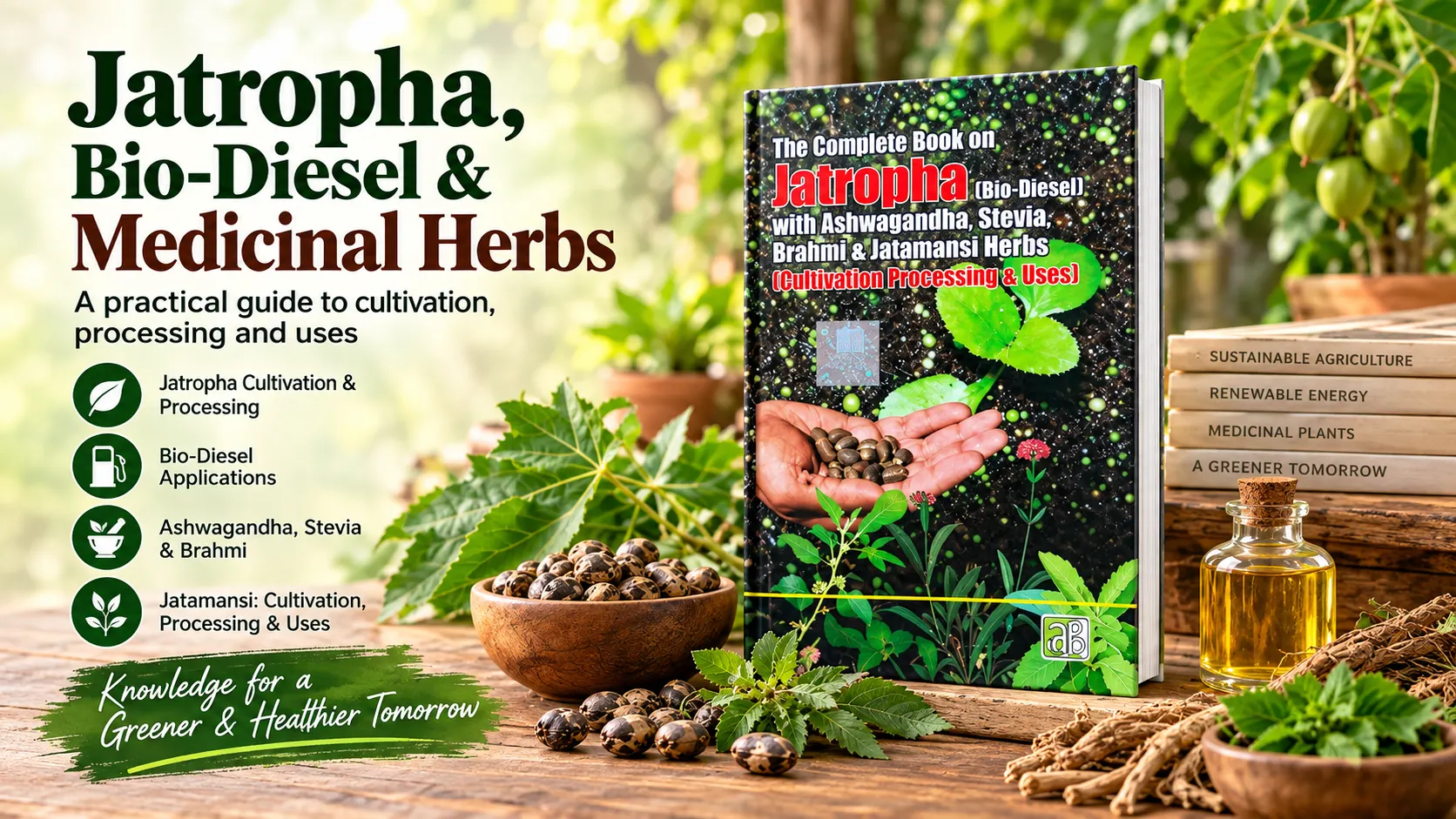
Niir Project Consultancy Services, one of India’s leading project consultancy firms, has come up with the Complete Book on Jatropha Bio-Diesel with Ashwagandha, Stevia, Brahmi, Jatamansi Herbs — Cultivation, Processing and Uses. As the title suggests the book contains all the relevant information on these two lucrative opportunities.

The Biofuel Side: Why Jatropha Still Matters

India’s dependence on fossil fuel imports is a structural vulnerability. The country spends hundreds of thousands of crore rupees annually importing crude oil, with transportation accounting for the bulk of demand. The government’s National Policy on Biofuels has consistently identified non-edible oilseed crops — particularly Jatropha curcas — as central to the strategy for domestic biofuel production and rural employment generation.

The Indian biofuel market size valued at USD 461.6 million in 2024 and is expected to reach USD 936.1 million by 2033, registering a CAGR of 7.76% during the forecast period. The growth of the biofuel market in India is majorly driven by the increasing demand for transportation fuel, greenhouse gas emissions regulations, and the Government’s initiatives for promoting biofuels in India. India has a great potential for biodiesel feedstock production as the country has abundant wastelands, which could be cultivated for biodiesel production.

Jatropha curcas is one such biodiesel crop that is drought-resistant and is capable of flourishing on wastelands. The Indian Jatropha plantations offer a sustainable source of biodiesel feedstock. A well-established Jatropha plantation on wastelands can yield good returns to growers. The Jatropha plantations provide economic benefits to growers due to the high yield of oil that can be extracted from Jatropha seeds. The Jatropha oil can be processed into biodiesel through transesterification process. Moreover, the biodiesel production from Jatropha curcas provides an additional revenue stream in the form of protein-rich cake that can be used as cattle feed or as an organic fertilizer.

The Union Ministry of New and Renewable Energy had issued guidelines for MSME-level bioenergy projects, and several states namely Rajasthan, Madhya Pradesh, Chhattisgarth, and Andhra Pradesh have been supportive of cultivating Jatropha curcas by providing land and purchasing feedstocks.

The main reason why Jatropha biodiesel production gained popularity in India was the lack of information. Most growers and entrepreneurs were not aware of the technical know-how required to establish Jatropha plantations. This book serves to be a complete guide for setting up Jatropha biodiesel processing units or cultivating Jatropha plantations.

The Herbal Side: A Market on Fire

While India’s biofuel potential is being driven by policymakers and large players in the transport and energy sector, medicinal herbs have been steadily catching up in popularity among the global herbal and nutraceutical markets.

India has been the major supplier of Ashwagandha, Brahmi, Jatamansi, and other adaptogenic herbs. Ashwagandha has seen tremendous demand growth in the last decade. The global market for Ashwagandha extract is expected to witness a CAGR of 11.6% during the period 2024-2029. The market size of Ashwagandha extract is estimated to increase from USD 0.73 billion in 2024 to USD 1.27 billion in 2029.

With the rising prevalence of chronic diseases such as diabetes, obesity, and cardiovascular diseases across the world, the herbal and nutraceutical markets have witnessed explosive demand growth in recent years. Stevia presents a lucrative opportunity for herbal growers and manufacturers as it addresses the demand for natural sweeteners with reduced calorific content. The Indian market for Stevia was valued at USD 73.70 million in 2024 and is anticipated to reach USD 133.20 million by 2033, registering a CAGR of 6.10% during the forecast period.

The Ministry of AYUSH has published cultivation guidelines and supports contract farming arrangements for many of these species. Collectively, India’s medicinal plants sector is now a multi-billion-dollar export opportunity, with the Agricultural and Processed Food Products Export Development Authority (APEDA) actively promoting value-added herbal exports.
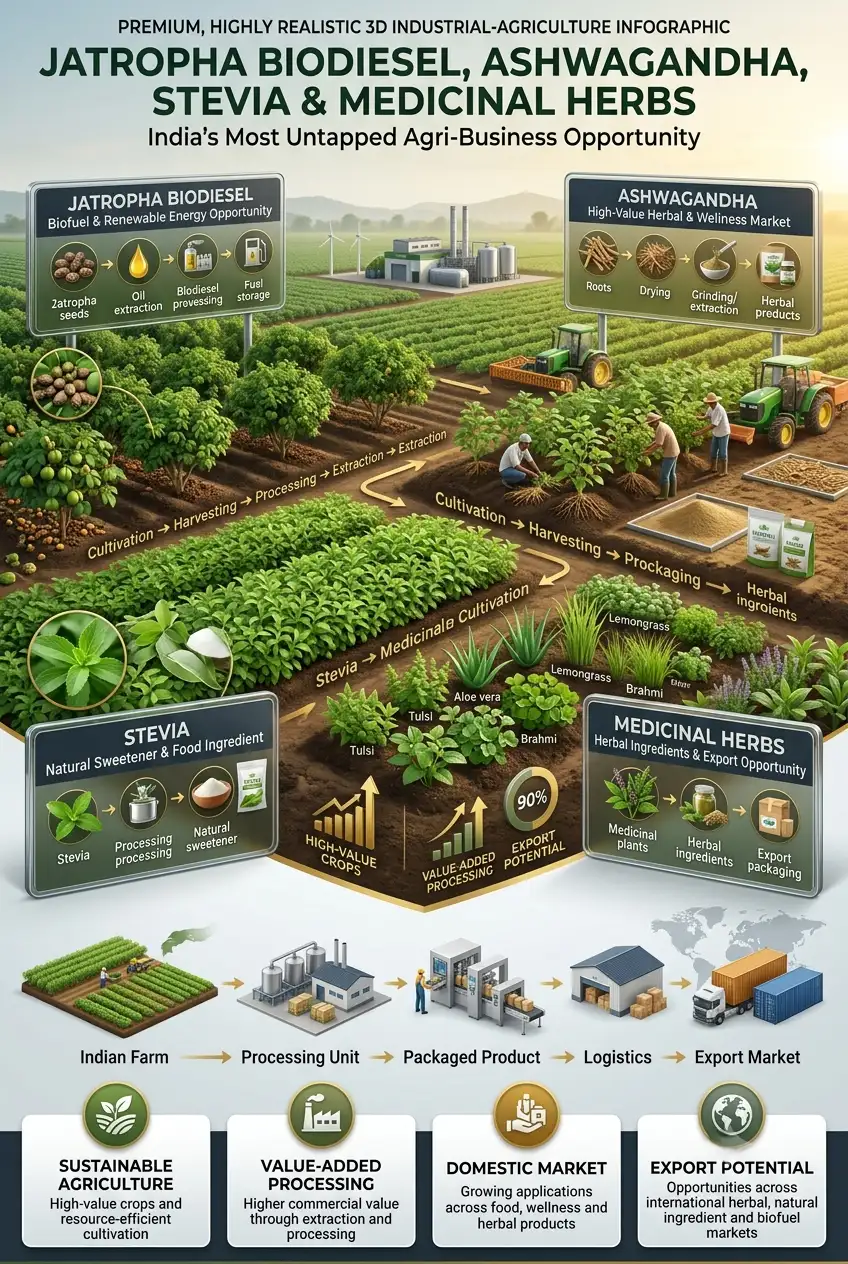
Jatropha biodiesel and medicinal herbs business in India
Jatropha biodiesel, Ashwagandha, Stevia, Brahmi and Jatamansi offer diverse agri-business and processing opportunities in India.

The Combined Opportunity: Why One Business Can Do Both

Here is what makes the combination of Jatropha biodiesel and medicinal herb cultivation genuinely exciting from an entrepreneurial standpoint.

Jatropha, by its nature, is grown on marginal land. Many of the herbs covered in this handbook — particularly Ashwagandha and certain Jatamansi ecotypes — are also well-adapted to semi-arid, low-fertility conditions. An entrepreneur establishing a Jatropha plantation in a state like Rajasthan, Bundelkhand, or parts of Maharashtra can intercrop or boundary-plant selected herbs on the same holding. The farm generates two revenue streams: oilseed for biodiesel or oil sale, and dried herb or extract for the nutraceutical trade.

Add a small-scale processing unit — which in India’s MSME financing ecosystem can be funded through schemes under the MSME Ministry or under priority sector lending — and the economic model becomes considerably more robust.

This is not a theoretical possibility. It is a practical model that has been quietly working across parts of rural India, and one that the right reference material makes significantly easier to execute.

Introducing the Book: A Complete Technical and Business Reference

The Complete Book on Jatropha Bio-Diesel with Ashwagandha, Stevia, Brahmi, Jatamansi Herbs — Cultivation, Processing and Uses has been published by NIIR Project Consultancy Services, New Delhi. Over the years, NIIR has been providing techno-commercial project reports and project consultancy services to clients across the globe. It has been recognized as one of the most trusted consultancy firms in India with more than 150,000 project reports prepared by NIIR across 85+ countries.

This book has been compiled with the intent to serve as a business guide for cultivators, agri-business promoters, investors, students, researchers, and others interested in exploring the business opportunities in herbal cultivation, processing, Jatropha cultivation, and biodiesel processing.

On the Jatropha and Biodiesel side, the book covers:

  • The botany, ecology, and genetic profile of Jatropha curcas — what makes it viable on degraded Indian soils
  • Nursery establishment, planting geometry, irrigation strategies, and pest/disease management specific to Indian agroclimatic zones
  • Seed collection, oil extraction technologies — mechanical pressing vs. solvent extraction — and the comparative economics of each
  • The transesterification process for biodiesel production, step by step, with the chemistry explained at a practical level
  • Biodiesel specifications, quality standards, blending ratios (B5, B20, B100), and compatibility with diesel engines
  • Seed cake utilisation — as organic manure, biogas feedstock, and potential high-protein animal feed after detoxification
  • Financial modelling: project costs, profitability scenarios, and break-even analysis for a small-scale biodiesel unit

On the Medicinal and Aromatic Herbs side, the book provides:

  • Cultivation protocols for Ashwagandha, Stevia, Brahmi, and Jatamansi — soil requirements, sowing seasons, irrigation, fertilisation, and harvesting schedules
  • Post-harvest handling and primary processing — drying, cleaning, grading, and storage for each herb
  • Extraction technologies for active constituents — withanolides from Ashwagandha, steviol glycosides from Stevia, bacosides from Brahmi, jatamansone from Jatamansi
  • Phytochemical profiles and validated medicinal uses, with references to pharmacopoeial standards and AYUSH guidelines
  • Market channels — domestic pharma and nutraceutical buyers, export documentation, and value-addition options
  • Industry contacts, machinery suppliers, and raw material procurement guidance

This is precisely the kind of multi-topic, end-to-end technical resource that Indian entrepreneurs and project planners consistently struggle to find in a single place. Most available literature either covers biofuels in isolation or addresses one or two herbs without the full processing and business context.

Who Should Read This Book

The book has been written in such a way that it serves the purpose of multiple stakeholders. Farmers and agri-business promoters aiming to expand their cultivation practices can explore options for cultivating herbs and medicinal plants on wastelands. MSME-level promoters looking to set up processing units can find exhaustive details on processing techniques. Consultants and project report writers can refer to the technical know-how provided in the book. Investors scouting for viable agri-project opportunities can use this book as a reference to make informed decisions. Researchers and scholars from agricultural universities and Krishi Vigyan Kendras can benefit from the comprehensive technical details provided in the book.

4 Authentic Reference Links

  1. National Policy on Biofuels — Ministry of New and Renewable Energy (MNRE), Government of India
  2. Medicinal Plants — Ministry of AYUSH, Government of India
  3. APEDA — Agricultural & Processed Food Products Export Development Authority, India
  4. MSME Schemes — Ministry of Micro, Small & Medium Enterprises, Government of India

The Complete Book on Jatropha Bio-Diesel with Ashwagandha, Stevia, Brahmi, Jatamansi Herbs — Cultivation, Processing and Uses is available now from NIIR Project Consultancy Services. Whether you are building a business plan, evaluating an investment, or simply want India’s most comprehensive technical reference on this subject, this handbook belongs on your desk.

Buy directly from the publisher:
→  NIIR.org — Official Book Page: https://www.niir.org/books/book/complete-book-on-jatropha-bio-diesel-with-ashwagandha-stevia-brahmi-jatamansi-herbs-cultivation-processing-uses/isbn-8178330040/zb,,104,a,0,0,a/index.html

→  Amazon India: https://www.amazon.in/dp/8178330040

→  Flipkart: https://www.flipkart.com/complete-book-jatropha-bio-diesel-ashwagandha-stevia-brahmi-jatamansi-herbs-cultivation-processing-uses/p/itmdyugjp678md82

Published by NIIR Project Consultancy Services (NPCS), 106-E Kamla Nagar, New Delhi — 110007.
NPCS is an ISO 9001:2015 certified consultancy with 30+ years of experience, 150,000+ project
reports delivered, and a presence across 85 countries. For bulk orders, institutional purchases, or
consultancy enquiries, visit niir.org.

Your Investment Deserves the Right Opportunity

Every serious investment begins with choosing the right sector and the right business model. With hundreds of industrial opportunities available across India’s manufacturing and clean-energy landscape, making the most informed choice is critical. NPCS Startup Selector tool helps entrepreneurs, MSMEs, and investors identify the most suitable business opportunities based on their investment capacity, location, and interests — so your capital is directed toward a venture with the strongest fit and potential.

Frequently Asked Questions

Is Jatropha biodiesel still commercially viable in India after early programme challenges? +
Yes. The early Jatropha programmes in India struggled primarily due to unrealistic yield projections and inadequate agronomy support. With proper variety selection, site-matched cultivation protocols, and small-scale processing economics rather than plantation-scale models, Jatropha-to-biodiesel remains viable — particularly where it is combined with other revenue streams from the same farm.
Can Ashwagandha and Stevia be cultivated together with Jatropha on the same land? +
Ashwagandha can be profitably intercropped with Jatropha on semi-arid soils. Stevia requires slightly more controlled irrigation but is well-suited to smaller plots within or adjacent to a Jatropha holding. The book details specific intercropping possibilities.
What are the key government support mechanisms for herbal and biofuel farming in India? +
The Ministry of AYUSH supports medicinal plant cultivation through the National AYUSH Mission. MNRE supports biofuel projects including Jatropha. MSME schemes provide capital and credit-linked subsidies for processing units. APEDA facilitates herbal export registration and market access.
What is the price range for Ashwagandha root and Stevia leaf in India's domestic market? +
Ashwagandha dry root commands roughly ₹80–150/kg in wholesale markets depending on withanolide content and origin. Dried Stevia leaf trades at ₹200–350/kg. Value-added extracts command multiples of these prices, which is where the real business case lies.
Is this book suitable for someone with no prior background in agribusiness or chemistry? +
Yes. The NIIR editorial approach is specifically designed for entrepreneurs and first-generation business promoters, not academicians. Technical processes are explained in accessible language with practical orientations, supported by process flow diagrams and cost tables.
What machinery and equipment are needed to set up a small-scale Jatropha biodiesel processing unit? +
A basic biodiesel production setup requires a seed decorticator, an oil expeller or screw press, a transesterification reactor, a methanol recovery unit, a glycerol separator, and storage tanks for both feedstock oil and finished biodiesel. The book covers equipment specifications, approximate costs, and a directory of Indian machinery suppliers — which is typically the most time-consuming part of project planning for a first-time promoter.
What is the typical land requirement and per-acre yield for a commercial Jatropha plantation in India? +
A commercial Jatropha plantation is generally viable starting from 10 acres, though pilot units of 2–5 acres are often recommended for first-time cultivators to establish management practices before scaling. Average seed yield in a mature plantation (Year 4 onwards) ranges from 2 to 4 MT per acre depending on variety, soil quality, and irrigation regime. Oil content in the seed ranges from 27% to 40%, translating to roughly 600–1,200 litres of crude Jatropha oil per acre per season under reasonable management conditions.
How is Brahmi (Bacopa monnieri) different from Jatamansi (Nardostachys jatamansi) in terms of commercial application and market demand? +
Brahmi is primarily a cognitive health herb — its bacosides are clinically studied for memory enhancement, anxiety reduction, and neuroprotective effects — making it a high-demand ingredient for nutraceutical and pharmaceutical formulations globally. Jatamansi, by contrast, is more niche: its roots yield jatamansone, an active compound used in traditional sedative and nervine formulations, and its rhizome oil is prized in aromatherapy and luxury cosmetics. Both have export demand, but Brahmi has a significantly larger and more organised domestic buyer base. The book covers market channels for both separately.
What are the export prospects for Ashwagandha and Stevia extracts from India? +
Both are strong export categories. Ashwagandha root extract — particularly KSM-66 and Sensoril standardised formats — is heavily imported by the US, Germany, Japan, and Australia for dietary supplement manufacturing. India's competitive advantage is its cultivation base, low production cost, and deep traditional knowledge of the crop. Stevia glycoside extracts are similarly imported by food and beverage manufacturers globally as a natural sugar substitute. APEDA facilitates export registration, and the Spices Board of India covers many herbal exports under its mandate. The book discusses export documentation, buyer identification, and quality benchmarking for both.
Can this business model qualify for MSME financing or government subsidies in India? +
Yes, in most cases. A Jatropha-based biodiesel processing unit qualifies as a renewable energy project under MNRE guidelines and may be eligible for capital subsidy or concessional credit. Herb processing units (drying, extraction, packaging) typically qualify as agro-processing MSMEs and are eligible for support under the Prime Minister Formalisation of Micro food processing Enterprises (PM FME) scheme, CGTMSE credit guarantee, and state-level agri-industry promotion policies. The specific eligibility depends on project scale, location, and the type of plant-based product being manufactured. The book's financial sections provide baseline project cost structures that form the starting point for formal DPR preparation.
What is the shelf life and storage requirement for biodiesel produced from Jatropha oil, and how does it compare to conventional diesel? +
Biodiesel (B100) has a shorter oxidative stability window than conventional diesel — typically 6 to 12 months under proper storage conditions, depending on antioxidant treatment and temperature control. Blended biodiesel (B5 or B20) in standard diesel tanks is less sensitive and handles much like regular diesel for short-term storage. For commercial producers, antioxidant additives and nitrogen blanketing are commonly used. The book addresses biodiesel quality parameters, BIS standards applicable to biodiesel in India, and storage best practices in a dedicated section — critical knowledge for anyone selling biodiesel into the organised market.
Is contract farming a viable route for sourcing Ashwagandha, Stevia, and Brahmi for a processing unit, and how does one structure such arrangements? +
Contract farming is actually the preferred model for herbal extract processors in India, for two reasons: it ensures consistent raw material supply with defined quality specifications, and it transfers cultivation risk to the farming community while the processor focuses on value addition. Stevia in particular is almost always cultivated under contract in India because the planting material (tissue-cultured or vegetatively propagated) is expensive and processors need to control glycoside content. Contract farming agreements for medicinal plants are governed under the Farmers (Empowerment and Protection) Agreement on Price Assurance and Farm Services Act framework. The book provides guidance on raw material quality parameters and procurement strategies that underpin a workable contract farming arrangement.
Tags: AshwagandhaBiodiesel BusinessHerbal BusinessHerbal ProcessingJatamansiJatropha BiodieselJatropha CultivationMedicinal Plants
Share197Tweet123
Previous Post

Paper Water Bottle Manufacturing: A Sustainable Business Opportunity Explore Manufacturing Technology, Machinery, Investment and Market Potential

Next Post

How to Start Biodegradable Bag Manufacturing Business Using Corn & Cassava Starch

Diksha Garg

Diksha Garg

Diksha Garg is a marketing strategist and business growth enthusiast with over 7 years of experience driving impact through data-driven insights and strategic storytelling. She writes for entrepreneurs and startups, breaking down complex business challenges into actionable ideas that help founders scale smarter, market better, and build sustainable growth.

Next Post
Biodegradable bag manufacturing using corn and cassava starch

How to Start Biodegradable Bag Manufacturing Business Using Corn & Cassava Starch

Leave a Reply Cancel reply

Your email address will not be published. Required fields are marked *

Contact Us

    Categories

    • Agri Business Opportunities
    • Business Ideas
    • Chemical Industry Business Opportunities
    • Cosmetics and Personal Care Business
    • Eco Friendly Sustainable Business
    • Entrepreneurship Leadership and Startup Growth
    • FMCG Consumer Products Business
    • Food Processing Business Industry
    • Future & Emerging Industries
    • Government Schemes Policies for Business
    • Import Export Business Opportunities
    • Industrial Project Reports Business Guide
    • Investment Funding for Startups
    • Manufacturing Business Ideas for Startups
    • Market Research Trends for Business
    • MSME & Small-Scale Industries
    • Paper Pulp Industry Business
    • Pharmaceutical Industry Business
    • Plastic & Packaging Business
    • Renewable Energy Startups
    • Startup Business Opportunities
    • Startup Business Planning and Strategy
    • Technology & Automation Business
    • Textile Industry Business
    • Uncategorized
    • Waste Management & Recycling Business
    • Water & Environmental Business
    Entrepreneur India Blog

    Copyright © 2026 Entrepreneur India

    Navigate Site

    • About
    • Advertise
    • Privacy & Policy
    • Contact

    Follow Us

    Welcome Back!

    Login to your account below

    Forgotten Password?

    Retrieve your password

    Please enter your username or email address to reset your password.

    Log In
    No Result
    View All Result
    • Home

    Copyright © 2026 Entrepreneur India

    Not enough quota to unlock this post
    Unlock left : 0
    Are you sure want to cancel subscription?