





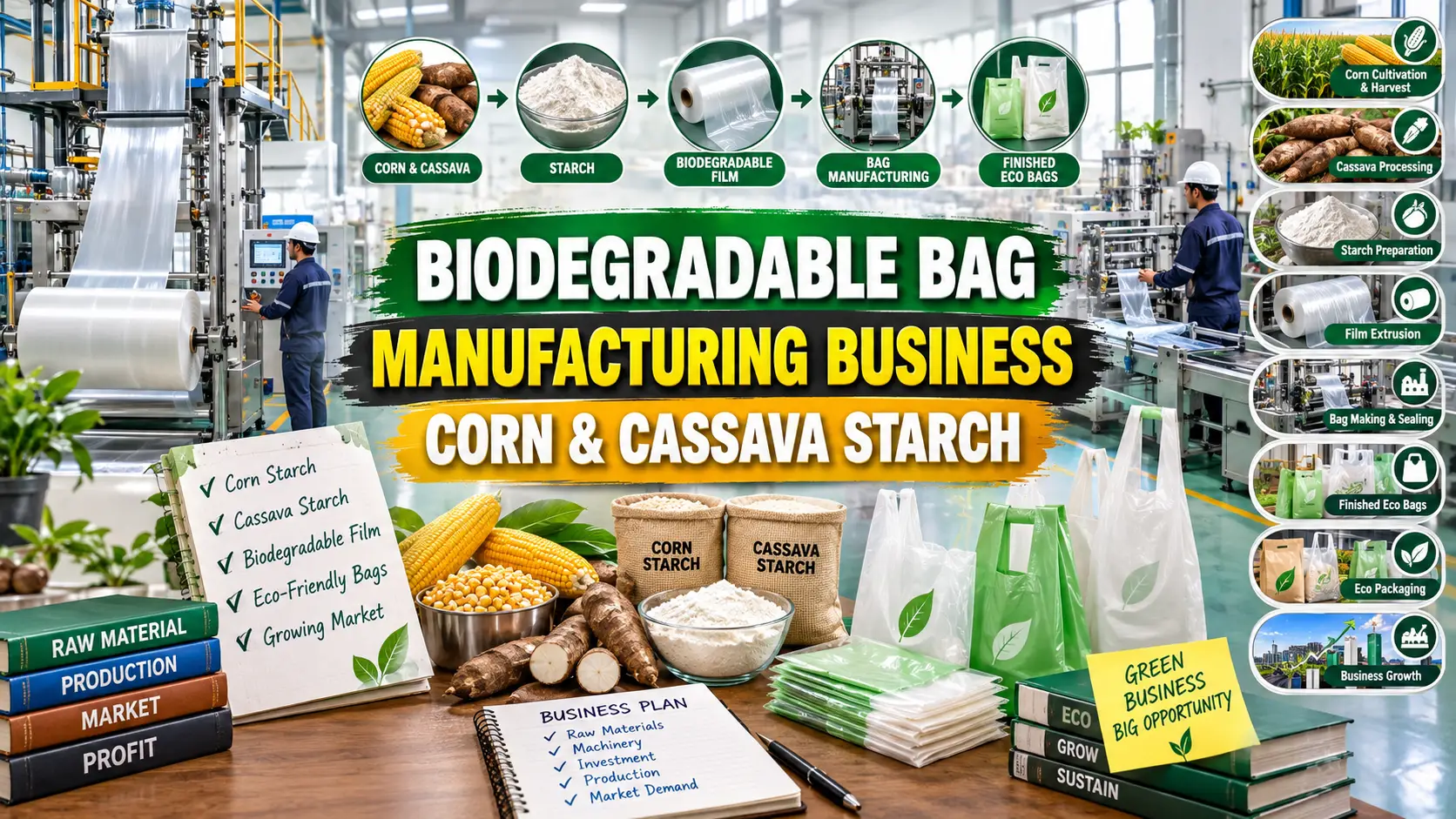
Biodegradable Bag Manufacturing Business
Tightening regulations on single-use plastics in India have turned starch-based biodegradable bags from an environmental idealism into a business reality. Organized retail chains, e-commerce logistics, and even municipal waste management programmes are now looking to transition to certified carry bags, and corn or cassava starch-based films present a viable alternative to standard polythene. For would-be entrepreneurs, this represents a unique opportunity, as the institutional demand is already forming at the regulated sector level.
Why Biodegradable Plastic Bags from Corn & Cassava Starch Is a Smart Business Idea Right Now
India’s phased single-use plastic ban has already removed thin-film carry bags from many regulated sectors, including organized retail, e-commerce logistics, and food delivery chains. As a result, businesses in these sectors are looking to transition to an alternative that will continue to be permitted, and starch-based bioplastics present an attractive option, as they are certified to break down in a composting environment. The technical complexity of the compostable certification process means that it is currently under-served by manufacturers, presenting an entry opportunity for a motivated producer.
Government Policies & Incentives
The rules notified under the CPCB – Plastic Waste Management Rules mandate the use of alternatives to single-use plastics, including carry bags. MoEFCC – Plastic Waste Management Rules oversee the certification process for compostable plastic bags, while the Ministry of MSME – Credit Guarantee Scheme provides credit guarantee cover for machinery financing as part of technology upgradation finance scheme for MSMEs.
State government environmental technology promotion schemes also provide capital subsidies for compostable and biodegradable packaging machinery, usually with eligibility criteria focused on the reduction of plastic use.
Multiple Manufacturing Business Ideas for Startups
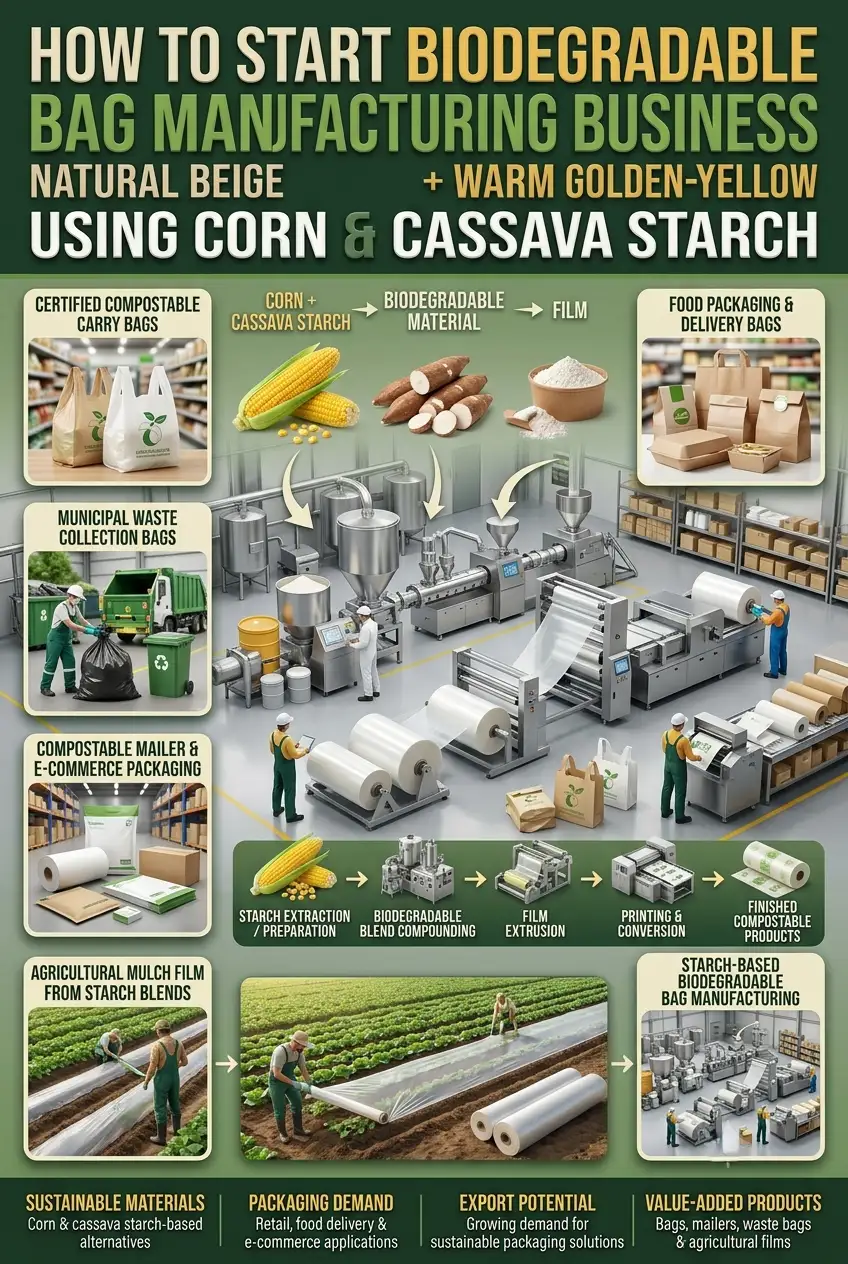
Certified Compostable Carry Bag Manufacturing
Retail carry bags present the largest manufacturing opportunity, as supermarkets and organized retail chains are the biggest buyers of such packaging. However, a compostable certification allows access to this market segment, as major buyers will only entertain suppliers with a third-party composability certificate.
Food Packaging & Delivery Bags for E-Commerce
Organized food delivery and e-commerce logistics chains are prime candidates for switching to biodegradable packaging, as their current use of polythene and plastic bags falls under the banned single-use plastic category. This is a lucrative segment, but its entry requirements are more demanding, as the bags must be able to withstand the rigours of transportation and not tear at the same time being certified compostable.
Municipal Waste Collection Bag Supply
Some municipal corporations have already transitioned to using compostable plastic bags for the collection of waste under their waste management programmes. This presents a recurring supply opportunity for a manufacturer that can meet the necessary certification and large-volume supply requirements.
Compostable Mailer & E-Commerce Packaging Manufacturing
E-commerce return bags and courier mailer bags are another potential market for certified compostable plastic bags. Similar to food packaging, courier bag manufacturers are under pressure to switch to certified compostable materials, presenting an opportunity for a bag manufacturer that can produce tear-resistant, tamper-evident bags. It is a niche but a lucrative one, as the mailer bag market offers attractive pricing.
Agricultural Mulch Film from Starch Blends
Biodegradable mulch films that break down after use are seeing increased demand among progressive farmers interested in adopting sustainable agriculture practices. A company that can produce mulch films from starch blend can tap into this emerging market.
Import–Export Opportunity Analysis
Some of the specialized resins and additives used in the production of starch-based packaging can be imported, allowing an entrepreneurial manufacturer to develop a domestic sourcing base. At the same time, the European and Southeast Asian markets are witnessing rising demand for certified compostable packaging, so an Indian exporter with the necessary certifications can leverage FICCI – Trade and Industry Support to build long-term trade relations.
Market Outlook & Scaling Roadmap
As more states and municipal corporations adopt single-use plastic bags, the demand for certified compostable alternatives is poised to grow substantially, with the market expected to extend beyond organized retail and e-commerce to include smaller kirana stores and municipal waste management programmes. Manufacturers that have the capacity to offer large-volume supply with the necessary certification will dominate the market ahead of smaller competitors who will have to acquire certification later.
Skills, Manpower & Quality Control
Extrusion and film blowing for starch-based bioplastics require trained manpower with a good understanding of the intricacies of temperature and humidity, as the material properties are significantly different from conventional polyethylene. A typical small-scale plant requires a workforce of 10–15 people, and the most immediately useful skill for a new entrant to the market is a process technician with experience in biopolymer extrusion and an understanding of the weak points in the production process, as a new plant will have many process-related quality issues during its early operations.
Indian MSME Success Stories
EcoRight Bags — Nakul Jain
Jain’s company EcoRight has been manufacturing and supplying certified compostable and reusable bags long before single-use plastic restrictions began to take off in India, positioning him to meet the demand well ahead of his competitors and build trust with retail buyers.
Enviro Biotech — Various Indian bioplastics entrepreneurs
Several Indian bioplastics manufacturers have carved out profitable niches for themselves by targeting a particular segment, such as retail carry bags, and supplying it consistently while larger manufacturers target multiple categories.
How NPCS Can Help Entrepreneurs Evaluate the Opportunity
We at Niir Project Consultancy Services (NPCS) provide consulting services to assist potential entrepreneurs in preparing a Market Survey cum Detailed Techno-Economic Feasibility Reports for initiating new ventures for Biodegradable Plastic Bags from Corn & Cassava Starch.
Our Market Survey cum Detailed Techno-Economic Feasibility Reports provide complete details about manufacturing processes, extensive market research and demand outlook, process flow diagrams, product mix, manufacturing process, machinery, and raw materials. It contains financial aspects such as capital investment, working capital requirements, profitability, and techno-economic aspects, enabling entrepreneurs to understand the scope of the project, its profit potential, and the time it takes to recoup the initial investment. This helps the entrepreneurs to take an informed decision before embarking on any new venture or industry.
For someone assessing the opportunity in Biodegradable Plastic Bags from Corn & Cassava Starch, that due diligence is an essential precursor to any large-scale investment in the project: our NPCS studies walk potential producers through the key considerations in selecting machinery, laying out the plant, planning the manpower, and modelling the finances for a turnkey project. Entrepreneurs seeking funding from banks, NBFCs, or state-level MSME initiatives typically find that a documented techno-economic feasibility study is required before loan approval, and working with an established consultancy can drastically reduce the time spent on the process, as we can apply the extensive experience of our team in hundreds of similar projects to help you get the most accurate assessment of the opportunity.
NPCS has published a comprehensive printed reference book on Biodegradable Plastic Bags from Corn & Cassava Starch, covering technology, market analysis, investment parameters, and manufacturing processes in depth — the printed book: Handbook on Biodegradable Plastics (Eco Friendly Plastics).
For a detailed techno-economic Project Report on setting up a manufacturing business in this industry — including plant economics, machinery lists, financial projections, and government incentives — the NPCS Project Report: Bioplastic Carry Bags and Garbage Bags Production is the ideal resource.
Common Pitfalls to Avoid
A common pitfall for an aspiring biodegradable bag manufacturer is attempting to market bags as biodegradable without the necessary certifications, resulting in regulatory issues later when the buyer insists on documentary proof of compliance. Another issue that novice manufacturers often face is an inadequate understanding of the impact of storage humidity on the integrity of starch-based films, potentially resulting in significant customer complaints.
Conclusion
Biodegradable bag manufacturing is an industry in which producers with the resources to obtain certification will benefit greatly from the rising regulatory tailwinds. Meanwhile, coordination with Invest Madhya Pradesh – Investment and Industrial Support can help with the next steps in setting up an industrial unit.
Your Investment Deserves the Right Opportunity
Every serious investment begins with choosing the right sector and the right business model. With hundreds of industrial opportunities available across India’s manufacturing and clean-energy landscape, making the most informed choice is critical. NPCS Startup Selector tool helps entrepreneurs, MSMEs, and investors identify the most suitable business opportunities based on their investment capacity, location, and interests — so your capital is directed toward a venture with the strongest fit and potential.


