





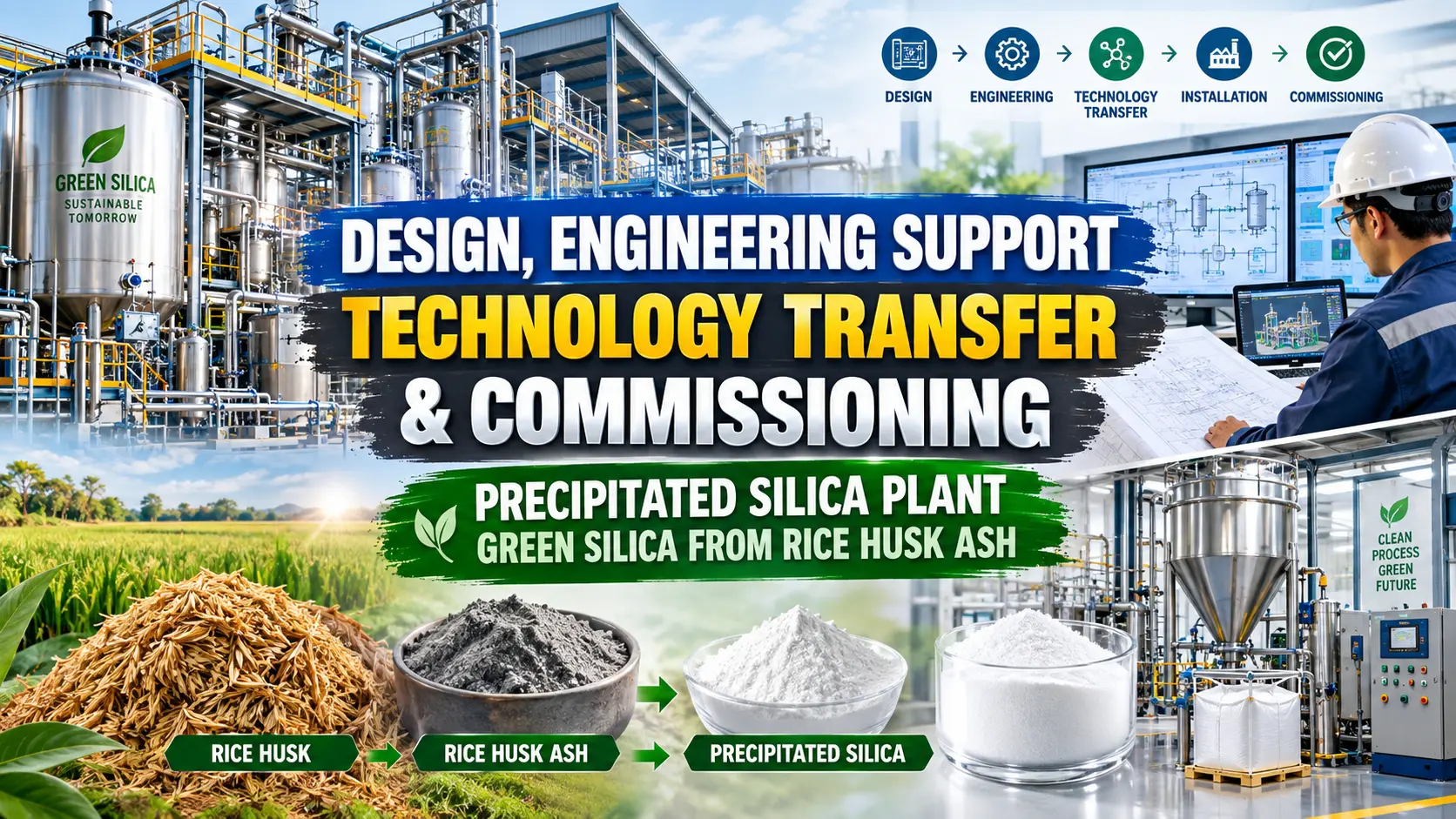
Our team brings over 30 years of direct, hands-on experience in the Precipitated Silica industry — not as observers, but as engineers and practitioners who have designed, commissioned, operated, and optimised silica plants across conventional quartz-based and green RHA-based process routes. This depth of experience spans every aspect of the plant lifecycle: initial concept to commercial production, from first-batch troubleshooting to long-term cost reduction programmes.
We have built our expertise across the following areas, each of which forms an active part of our consultancy offer to every client:
| Silica Plant Setup & Operation | End-to-end plant commissioning from greenfield through stable commercial production, including process troubleshooting at every stage. |
| Rice Husk Ash Process Route | Sodium silicate synthesis from RHA, precipitation chemistry, spray-dryer optimisation and product grade development across rubber, food, pharma and agricultural applications. |
| Utility Design | Steam systems, cooling towers, air compressors, softening plants, ETP design — all sized against the actual process load, not industry-average estimates. |
| Technology Transfer | Full transfer of process know-how, reaction parameters, grade-specific SOP libraries and quality systems — enabling the client to operate independently after handover. |
| Production Optimisation | Throughput maximisation, yield improvement, grade extension and batch-cycle optimisation to achieve the best cost-per-tonne and product-specification combination. |
| Cost Reduction | Raw material utilisation improvement, utility and energy audits, acid and caustic lye consumption optimisation, waste-to-value initiatives including sodium sulphate recovery. |
| Quality Systems | QC laboratory design, test method development for incoming RHA, sodium silicate intermediate and finished silica, grade-specific specification setting for BET, OAN, pH, moisture, particle size and heavy metals. |
| Team Development & Training | Structured training programmes for engineers, supervisors, plant operators and QC personnel — classroom and on-the-job, covering process chemistry, equipment operation, SOP adherence and safety. |
Objective
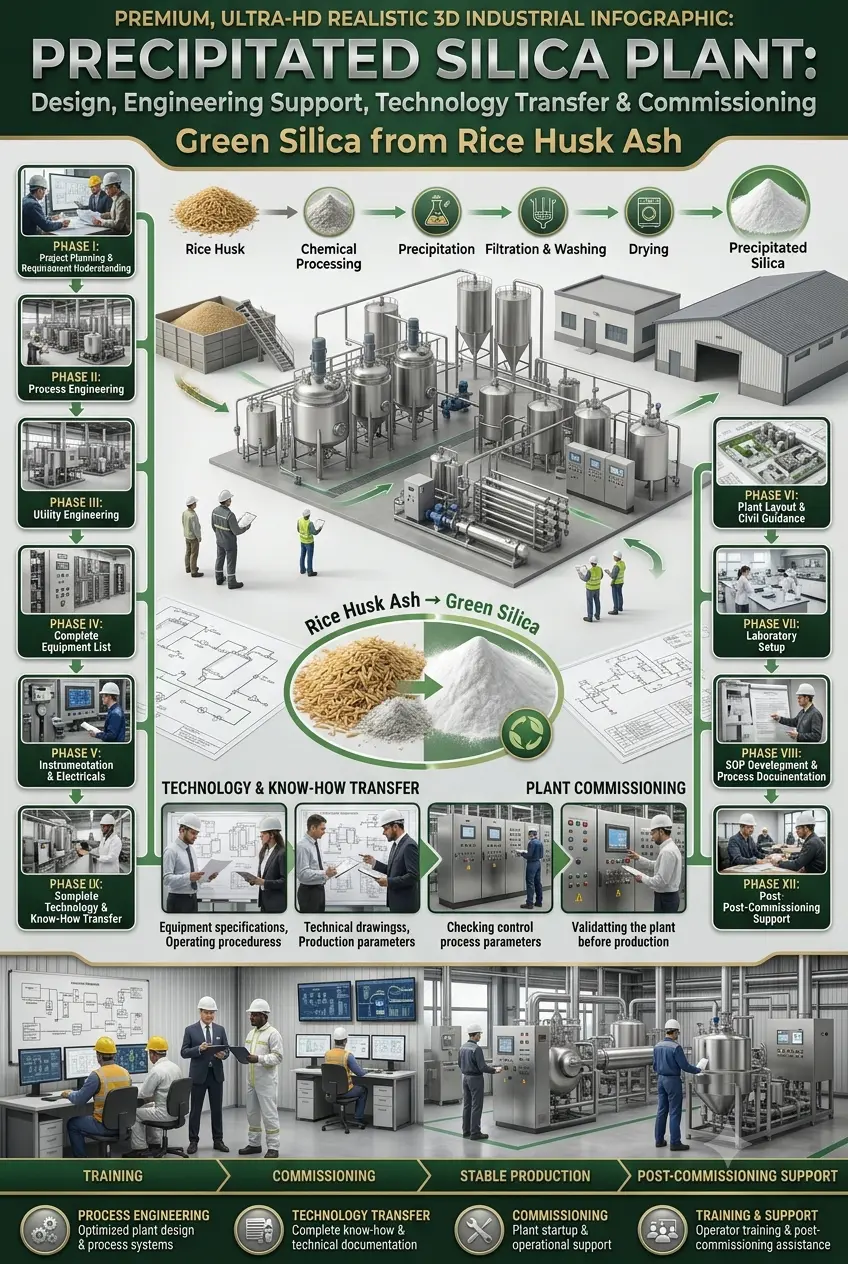
Our objective is to provide complete, end-to-end technical support for establishing a modern, efficient, safe and commercially viable Precipitated Silica Plant. We do not operate as a documentation-only consultant. We remain engaged across all twelve phases of the project — from the first planning meeting through to stable commercial production and post-commissioning optimisation.
A precipitated silica plant requires tight integration between process chemistry, utility systems, equipment selection, instrumentation, quality control, and operator competency. Our consultancy model is designed around this integration — ensuring that decisions made in one phase do not create problems in a later one. Our single-source accountability across all phases is what distinguishes this engagement from a fragmented multi-vendor project approach.
Elaborated Scope of Work
The project shall be executed across twelve structured phases. Each phase produces specific deliverables and feeds directly into the next. The phases are designed for parallel execution where applicable — compressing the overall project timeline without sacrificing engineering quality.
Phase I Project Planning & Requirement Understanding
Foundation phase — gets every subsequent phase right from the start
This phase is the critical foundation on which all subsequent engineering work rests. We invest significant time here — because a wrong assumption in Phase I generates cascading cost and delay across Phases II through XII. The planning phase covers four inter-connected activities:
✦ Client Requirement Understanding: Detailed discussions with the client’s leadership and technical team to understand the intended product grades (rubber, food, pharma, dental, agricultural), target customer profile (domestic OEM, B2B bulk, export), production ramp-up schedule, and any site-specific constraints. This defines the commercial objectives that the technical design must serve.
✦ Production Capacity Planning: Determination of the optimal daily and annual production capacity based on target market, available capital, feedstock supply security, and revenue projections. We also provide guidance on whether to design for a single grade or multi-grade flexibility from inception — a decision that affects reactor design, spray-dryer selection, and laboratory investment.
✦ Raw Material Assessment: Evaluation of the proposed RHA feedstock source — silica content (target >85%), Loss on Ignition (residual carbon, target <5% for rubber grade, <2% for specialty grades), alkali metal content (K₂O, Na₂O), moisture, and particle characteristics. RHA quality directly governs sodium silicate yield, product purity, and ETP loading. This assessment determines whether the proposed feedstock is commercially viable or requires pre-treatment.
✦ Utility Assessment: Review of available utilities at the proposed site — water source and quality, power availability and tariff structure, natural gas or furnace oil availability for the spray dryer, connectivity for chemical deliveries (caustic soda, sulphuric acid), and site drainage capacity for ETP. This assessment identifies utility gaps that must be addressed before construction begins.
Why This Matters: Decisions made in Phase I set the cost ceiling for every phase that follows. A plant sized incorrectly, located away from feedstock clusters, or designed without assessing utility availability is a project that overspends from day one.
Phase II Process Engineering
The technical backbone of the entire plant
Process engineering is the most intellectually intensive phase of the project. It defines every material flow, every reaction condition, and every equipment specification that the rest of the plant depends on. All engineering work in Phases III through VII is derived from Phase II outputs.
✦ Process Flow Diagram (PFD): A complete graphical representation of the entire manufacturing process — from RHA intake through sodium silicate synthesis, precipitation, filtration, re-dispersion, spray drying and milling — showing all major equipment, material streams, and process flow directions. The PFD is the primary reference document for the entire project team.
✦ Material Balance: Quantitative calculation of all material inputs and outputs at each process stage. The material balance establishes the mass of RHA required per tonne of finished silica, caustic soda and sulphuric acid consumption per batch, water usage across the process, sodium sulphate generation, and ETP load. This is the commercial viability document — it directly underpins the raw material cost model.
✦ Utility Balance: Calculation of steam, cooling water, compressed air, electrical power, and softened water demand at each process stage. The utility balance feeds directly into Phase III utility engineering and is the basis for all utility capital and operating cost estimates.
✦ Process Description: A detailed narrative describing the chemistry and operating principles at each stage: sodium silicate synthesis (reaction mechanism, temperature and pressure regime, dissolution kinetics), precipitation (nucleation and growth chemistry, pH-time curve design for each grade, acid addition profile), filtration (cake formation, wash cycle rationale), spray drying (evaporation mechanism, particle formation), and milling. This document becomes the technical foundation for SOP development in Phase VIII.
✦ Batch Cycle Design: For each production grade, a complete batch time-line: reactor loading sequence, heating-up time, reaction hold time, acid addition duration, pH hold time, slurry transfer, filtration duration, wash cycles, re-dispersion time, and spray-dryer run time. Batch cycle design determines achievable throughput per reactor per day — which determines whether the production capacity target is met.
✦ Process Parameters: Grade-by-grade specification of all critical process parameters: sodium silicate concentration and modulus, precipitation temperature, acid addition rate profile, target pH at each reaction stage, agitation speed and impeller configuration, filter press operating pressure, spray-dryer inlet and outlet temperatures, atomiser speed (or nozzle pressure), and milling speed and classifier setting. These parameters are the core of the technology transfer.
Why This Matters: Without process engineering, equipment selection is guesswork. A reactor ordered without knowing the required acid addition rate, agitation power, and heat transfer requirement will underperform or fail specification — at full capital cost.
Phase III Utility Engineering
Silent killer of under-designed plants — and major operating cost driver
Utility engineering is where many independently managed chemical plant projects fail silently. Steam, cooling, air, water, and effluent systems are sized against the actual process load from Phase II — not estimated from industry benchmarks. Every utility system below is designed with redundancy and future expansion capacity considered.
✦ Steam System Design: Steam demand calculation for reactor jacketing (for sodium silicate synthesis and precipitation temperature maintenance), spray-dryer air heating, and process hot water generation. Steam header sizing, pressure-reducing station design, condensate return system, and steam trap selection. A poorly designed steam system is the most common cause of batch-cycle time overruns in new silica plants.
✦ Boiler Capacity Sizing: Selection of boiler type (fire-tube, water-tube), rated steam output (in TPH), operating pressure, and fuel type based on the steam demand calculation. Guidance on single boiler vs. dual-boiler configuration for production continuity.
✦ Hot Water Generation: Hot water circuit design for reactor jacket supply and return — temperature, flow rate, pump sizing, and heat exchanger specification where indirect heating is used.
✦ Cooling Tower Design: Cooling water demand calculation for the precipitation reactor (to quench the exothermic precipitation reaction and maintain temperature), condenser cooling, and process cooling. Cooling tower capacity (in TR), pump sizing, water treatment chemistry, and blowdown management. An undersized cooling tower cannot control precipitation temperature — directly degrading product surface area.
✦ Softening Plant: Softened water demand for boiler feedwater, process water, and cake washing. Ion exchange resin sizing, regeneration frequency, and salt consumption calculation.
✦ Air Compressor System: Compressed air demand for membrane filter press squeezing, instrument air supply (for control valves and DCS), pneumatic conveying (if applicable), and packaging equipment. Compressor sizing, air dryer specification, and receiver tank capacity.
✦ Water Reuse System: Design of internal water reuse loops — condensate recovery, filter press filtrate recycling where quality permits, and cooling tower blowdown reuse — to minimise freshwater consumption and effluent volume.
✦ Effluent Treatment Plant (ETP): ETP design for the process effluent stream — principally sodium sulphate-containing wash water and filter press filtrate. Flow rate, COD load, suspended solids, and pH characterisation from the material balance. Treatment train design (neutralisation, flocculation, filtration), sludge handling, and compliance with applicable discharge standards.
Why This Matters: Utility systems account for 25–35% of total plant operating cost. A utility system sized correctly and operated efficiently from commissioning is the single largest lever on long-term cost-per-tonne. Undersizing creates production bottlenecks; oversizing wastes capital.
Phase IV Complete Equipment List
The procurement blueprint — size, spec, and material of construction for every item
The equipment list is not a catalogue — it is a precision-specified procurement document derived directly from the material balance and process parameters of Phase II. Every item is sized, specified, and assigned materials of construction matched to the process chemistry. The client uses this list to invite vendor quotations and evaluate proposals against a defined technical standard.
✦ Reactors: Specification of sodium silicate synthesis reactors and precipitation reactors — vessel capacity (m³), design pressure (bar), jacket design (area, medium, temperature), agitator type (anchor, turbine, or paddle), agitator power (kW), shaft speed (RPM), impeller configuration, material of construction (SS304/SS316L for wetted parts), inlet and outlet nozzle sizes, and instrumentation connections.
✦ Storage Tanks: Specification of day tanks, intermediate storage vessels, and product storage — capacity, construction material (HDPE, SS316, MS with lining), vent arrangement, overflow, level instrumentation, and pump connections. Separate specifications for caustic lye storage, sulphuric acid storage (with secondary containment), sodium silicate day tanks, and wash water tanks.
✦ Silos and Hoppers: RHA intake silos, activated carbon silos (if used), and finished product powder hoppers — capacity, discharge mechanism (screw, vibrating floor, rotary valve), dust control, and material of construction.
✦ Pumps: Specification of all process pumps — type (centrifugal, peristaltic, progressive cavity), flow rate (m³/hr), head (m), material of construction, seal type, and drive motor rating. Includes sodium silicate transfer pumps, acid dosing pumps, slurry transfer pumps, filter press feed pumps, and re-dispersion pumps.
✦ Conveyors: Belt conveyors, screw conveyors, or pneumatic conveying systems for RHA handling and finished product transfer — capacity, length, inclination, belt/screw material, and drive specification.
✦ Heat Exchangers: Shell-and-tube or plate heat exchangers for pre-heating of process water or sodium silicate — area (m²), duty (kW), shell and tube materials, fouling factors, and pressure ratings.
✦ Blowers: Process air blowers for spray-dryer air supply (main process air) and secondary air — flow rate (m³/min), pressure rise (mbar), power, and impeller material. Also bag filter pulse-jet air supply blowers.
✦ Filter Presses: Membrane filter press specification — number of chambers, chamber volume, filter plate dimensions (mm), operating pressure (bar), membrane squeeze pressure, filter cloth specification, cloth washing system, cake discharge mechanism, and frame material. This is often the most critical single equipment item — under-specified presses generate high cake moisture, increasing spray-dryer energy load.
✦ Spray Dryer: Chamber diameter and height, inlet air temperature rating (°C), atomiser type (rotary disc or two-fluid nozzle) and speed/pressure range, evaporative capacity (kg water/hr), product outlet configuration, cyclone separator efficiency, bag filter specification, and burner type and rating. Multi-grade design parameters included where applicable.
✦ Workshop Equipment: Process laboratory instrumentation (detailed under Phase VII), maintenance workshop equipment (lathe, drill press, welding machine), safety equipment, and personal protective equipment requirements.
Why This Matters: Poorly specified equipment is the single largest source of commissioning delays and capital write-offs in chemical plants. An equipment list prepared from process engineering data — not from vendor catalogues or industry rules of thumb — eliminates the most common specification errors before any purchase order is signed.
Phase V Instrumentation and Electricals
Process control infrastructure — the nervous system of a quality-consistent plant
A precipitated silica plant without a well-designed instrumentation and electrical system cannot maintain product consistency across shifts, operators, and seasons. This phase defines the process measurement and control architecture that locks in specification-consistent production.
✦ Flow Metering: Specification of flow meters for all critical streams: sulphuric acid addition to the precipitation reactor (the most critical measurement in the plant — directly controls pH profile), caustic lye addition to the synthesis reactor, sodium silicate transfer, and process water streams. Flow meter type (Coriolis, electromagnetic, rotameter) and installation requirements for each service.
✦ Level Measurement: Level gauges and transmitters for all reactors, storage tanks, and hoppers — technology selection (ultrasonic, radar, differential pressure, displacer) based on process fluid properties. High-level and low-level alarms for process safety and production continuity.
✦ Temperature Measurement: Thermocouples and RTDs for reactor jacket temperature, process fluid temperature at critical reaction stages, spray-dryer inlet and outlet temperature (most critical for product surface area control), and boiler and steam header temperature. Temperature transmitters connected to the DCS for real-time monitoring and alarm management.
✦ pH Measurement and Control: In-line pH electrodes at the precipitation reactor — with automatic calibration provisions, electrode cleaning systems, and spare electrode management. pH signal connected to the acid dosing pump control loop. This is the most critical control loop in the plant.
✦ DCS / PLC System: Recommendation for a Distributed Control System (DCS) or Programmable Logic Controller (PLC) based SCADA system appropriate to the plant scale — specifying the number of I/O points, operator workstation requirements, historian function, alarm management, and batch record generation capability. The DCS/PLC system should be capable of generating electronic batch records for each production run — essential for GMP compliance if pharma grades are produced.
✦ Electrical Single-Line Diagram Guidance: Guidance on HT/LT power distribution architecture, motor control centre (MCC) requirements, hazardous area classification (ATEX/IECEx zones) in chemical handling areas, and earthing and bonding requirements for flammable chemical storage.
Why This Matters: A plant’s ability to produce specification-consistent product is directly proportional to its instrumentation discipline. Manual addition of sulphuric acid without flow metering produces off-spec surface area on every batch where the operator’s timing or pour rate varies. Instrumentation eliminates this variability.
Phase VI Plant Layout and Civil Guidance
Spatial architecture that determines maintenance cost, safety, and expansion potential
Plant layout is a discipline that most first-time chemical plant developers underestimate. Poor layout decisions — made to save space or civil cost at construction — generate chronic maintenance inefficiency, process bottlenecks, and safety risks over the plant’s operating life. This phase prevents those errors.
✦ Equipment Layout Guidance: Recommended spatial arrangement of all major process equipment — reactors, filter presses, spray dryer, storage tanks, milling equipment — with minimum clearances for maintenance access, pipe routing, and material handling. Arrangement logic based on process flow sequence to minimise pump head requirements and slurry transfer distances.
✦ Pipe Routing Guidance: Routing principles for all major process pipelines — acid lines (with double containment guidance), sodium silicate lines (with heat-tracing provisions where viscosity requires), slurry lines (gravity vs. pumped routing, minimum slopes to prevent settling), steam and condensate lines, and utility distribution headers. Guidance on pipe material selection for each service.
✦ Future Expansion Space Planning: Identification of equipment bays and utility infrastructure dimensions that allow capacity expansion (additional reactor, second spray dryer) without major civil reconstruction. This is the most commonly omitted layout consideration in first-plant design — and the most costly to retrofit.
✦ Material Flow Optimisation: Review of RHA intake routing, intermediate material transfer paths, and finished product packaging area positioning to minimise double-handling, cross-contamination risks, and fork-lift traffic conflicts.
✦ Critical Control Point (CCP) Placement: Guidance on locating sampling points, isolation valves, and emergency shutdown connections at process-critical positions. CCP placement directly affects the speed and accuracy of in-process quality checks during production.
✦ Civil Drawings: Reference civil drawings for plant foundation loadings, floor drainage gradients, secondary containment bund dimensions for chemical storage areas, and fire water system requirements. Provided for the client’s civil contractor as design input.
✦ Plant Layout Drawing: A scaled plant layout drawing showing all major equipment positions, primary access routes, utility header locations, and fire and safety egress routes. Issued for record and as the base drawing for vendor installation coordination.
Why This Matters: A plant designed on a floor plan that optimises construction cost often generates 10–15% higher operating cost per tonne over its lifetime — from pump energy waste, maintenance downtime, and cross-contamination losses. Layout investment at this stage is the cheapest operating cost reduction available.
Phase VII Laboratory Setup
The quality gate — without it, no serious customer can be served
A precipitated silica plant without a properly equipped and staffed QC laboratory cannot supply to any serious customer. Rubber compounders, tyre manufacturers, pharma distributors, and food manufacturers all require product accompanied by a Certificate of Analysis (CoA) — and the data on that CoA must be generated by a traceable, documented testing system. This phase designs that system.
✦ Laboratory Equipment List: Complete specification of all QC instruments required for the intended product grades: BET surface area analyser (nitrogen adsorption — most critical instrument), laser diffraction particle size analyser, analytical balance (0.1 mg readout), pH meter and standard buffers, Karl Fischer moisture titrator (or moisture balance), muffle furnace (for LOI and sulphate-on-ignition tests), drying oven, centrifuge, turbidimeter, oil absorption test equipment (OAN/DBP method), ICP-OES or AAS spectrometer (for heavy metals — required for food and pharma grades), and consumables. Includes recommendation on primary vs. referee analytical methods.
✦ Raw Material Testing Procedures: Documented test methods for incoming RHA: silica content determination, LOI test (combustion at 900°C), alkali metal content (potassium, sodium), moisture content, particle size, and visual assessment. These methods establish the acceptance criteria that govern feedstock purchase decisions.
✦ In-Process Testing Procedures: Test methods for sodium silicate intermediate: density (hydrometer), silicate modulus (titration), pH, clarity and colour assessment. Test methods for silica slurry after precipitation: pH, particle size check, BET surface area (rapid method). In-process testing enables early detection of off-spec batches before they reach the spray dryer — saving energy and preventing finished goods rejection.
✦ Finished Goods Testing Procedures: Grade-specific finished product test methods: BET surface area (full nitrogen adsorption method), oil absorption number (OAN — ASTM D2414 or equivalent), pH of 5% aqueous suspension, moisture content, sieve residue (coarse particle control), sulphate on ignition (for pharma and food grades), heavy metal analysis (for pharma, food, and dental grades), whiteness (for dental and cosmetic grades), and abrasivity (Radioactive Dentin Abrasivity — RDA — for dental grade). Specification limits for each grade and each parameter are defined and documented.
✦ QC Documentation System: Certificate of Analysis format, test report templates, raw material inward inspection register, batch QC record format, non-conformance report (NCR) procedure, and product release authority protocol.
Why This Matters: Laboratory investment is the lowest-cost route to market access. A customer who cannot audit your test methods and verify your CoA data will not approve you as a supplier — regardless of your production capacity or price competitiveness.
Phase VIII SOP Development and Process Documentation
The institutional memory of the plant — what survives every staff change
Standard Operating Procedures are the mechanism by which process knowledge is institutionalised. A precipitated silica process where each shift team relies on memory — rather than documented procedures — is a process that drifts. SOP-disciplined production is repeatable production.
✦ Standard Operating Procedures: Complete SOP library covering every major production step: RHA intake and storage, caustic lye preparation, sodium silicate synthesis (reactor loading, heating, reaction, discharge), filtration of sodium silicate, precipitation (reactor preparation, silicate charge, acid addition, hold, pH check, discharge), filter press operation (loading, pressing, membrane squeeze, cake washing, discharge), re-dispersion, spray-dryer startup and shutdown, milling operation, finished product sampling and QC, packaging and storage, and shift handover protocol. Each SOP specifies: materials required, equipment state at start, step-by-step operating sequence, critical parameters and their monitoring method, in-process checks, deviation response, and records to be completed.
✦ Format Design: Standardised batch record templates for each production grade, equipment logbook formats (reactor logbook, spray-dryer logbook, filter press logbook), daily production report format, utility consumption log, and QC test record templates. Formats designed for paper-based recording with future migration to electronic batch records considered.
✦ Log Books: Design of plant log books: equipment maintenance history log, calibration record, instrument fault log, chemical delivery and inventory log, and visitor/contractor access log.
✦ Safety Operating Procedures: Chemical handling safety SOPs for sulphuric acid (spill response, PPE requirements, first aid), caustic lye (burn response, neutralisation), and compressed gases. Emergency shutdown procedure for the spray dryer (fire response, solvent-free operation safe shutdown). Included as an integral part of the SOP library, not an appendix.
Why This Matters: Every time a new operator starts or an experienced operator leaves, the SOP library is what prevents a quality regression. Plants without documented procedures re-learn the same process lessons repeatedly — at cost.
Phase IX Complete Technology and Know-How Transfer
The most valuable phase — the client’s permanent intellectual asset
This phase is the most commercially significant component of the entire consultancy engagement. The know-how transferred in this phase is not generically available — it is the accumulated product of 30+ years of precipitated silica plant operation and optimisation, condensed into documented, transferable form.
✦ Process Know-How Documentation: Complete written documentation of the proprietary process knowledge base: RHA quality-to-sodium silicate yield relationships, silicate modulus optimisation for each target product grade, pH-profile curves for precipitation of each grade (surface area vs. pH trajectory), temperature-time profiles for precipitation, acid-to-silicate ratios and their effect on sodium sulphate generation, spray-dryer inlet temperature vs. BET surface area correlation, and milling parameter vs. particle size relationship. This documentation enables the client to understand why the process works — not just how to run it.
✦ Grade-Specific Production Parameters: A complete parameter matrix for each production grade: rubber grade (standard, HDS), food grade, pharma grade, dental grade, and agricultural silicon grade (if applicable). Each matrix specifies: sodium silicate modulus, precipitation temperature, pH target at each stage, acid addition rate, hold time, filter press operating parameters, spray-dryer temperature profile, atomiser speed, and milling settings. This matrix is the production team’s reference document for switching between grades.
✦ Product Stabilisation Techniques: Documentation of the process adjustments required to stabilise product quality on a new plant: how to respond to BET surface area drift (too high or too low), how to correct pH variation in finished product, how to address cake moisture problems from the filter press, and how to manage spray-dryer outlet temperature instability. These are the practical lessons that take years to learn through trial and error — transferred in this phase.
✦ Process Troubleshooting Guide: A structured troubleshooting reference organised by symptom: off-spec BET surface area, off-spec OAN, high moisture in finished product, discolouration (grey or yellow tint), excessive fines generation from the mill, filter press cake cracking, spray-dryer wall build-up. For each symptom: probable causes ranked by likelihood, diagnostic steps, and corrective actions. This document is used by the plant team after the consultancy engagement ends.
✦ Grade Development Guidance: Principles for developing new silica grades beyond the initial set — how to adjust process parameters to modify surface area, oil absorption, or bulk density for a customer-specific application. This equips the client’s technical team to respond to new market opportunities without requiring external consultancy.
Why This Matters: Without a structured know-how transfer, the client remains dependent on external expertise indefinitely. This phase is what makes the plant owner the technology owner — converting a consultancy relationship into a permanent in-house capability.
Phase X Commissioning Support
Where the investment becomes a plant — and where the most expensive mistakes occur
Commissioning is the highest-risk phase of any chemical plant project. Equipment that performed within specification on the vendor’s test bench behaves differently when integrated with real process materials, real utility supplies, and real production sequences. Our on-site commissioning support prevents the costly trial-and-error period that characterises self-managed commissioning.
✦ Equipment Installation Review: Systematic review of all installed equipment before process trials begin: inspection of reactor agitator installation and mechanical seal condition, filter press plate and cloth condition, spray-dryer refractory and atomiser installation, pump alignment and seal flushing, instrument calibration verification, and DCS/PLC loop checks. Punch-list generation and resolution tracking before process start.
✦ Dry Trials: Sequential operation of all equipment without process materials — confirming mechanical functionality, drive direction, control system response, interlock logic, and safety system activation. Dry trials are the last opportunity to identify electrical and mechanical defects without production material involved.
✦ Water Trials: Full-plant circulation using water in place of process materials — verifying pump performance, pipe system integrity (for leaks), filter press sealing and pressing function, spray-dryer airflow and temperature distribution, and DCS data acquisition. Water trials confirm the plant is mechanically ready for process material introduction.
✦ Live Plant Commissioning: Introduction of actual raw materials — RHA, caustic lye, sulphuric acid — and execution of the first production batches under our direct on-site supervision. Reaction parameters are monitored in real time and adjusted against the target pH profile and temperature curve from Phase II. First batch quality results are immediately compared against the product specification matrix from Phase IX.
✦ Initial Production Support: Supervision of the first 10–15 production batches to establish process stability: confirming that batch cycle times are achievable, that product quality is within specification, that utility consumption matches the design estimate, and that the operating team can execute the SOP without guidance. Deviations from target are diagnosed and corrected in real time.
✦ Product Stabilisation: After initial production batches are complete, systematic adjustment of process parameters to tighten product specification compliance — reducing batch-to-batch variation in BET surface area, OAN, and moisture content. Stabilisation is complete when three consecutive batches meet full specification without parameter adjustment. This milestone is the trigger for the final commissioning payment.
Why This Matters: Every week of commissioning delay costs the client both cash (operating cost without revenue) and opportunity (delayed customer qualification). Our on-site presence during commissioning eliminates the most common causes of delay — misinterpreted instrument readings, incorrect SOP sequencing, and vendor equipment defects discovered late.
Phase XI Training
The investment that sustains quality after the consultancy ends
A commissioned plant is only as good as the team running it. Training is not an orientation — it is a structured competency-building programme delivered in parallel with commissioning, ensuring that the plant team can operate independently and correctly from day one of commercial production.
✦ Engineer Training — Process Chemistry and Control: For plant engineers and production supervisors: the chemistry of sodium silicate synthesis (reaction mechanism, modulus control, quality checkpoints), precipitation chemistry (nucleation and growth mechanisms, pH profile interpretation, temperature effects on surface area), spray-dryer operating principles (evaporation kinetics, particle formation, surface area vs. temperature relationship), and milling theory (particle size reduction mechanisms, classifier operation). Engineers must understand why each parameter matters — not just what value to set.
✦ Engineer Training — Troubleshooting: Using the Phase IX troubleshooting guide in live practice: recognising BET surface area drift from process data, diagnosing filter press underperformance from cake moisture results, identifying spray-dryer wall build-up from outlet temperature patterns. Engineers are trained to diagnose from data — not wait for visible product failure.
✦ Supervisor Training — SOP Execution and Shift Management: For production supervisors: SOP walkthrough for all major production steps, shift handover protocol, in-process check execution and recording, batch record completion, non-conformance identification and reporting, and escalation procedure for process deviations. Supervisors are the SOP enforcement layer — their training is what makes procedures stick across the operating team.
✦ Operator Training — Equipment Operation: For plant operators: hands-on equipment operation training for each major item — reactor loading and discharge, filter press operation (plate pulling, cloth inspection, cake discharge), spray-dryer startup and shutdown sequence, milling operation, and packaging. Operators are trained on safety requirements for each task, PPE usage, and emergency response.
✦ QC Team Training: For quality control technicians: calibration procedures for all laboratory instruments, execution of all test methods from Phase VII, CoA preparation, sample management, and NCR procedure. The QC team must be able to independently verify incoming raw material quality, conduct in-process checks, and release or reject finished goods without external guidance.
Why This Matters: A plant with undertrained operators runs at 70–80% of its design quality level — not because the process is wrong, but because the team executing it lacks the competency to hold process parameters within specification consistently. Training is the highest-ROI investment in this phase list.
Phase XII Post-Commissioning Support
Where the plant becomes profitable — sustained performance, not just initial startup
Commissioning delivers a working plant. Post-commissioning support delivers a profitable one. The first 6–12 months of operation are the period of highest performance risk — when production volumes ramp up, process variability becomes visible, and the operating team faces situations not covered in initial training. This phase provides structured expert support throughout that period.
✦ Product Stabilisation Continuation: Extension of the stabilisation work begun in Phase X into the commercial production period — targeting progressively tighter batch-to-batch variation in all key specification parameters. Stabilisation targets are reviewed monthly and adjusted as the plant team’s competency increases.
✦ Process Improvements: Systematic identification and implementation of process improvements — reaction sequence optimisation, acid addition profile refinement, filter press cycle optimisation, spray-dryer throughput improvement, and milling yield enhancement. These are not cosmetic adjustments — each improvement translates directly into lower cost-per-tonne or improved specification compliance.
✦ Utility and Energy Optimisation: Detailed audit of utility consumption against the Phase II utility balance: steam consumption per tonne of product, cooling water consumption, compressed air usage, electrical power per tonne. Identification of over-consumption points and implementation of reduction measures — heat recovery, steam trap maintenance, cooling tower optimisation, compressed air leak elimination. Energy cost savings of 10–20% vs. first-year consumption are typically achievable.
✦ Quality System Maturation: Support for the development of the client’s internal quality system beyond the initial SOP library: customer specification management, CoA review process, non-conformance root cause analysis system, customer complaint response procedure, and preparation for third-party quality audits (FSSAI, ISO 9001, GMP audit for pharma customers).
✦ Grade Extension Support: Technical guidance for developing additional product grades — new surface area targets, modified particle size distributions, pharma or food grade qualification — using the grade development guidance framework from Phase IX. Grade extension is how the plant grows its revenue without growing its capacity.
✦ Cost Reduction Initiatives: Systematic review of raw material procurement (RHA quality vs. cost trade-offs, caustic lye procurement strategy, sulphuric acid logistics), process yield improvement, sodium sulphate recovery feasibility assessment, and packaging material optimisation.
Why This Matters: Most new chemical plants operate at 60–75% of their potential profitability in the first year — not because the market isn’t there, but because the process, team, and systems aren’t yet optimised. Post-commissioning support is what bridges the gap from first production to full-potential performance.
Additionally, we shall provide Civil Drawings and Plant Layout to the Client for records as standard deliverables alongside the Phase VI engineering package.
About NPCS — Niir Project Consultancy Services
Niir Project Consultancy Services (NPCS) is one of India’s most respected industrial and business consulting firms, established in 1994. With over 30 years of continuous practice in industrial consultancy, project feasibility, technology transfer, and plant engineering support, NPCS has built a track record that spans more than 150,000 successful projects delivered to clients across 85 countries. We are the consultancy that has helped thousands of first-generation entrepreneurs, established MSMEs, and large industrial groups translate a business idea into a commercially operational manufacturing facility.
We operate through three digital platforms — niir.org, entrepreneurindia.co, and npcsblog.com — providing a continuously updated resource of industrial knowledge, project ideas, manufacturing opportunities, and market intelligence to a community of over half a million entrepreneurs and investors.
Our core services span: Techno-Economic Feasibility Reports (DPRs), Market Survey and Demand Analysis, Process Engineering Consultancy, Technology Transfer, Plant Commissioning Support, Quality System Development, Operator Training, and Post-Commissioning Optimisation. Every engagement is grounded in direct, hands-on experience of the industries we serve — not in theoretical frameworks or generic research reports.
| Detailed Project Reports (DPRs) | Complete techno-economic feasibility studies covering manufacturing process, market analysis, demand projections, machinery and raw material requirements, project cost estimates, financial projections, profitability analysis, and break-even. Bank-ready and government-scheme compliant. |
| Market Survey and Demand Analysis | Primary and secondary market research covering domestic demand, competitive landscape, pricing trends, customer segment analysis, and import-export opportunity assessment for specific industrial products. |
| Process Engineering Consultancy | Process Flow Diagram development, material and utility balance calculations, equipment specification, instrumentation and control guidance, plant layout, and SOP development for manufacturing plants across chemicals, food, pharma, and other sectors. |
| Technology Transfer | Documented transfer of process know-how, reaction parameters, grade-specific production manuals, product stabilisation techniques, and troubleshooting guides — enabling plant owners to operate independently and develop new product grades. |
| Plant Commissioning Support | On-site engineering support through dry trials, water trials, live commissioning, initial production batches, and product stabilisation. Our engineers remain on-site until three consecutive on-spec production batches are achieved. |
| Training Programmes | Structured training for engineers (process chemistry and troubleshooting), supervisors (SOP execution and shift management), operators (equipment operation and safety), and QC teams (testing procedures, CoA preparation, instrument calibration). |
| Post-Commissioning and AMC | Ongoing production optimisation, energy and utility cost reduction, quality system maturation, grade extension support, and annual maintenance consulting to sustain and improve plant performance over the operating life. |


