





Gypsum Board and Plaster of Paris Manufacturing
India’s Construction Boom Is Quietly Creating a Gypsum Gold Rush
Walk into any modern office in Gurugram, a new residential complex in Pune, or a shopping mall in Hyderabad and you will almost certainly be surrounded by gypsum even if you cannot see it. The smooth false ceilings above, the lightweight partition walls separating meeting rooms, the fire-resistant linings in hotel corridors, all of it comes from one of the most underappreciated industrial minerals in India: gypsum.
Gypsum, chemically calcium sulfate dihydrate (CaSO₄·2H₂O), has been used in construction for thousands of years, from the plastered walls of ancient Egypt to today’s smart homes. What has changed significantly in recent decades is the increased demand, sophistication in manufacturing and critically for entrepreneurs, the commercial opportunity this mineral presents.
India’s construction sector is the backbone of several downstream industries, and gypsum is right at the heart of the building materials value chain. Whether it is the gypsum board that lines your living room wall, the Plaster of Paris used by a sculptor in Jaipur or the surgical plaster wrapping a fracture, gypsum-based products are everywhere. And demand is only going up!
The Indian Gypsum Market: Where the Numbers Point
India has significant natural gypsum reserves. According to the Indian Bureau of Mines (IBM), Ministry of Mines, Government of India, total gypsum reserves and resources in India are estimated at over 1,330 million tonnes with Rajasthan accounting for approximately 81% of this figure followed by Jammu & Kashmir and Tamil Nadu. Rajasthan has historically contributed more than 99% of India’s natural gypsum production annually.
The scale of industrial gypsum application in India is also growing beyond natural deposits. Phosphogypsum – a by-product of the phosphatic fertilizer industry – is being tapped increasingly for cement and board manufacturing. Marine gypsum and synthetic gypsum from thermal power plants (FGD gypsum) are also emerging as additional raw material streams reducing the country’s dependence on mined material and presenting a viable feedstock option for entrepreneurs beyond Rajasthan.
On the finished-product side, the Indian gypsum board market tells a compelling story:
The India gypsum board market reached USD 1,036 million in 2024 and is projected to grow to USD 1,576 million by 2033, registering a CAGR of 4.8% (IMARC Group). Multiple global projections are bullish on the prospects: the global gypsum board market valued at USD 13.73 billion in 2024, is forecast to reach USD 18.16 billion by 2032 at a CAGR of 3.6% (Fortune Business Insights).
India’s gypsum-based products market is projected to reach US$30 million by 2030, driven by increasing demand from construction and sustainability initiatives and regulatory compliance, and that figure covers only a slice of the overall gypsum sector’s potential.
The Indian government’s push on infrastructure – affordable housing under Pradhan Mantri Awas Yojana (Urban), 100 Smart Cities Mission, industrial corridor development and healthcare and education infrastructure expansion – feeds directly into demand for lightweight, fire-resistant and easy-to-install gypsum-based building products. The Energy Conservation Building Code (ECBC) and the push for green building certification (LEED, GRIHA) are also tilting procurement decisions of architects and builders towards gypsum boards over traditional brick-mortar construction.
Why Gypsum Products Are the Smart MSME Play Right Now
The gypsum products segment has several structural advantages that make it attractive for MSMEs, first-time entrepreneurs and investors looking for a manufacturing opportunity in the construction materials space.
Steady and Diverse Demand Across Multiple End-Use Sectors
Gypsum board is not a niche product – it has become mainstream in Indian residential, commercial and institutional markets. Beyond drywall and partition systems, applications extend to false ceilings, exterior sheathing, shaft liners and pre-fabricated modular housing. Plaster of Paris has its own strong demand in dentistry, medical (orthopedic casts), ceramics, sculpture and decorative plasterwork. This breadth of end-use means a gypsum products business is relatively insulated from sector-specific downturns.
Raw Material Availability Within India
Unlike many industrial inputs that require imports, India’s domestic gypsum supply is substantial. The 100% FDI approval for gypsum products under automatic route has spurred foreign investment in Indian gypsum manufacturing infrastructure. For entrepreneurs in Rajasthan, Gujarat and adjoining states, it is process knowledge and capital equipment selection that is the limitation.
Relatively Accessible Capital Investment Thresholds
Gypsum board and Plaster of Paris manufacturing plants can be set up at both micro and medium scales. A small-scale Plaster of Paris unit can be established under MSME guidelines with modest land, kilns, grinding equipment and packaging lines. Government schemes like the MSME Credit Linked Capital Subsidy Scheme (CLCSS) and priority-sector lending from banks add financial accessibility.
Export Opportunity
India’s growing industrial capability in gypsum processing is opening export corridors to neighboring countries in South Asia, Southeast Asia and some African nations. The Invest India portal and the Construction Materials Export Promotion Council highlight building materials as a priority export category, with several sub-categories enjoying favorable GST and duty structures.
Gypsum Board vs. Plaster of Paris: Understanding the Two Dominant Products
Gypsum Board (Drywall)
Gypsum board consists of a non-combustible gypsum core sandwiched between two layers of paper liner. It is produced in continuous board lines – a capital-intensive process involving slurry preparation, board forming, cutting and kiln drying. Specialty boards – moisture-resistant, fire-resistant and impact-resistant variants – command premium pricing. India’s three major gypsum board manufacturers dominate organized supply but a large semi-organized segment exists that regional MSME players can address effectively.
Plaster of Paris
Plaster of Paris (PoP) is produced by calcining raw gypsum at controlled temperatures (150-180°C) to drive off approximately three-quarters of the chemically bound water, yielding calcium sulfate hemihydrate. The process equipment – rotary kilns or kettle calcination systems – is relatively compact making it viable for small-scale production. PoP has extremely broad applications: dental casts, surgical orthopedic plasters, ceramic moulds, decorative ceiling cornices, and wall finishing.
The Production Process: From Mine to Finished Product
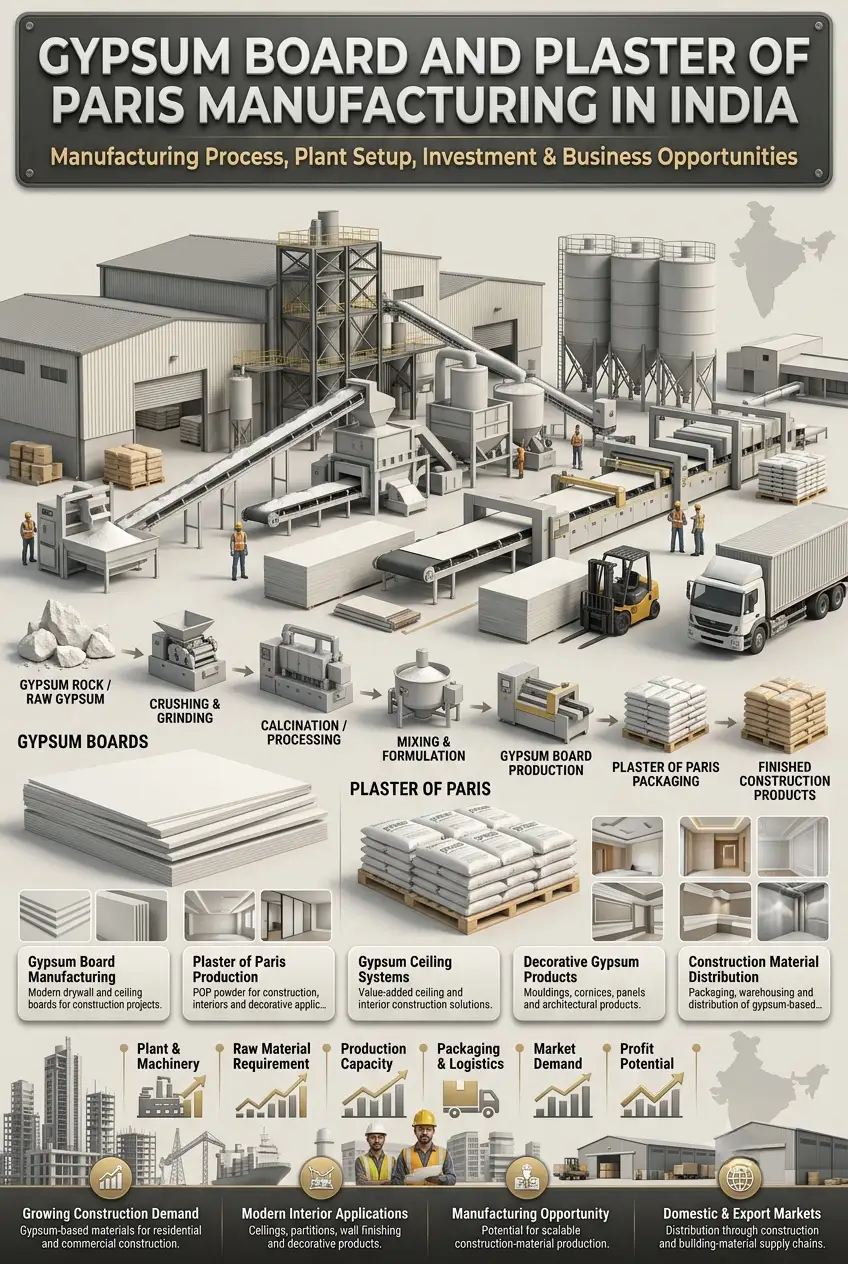
Understanding the gypsum value chain is essential for anyone planning to enter this business. The production sequence involves several well-defined stages:
- Mining & Extraction: Natural gypsum is mined via open-cast methods at shallow deposits in Rajasthan’s Barmer and Bikaner districts, or semi-mechanized underground methods for deeper seams.
- Crushing & Sizing: Run-of-mine gypsum rock is crushed to small lumps (below 10mm) before further processing. Jaw crushers, roll crushers, hammer mills are commonly used.
- Calcination: The heart of PoP and gypsum board core production – controlled heating of crushed gypsum to produce beta-hemihydrate (for PoP and standard wallboard) or alpha-hemihydrate (for high-strength dental/industrial plasters). Rotary kilns, kettle calciners, and flash calciners are the principal equipment types.
- Grinding & Blending: Calcined gypsum is ground to specified fineness (150-200 mesh for PoP) and blended with additives – retarders, accelerators, fiber, or lime – depending on the end application.
- Board Manufacturing: A slurry of calcined gypsum, water, foaming agents, and additives is sandwiched between paper liners on a continuous board line, hardened, cut to length, and dried in a multi-deck kiln dryer.
- Packaging, Storage & Dispatch: Gypsum board requires careful palletizing and covered storage to prevent moisture damage during transit. PoP is typically bagged in 25-50 kg multi-wall paper sacks stored in dry warehouses.
Market Trends Shaping the Gypsum Industry in 2025 and Beyond
Green Building Adoption
Gypsum boards are inherently sustainable – no toxic chemicals, comparatively low calcination temperatures, and are recyclable at end-of-life. India’s growing LEED and GRIHA-certified building stock is a direct consumption driver. In 2022, green buildings in India reportedly conserved over 45 billion kWh of energy and mitigated 40 million tonnes of GHG emissions.
Urbanization and Affordable Housing Demand
Approximately 600 million people are projected to live in Indian cities by 2030, requiring an estimated 25 million additional housing units in the mid-range and affordable segments. Gypsum-based construction – faster to erect than conventional masonry, lighter on structural load, and compatible with modular systems – is being favored by affordable housing developers.
Fire Safety and Moisture Resistance Specifications
Building codes and safety regulations in commercial, hospitality, and healthcare construction are becoming more stringent. Fire-resistant gypsum board (Type X/Type C) and moisture-resistant board are witnessing premium demand from hospitals, star hotels, educational institutions and data centers – all of which are expanding in India at pace.
FGD Gypsum from Power Plants
India’s thermal power plants are now mandated to install Flue Gas Desulfurization (FGD) systems, generating millions of tonnes of high-purity synthetic gypsum annually. This is a large, geographically distributed raw material base for new gypsum board plants near power generation clusters – in Maharashtra, Uttar Pradesh, and Chhattisgarh – reducing Rajasthan raw material dependence.
The Book That Industry Professionals Have Been Waiting For
Given the complexity of the gypsum value chain – spanning mining regulations, calcination process engineering, board manufacturing equipment, transportation logistics, and quality specifications, reliable technical guidance has always been in short supply. Most available resources are either too theoretical or fragmented. There is a genuine gap for a single comprehensive, practitioner-oriented reference covering the entire business from mineral to market.
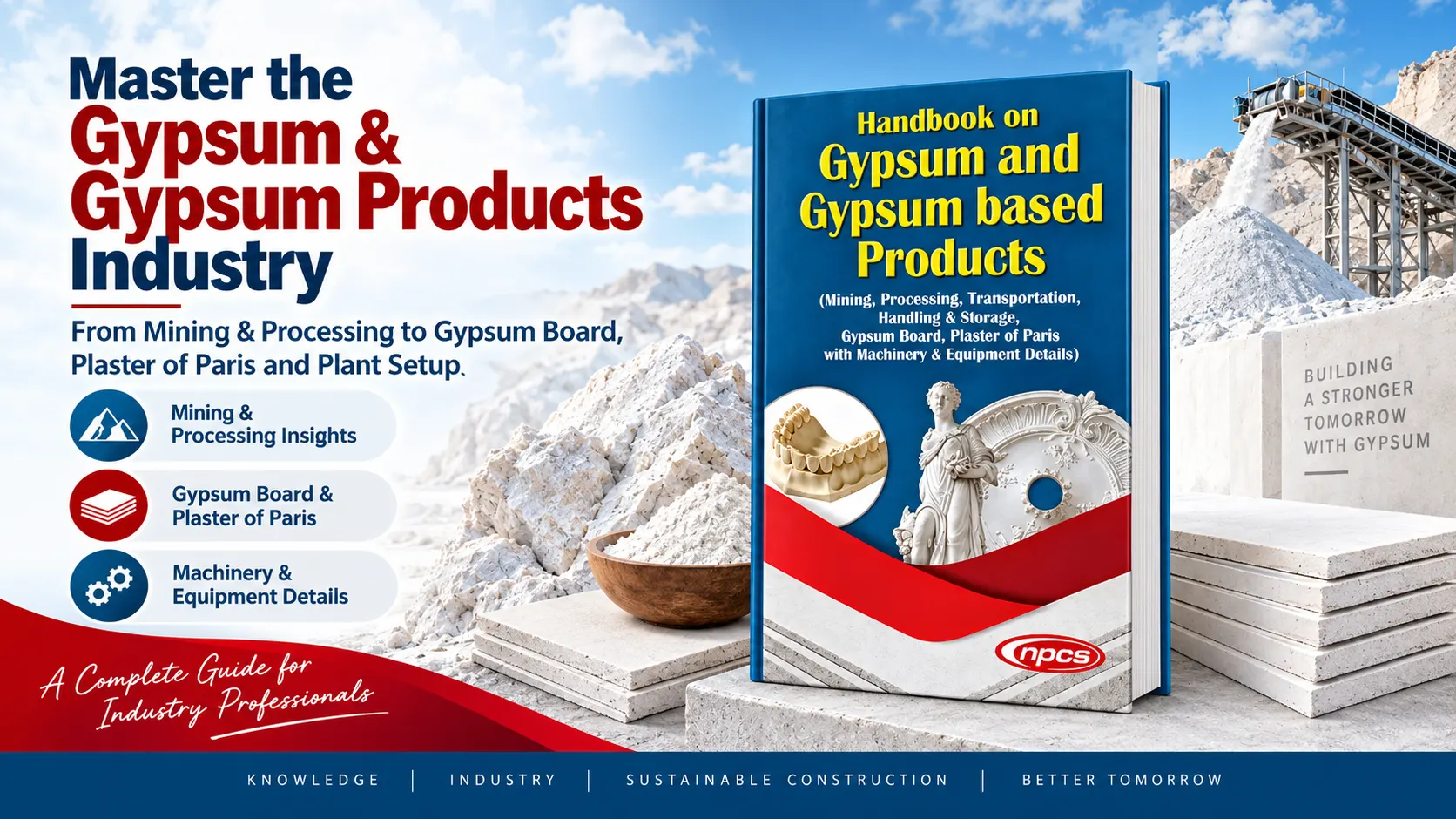
That gap is now filled. Handbook on Gypsum and Gypsum Based Products
Mining, Processing, Transportation, Handling and Storage, Gypsum Board, Plaster of Paris with Machinery and Equipment Details
Author: P.K. Tripathi Publisher: NIIR Project Consultancy Services (NPCS), New Delhi ISBN: 9788194737919 Pages: 360 Format: Paperback
This 360-page reference work from NIIR Project Consultancy Services – India’s most respected industrial consultancy with over 30 years in technical publishing and 150,000+ project reports delivered across 85 countries – is the most thorough single-volume guide to the gypsum business available today in the Indian market.
The book does not stop at theory. It walks the reader through the full operational lifecycle: how gypsum is mined, how it is processed into usable products, how it should be transported, handled and stored without degradation, how gypsum boards are manufactured, how Plaster of Paris production works, and critically, what machinery and equipment are required at every stage, complete with plant layout diagrams and process flow charts.
What the Book Covers
- Gypsum Mining: The book opens with a detailed treatment of gypsum as a mineral – its geology, grade classification, deposit types in India, mining methods, quarrying techniques, drilling and blasting protocols, and the regulatory framework governing mineral leases and environmental clearances.
- Processing Technology: From primary crushing through calcination to finished powder – size reduction, screening, kiln selection (rotary kiln vs. kettle calciner vs. flash calciner), calcination temperature control, grinding, and quality testing.
- Transportation, Handling and Storage: Guidelines on packing specifications, moisture protection during transit, warehousing standards, and stack management for both lump gypsum and bagged finished goods.
- Gypsum Board Manufacturing: Complete board production process – slurry preparation, forming, setting, trimming, drying, and finishing. Board specifications, quality parameters, BIS standards, and production line configuration options with plant layout examples.
- Plaster of Paris Manufacturing: PoP production with equal rigor – raw material selection, calcination process optimization, additive formulation for dental, surgical, industrial and decorative grades, and packaging requirements.
- Machinery, Equipment Details & Supplier Information: Photographs of actual machinery, supplier references, and plant layout templates – removing a significant research burden for first-time equipment buyers.
This is genuinely a one-stop guide for anyone serious about entering or expanding in the gypsum industry – from concept and feasibility to equipment selection and plant layout. The business relevance is grounded in current Indian market realities as opposed to generic global templates.
Who Should Read This Book
- Entrepreneurs and First-Time Manufacturers: Anyone evaluating gypsum board or Plaster of Paris manufacturing as a business will find the process technology, machinery overview and plant layout guidance indispensable for project planning and DPR preparation.
- MSME Business Owners in Construction Materials: Existing manufacturers looking to diversify into gypsum products or add a new product line can use the book to benchmark processes, identify equipment gaps, and understand quality standards.
- Mining Professionals and Mineral Contractors: Practical guidance on quarrying methods, grade assessment, and post-extraction handling adds value for those operating or planning gypsum mines.
- Project Consultants and Financial Advisors: Consultants preparing techno-economic feasibility studies or DPRs for clients entering the gypsum sector can use the book as a reliable baseline reference for process parameters and machinery cost indicators.
- Architects, Interior Designers, and Civil Engineers: Understanding the manufacturing side helps professionals write better product specifications and make more informed supplier evaluations.
- Investors and Institutional Lenders: Banks, NBFCs, and investors evaluating proposals for gypsum manufacturing ventures can use this book to independently assess technical viability and production economics.
Why This Book Stands apart
There is no shortage of technical papers on gypsum chemistry, and no shortage of market reports on the gypsum board industry. What has been missing is a single practical guide that bridges the two – connecting the science of gypsum processing with the business of manufacturing and selling gypsum products in the Indian context.
P.K. Tripathi’s handbook does exactly that. It is written for the practical decision-maker – the entrepreneur reviewing a business plan, the plant manager optimizing a production line, the consultant building a feasibility model. The plant layout diagrams, process flow charts and machinery photographs make it immediately usable – not just theoretically informative.
Niir Project Consultancy Services has published over 1,500 project reports and technical handbooks across industrial verticals since 1994. This gypsum handbook reflects the same rigorous, field-grounded approach that has made NPCS publications the reference standard for Indian manufacturing entrepreneurs.
Reference & Data Sources
- Indian Bureau of Mines (IBM), Ministry of Mines, Government of India — Gypsum Mineral Report
- Ministry of MSME, Government of India — MSME Support Schemes (CLCSS, Credit Guarantee, Technology Upgradation)
- Pradhan Mantri Awas Yojana (Urban) — Housing for All, Ministry of Housing and Urban Affairs
- Invest India — National Investment Promotion and Facilitation Agency, Ministry of Commerce & Industry
GET YOUR COPY — PURCHASE INFORMATION
Handbook on Gypsum and Gypsum Based Products
Mining, Processing, Transportation, Handling and Storage, Gypsum Board, Plaster of Paris with Machinery and Equipment Details
Author: P.K. Tripathi | Publisher: NIIR Project Consultancy Services, New Delhi | ISBN: 9788194737919 | Pages: 360 | Format: Paperback
If you are planning to enter the gypsum products manufacturing business, expand an existing operation, or need a reliable technical and business reference for project planning, this handbook belongs on your desk. Order through your preferred platform below.
Your Investment Deserves the Right Opportunity
Every serious investment begins with choosing the right sector and the right business model. With hundreds of industrial opportunities available across India’s manufacturing and clean-energy landscape, making the most informed choice is critical. NPCS Startup Selector tool helps entrepreneurs, MSMEs, and investors identify the most suitable business opportunities based on their investment capacity, location, and interests — so your capital is directed toward a venture with the strongest fit and potential.


