





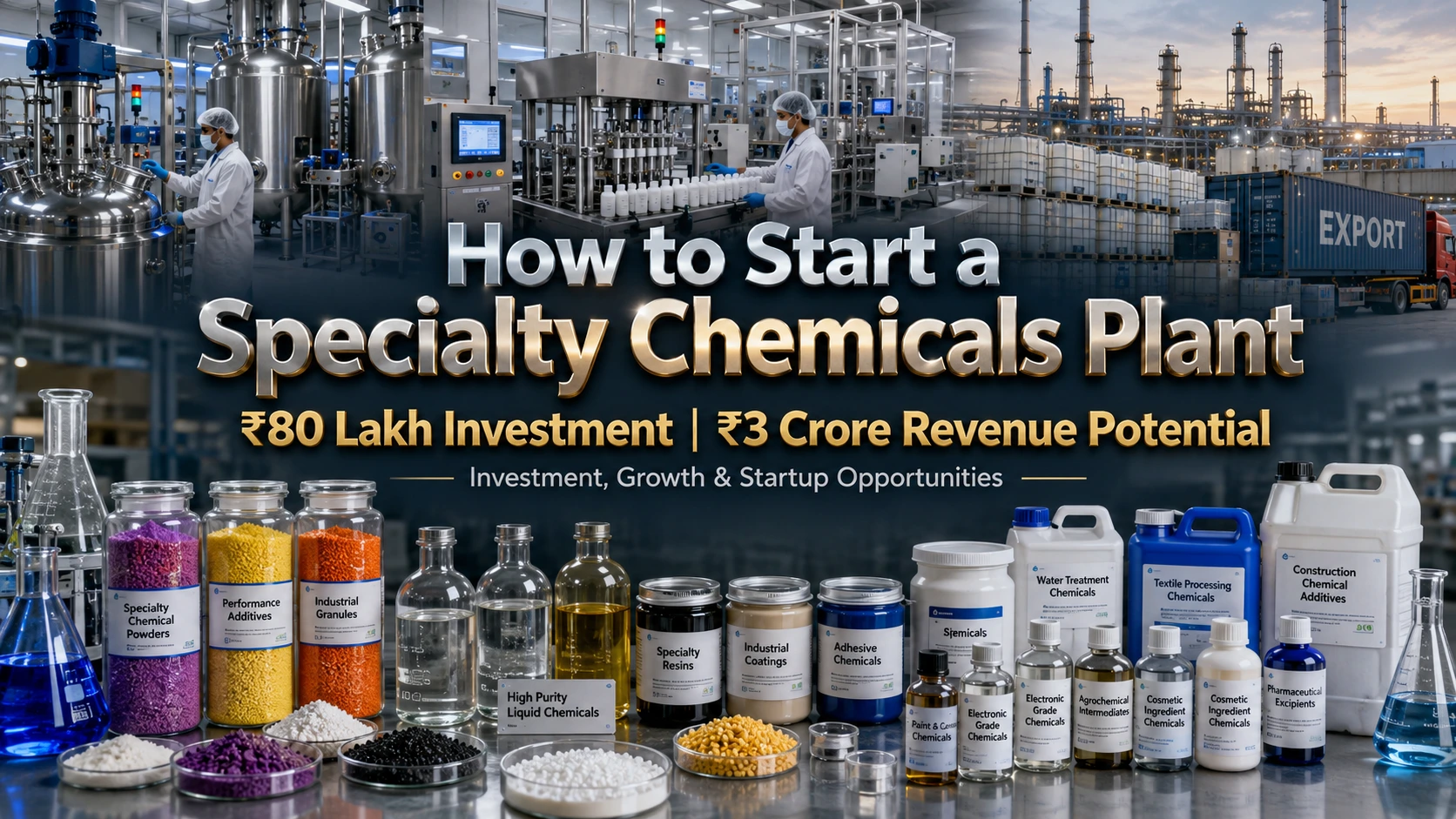
Specialty Chemicals Plant in India
The Numbers Don’t Lie: India’s Import Problem in Chemicals
There are many positive news pieces about India’s specialty chemicals industry. Global supply chain changes, China-plus-one policies and domestic demand are all discussed. However, here is the chilling fact – India is importing almost 60% of its specialty chemicals, which accounts for a lot of foreign exchange annually. This imbalance in imports and exports is no mere number to every entrepreneur who is considering business ideas in this space. It is an opportunity of ₹3 lakh crore plus that can be grabbed by the smart and well-capitalised local manufacturers.
In India, contribution of chemical industry towards GDP is about 7%. But not all the chemicals used in the country are also imported and one of the most important specialty chemical imports comes from China. The import dependence of agrochemical intermediates, performance polymers, electronic chemicals and specialty dyes exceeds 55% to 80%. This is a far different picture than the ‘India is a chemicals hub’ myth that is peddled in trade corridors.
Why the Import Dependency Persists
These are structural and not incidental causes that India is dependent on chemical imports. First, the country’s domestic manufacturing capacity, in specialty chemicals, has historically not been able to keep up with growth in demand. Indian chemical players have grown their market share in commodity chemicals and missed out on high-value, technically challenging specialty businesses.
Secondly, R&D spending in Indian chemicals industry is still not on par with international standards. For the production of specialty chemicals, scaling up without having deep process chemistry knowledge is difficult. Thirdly, the fragmented logistics and supply chain of raw materials and environmental compliance costs have been obstacles for small and medium-sized producers to compete in cost with Chinese producers.
Now, however, the tide has turned. But supply has been tightened by the regulatory measures imposed on Chinese chemical manufacturers. Indian suppliers are actively being qualified by the multinational buyers. It leaves a small but genuine opportunity for Indian MSMEs to gain market share in the import substitution market.
Related Article: Specialty Chemicals Business in India: Complete Guide to Investment, Profit Margins, Licenses & Manufacturing Setup
Government Policies Backing Specialty Chemicals
The Indian government is not unaware of this. There are a number of policy instruments that are actively promoting specialty chemicals manufacturing and understanding these before investing time and money is important.
The Production Linked Incentive (PLI) scheme is being administered by the Department of Chemicals and Petrochemicals to provide production linked financial incentives for different categories of chemicals, including specialty chemicals linked to the pharmaceutical and agrochemical value chains.
MSME Ministry’s Credit Guarantee Fund Trust for Micro and Small Enterprises (CGTMSE) provides the facility of collateral free loans to eligible entrepreneurs up to ₹2 crore. This is essential for the first-generation chemical entrepreneurs who don’t have assets to pledge.
Chemicals are a priority sector and this is supported by Make in India through single window clearance, facilitation of investors and making the sector visible to world procurement teams looking for alternatives to China.
The Startup India scheme by the DPIIT provides ex exemptions on tax for three years, rebate on patent fees and quick regulatory clearance to DPIIT recognised chemical startups, which is a significant benefit for the entrepreneurs with limited financial resources.
Further, the Indian Chemical Council provides guidance and trade information and networking opportunities to chemical entrepreneurs at all stages of the sector.
High-Potential Business Ideas for Chemical Entrepreneurs
1. Agrochemical Intermediate Manufacturing
India produces four times more agrochemicals than does the world, but imports large amounts of technical grade intermediates. Initiating an agrochemical intermediate unit (for products such as chlorpyrifos intermediates, fungicide precursors, or herbicide actives) provides a good visibility for the demand. Domestic formulators desire to lower sourcing risks from China and long-term supply contracts can be obtained with quality producers. The investment amount required for a mid-scale unit range from ₹1.5 crore to ₹3 crore depending on the product. Technical-grade intermediate margins are between 20% and 35% for well-positioned manufacturers. The main key to success is the knowledge of the process chemistry and consistency in the quality certification. Early certification with BIS or ISO helps entrepreneurs to create high fence around smaller players.
Get Detailed Insights from This Book: The Complete Technology Book on Agrochemicals
2. Specialty Dyes and Reactive Pigments
India has vast demand for huge quantity of textile and coating dyes and pigments; however, it has limited supply of manufactured specialties. Import volume is high in the following categories of dyes: Reactive dyes for cotton fabrics, Disperses dyes for polyester and Organic dyes for industrial coatings. A specialized dyes factory that focuses on one or two product families will become profitable earlier than a factory that tries to diversify into a wide range of products. The cost of a small unit of Reactive dyes starts from ₹80 lakh to ₹2 crore. The export market is another added dimension: Indian dye manufacturers are now competing with Southeast Asian and African textile markets where the Chinese options are being shunned due to geopolitical considerations.
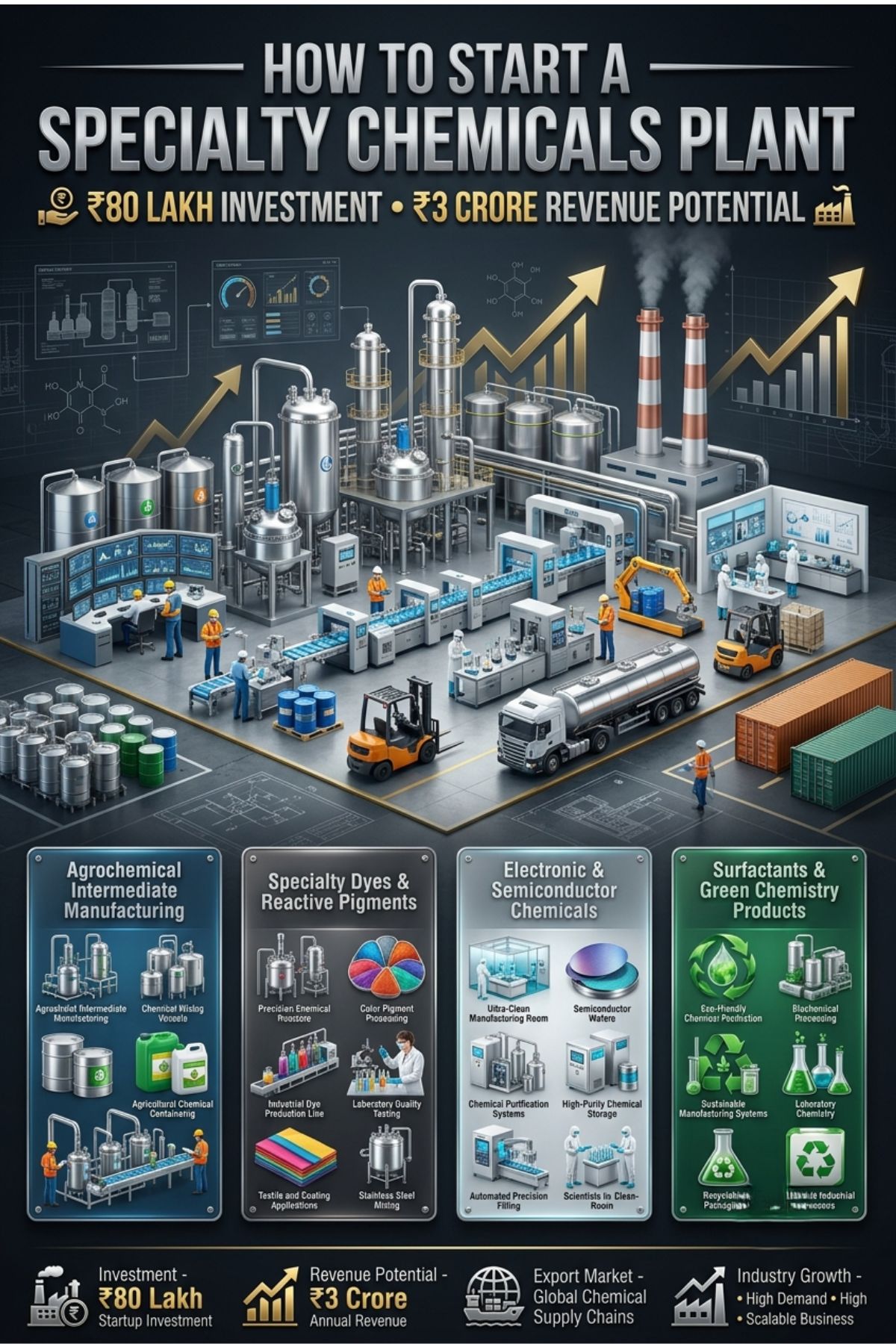
3. Electronic and Semiconductor Chemicals
This is undoubtedly one of the fastest growing opportunities in the specialty chemicals field. The government’s semiconductor incentive package of ₹76,000 crore will fuel India’s semiconductor and electronics manufacturing push, thereby generating a huge demand for ultra-high purity chemicals for etching, cleaning and photolithography. India presently imports almost 80% of these chemicals from Japan, South Korea and Germany. A manufacturing facility for electronic grade IPA, ultra-pure sulfuric acid or specialty etchants is a real need in domestic supply. Chemical engineers who also have some access to cleanroom manufacturing equipment will be able to sell at higher prices and with longer supply contracts to electronics OEMs and semiconductor fabs.
4. Surfactants and Green Chemistry Products
In India, the markets for personal care and home care products and industrial cleaning are expanding at the rate of 8% to 12% per year, creating a demand for specialty surfactant and green chemical formulations. There is a significant import of ingredients such as bio-based esters, alkyl polyglycolides (APG) and methyl ester sulfonates (MES) with the number of domestic suppliers having limited investment in them. A company that can combine green chemistry credentials with competitive prices to supply the premium domestic market and also the export market of European FMCG firms, who are actively looking to acquire suppliers of bio-based surfactant, can capture both markets. One of the more promising entry points in specialty chemicals is the relatively modest capital requirements; a viable small plant can begin at ₹60 to ₹80 lakh.
Import-Export Opportunity Analysis
The overall chemical trade deficit in India is well-established, as is the opportunity for export. Indian specialty chemical manufacturers that have quality standards such as EU REACH compliance, US EPA compliance or Japanese JIS standards get access to premium export markets, where the Chinese suppliers are hindered by regulatory or reputational problems.
One of the markets that is really lucrative is exports to the agrochemicals sector. India is already exporting technical grade pesticide to more than 130 countries. The manufacturers who shift their focus from formulation to intermediates and active ingredients reap much greater profits. The specialty exporters to textile market in Europe also have an advantage from India’s preference towards them as the freight charges to them is also less than those to China.
The trade information and the export market intelligence can be taken from the Chemicals and Petrochemicals Manufacturers Association (CPMA) and the export promotion platforms under the Ministry of Commerce.
Toll manufacturing is another option for new entrepreneurs: they can manufacture raw materials owned by big companies without investing in their own full-scale manufacturing. This helps to minimize capital exposure and help develop technical skills and connections in the industry.
Get Detailed Project Report (DPR): Chemicals (Organic, Inorganic, Industrial) Projects
Indian MSME Success Stories in Specialty Chemicals
Aarti Industries — The Benzene Chemistry Specialist
Relentless backward integration and process efficiency has given Aarti Industries, Gujarat, a world-class position in the field of specialty chemicals based on benzene. It began as a simple chemical trading business and evolved into a worldwide supplier of nitro-chlorobenzene derivatives for multinational chemical and pharmaceutical and agrochemical companies. The take-home message: Aarti’s founders picked a techno-geek niche, continuously worked on process R&D, and concentrated on long-term customer relationships with global buyers — not commodity volumes.
Vinati Organics — Mastering Specialty Monomers
Vinati Organics is one of the most cited success stories of MSME to large enterprise in India. The transformers of the Saraf family, they turned a small chemical business from the state of Maharashtra into the world’s largest producer of IBB (isobutyl benzene) and ATBS (acrylamido tertiary butyl sulfonic acid). They had just one idea, and it was a simple one: they wanted to find a specialty chemical that is traded on the global market, but produced by few companies, get the production process cheap and build a global market share. Today Vinati holds 65% of the global share of ATBS market. The takeaway message for new entrepreneurs: niche dominance over broad diversification in specialty chemicals.
Sudarshan Chemical Industries — Pigments as a Global Business
Founded by the Rathi family in Pune, India, Sudarshan Chemical is the largest pigment manufacturing plant in India and one of the top five worldwide in the category of organic pigment. The company’s growth story is a proof of how the leveraging of the domestic market scale and export market access can drive the company’s growth. Sudarshan built R&D and application labs that enabled it to provide performance level pigments to the automotive coatings, plastics, and cosmetics manufacturers worldwide. There is one conclusion that can be drawn from the experience of all new businesses in the pigments industry: knowledge of application – the way your chemical works in the final product – is as vital as the chemistry.
How NPCS Supports Specialty Chemical Entrepreneurs
At Niir Project Consultancy Services (NPCS), we are at this juncture with first-generation entrepreneurs and MSME investors: When the opportunity is present, but the roadmap to get it done isn’t. Specialty chemical manufacturing projects are prepared with a Market Survey cum Detailed Techno-Economical Feasibility Reports (DPRs).
We have reports that include manufacturing process flows, raw material procurement, plant and machinery specifications, plant capacity, regulatory compliance requirements, and full financial statements with break-even analysis, IRR and payback period. For specialty chemical projects, where technical complexity and the capital required for the project necessitates careful pre-investment analysis, it’s not a formality to have a professionally prepared DPR. It’s a matter of the difference between a successful venture and an expensive mistake.
Find high-return business ideas based on your budget & ROI
India’s Specialty Chemicals Import Snapshot
Key Segments and Import Dependence Overview
| Chemical Segment | India’s Import Dependence | Annual Import Value (Approx.) | Key End-Use |
| Agrochemical Intermediates | ~65% | ₹18,000 Cr+ | Pesticides, Herbicides |
| Specialty Dyes & Pigments | ~55% | ₹9,500 Cr+ | Textiles, Paints |
| Performance Polymers | ~70% | ₹14,000 Cr+ | Auto, Electronics |
| Flavours & Fragrances | ~60% | ₹6,800 Cr+ | FMCG, Pharma |
| Electronic Chemicals | ~80% | ₹11,200 Cr+ | Semiconductors, PCB |
| Surfactants & Specialties | ~45% | ₹7,300 Cr+ | Personal Care, Detergents |
Source: Industry estimates based on DGCI&S data, CPMA, and Chemicals & Petrochemicals Department reports. Figures are approximate and indicative.
Frequently Asked Questions
Q1. Can specialty chemicals be a business for first-generation entrepreneurs who do not have any chemistry background?
Yes, but there are some caveats. In some specialty chemical areas such as surfactants, cleaning chemicals and some agrochemical formulations, deep process chemistry skills are not required and these areas are open to entrepreneurs who are more generalised in their manufacturing background. In more technical areas, such as electronic chemicals or especially performance polymers, however, a technical co-founder or experienced chemical engineer with the start-up is essential. A detailed feasibility study can identify segments that are in line with your technical and capital capability.
Q2. What is its capital requirement for setting up a specialty chemicals unit?
This can differ greatly depending on the segment. A small surfactant or specialty cleaning chemical unit can be established at a cost of ₹50 to ₹80 lakh. The cost range of a mid-scale plant for reactive dyes or agrochemicals intermediate is ₹1.5 crore to ₹4 crore. The electronic grade chemical manufacturing process is very demanding in terms of purity requirements, clean room infrastructure required, and can cost ₹5 crore or more. Equipment costs must be supplemented with the cost of land, pollution control facilities and working capital.
Q3. What is the compliance scenario for chemical industry in India?
India has laws governing the manufacture of chemicals, such as the Environment Protection Act, the Factories Act, the Hazardous Waste Management Rules and sector specific guidelines from the Central Pollution Control Board (CPCB). Consent to establish and Consent to operate is required from the State Pollution Control Board. It can be a lengthy exercise, but is easily handled with the right legal and technical counsel. Compliance is a project necessity, and ignoring it could result in project delays and shut downs.
Q4. What are the most direct financial advantages of the government schemes to chemical start-ups?
These schemes are most directly relevant to the MSMEs: CGTMSE scheme for collateral-free loans, MSME Udyam credit-linked capital subsidy scheme, PLI scheme for specific chemical categories. Further, the soft loan funds of SIDBI (SIDBI Make in India Soft Loan Fund for MSMEs) as well as state level Industrial Development Corporation subsidy for chemical park units can bring down the actual capital cost significantly. Talk with a MSME consultant before applying greatly improves the rate of applications getting approved.
Q5. Is it realistic to compete with the established Chinese suppliers, as a small chemical manufacturer?
It is difficult to compete with the large-scale Chinese manufacturers with only cost consideration. But the environment is changing with competition. Real commercial openings exist through regulatory conditions, supply chain reliability issues and the increased appetite of global buyers for dual sourcing of Chinese chemicals. Indian manufacturers who can supply good quality, transparent supply chain and flexibility of orders sizes that a large Chinese plant doesn’t offer win the business, which pure cost-competition cannot.
Q6. Where can entrepreneurs find reliable market data on specialty chemical demand in India?
The Ministry of Chemicals and Petrochemicals, DGCI&S (Directorate General of Commercial Intelligence and Statistics), the Indian Chemical Council, and CPMA publish trade and market data. Commissioned market research reports and techno-economic feasibility studies from consultancy firms provide deeper product-level analysis that generic industry reports rarely cover. Cross-referencing multiple sources — government data, industry association data, and primary research — gives the most reliable demand picture.
Conclusion
India’s 60% chemical import dependence is not a sign of sector weakness. It is a structural opportunity of extraordinary scale. The government is aligned, global buyers are motivated, and domestic demand continues to grow. The entrepreneurs who move now — with careful product selection, thorough feasibility analysis, and disciplined capital deployment — are positioned to build the specialty chemical businesses that will genuinely reduce India’s import bill a decade from now.
The business ideas in this sector are not theoretical. They are commercially validated by the import data itself. Every crore of chemicals India imports today is a crore of potential revenue for a domestic manufacturer who solves the supply gap with quality and consistency.
The question is not whether the opportunity exists. The question is whether you move before the window closes.


