

• Latest
  • Trending
  • All
The Global Push for Zero-Waste Cities: How India Can Lead the Change

The Global Push for Zero-Waste Cities: How India Can Lead the Change

May 26, 2026
Water Park Business in India – Investment Cost, Profit Margin and Project Report Guide

India’s Water Park Market Is Growing 10% Annually — Here’s Why

May 30, 2026
Green Manufacturing Business Ideas in India 2026

Entrepreneur India May 2026 Green Manufacturing Revolution— 7 Sustainable Startup Businesses Turning Waste into Wealth

May 29, 2026
Project & Profile
India startup revolution showing young entrepreneurs building startups in India

India’s Startup Revolution: How First-Gen Founders Are Building ₹100 Crore Businesses from Scratch

May 29, 2026
ALMM solar manufacturing India 2026 policy and government approved solar industry growth

ALMM Mandatory June 2026: India Solar Cell Opportunity

May 29, 2026
Construction Materials in India

Construction Materials in India: Market Boom, Business Opportunities & an Essential Knowledge Resource

May 28, 2026
Biofertilizer production process showing microbial culture fermentation and manufacturing setup in organic farming industry

The Complete Business Guide to Biofertilizer Manufacture and Organic Farming

May 28, 2026
Ayurvedic medicine manufacturing

Ayurvedic Medicine Product Lines from the Handbook on Herbal Medicines That Can Generate ₹80 Lakh/Year

May 28, 2026
Best Factory Business Ideas Afghanistan using local raw materials like saffron, dry fruits, marble, cashmere, and sesame industries

Best Factory Business Ideas in Afghanistan Based on Local Raw Materials and Market Demand

May 23, 2026
Entrepreneur India Magazine April 2026 manufacturing business ideas

10 Profitable Manufacturing Business Ideas You Need to Know Right Now — From Entrepreneur India April 2026

May 23, 2026
Nylon 6 Manufacturing in India: Automotive & Textile Import Substitution Guide

Nylon 6 Manufacturing in India: Automotive & Textile Import Substitution Guide

May 19, 2026
HDPE PP woven sack manufacturing plant in India

HDPE/PP Woven Sack Manufacturing: Fertilizer & Cement Packaging Demand in India

May 19, 2026
Public health chemical spraying for malaria mosquito control in Africa

How to Export DDT and Public Health Chemicals from India

May 18, 2026
  • About
  • Advertise
  • Privacy & Policy
  • Contact
Saturday, May 30, 2026
  • Login
Entrepreneur India Blog
  • Home
  • About
  • Books
  • Business Ideas
  • Contact
No Result
View All Result
Entrepreneur India Blog
No Result
View All Result
Home Eco Friendly Sustainable Business

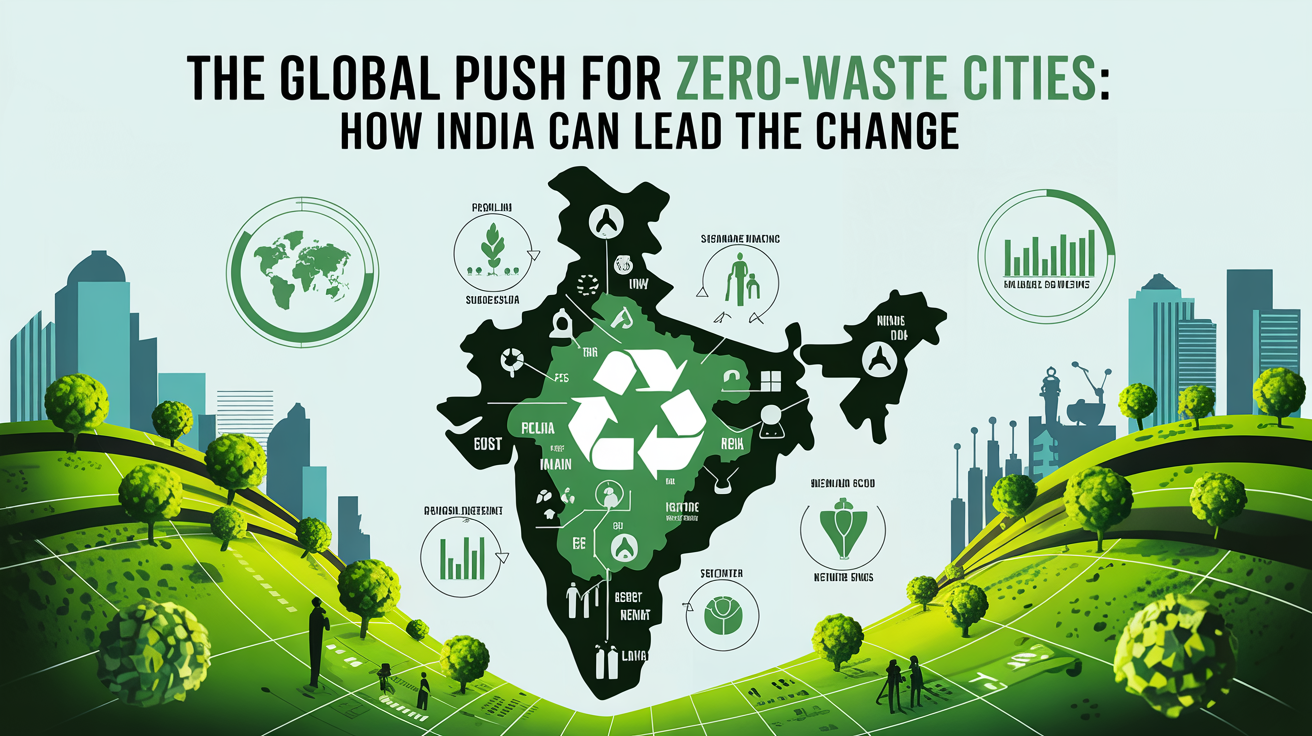
The Global Push for Zero-Waste Cities: How India Can Lead the Change

by Diksha Garg
in Eco Friendly Sustainable Business, Waste Management & Recycling Business
0
The Global Push for Zero-Waste Cities: How India Can Lead the Change
506
SHARES
1.4k
VIEWS
Share on FacebookShare on Twitter

From zeroing in on the cities to make it very apparent that waste and environment management in cities have become a more crucial focus worldwide, even for zero-waste cities whose ambition is to reduce waste generation, maximize recycling and composting, and eradicate reliance on landfills. This blog delves into the global zero-waste benchmarking movement, the present scenario of waste management in India, and the future possibilities that such a change may bring for India. 

Table of Contents

Toggle
  • Understanding the Global Zero-Waste Movement
  • The Waste Management Conundrum for Zero-Waste Cities:
  • How India Can Step Forward towards Becoming the Champion of Zero Waste?
    • 1. Strengthening Waste Segregation at Source
    • 2. Extending the Waste Collection and Recycling Infrastructure
    • 3. Promoting the Circular Economy Model
    • 4. Waste to Energy Implement Waste to Energy technologies
    • 5. Public Participation and Awareness
    • 6. Stronger Policies and Regulations
  • Successful Zero-Waste Initiatives in India
    • 1. Pune’s SWaCH Model
    • 2. Ambikapur’s Zero Waste Model
    • 3. Clean City Model of Indore
  • Closing Thoughts

Understanding the Global Zero-Waste Movement

Zero-waste principles are being adopted by almost all cities across the globe to address the increasing waste problem. The approach to zero waste would be to prevent minimal waste from reaching landfills and incinerators by reducing, reusing, and recycling material. All these methods have proved effective in managing urban waste in sustainable ways while promoting a circular economy.

Also read: Kraft Paper from Waste Cartons: A Profitable Business Opportunity.

The Waste Management Conundrum for Zero-Waste Cities:

It is estimated that India produces about 62 million tons of municipal solid waste every year, of which merely 30% is processed. The remaining waste piles up inside thousands of overflowing landfills, thus polluting air, water, and soil. Some of the issues in transmission systems concerning India’s waste management are 

1. Absence of Segregation at Source – The Majority of waste is not segregated into biodegradable and non-biodegradable components. Hence, recycling becomes inefficient. 

2. Underdeveloped Waste Collection and Processing Infrastructure – The collection and processing of waste have become nonexistent for most urban areas. Most materials end up in the backyards unregulated.

3. Low Public Awareness – Most residents do not know sustainable waste disposal practices, lowering the effectiveness of existing waste management systems.

4. Increasing the Challenges Associated with Plastic Waste – India generates more than 3.5 million metric tons of plastic waste, a huge portion of which goes to either landfills or oceans. 

How India Can Step Forward towards Becoming the Champion of Zero Waste?

India can become a leader in the global zero-waste movement if it develops more detailed and creative methods of waste management, such as these: 

1. Strengthening Waste Segregation at Source

This can be achieved through a series of steps to promote waste segregation at the household and community levels—stringent measures in penalty for noncompliance. Providing separate bins for wet and dry waste to households. 

2. Extending the Waste Collection and Recycling Infrastructure

India needs to invest in More-nohod more waste collection centres and MRFs, Advanced technologies for recycling purposes that will improve the processing of plastic, electronic and organic wastes, and to discuss the possibilities of joint ventures with private players and start-ups dealing in waste management solutions. 

3. Promoting the Circular Economy Model

A circular economy minimizes waste by keeping materials in use for as long as possible. India could promote eco-friendly packaging as well as discourage single-use plastics. Incentivize businesses that increasingly introduce recycled materials into their products. Have producer responsibility programs whereby manufacturers would be responsible for the disposal of waste. 

4. Waste to Energy Implement Waste to Energy technologies

Sweden has been effective in energy-from-waste programs. By these efforts, India can also do the following: As with waste-to-energy plants producing power from unrecyclable waste, biogas generation from organic wastes eliminates fossil fuel dependence.

5. Public Participation and Awareness

Behavior change is most important for zero waste. To motivate the citizens to participate in Environmental education in schools and colleges with incentives such as tax rebates or subsidies to communities practicing sustainable waste management. Digital and social media campaigns to amplify the message of waste reduction. 

6. Stronger Policies and Regulations

To make government policies enforceable for effective waste management, a few important measures should be – Strict enforcement of the prohibitory ban on single-use plastics.

Related Business Plan: Biomass Pellets from Bio Waste

Successful Zero-Waste Initiatives in India

There are several models of waste management that have really proved true in some cities and communities in India. 

1. Pune’s SWaCH Model

A cooperative of waste pickers has an incorporation of door-to-door waste collection and thus ensures high rates of recycling.

2. Ambikapur’s Zero Waste Model

Nearly 100% waste segregation is achieved in this town of Chhattisgarh, while the city has now taken its landfill site towards planting a public garden.

3. Clean City Model of Indore

Indore, the cleanest city in India, has a good take on waste-to-compost as well as public participation in waste management.

Closing Thoughts

Thus, there is a vibrant possibility that India can lead the way in the world’s zero waste movement. Stringent policies on waste segregation, an improved recycling infrastructure, community involvement, and stricter laws could make India’s push toward sustainable urban living quite impactful. With the right mix of government and business action, along with citizen will, it would be remarkably positioned to set an example for the world and create cleaner, greener, and waste-free cities.

Tags: ManufacturingManufacturing StartupsSustainability
Share202Tweet127
Previous Post

Microbial Bioplastics: The Next Game-Changer in the Packaging Industry

Next Post

The Green Hydrogen Revolution: How India is Betting on Clean Fuel

Diksha Garg

Diksha Garg

Diksha Garg is a marketing strategist and business growth enthusiast with over 7 years of experience driving impact through data-driven insights and strategic storytelling. She writes for entrepreneurs and startups, breaking down complex business challenges into actionable ideas that help founders scale smarter, market better, and build sustainable growth.

Next Post
The Green Hydrogen Revolution: How India is Betting on Clean Fuel

The Green Hydrogen Revolution: How India is Betting on Clean Fuel

Leave a Reply Cancel reply

Your email address will not be published. Required fields are marked *

Contact Us

    Categories

    • Agri Business Opportunities
    • Chemical Industry Business Opportunities
    • Cosmetics and Personal Care Business
    • Eco Friendly Sustainable Business
    • Entrepreneurship Leadership and Startup Growth
    • FMCG Consumer Products Business
    • Food Processing Business Industry
    • Future & Emerging Industries
    • Government Schemes Policies for Business
    • Import Export Business Opportunities
    • Industrial Project Reports Business Guide
    • Investment Funding for Startups
    • Manufacturing Business Ideas for Startups
    • Market Research Trends for Business
    • MSME & Small-Scale Industries
    • Paper Pulp Industry Business
    • Pharmaceutical Industry Business
    • Plastic & Packaging Business
    • Renewable Energy Startups
    • Startup Business Opportunities
    • Startup Business Planning and Strategy
    • Technology & Automation Business
    • Textile Industry Business
    • Uncategorized
    • Waste Management & Recycling Business
    • Water & Environmental Business
    Entrepreneur India Blog

    Copyright © 2026 Entrepreneur India

    Navigate Site

    • About
    • Advertise
    • Privacy & Policy
    • Contact

    Follow Us

    Welcome Back!

    Login to your account below

    Forgotten Password?

    Retrieve your password

    Please enter your username or email address to reset your password.

    Log In
    No Result
    View All Result
    • Home

    Copyright © 2026 Entrepreneur India

    Are you sure want to unlock this post?
    Unlock left : 0
    Are you sure want to cancel subscription?
    Call Us
    Whatsapp