
NPCS has been helping entrepreneurs, startups, MSMEs, and industrial investors since 1992 with detailed project reports, feasibility studies, market research, and business consulting services across 50+ industries.
|
Author: P. K. Chattopadhyay |
ISBN: 978-81-940995-7-4 |
|
Code: NI378 |
Format: paperback |
|
Price (₹): ₹0 |
Price (US$): $0 |
|
Publisher: Asia Pacific Business Press Inc. |
Usually Ships within: 5 |
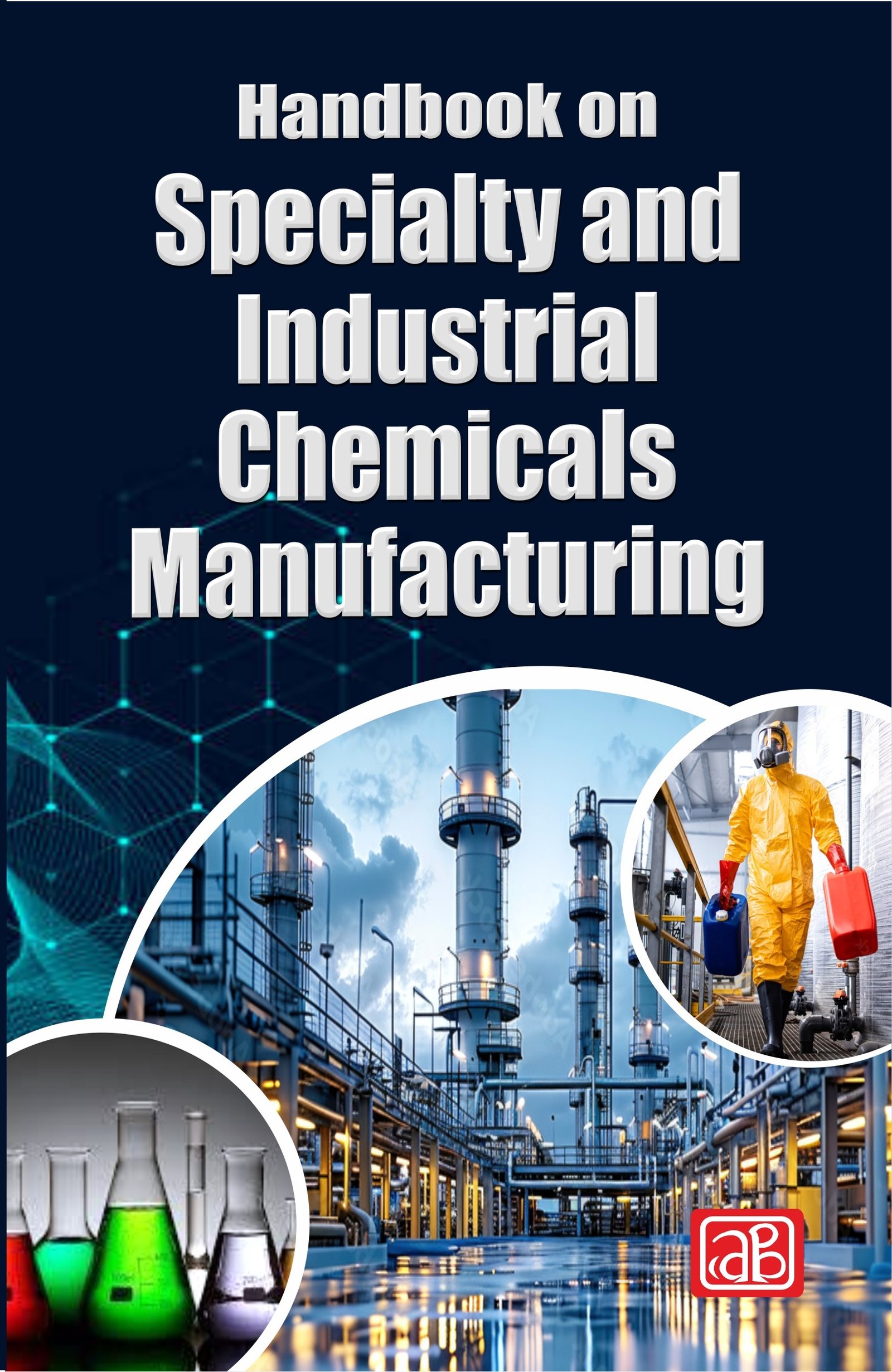
Specialty and industrial chemicals are essential to modern manufacturing, providing raw materials, intermediates, processing aids, and functional products for diverse industries. Their applications extend across agriculture, food, pharmaceuticals, textiles, construction, water treatment, electronics, polymers, fertilizers, and other process industries. Effective chemical manufacturing requires knowledge of reactions, raw materials, processing conditions, product quality, equipment, safety, environmental practices, and regulatory requirements. This handbook brings these aspects together in a practical reference.
The global and Indian chemical manufacturing sector supports diverse production and processing activities, with demand arising from established and emerging applications. India has a broad chemical ecosystem offering opportunities for domestic supply, import substitution, value addition, and exports. Specialty and industrial chemicals serve markets through acids, alkalis, phosphate compounds, metal salts, industrial gases, polymers, resins, oxidizing chemicals, adsorbents, and fertilizer chemicals. The need for efficient processing, quality products, responsible manufacturing, and wider applications creates scope for producers, MSMEs, startups, and entrepreneurs.
This handbook provides broad coverage of chemical production and related industrial practices. It begins with chemical classification, starting a chemical manufacturing industry, government policies, legal requirements, and safety documentation, followed by inorganic and organic acids, alkali and caustic chemicals, phosphate compounds, metal salts, industrial gases, polymers, and specialty chemicals. It also covers activated carbon, precipitated calcium carbonate, fertilizer chemicals, urea production routes, BIS specifications, plant layouts, process flow diagrams, and plant and machinery information. Manufacturing processes, raw materials, formulations, product types, applications, market considerations, and export prospects are discussed throughout.
A key strength of the handbook is its systematic, manufacturing-oriented approach. Rather than limiting discussion to chemical properties, it connects product knowledge with production methods, process stages, equipment requirements, quality considerations, applications, and business factors. This breadth makes it useful for understanding individual products and the wider structure of chemical manufacturing. It serves as a technical reference, academic resource, and practical guide for evaluating manufacturing opportunities.
The handbook is recommended for students, researchers, chemical engineers, industry professionals, producers, manufacturers, startups, entrepreneurs, MSMEs, project planners, exporters, and practitioners seeking a clear understanding of specialty and industrial chemical manufacturing. By bringing technical, operational, regulatory, and application-oriented information into one resource, it provides a reliable foundation for study, planning, and informed decision-making.

|
Author P. K. Chattopadhyay |
ISBN 9788195744718 |
|
Code NI353 |
Format paperback |
|
Price: Rs ₹1895 |
US$ $150 |
|
Publisher Asia Pacific Business Press Inc. |
Usually Ships within 5 |

|
Author NIIR Board of Consultants & Engineers |
ISBN 8178330563 |
|
Code NI126 |
Format paperback |
|
Price: Rs ₹1100 |
US$ $125 |
|
Publisher Asia Pacific Business Press Inc. |
Usually Ships within 5 |

|
Author NPCS Board |
ISBN 9789381039144 |
|
Code NI3 |
Format hardcover |
|
Price: Rs ₹1695 |
US$ $147.95 |
|
Publisher NIIR PROJECT CONSULTANCY SERVICES |
Usually Ships within 5 |

|
Author NIIR Board |
ISBN 817833075X |
|
Code NI85 |
Format paperback |
|
Price: Rs ₹1100 |
US$ $125 |
|
Publisher Asia Pacific Business Press Inc. |
Usually Ships within 5 |

|
Author NIIR Board |
ISBN 8178330687 |
|
Code NI89 |
Format paperback |
|
Price: Rs ₹975 |
US$ $100 |
|
Publisher Asia Pacific Business Press Inc. |
Usually Ships within 5 |

|
Author NIIR Board of Consultants & Engineers |
ISBN 8186623965 |
|
Code NI159 |
Format paperback |
|
Price: Rs ₹1450 |
US$ $150 |
|
Publisher National Institute of Industrial Research |
Usually Ships within 5 |
|
Author NIIR Board |
ISBN 8178330695 |
|
Code NI80 |
Format paperback |
|
Price: Rs ₹1100 |
US$ $125 |
|
Publisher Asia Pacific Business Press Inc. |
Usually Ships within 5 |

|
Author P. K. Chattopadhyay |
ISBN 9788194737971 |
|
Code NI317 |
Format paperback |
|
Price: Rs ₹2225 |
US$ $200 |
|
Publisher NIIR PROJECT CONSULTANCY SERVICES |
Usually Ships within 5 |

|
Author H. Panda |
ISBN 8178330679 |
|
Code NI7 |
Format paperback |
|
Price: Rs ₹750 |
US$ $100 |
|
Publisher Asia Pacific Business Press Inc. |
Usually Ships within 3 |

|
Author Ajay Kumar Gupta |
ISBN 9788195830459 |
|
Code NI360 |
Format paperback |
|
Price: Rs ₹349280 |
US$ $3700 |
|
Publisher NIIR PROJECT CONSULTANCY SERVICES |
Usually Ships within 5 |
Entrepreneur India, an Industrial monthly magazine on industrial development, technologies & project opportunities aims at simplifying the process of choosing the suitable project for investment.

Entrepreneur India - Copyright 2017-. All rights reserved.